Walchand Hirachand was a Gujarati Jain industrialist from Maharashtra who spent three decades fighting the British colonial system to build Indian-owned enterprises in shipping, aviation and automobile manufacturing. His Scindia Steam Navigation Company was the first Indian-owned shipping line to challenge British dominance of Indian coastal trade. His Hindustan Aircraft Limited and Hindustan Motors were among the first Indian-owned enterprises in their respective industries. He was consistently opposed, undermined and legislated against by a colonial government determined to protect British commercial interests. He died in 1953 with his industries either struggling or about to be nationalized, a man who had been right about almost everything and rewarded for almost none of it.| Detail | Information |
| Subject | Walchand Hirachand |
| Born | 23 November 1882, Sholapur, Maharashtra |
| Died | 28 April 1953, Bombay, Maharashtra |
| Primary Industries | Shipping, aviation, automobile manufacturing, construction |
| Key Company | Scindia Steam Navigation Company |
| Primary Adversary | British India Steam Navigation Company, colonial shipping laws |
| Nationalist Position | Swadeshi industrialist, Congress sympathizer |
| Legacy | Pioneer of Indian shipping, aviation and automobile industries |
The Cost of Building Forbidden Industries
Walchand Hirachand was a Gujarati Jain industrialist from Maharashtra who spent three decades fighting the British colonial system to build Indian-owned enterprises in shipping, aviation and automobile manufacturing. He was born in 1882 in Sholapur into a family with a background in trade and contracting. His Scindia Steam Navigation Company was the first Indian-owned shipping line to challenge British dominance of Indian coastal trade. His Hindustan Aircraft Limited and Hindustan Motors were among the first Indian-owned enterprises in their respective industries. He was consistently opposed, undermined and legislated against by a colonial government determined to protect British commercial interests. He died in 1953 with his industries either struggling or about to be nationalized, a man who had been right about almost everything and rewarded for almost none of it.
Partition of Bengal 1905: Lord Curzon’s Blunder and Rise of Swadeshi
From Construction to Industrial Vision
Walchand Hirachand made his initial fortune in construction and contracting, building roads, railways and government works under colonial contracts. This background gave him something that many Indian industrialists of his generation lacked: a direct understanding of infrastructure. He knew how things were built, what they cost, how long they took and what skills they required. When he turned this understanding toward shipping, aviation and automobiles, he was not simply investing in industries he admired from a distance. He was applying practical knowledge to sectors where he understood both the opportunity and the obstacles. His nationalism expressed itself through the conviction that India needed to build its own industrial capacity if independence was to mean anything real. The time to build was before independence, not after, because waiting for independence meant waiting for permission that the colonial government was never going to give. This conviction brought him into direct and repeated conflict with a colonial system entirely committed to preventing exactly what he was trying to do.
Mahatma Gandhi Return to India: 1915 and the Year of Silence
The Scindia Steam Navigation Company
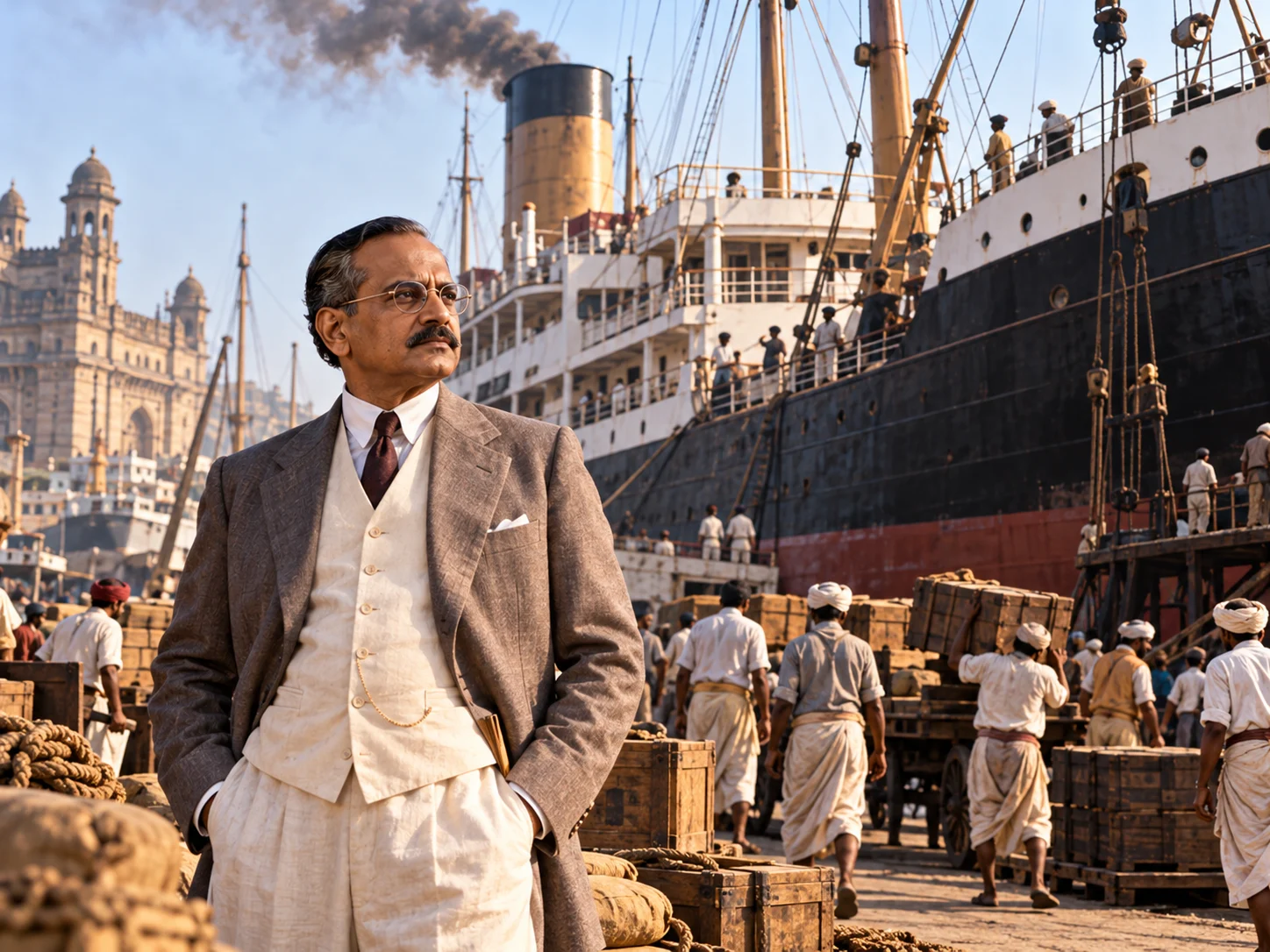
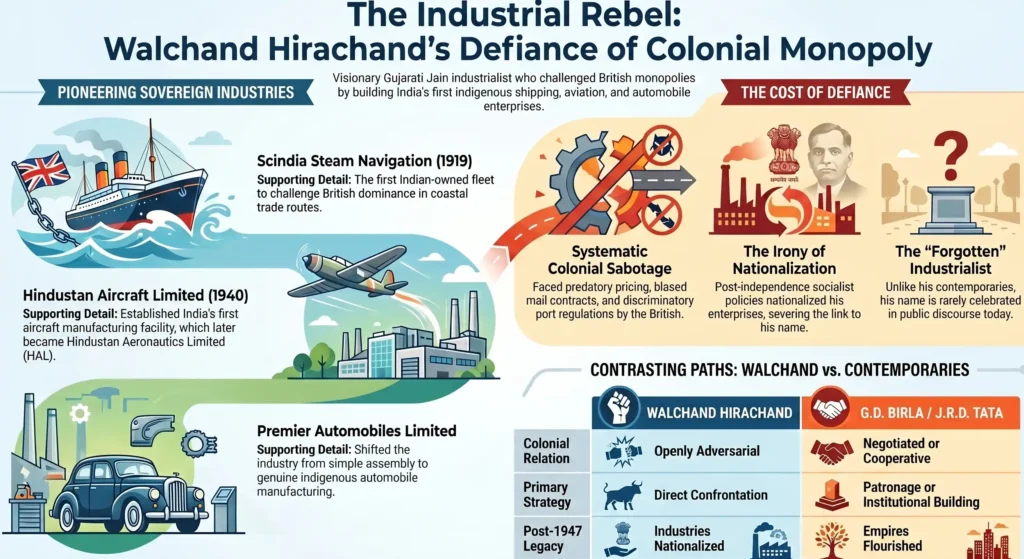
In 1919, Walchand Hirachand and his partners launched the Scindia Steam Navigation Company in Bombay. An Indian-owned shipping company operating on the coastal trade routes that British firms had controlled for decades was not simply a commercial venture. It was a political statement, a demonstration that Indians could build and operate modern commerce without British intermediaries.
The British commercial establishment understood this perfectly. Colonial shipping regulations were interpreted to disadvantage Indian operators. Profitable mail contracts were consistently skewed toward British firms. Port access and berthing were administered to create additional costs and delays for Indian vessels. The British India Steam Navigation Company used its commercial power to engage in predatory pricing on routes where Scindia was developing a presence.
Walchand responded to each obstacle with stubborn persistence. He lobbied colonial administrators, he appealed to sympathetic members of the legislative council and he built his fleet despite the additional costs imposed by discriminatory regulation. By the 1930s, Scindia had become a viable enterprise despite everything the colonial system had done to prevent it, a remarkable achievement that owed everything to the founder’s refusal to accept the terms the colonial establishment had set.
How the Murugappa Group Built a Silent Empire in Southern India
Hindustan Aircraft Limited
In 1940, Walchand established Hindustan Aircraft Limited in Bangalore, the first Indian-owned aircraft manufacturing company. The timing was extraordinary. The Second World War was underway and the British colonial government needed aircraft manufacturing capacity in India. Walchand proposed to provide it through an Indian-owned enterprise that would build aircraft in India using Indian labor.
The colonial government allowed the enterprise to be established and then progressively transferred effective control to American and eventually to British interests, using the wartime emergency as justification for overriding Indian ownership. By the end of the war, Hindustan Aircraft Limited had been so thoroughly reorganized under government direction that Walchand’s founding vision of Indian-owned manufacture had been largely supplanted.
The institution survived. It became Hindustan Aeronautics Limited after independence, one of India’s most significant defense manufacturers. Walchand’s role in its founding is acknowledged in official histories but is rarely given the prominence it deserves.
Premier Automobiles Limited
Walchand’s automobile venture followed a similar pattern. He established Premier Automobiles Limited in Bombay in the 1940s with the intention of manufacturing automobiles in India rather than simply assembling imported components. The colonial government’s industrial licensing framework was structured to make genuine Indian-owned automobile manufacturing extremely difficult. Import licenses for machinery, manufacturing approvals and foreign exchange allocation were all administered through a system that consistently favored foreign enterprises.
Walchand navigated these obstacles with the same combination of lobbying, legal challenge and persistence that had characterized his shipping battles. Premier Automobiles did begin production of Indian-assembled vehicles before independence. After independence, it became one of the companies that produced the Ambassador and other vehicles that defined Indian motoring for decades.
Again, the institution survived. Again, Walchand’s founding role was acknowledged but not celebrated in proportion to what he had actually done.
Double Ikat Patola of Patan and Why It Takes a Year to Weave
Quick Comparison Table
| Feature | Walchand Hirachand | G.D. Birla | J.R.D. Tata | Ardeshir Godrej |
| Community | Gujarati Jain | Marwari | Parsi | Parsi |
| Primary Industry | Shipping, aviation, automobiles | Textiles, cement | Steel, aviation | Locks, safes, consumer goods |
| Nationalist Method | Direct industrial confrontation | Financial patronage of Congress | Institutional nation building | Swadeshi manufacturing |
| Relationship With Colonial Authority | Openly adversarial | Negotiated | Cooperative where necessary | Independent |
| Post Independence Legacy | Industries nationalized, largely forgotten | Birla empire flourished | Tata empire flourished | Godrej empire flourished |
Curious Indian: Fast Facts
- Walchand Hirachand founded the Scindia Steam Navigation Company in 1919, the first serious Indian challenge to British dominance of Indian coastal shipping.
- He established Hindustan Aircraft Limited in Bangalore in 1940, the first Indian-owned aircraft manufacturing company, which later became Hindustan Aeronautics Limited.
- The British India Steam Navigation Company used predatory pricing and regulatory influence to obstruct Scindia’s development across multiple decades.
- Walchand was born in 1882 in Sholapur into a Gujarati Jain family with a background in trade and contracting.
- His initial fortune was made in construction and contracting, building roads and railways under colonial contracts.
- Premier Automobiles Limited, which he founded, eventually became one of the manufacturers of the Ambassador, the vehicle that defined Indian motoring for decades.
- He died in 1953, six years after independence, with his industrial legacy largely unacknowledged in the public discourse of the new nation.
- The colonial government transferred effective control of Hindustan Aircraft Limited away from Walchand during the Second World War using wartime emergency as justification.
The Irony of Independence
Independence in 1947 did not bring Walchand the vindication he might have expected. The Nehru government’s industrial policy, shaped by socialist principles and suspicion of large private industrial capital, led to the nationalization or effective government takeover of several enterprises Walchand had spent decades building.
The irony was profound. Walchand had built these enterprises because he believed India needed Indian-owned industrial capacity. He had fought the colonial government’s attempts to limit and control that capacity for three decades. Now the independent Indian government was doing something structurally similar, not for the benefit of British commercial interests but in the name of Indian socialism.
Walchand did not live long enough to see the full consequences. He died in 1953, six years after independence, with his industrial empire in a state of uncertainty and with his historical contribution to Indian industrial development largely unacknowledged.
The Forgetting
The forgetting of Walchand Hirachand is not accidental. It reflects how independent India constructed its historical memory of the freedom movement. The Congress-centered narrative emphasized political activism, moral witness and mass mobilization. Industrial nation-building of the kind Walchand practiced was harder to incorporate into this narrative, especially when the industrialist in question had not been a prominent Congress figure and when his enterprises had complex, sometimes contentious relationships with the post-independence government.
The nationalization of his enterprises also meant that the institutions he built were absorbed into the state apparatus, losing their identity as Walchand’s creations and becoming simply government enterprises whose origins were no longer commercially relevant to remember.
The communities that might have championed his memory—the Gujarati Jain business community from which he came, the shipping and aviation industries he helped found—did not produce the kind of sustained biographical and historical advocacy that has kept other industrialists of his generation in public memory.
What Endures
Walchand Hirachand was right about almost everything. He was right that India needed its own shipping industry. He was right that India needed to manufacture its own aircraft. He was right that India needed to produce its own automobiles. He was right that the time to build these industries was before independence rather than after, because waiting for independence would mean waiting for permission that the colonial government was never going to give.
He fought for all of these things for three decades against a colonial system that understood exactly what he was doing and was determined to prevent it. He built them anyway, partially and expensively and in the face of sustained legal and commercial opposition, and what he built became part of the foundation on which independent India’s industrial economy rested.
The tragedy of Walchand Hirachand is not that he failed. Most of what he built survived him. The tragedy is that a man who spent his life building the industrial foundation of a free India lived just long enough to see that free India take those foundations for granted. That is a particular kind of loss, quiet and without drama, that history rarely knows how to mourn properly.
How Azim Premji Turned Cooking Oil Into a Technology Empire
If you think you have remembered everything about this topic take this QUIZ
Results


#1. In which year did Walchand Hirachand launch the Scindia Steam Navigation Company, marking the first serious Indian challenge to British coastal shipping dominance?
#2. Where was the industrialist Walchand Hirachand born?
#3. Which British commercial entity served as the primary shipping adversary to Walchand Hirachand’s Scindia Steam Navigation Company?
#4. Walchand Hirachand accumulated his initial fortune and critical infrastructure experience in which field?
#5. What justification did the colonial government use during World War II to systematically strip Walchand Hirachand of his control over Hindustan Aircraft Limited?
#6. Which company did Walchand Hirachand establish in the 1940s with the explicit vision of manufacturing automobiles within India?
#7. Why did the post-independence Nehru government nationalize or take over many of the strategic industries built by Walchand Hirachand?
#8. Compared to contemporaries like G.D. Birla and J.R.D. Tata, how is Walchand Hirachand’s relationship with colonial authorities uniquely characterized?
Who was Walchand Hirachand and why is he significant in Indian industrial history?
Walchand Hirachand was a Gujarati Jain industrialist from Maharashtra who founded India’s first serious Indian-owned shipping line, its first Indian-owned aircraft manufacturing company and contributed to the founding of its automobile manufacturing industry. He is significant because he built these industries in direct confrontation with a colonial government that was legally and commercially committed to preventing Indian industrial capacity in these sectors, demonstrating that Indian entrepreneurship could challenge colonial economic control directly and industrially.
What was the Scindia Steam Navigation Company and what obstacles did it face?
The Scindia Steam Navigation Company was founded in 1919 as the first serious Indian challenge to British dominance of Indian coastal shipping. It faced systematic discrimination including unfavorable interpretation of shipping regulations, exclusion from profitable mail contracts, disadvantaged port access and predatory pricing by the British India Steam Navigation Company on routes where Scindia was developing a viable presence. Despite these obstacles, it grew into a viable enterprise through Walchand’s sustained persistence.
What happened to Hindustan Aircraft Limited after Walchand founded it?
Hindustan Aircraft Limited was founded by Walchand in Bangalore in 1940 as India’s first Indian-owned aircraft manufacturing company. During the Second World War, the colonial government progressively transferred effective control to American and British interests using wartime emergency as justification, largely displacing Walchand’s founding vision of Indian ownership. After independence, it became Hindustan Aeronautics Limited, one of independent India’s most significant defense manufacturers, though Walchand’s founding role is rarely given prominence in its official history.
Why did Walchand Hirachand not receive more recognition after Indian independence?
Several factors contributed to his relative obscurity. The Congress-centered narrative of independence emphasized political activism over industrial nation-building. The nationalization of his enterprises absorbed them into the state apparatus, severing their identity as his creations. He was not a prominent Congress figure and his enterprises had complex relationships with the post-independence government. The communities that might have championed his memory did not produce sustained biographical advocacy of the kind that keeps other figures in public memory.
What is Walchand Hirachand’s connection to the Ambassador car?
Walchand founded Premier Automobiles Limited in Bombay in the 1940s with the intention of manufacturing automobiles in India. After independence, the Indian automobile industry developed through a complex process of licensing and collaboration that involved multiple companies. Premier Automobiles became one of the manufacturers associated with the development of Indian automobile production in the early independence period, with the broader industry that Walchand helped pioneer, eventually producing the Ambassador and other vehicles that defined Indian motoring for decades.