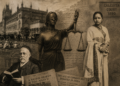
Chittagong, 18 April 1930: sixty-five revolutionaries raided the British armoury and won. By dawn, they understood what victory looked like when the ammunition was nowhere to be found
At ten o’clock on the night of April 18, 1930, Surya Sen gave the order.
Sixty-five young men from the Indian Republican Army—most in their teens and twenties, trained in Chittagong, inspired by the Easter Rising in Ireland, taught to believe that armed struggle was the only language the British understood—moved toward the police armoury.
The plan was elaborate. They would seize the armoury and take the guns. They would cut the telegraph and telephone lines, severing Chittagong from Calcutta. They would raid the European Club and take hostages. They would loot the imperial banks to gather money for future uprisings. They would free jailed revolutionaries. They would seize a city and hold it, even if only for a day. They would show that the British could be fought.
Surya Sen, who they called Masterda—the Master—was thirty-six years old. He had been a maths teacher. For years, he had taught young people the handling of weapons and the making of bombs. He had written their names on the rolls of his classroom. Now he was writing them into history.
The raid was fast and brutal. One group, led by Ganesh Ghosh, rushed the police armoury and captured it. They raised the Indian National Flag. Another group moved toward the telegraph office and severed the lines. The telephone exchange went dead. The trains stopped. For a few hours, Chittagong was isolated from the rest of the Raj.
At the armoury, the revolutionaries found what they were looking for: guns. Rifles. Revolvers. Weapons enough to arm sixty-five young men and more. They took them. They carried them. They felt the weight of the rifles in their hands and understood that they held, literally, the means of revolution.
But as they searched the armoury, desperation began to set in. They looked for ammunition. Bullets. Cartridges. The shells that would make the guns into anything more than metal tubes and wood and iron.
There was none. The British had stored the ammunition somewhere else.
By the time British reinforcements arrived from Calcutta, Surya Sen knew they had to leave.
Despite this, Surya Sen gathered the revolutionaries at dawn on the steps of the armoury. He took a military salute. He raised the national flag. And he proclaimed a Provisional Revolutionary Government of Chittagong. He declared the city independent.
For a few hours, it was true. Chittagong was theirs. The guns were in their hands. The British had been driven out. Young people across the city were overjoyed. Some joined them. Some came to see what this meant—a city that had said no to the Raj.
But everyone who held a gun knew the truth. Without ammunition, the guns were theater. Beautiful, symbolic, historically important—but useless.
By the time British reinforcements arrived from Calcutta, Surya Sen knew they had to leave. The revolutionaries retreated toward Jalalabad Hill, a few days’ journey away. They carried their empty guns, their unfired hopes, moving through the landscape they had tried to liberate.
On Jalalabad Hill, the British forces caught them. What followed was a brief skirmish and then a longer nightmare. Machine gunners arrived. Twelve revolutionaries died. Many were arrested. Some managed to flee, including Surya Sen, who would spend nearly three years hiding before being betrayed by someone he trusted and arrested in February 1933.
The Chittagong Armoury Raid, in the ledgers of military history, was a failure. They seized weapons but could not fire them. They declared independence but could not hold it. They isolated a city for a few hours and then had to abandon it.
But something else had happened. Young people had stood up. Sixty-five of them had moved toward the British authority without hesitation. They had taken the armoury. They had raised the flag. They had shown that it was possible to rebel, even if rebellion ended in death.
And across India, in Bengal and beyond, people had heard the story. The guns without bullets had made a noise louder than any shot could have made.
If you think you have remembered everything about this topic take this QUIZ
Results
QUIZ START
#1. Jatindra Nath Mukherjee earned the name ‘Bagha Jatin’ after killing which animal with a knife in 1906?
Previous
Next
#2. What was the name of the revolutionary newspaper published by the movement that Bagha Jatin led?
Previous
Next
#3. The Ghadar Party, which coordinated with Bagha Jatin’s network, had its headquarters located in which city?
Previous
Next
#4. Who was the coordinator of the Indian revolutionary network in Berlin and the brother of poet Sarojini Naidu?
Previous
Next
#5. Which ship was loaded with German weapons off the coast of California but failed to complete its maritime rendezvous with the Maverick?
Previous
Next
#6. In which district of present-day Odisha did Bagha Jatin plan to receive the German arms shipment and later fight his final battle? A) Cuttack
Previous
Next
#7. On what date did Bagha Jatin die of wounds sustained during the Battle of the Buribalang River?
Previous
Next
#8. Which archival collection, released after World War II, significantly revised historical understanding of Germany’s heavy financial investment in the conspiracy?
Previous
Finish
Who was Bagha Jatin and how did he get that name?
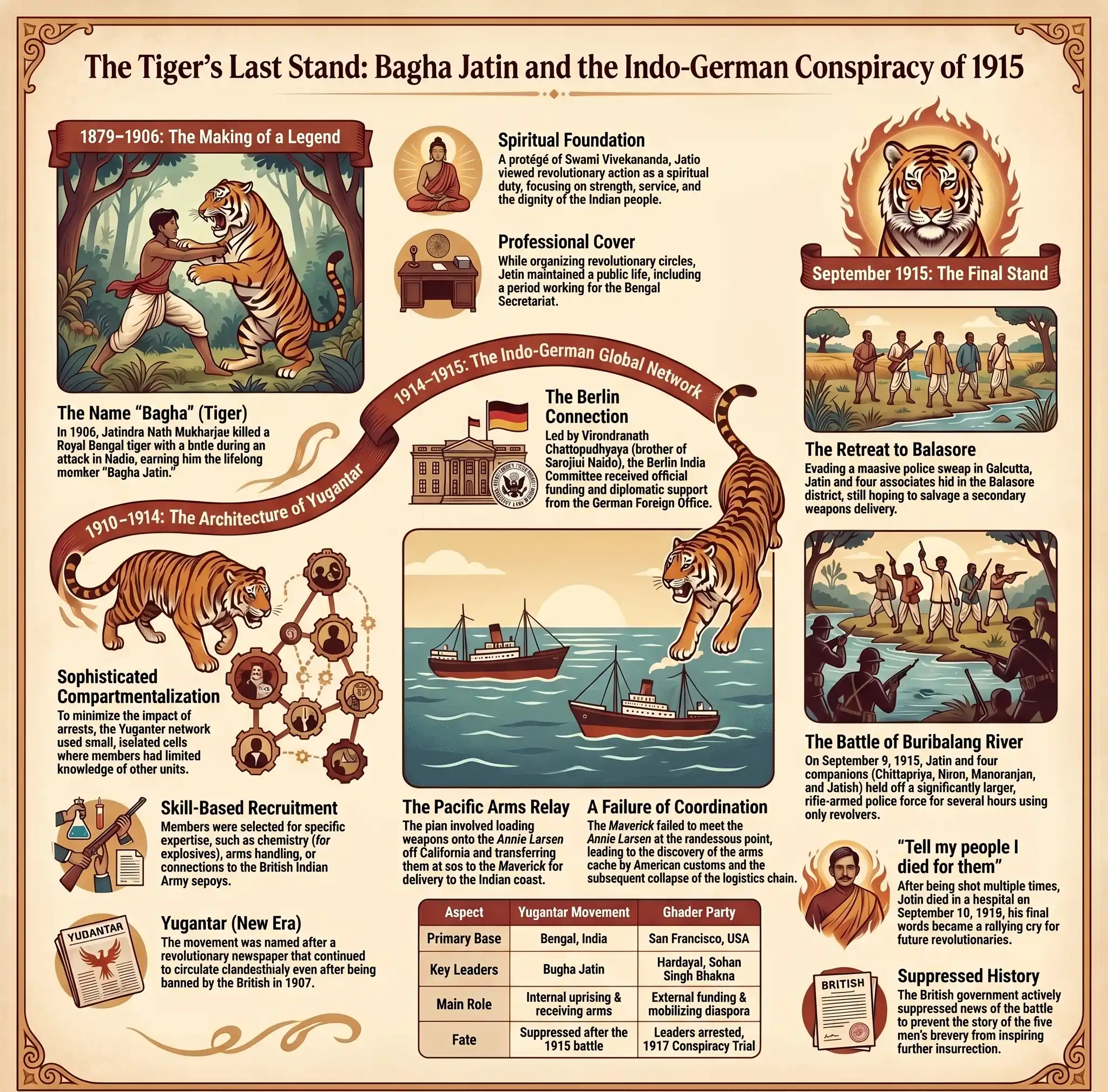
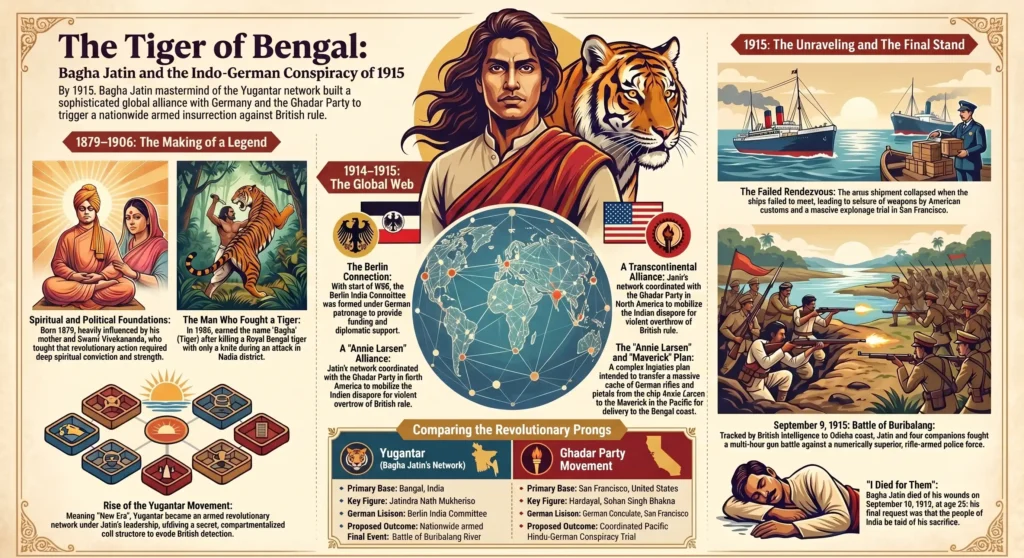
Bagha Jatin was the revolutionary name of Jatindra Nath Mukherjee, the de facto leader of the Yugantar armed revolutionary movement in Bengal in the early twentieth century. He earned the name, which means Tiger Jatin in Bengali, after fighting and killing a Royal Bengal tiger with a knife in 1906 following an attack near a forest in Nadia district. The name became widely known within revolutionary circles as a marker of his extraordinary personal courage.
The Indo-German Conspiracy, also called the Hindu-German Conspiracy, was a plan coordinated between Indian revolutionary networks in Bengal, the Ghadar Party in the United States, the Berlin India Committee supported by the German Foreign Office, and German agents across Southeast Asia to deliver a large shipment of German weapons to India and launch a coordinated armed uprising against British rule. The plan was timed to exploit Britain’s military commitments during the First World War. It collapsed primarily because the arms shipment organized through the Annie Larsen and Maverick ships in the Pacific was intercepted by American authorities.
What was the Battle of Buribalang river?
The Battle of Buribalang river took place on September 9, 1915, near Chashakhand village in the Balasore district of present-day Odisha, when British colonial police forces caught up with Bagha Jatin and his four companions. The group fought for several hours with revolvers against a larger, rifle-armed police force, inflicting casualties before their ammunition was exhausted. One of Bagha Jatin’s companions was killed outright. Bagha Jatin was severely wounded and died in Balasore district hospital the following day, September 10, 1915.
What role did Germany play in the conspiracy?
Germany’s involvement was substantial and officially sanctioned through the German Foreign Office and the German General Staff. Germany established the India Committee in Berlin in 1914, providing Indian revolutionary leaders in Europe with offices, funding, and access to German diplomatic networks. German agents coordinated the arms shipment operation through the German consulate in San Francisco and through networks in Southeast Asia. German Foreign Office archives released after the Second World War have confirmed the scale of this investment, revising earlier assessments that tended to treat German involvement as marginal or opportunistic.
Why is the Indo-German Conspiracy less well known than other episodes of India’s freedom movement?
The conspiracy’s relative obscurity reflects several factors. Its reliance on external German support made it politically awkward for nationalist historians constructing a narrative of India’s independence movement as an internally driven moral and political struggle. Its armed insurrectionary character placed it outside the dominant Gandhian framework that shaped popular historical memory of the independence movement. The colonial government’s active suppression of news about Bagha Jatin’s final battle further reduced its immediate public impact. And the scale of its ambition, which made it genuinely threatening to British authority, also made the colonial administration particularly thorough in suppressing the documentary record of its near success.
Sources & References
UPSC IAS, “Chittagong Armoury Raid 1930” (2026) — April 18, 1930, 65 revolutionaries led by Surya Sen, capture of police armoury, cutting of telegraph and telephone, European Club seizure, failed to secure ammunition, proclamation of provisional government, raised national flag, Jalalabad Hill confrontation 22 April, 12 killed.
Wikipedia, “Surya Sen” (n.d.) — Born March 22, 1894 in Noapara, Chittagong; died January 12, 1934 executed by hanging; teacher and revolutionary; led Indian Republican Army; elaborate plan including seizing arms and destroying communications; gained arms but failed to capture ammunition; 12 revolutionaries died on Jalalabad Hill; Sen escaped but arrested February 1933.
Wikipedia, “Chittagong Armoury Raid” (n.d.) — Raid attempted to seize weapons and ammunition, destroy telegraph and telephone office, take hostages from European Club, sever Chittagong from Calcutta, loot imperial banks, free jailed revolutionaries; revolutionaries captured police armoury and hoisted flag but failed to find ammunition.
Surya Sen UPSC Notes, “Surya Sen, Chittagong Armoury Raid, Activities, Legacy” (2026) — Known as “Master Da”; born March 22, 1894; worked as teacher; arrested 1933, executed January 12, 1934; inspired youth during B.A. studies at Berhampore College; joined Anushilan Samiti; inspired by Easter Rising in Ireland.
Modern India History Notes, “Chittagong Armoury Raid (1930)” (2024) — Joined Anushilan Samiti; worked as maths teacher from 1918; taught young people weapons handling and bomb construction; devised strategy to raid and isolate Chittagong; associates included Ganesh Ghosh, Lokenath Bal, Ananta Singh; apprehended February 1933 after betrayal.
Paripurna Datta is the founder and editor of Curious Indian, an independent editorial publication focused on Indian history, culture, science, society, and the stories behind them. He oversees research, editorial standards, and the publication's long-term direction.
Paripurna Datta is the founder and editor of Curious Indian, an independent editorial publication focused on Indian history, culture, science, society, and the stories behind them. He oversees research, editorial standards, and the publication's long-term direction.