Equal Portions for All, Made in Prayer
There is a moment in every Gurdwara service when a sewadar, a volunteer in service, approaches each person seated in the congregation and places a small portion of warm, fragrant dough into their cupped hands. The person seated next to them receives the same portion. The person behind them receives the same portion. The visiting tourist who wandered in out of curiosity receives the same portion as the lifelong Sikh who has attended this Gurdwara every day for forty years.
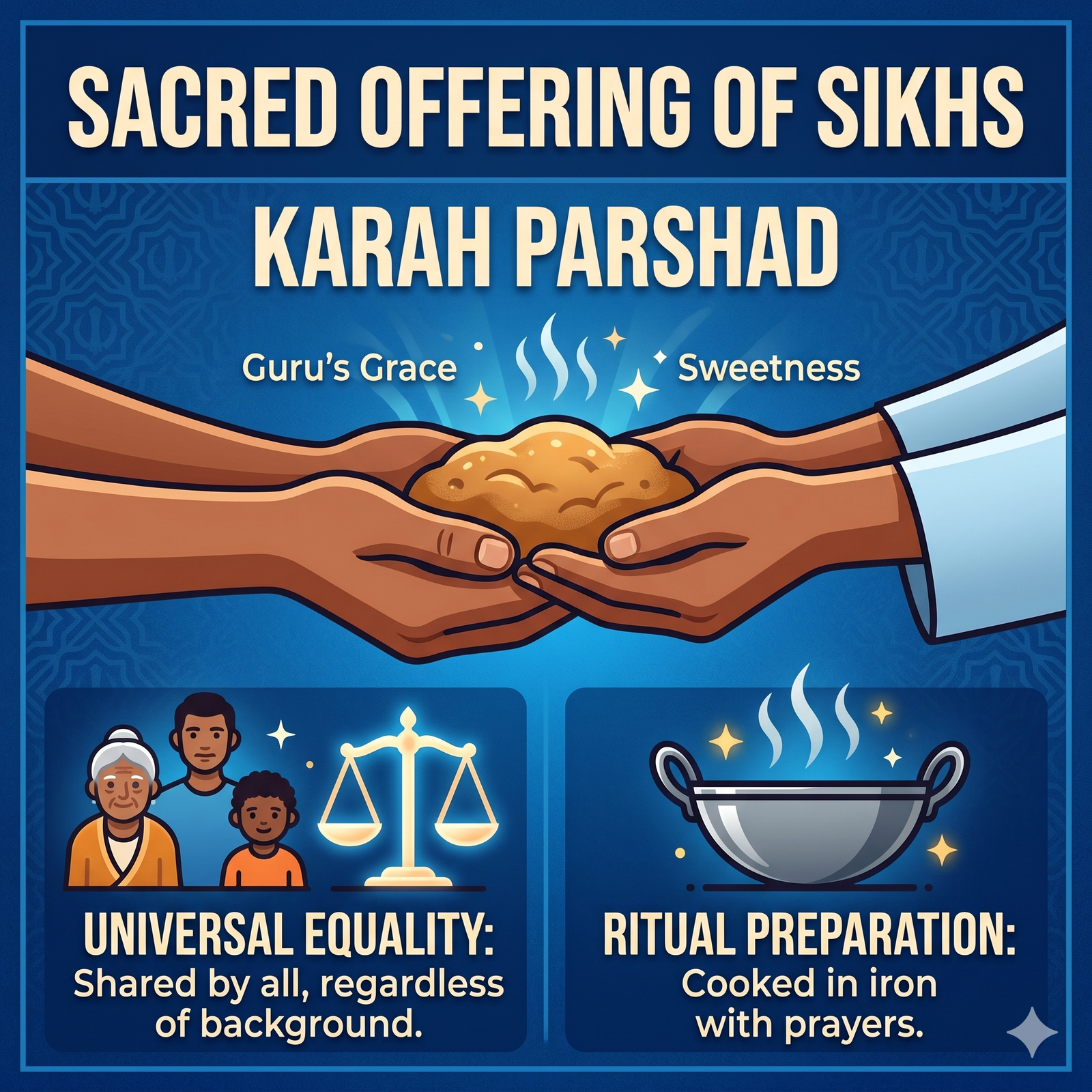
That moment of equal distribution is Karah Parshad—a sacred food offering made from whole wheat flour, ghee and sugar cooked in an iron vessel while prayers are recited. It embodies one of the most fundamental principles of Sikhism: that in the presence of the Guru, all human beings stand equal.
The Ingredients and What They Mean
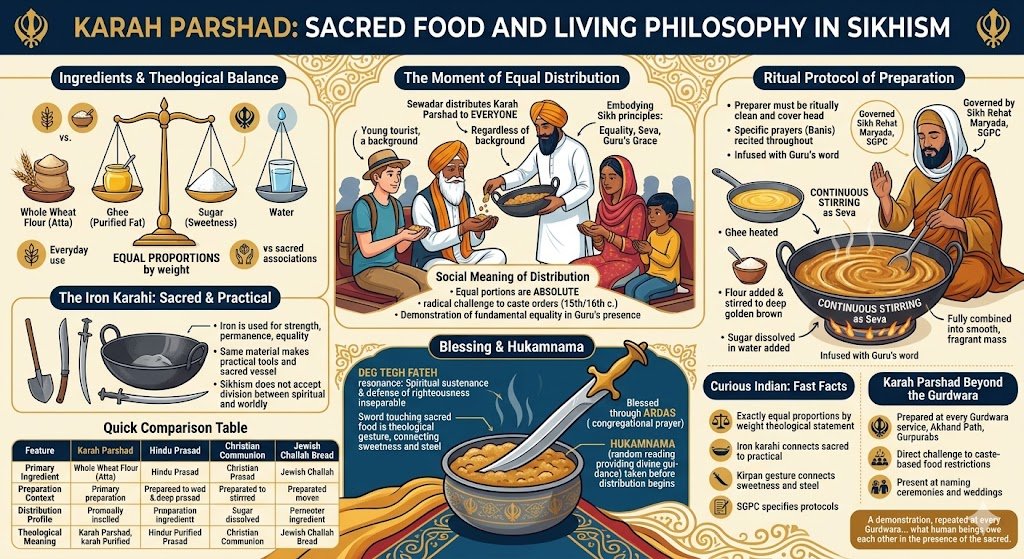
Karah Parshad is made from three ingredients combined in equal proportions by weight. Whole wheat flour, ghee and sugar are the three components, each present in the same quantity as the others. Water is added during cooking to bring the mixture to its final consistency. The equal proportion of the three ingredients is not a culinary preference. It is a theological statement about balance and the refusal to elevate any single element above the others.
The choice of ingredients is significant. Whole wheat flour, atta, is the most basic and universal of foods in the Indian subcontinent, the ingredient from which the daily bread of ordinary people is made. Ghee is a purified fat with deep associations in Indian religious practice, used in fire offerings and temple rituals across traditions. Sugar provides sweetness and in the Sikh tradition is associated with the sweetness of the Guru’s grace. Together, the three ingredients combine the everyday and the sacred into a single substance.
The iron vessel in which Karah Parshad is cooked, the karahi, is also significant. Iron is used rather than other metals because of its associations with strength and permanence. The same material that makes agricultural tools makes the vessel in which the sacred offering is prepared. This connection between the sacred and the practical reflects Sikh philosophy, which has never accepted a sharp division between the spiritual and the worldly.
Warli Paintings: Ancient Visual Language of Maharashtra’s Tribes
The Ritual Protocol of Preparation
The preparation of Karah Parshad is governed by specific protocols laid out in the Sikh Rehat Maryada, the official code of Sikh conduct established by the Shiromani Gurdwara Parbandhak Committee, which oversees the management of Sikh Gurdwaras and the maintenance of Sikh religious standards across the tradition.
The person preparing the Karah Parshad must have bathed and be in a state of ritual cleanliness. They must cover their head. They must recite specific prayers from the Guru Granth Sahib while the preparation proceeds. The five banis, the sacred prayers, or specific sections of them, are recited during the cooking process so that the preparation of the food and the recitation of the sacred text occur simultaneously, infusing the act of cooking with the presence of the Guru’s word.
The cooking itself follows a specific sequence. The ghee is heated first in the karahi. The flour is added to the hot ghee and stirred continuously over the heat until it turns a deep golden brown and releases its fragrance. Sugar dissolved in water is then added to the cooked flour and ghee mixture and stirred until the three elements are fully combined into a smooth, thick, intensely fragrant mass.
The continuous stirring required during this process is understood as a form of seva, of selfless service performed in the presence of the Guru. The person stirring is engaged in an act of devotion that happens to involve cooking.
The Shiromani Gurdwara Parbandhak Committee has specified that the Karah Parshad prepared in the Gurdwara must be made exclusively by Sikhs who are in a state of ritual readiness. This requirement maintains the sacred character of the preparation and distinguishes it from ordinary food production.
The Ardas and the Blessing
Before the Karah Parshad is distributed to the congregation, it is placed before the Guru Granth Sahib, the Sikh holy scripture, and blessed through the Ardas, the Sikh congregational prayer. The Ardas is a formal prayer of supplication and remembrance that is recited standing, with hands folded, and that invokes the Gurus, the martyrs and the entire Sikh community.
After the Ardas, a kirpan, the ceremonial sword that is one of the five articles of Sikh faith, is passed through the Karah Parshad. This act, called deg tegh fateh in its symbolic resonance, connects the offering to the Sikh principle that spiritual sustenance and the willingness to defend righteousness are inseparable values. The sword touching the sacred food is a theological gesture, saying that the sweetness of the Guru’s grace and the Sikh commitment to justice belong in the same moment.
The Hukamnama, the random reading from the Guru Granth Sahib that provides divine guidance for the congregation, is then taken. Only after all of this does the distribution of the Karah Parshad begin.
Intricate Kolam Floor Art Drawn Daily in South Indian Homes
The Distribution and Its Social Meaning
The distribution of Karah Parshad is conducted by sewadars who move through the congregation with the karahi, placing equal portions into the cupped hands of each person present. The instruction to hold both hands together to receive the Parshad is significant. It is the posture of receiving, of openness, of the acknowledgment that what is being given is a gift rather than something owed or purchased.
The equality of the portions distributed is absolute within the Gurdwara. There is no larger portion for the senior member of the congregation, no smaller portion for the visitor or the child, no distinction based on wealth, caste, religion or any other social category. This practice is a direct enactment of one of the most fundamental principles of Sikhism.
This equality was radical in its original 15th and 16th century context, when the caste system structured virtually every dimension of social interaction in northern India including the sharing of food. The refusal to distinguish between people when distributing sacred food was not a minor ritual preference. It was a direct challenge to the social order, a statement made in the most practical and undeniable of terms: the Guru’s grace does not recognize the categories by which human society divides itself.
Karah Parshad Beyond the Gurdwara
Karah Parshad is not confined to formal Gurdwara services. It is prepared and distributed at every significant occasion in Sikh religious life, including the Akhand Path, the continuous unbroken reading of the entire Guru Granth Sahib that takes approximately forty-eight hours, at Gurpurabs, the anniversaries of the Sikh Gurus’ births and deaths, and at private ceremonies including naming ceremonies and weddings conducted according to the Anand Karaj, the Sikh marriage rite.
In each of these contexts, the preparation follows the same protocol and the distribution maintains the same equality. The consistency of the practice across contexts is itself theologically meaningful. The Karah Parshad is not a special occasion offering reserved for high holy days. It is present at every gathering in the Guru’s presence, from the smallest private ceremony to the largest congregational celebration.
The Langar connection is also significant. The Sikh institution of Langar, the free community kitchen that serves meals to all visitors at every Gurdwara regardless of their background, shares the same philosophical foundation as the Karah Parshad. Both practices express the same commitment to equality, service and the refusal to recognize social hierarchies in the presence of the Guru. The Karah Parshad is the sacred dimension of this commitment. The Langar is its daily practical expression.
Danda Nata: Twenty One Days of Sacred Suffering in Odisha
The Theology Made Edible
Guru Nanak, who founded Sikhism in the 15th century, understood that ideas about equality and the grace of the divine needed to be embodied in practice rather than simply stated in doctrine. The Langar, the free community meal, was one embodiment of this understanding. The Karah Parshad was another. Both persist because they are not simply rituals. They are demonstrations, repeated at every service in every Gurdwara in the world, of a specific understanding of what human beings owe each other in the presence of the sacred.
To receive the Karah Parshad is to participate in that demonstration. The warm weight of it in your hands is made edible. The equal portion given to the person beside you is a statement about the world the tradition is trying to build.
The Elaborate Parsi Sky Burials and Towers of Silence
If you think you have remembered everything about this topic take this QUIZ
This quiz no longer existsWhat is Karah Parshad and why is it significant in Sikhism?
Karah Parshad is a sacred food offering prepared and distributed at every Sikh Gurdwara service and religious occasion. It is made from equal parts of whole wheat flour, ghee and sugar cooked in an iron vessel while prayers are recited. Its significance lies in both its preparation, which is understood as an act of devotion and seva, and its distribution, which is conducted in equal portions to every person present regardless of caste, religion or social position, directly embodying the Sikh principle of universal equality
What are the exact ingredients and proportions used in Karah Parshad?
The traditional recipe uses equal proportions by weight of whole wheat flour, pure ghee and sugar. Water is added during cooking to bring the mixture to its characteristic consistency. The equality of the three main ingredients is theologically significant, reflecting the Sikh refusal to elevate any element above another. The recipe is consistent across Gurdwaras worldwide and is specified in the Sikh Rehat Maryada.
Who is permitted to prepare Karah Parshad and what preparation is required?
According to the Sikh Rehat Maryada, Karah Parshad must be prepared by a Sikh who has bathed, covered their head and is in a state of ritual cleanliness. Specific prayers from the Guru Granth Sahib are recited throughout the cooking process. The preparation is understood as an act of seva performed in the presence of the Guru rather than as ordinary food production
What happens to the Karah Parshad before it is distributed to the congregation?
Before distribution, the Karah Parshad is placed before the Guru Granth Sahib and blessed through the Ardas, the Sikh congregational prayer recited standing with folded hands. After the Ardas, a kirpan is passed through the offering as a theological gesture connecting the sweetness of divine grace with the Sikh commitment to justice. The Hukamnama, the random reading from the Guru Granth Sahib, is then taken before distribution begins.
How does the Karah Parshad relate to the broader Sikh principle of equality?
The equal distribution of Karah Parshad to every person present regardless of background is a direct enactment of the Sikh principle that all human beings stand equal in the presence of the Guru. In its original 15th and 16th century context, this practice was a radical challenge to the caste-based food sharing restrictions that structured social interaction in northern India. The practice shares its philosophical foundation with the Sikh institution of Langar, the free community kitchen, both being expressions of the same commitment to equality and selfless service.
Sources & References
Sikh Rehat Maryada documentation — official code of Sikh conduct, specifications for Karah Parshad preparation, ritual protocols for prayer recitation, and requirements for ritual cleanliness.
Shiromani Gurdwara Parbandhak Committee publications — management of Sikh Gurdwaras, maintenance of religious standards, specifications for sacred food preparation and ceremonial protocols.
Guru Granth Sahib text — Sikh holy scripture, sacred prayers (banis) recited during Karah Parshad preparation, Hukamnama (random readings), and theological foundations of equality.
Sikh founding history — Guru Nanak (15th century founder), establishment of Langar (free community kitchen), principles of equality and seva (selfless service).
Sikh ceremonies and occasions — Akhand Path (48-hour unbroken reading), Gurpurabs (Guru anniversaries), Anand Karaj (Sikh marriage rite), and role of Karah Parshad in each.
Sikh ritual objects and symbolism — kirpan (ceremonial sword), deg tegh fateh (connection between sweetness and steel), five articles of Sikh faith, Ardas (congregational prayer).
Academic historical resources — Punjabi University in Patiala archives on Sikh history, theology, practice, and 15th-16th century context of caste-based food sharing restrictions in northern India.