The Sacred Ritual That Tests the Body and Spirit
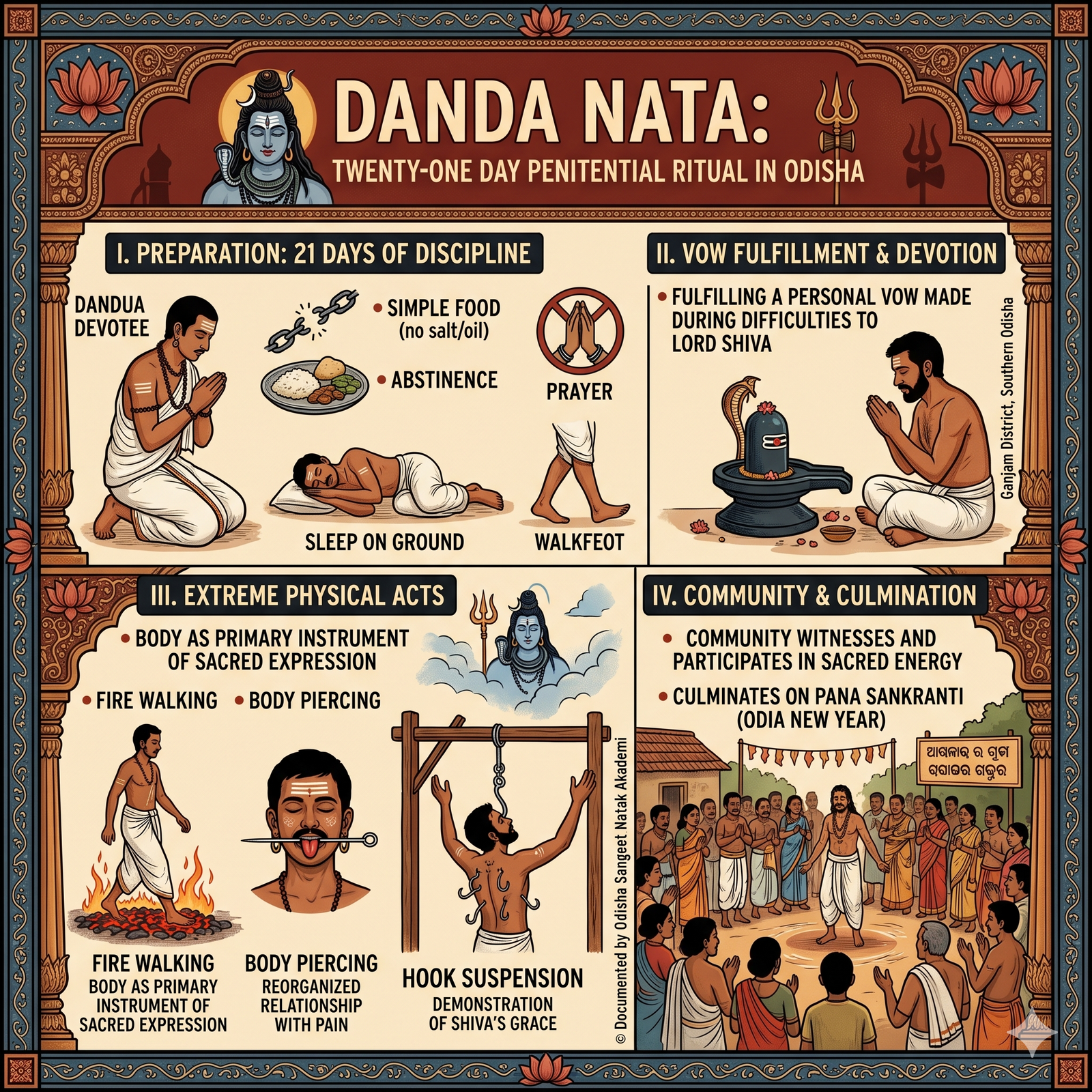
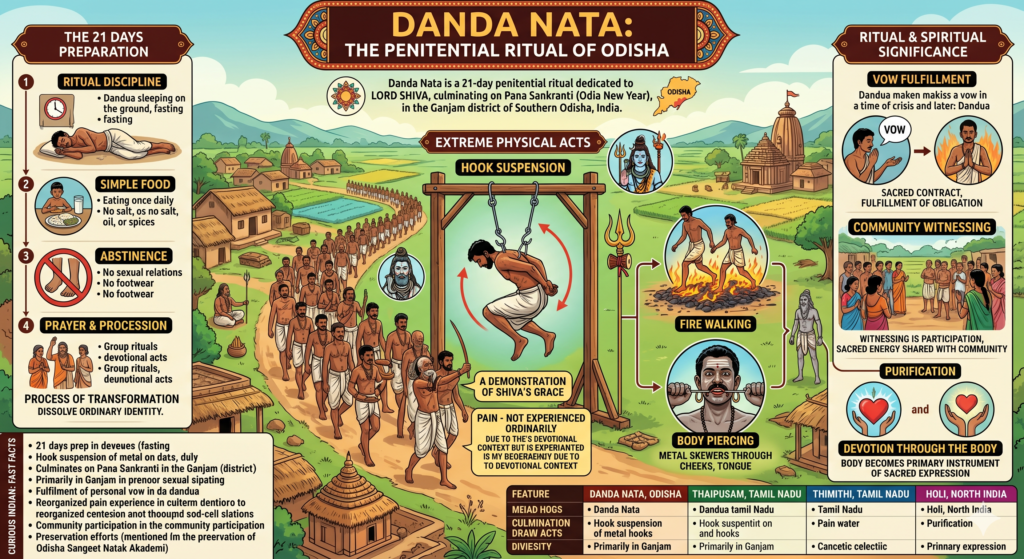
Every year, in the weeks before Pana Sankranti—the Odia New Year in April—men in the Ganjam district of southern Odisha enter a twenty-one-day ritual discipline called Danda Nata. They sleep on the ground instead of beds. They eat once a day, plain food with no salt or oil. They walk barefoot. They abstain from sex. At the end, some of them will walk across burning coals. Some will pierce their cheeks and tongues with metal skewers. Some will hang suspended from poles by hooks driven through the skin of their backs.
These men are called Danduas. They are fulfilling vows they made to Shiva.
They made these vows during moments of crisis. A man fell ill and prayed to Shiva. A family faced disaster and he asked for the god’s help. He promised that if Shiva answered him, he would undergo the Danda Nata discipline. When the crisis passed and the prayer was answered, he kept his promise.
The Danda Nata is not punishment. It is payment of a debt.
What the twenty-one days demand
The discipline begins twenty-one days before Pana Sankranti. The Dandua enters a state of ritual separation from ordinary life. He sleeps on the ground. He eats once daily—rice, lentils, vegetables, no salt or oil or spice. He does not wear shoes. He abstains from sex. He moves through specific rules about ritual cleanliness that govern how he touches other people and passes through community spaces.
He spends hours each day in prayer and procession. He performs preliminary ritual acts that build toward what comes at the end.
The practice is not random hardship. Each restriction serves a purpose. Together, they accomplish what the tradition calls a transformation. Over twenty-one days, the Dandua’s ordinary identity is supposed to dissolve. What remains, according to the practice, is a ritual identity—a self that belongs more to Shiva than to the person who entered the discipline.
By the time the culminating rituals arrive, the Dandua has been reorganized. He is no longer a person going through pain. He is a person through whom Shiva is demonstrating his presence.
The Mysterious 500 Year Old Mummy of Sangha Tenzin in Spiti Valley
The vow structure
The vow is not made by an external authority. The Dandua decides. He decides when he is desperate, when he is praying to Shiva during a crisis, when nothing else is working. He says: if you help me, I will do this.
Shiva responds, or the person believes Shiva responds. The crisis passes. The vow remains.
This vow structure matters because it changes what the body goes through. The Dandua is not choosing to experience pain for its own sake. He is not testing his endurance. He is discharging an obligation he created himself in dialogue with his god. The terms were set at the moment of desperation, not imposed by anyone else.
The scholars and ethnographers who have documented the tradition across generations of participants consistently note one fact: the Danduas report that the pain they experience during the physical acts is not the same as ordinary pain. It is not absent. It is there. But it arrives in a different context. The context itself has been so completely reorganized by the twenty-one days, by the vow, by the devotional relationship with Shiva, that the sensation is processed differently.
Whether this is divine grace or the effects of extreme devotional states, the experience is consistent across participants. The absence of the pain-response you would expect—the screaming, the writhing, the normal reaction to hooks through the back—is read within the tradition as evidence that Shiva is present inside the person.
Savitribai Phule: School That Changed India’s History
The physical acts
The culminating rituals happen publicly, in front of the community. The Danduas perform a sequence of physical acts that escalate in intensity.
Some walk across burning coals with bare feet, moving with deliberation, their expression unchanging.
Some pierce their bodies with metal skewers. The metal goes through the cheeks, the tongue, sometimes other parts. They perform their daily activities with the metal still in place—praying, moving through the community, carrying objects—as a visible expression of Shiva’s presence inside them.
Some suspend themselves from specially constructed wooden frames or poles by hooks driven through the skin of their backs. They may remain stationary, or they may rotate slowly, their arms extended, their face turned upward. They may be carried in procession through the community in this suspended state.
The hooks and the suspension are not understood as an infliction of suffering. They are a demonstration of Shiva’s grace. The Dandua hanging from hooks without visible pain is showing something to the community: that his god has reorganized his relationship with his own body. The absence of ordinary pain response is evidence of the divine presence.
Why Peer Ali Khan Chose the Gallows Over Betraying His City
Why Shiva
Shiva is not a random choice. In Hindu theology, Shiva is the god of dissolution—the breaking apart of ordinary boundaries, the transcendence of normal physical experience. His mythology is full of moments where the rules of physical reality simply stop applying. His devotees, the ascetics who cover themselves in ash and practice extreme austerities, have occupied a special place in Indian religious imagination for thousands of years as people who have reorganized their relationship with the body through their relationship with the god.
The Danduas are not full-time ascetics. They return to ordinary life after Pana Sankranti. But for those twenty-one days, they inhabit a version of what Shaivite asceticism has always understood as one of the highest forms of devotion: the body becomes the instrument through which devotion is most completely expressed.
The community witnesses
The rituals happen publicly. The community gathers. This is not passive observation. The community’s witnessing is part of the ritual. The Danduas are fulfilling vows for themselves and their families. But the community that watches them fulfills something too. It participates in the sacred energy that the ritual generates. The extreme physical devotion of the Danduas produces a form of spiritual benefit that the tradition understands as extending to everyone present.
Mysterious Bird Deaths In Jatinga Valley That Science Cannot Fully Explain
Under pressure
Danda Nata faces pressure from several directions. In some cases, legal authorities have scrutinized the body piercing and hook suspension practices, creating tension between the tradition’s practitioners and regulatory bodies. Urbanization and migration from Ganjam district have reduced the number of young men who grow up embedded in the community contexts that produce Danduas. And in educated urban settings, extreme physical devotion is more likely to be called superstition than spiritual practice.
The practitioners respond by asking: what else produces what this produces? The Danda Nata creates, inside the devotee and inside the witnessing community, an experience of Shiva’s presence that cannot be created any other way. Extreme physical discipline is not the obstacle to that experience. It is the condition that makes it possible.
The tradition persists because it does something real for the people who participate in it. A Dandua hanging from hooks above his community is not performing suffering. He is demonstrating a relationship—the relationship between a devotee and his god, expressed in the only language as direct and undeniable as flesh pushed past its ordinary limits and finding something unexpected on the other side.
Shiva is the god of dissolution. Danda Nata is the tradition that takes that theology seriously enough to live it in the body, once a year, for twenty-one days, in the villages of Ganjam district, before the new year arrives.
The Magnetic Hill of Ladakh That Defies the Laws of Gravity
If you think you have remembered everything about this topic take this QUIZ
Results


#1. In which specific district of southern Odisha is the Danda Nata ritual tradition primarily practiced?
#2. On which specific occasion does the twenty-one day Danda Nata ritual cycle reach its culmination?
#3. What are the male devotees who participate in the Danda Nata rituals called? A) Palols
#4. Which deity is the central focus of the vows and devotional practices in Danda Nata?
#5. During the twenty-one days of preparation, how many times a day are the participating devotees permitted to eat?
#6. Which institution is explicitly mentioned as having preserved research or documented the traditions of Danda Nata alongside the Odisha State Museum?
#7. Which of the following is described as the most dramatic and discussed physical act in the culminating rituals of Danda Nata?
#8. In the preparatory discipline of Danda Nata, how are the participants required to modify their food?
What is Danda Nata and where is it practiced?
Danda Nata is a twenty-one day penitential ritual tradition practiced primarily in the Ganjam district of southern Odisha. Male devotees called Danduas undertake extreme physical disciplines including fasting, fire walking, body piercing and hook suspension as the fulfillment of personal vows made to Lord Shiva. The tradition culminates on Pana Sankranti, the Odia New Year in mid-April.
Who are the Danduas and what qualifies them to participate?
Danduas are male devotees who have made personal vows to Shiva during times of difficulty and who are fulfilling those vows through participation in the Danda Nata ritual cycle. There is no hereditary qualification. Any male devotee who has made a vow and who undergoes the required twenty-one day preparatory discipline may participate. The vow itself is the qualification
Why do the Danduas report not experiencing ordinary pain during the physical acts?
Practitioners and scholars who have studied the tradition consistently note that the twenty-one day preparatory period reorganizes the Dandua’s relationship with his body through the sustained devotional context of the preparation. Within the tradition, this reorganization is understood as the presence of Shiva within the devotee. The physical sensation is not absent but is experienced within a context so completely organized around the devotional relationship that it is processed differently from ordinary pain.
What is the significance of Shiva as the deity of the Danda Nata tradition?
Shiva is the deity most associated in Hindu theology with dissolution, with the transcendence of ordinary physical conditions and with the ascetic reorganization of the body’s relationship with sensation. His mythology and his devotional tradition have always included extreme physical austerity as one of the highest expressions of devotion. The Danduas’ discipline belongs to this broader Shaivite tradition of using the body as the primary instrument of sacred expression.
Is Danda Nata facing pressure from modern authorities?
Legal scrutiny of body piercing and hook suspension practices has created tension between the tradition’s practitioners and regulatory authorities in some instances. Urbanization and migration from Ganjam district have also reduced the number of young men embedded in the community contexts that produce Danduas. Practitioners respond to these pressures by emphasizing what the tradition produces, an experience of Shiva’s presence unavailable through any other means, as the justification for its continuation.
Sources & References
Ethnographic studies on Danda Nata ritual — documented accounts of the twenty-one-day discipline, vow structure, and physical practices in Ganjam district, Odisha.
Anthropological research on Shaivite asceticism — theological understanding of Shiva as the god of dissolution, transcendence of physical boundaries, and the role of extreme austerities in Hindu devotional practice.
Academic documentation of Pana Sankranti — the Odia New Year festival calendar and timing of seasonal rituals in Odisha.
Studies on pain perception in extreme devotional states — scholarly analysis of how intensive spiritual practices affect pain response and perception across different religious traditions.
Legal and regulatory documentation — reports on contemporary scrutiny of extreme physical practices in traditional rituals, and tensions between cultural practitioners and regulatory authorities in India.
Regional migration and urbanization studies — research on how demographic shifts from Ganjam district affect the transmission of traditional knowledge and ritual participation.