How a Rice land Lost Three million People in the Middle of a World War
For most of India, a plate of rice is the meaning of a full stomach. It is the first solid food a baby is given. It is what “have you eaten?” really asks about. Warm, plain, everyday rice.
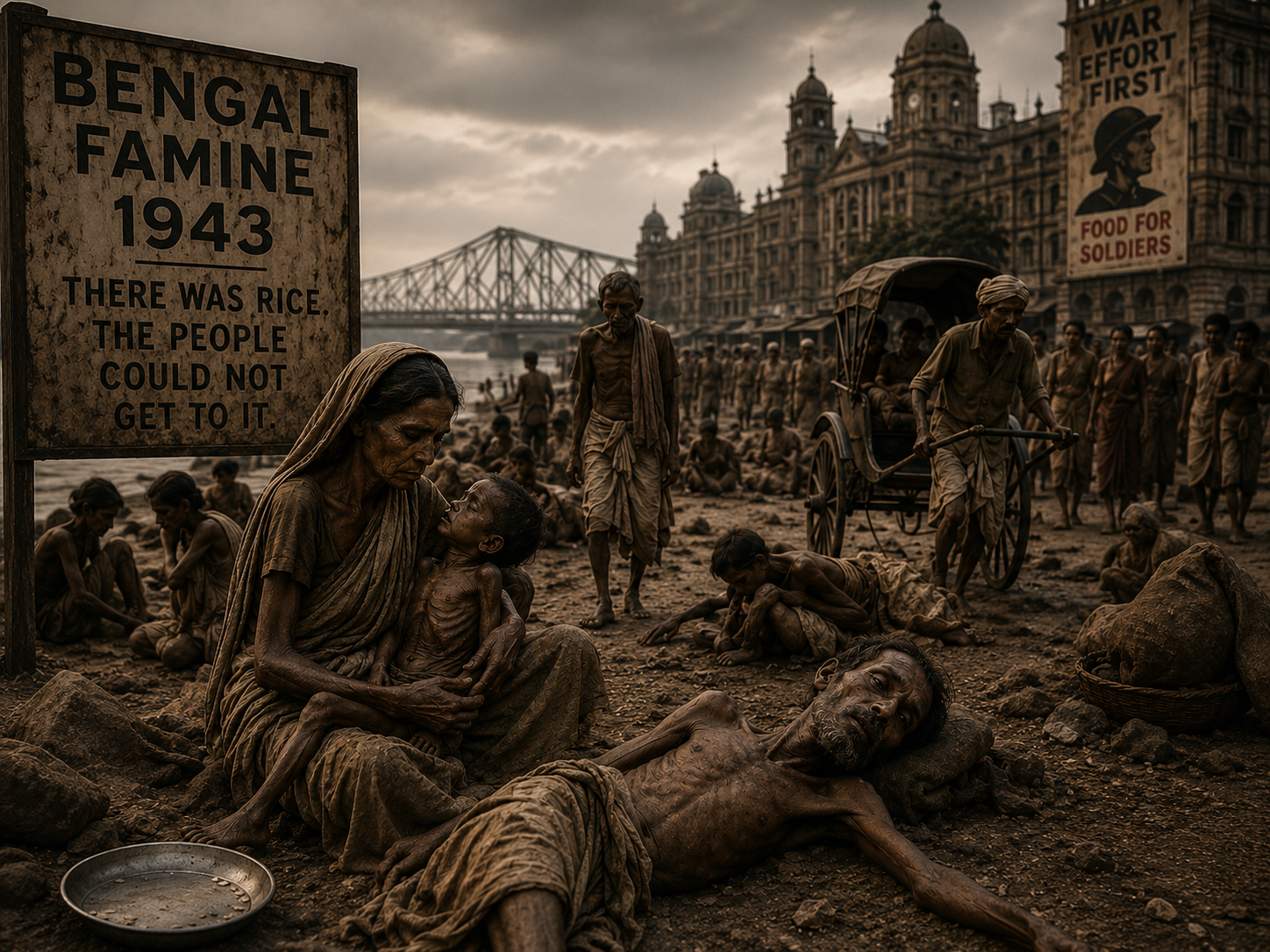
Now hold one thought that is hard to hold. In 1943, in the rice-growing land of Bengal, around three million people starved to death. And they did not die in a desert or a drought. They died in a green land, with rice growing in the fields and stored in the godowns.
There was rice in Bengal. The people who died simply could not get to it. This is the story of how that happened, and of the long silence that followed.
Quit India Movement: How a Leaderless Nation Fought for Freedom
A rice land, starving
Bengal in those days was much bigger than today’s West Bengal. It included what is now the whole country of Bangladesh. It was wet, green, and criss-crossed by rivers, and it grew rice for millions.
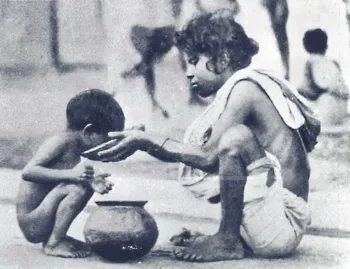
1943 Bengal famine. Source: Wikimedia Commons
By the middle of 1943, its roads and railway stations filled with skeletons that were still walking. Whole families left their villages and dragged themselves to Calcutta, hoping to find food in the city. Most found only a place to lie down and die.
The people who died were almost all poor. Landless workers, fishermen, potters, widows, the old. The rich in Bengal did not starve. That single fact tells you this was not a simple case of a country running out of food.
What set it off
Several bad things came together at once.
In 1942, in the middle of the Second World War, Japan captured Burma, next door. Burma had been sending huge amounts of rice to India for years. That supply stopped almost overnight.
Then, on 16 October 1942, a cyclone smashed into the Bengal coast. It flattened crops and drowned fields with salt water. A rice disease spread through what was left. So the harvest was smaller than usual.
But a smaller harvest is not the same as three million deaths. Britain’s own experts later agreed that the 1943 crop was not small enough, by itself, to starve Bengal. Something turned a shortage into a slaughter.
Jallianwala Bagh Massacre 1919: Tragedy That Ignited a Revolution
The boats they took away
Here the war made its cruelest mark.
The British were terrified that Japan would invade India through Bengal’s rivers and coast. To stop the enemy from using local resources, they carried out what they called a “denial policy.” In the coastal districts, they seized the country boats that people used to fish and to carry rice from village to village.
The authorities impounded 66,653 boats in Bengal. For fishermen and boatmen, that was their work, their food, and their way of moving rice, all taken at once.
At the same time, in rice-surplus districts like Midnapore, stocks of rice were ordered to be removed so the Japanese could not seize them. So in the very areas that grew extra rice, the rice could no longer travel to the areas that had none. The rivers that had always carried food now carried nothing.
The Battle of Plassey: How a Conspiracy Toppled the Nawab of Bengal
The price no poor family could pay
With Burma’s rice gone and boats off the water, fear took over the market. Traders and the wealthy began to hoard rice, sure the price would keep climbing. It did.
In Calcutta, the price of rice rose from about 4 rupees to 37 rupees a maund between 1941 and July 1943 — nearly nine times over.
A rich family could still buy rice at that price. A landless labourer earning a few annas a day could not buy even a handful. The rice was there in the shops. It had simply floated out of a poor person’s reach.
And the government made choices about who came first. Soldiers had to be fed. War factories in Calcutta had to be fed. Some rice was even sent out of India to feed troops elsewhere. The starving villager was at the back of the line, and the line ran out long before it reached him.
Years later, the economist Amartya Sen gave this a plain explanation. Famines, he showed, are often not about there being no food at all. They are about ordinary people losing the money and the means to get the food that exists. Bengal in 1943 was his clearest, saddest proof.
The silence
Perhaps the hardest part is how quietly it was allowed to happen.
It was wartime, and the newspapers were censored. The government did not want stories of mass death spreading while it was fighting a war. For months, the dying in the villages barely reached the front pages. The government never even formally declared a famine, a step that would have forced certain relief measures into action.
The silence was finally broken by a newspaper in Calcutta called The Statesman. In August 1943, its editor, Ian Stephens, printed page after page of photographs of the starving and the dead on the city’s streets. The pictures could not be argued with. Once people across India and Britain saw them, the pressure to act became too great to ignore.
The Surprising Health Benefits Of Black Rice Of Manipur
How they died
By the time real help came, it was very late.
Most of the three million did not die of hunger alone. Starvation left bodies too weak to fight off illness, and then malaria, cholera, smallpox and dysentery swept through the weakened crowds. The dying went on well into 1944, long after the worst of the food crisis had passed.
Relief, when it arrived, was large. Free kitchens were set up across Bengal.
By October 1943, free kitchens were feeding around 1.3 million people every single day. That number shows both the scale of the help and the scale of the need it was trying to meet.
A new Viceroy, Lord Wavell, took charge in the autumn of 1943 and ordered the army to move and hand out food. Historians widely credit that army effort with finally breaking the famine. It could have been done months earlier, when the first villages began to empty.
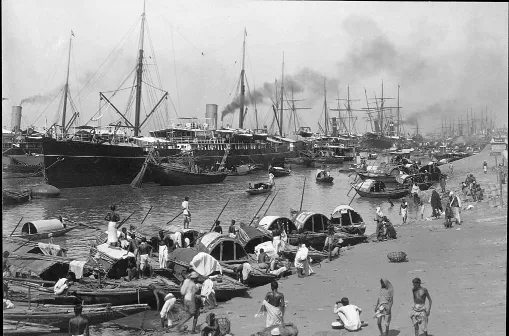
during the 1943 denial policy. Source: Wikimedia Commons
Was it man-made?
This is the question people still argue about, and it deserves an honest answer rather than a slogan.
One side says the famine was largely made by human choices. The 1943 harvest was not disastrous. Food was being hoarded, prices were left to spiral, rice was still leaving the region, and relief was slow. A scientific study in 2019, led by researchers at IIT Gandhinagar, found that this was the one major Indian famine of that era that was not caused by drought. The writer Madhusree Mukerjee has argued that Prime Minister Winston Churchill’s war cabinet delayed and diverted ships that could have carried grain to Bengal.
The other side points to the war raging all around. Japan was on Bengal’s doorstep, bombing Calcutta and prowling the coast in submarines. The seizure of the boats was a military decision meant to block an invasion. Churchill’s defenders note that he did ask for American ships, sent grain from Australia and Iraq, and appointed Wavell, whose army relief helped end the famine.
Historians who study famines make one careful point. A famine is almost never the work of one villain. Nature and human decisions usually combine. What is fair to say about Bengal is this: the deaths came less from a missing harvest and more from decisions about who got the food that existed. That is why so many call it man-made, even as the full blame is still shared and debated.
The boy who never forgot
There was a nine-year-old boy in Bengal in 1943 who watched the starving come into his town. He noticed something that stayed with him for life: his own family and their neighbours never went hungry, while thousands of poor strangers died within sight of full markets.
That boy was Amartya Sen. He grew up to study exactly this puzzle, and in 1998 he won the Nobel Prize in Economics. His life’s biggest idea grew straight out of what he saw as a child: that hunger is usually a failure to share and to reach, not simply a failure of the rains.
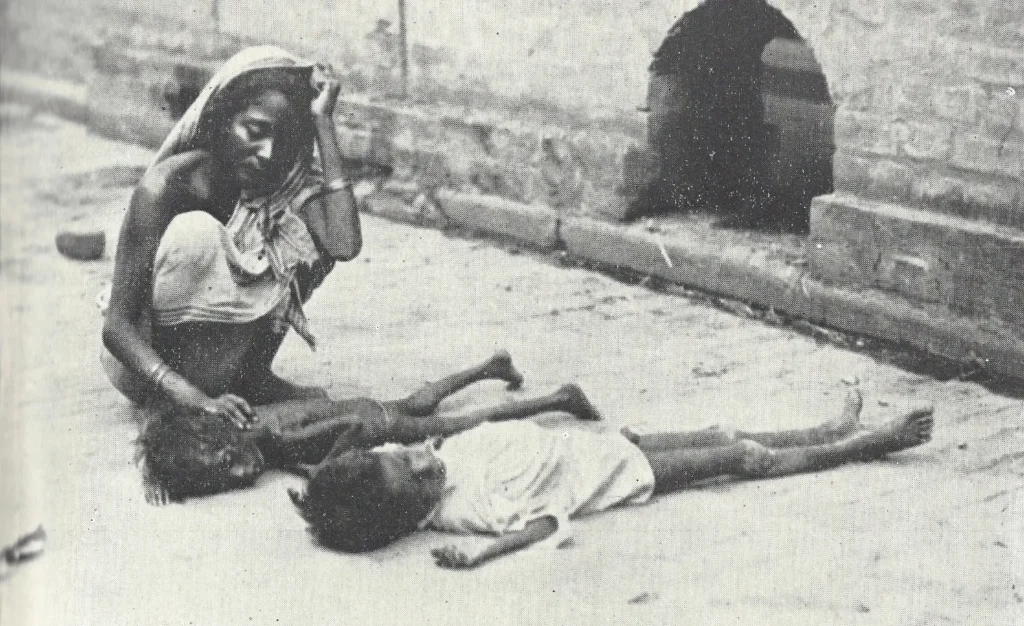
The rice on your plate
So the next time a plate of warm rice is set in front of you, hold it in your mind for a moment longer.
Eighty years ago, in one of the great rice lands of the world, about three million people died within reach of that same grain. Not because the earth stopped giving it, but because the ways to get it to them were cut, delayed, and left to the market and the war.
The most ordinary food on the Indian plate once measured the distance between the fed and the forgotten. That is a story worth remembering, quietly, at every full meal.
If you think you have remembered everything about this topic take this QUIZ
Results


#1. Approximately how many people died during the Bengal famine of 1943?
#2. Which neighboring country’s capture by Japan halted critical rice supplies to India?
#3. What was the British “denial policy” in coastal Bengal?
#4. Between 1941 and July 1943, the price of rice in Calcutta rose from 4 rupees per maund to roughly what amount?
#5. Which newspaper broke the government’s silence by publishing photos of the starving?
#6. Who was the new Viceroy that finally ordered the army to distribute food in the autumn of 1943?
#7. A 2019 scientific study by IIT Gandhinagar concluded that the 1943 famine was unique because it was NOT caused by what?
#8. Which future Nobel Prize-winning economist witnessed the famine firsthand as a nineyear-old boy?
What caused the Bengal famine of 1943?
The famine was caused by a devastating combination of natural and human factors. A 1942
cyclone and crop disease reduced the harvest, while the fall of Burma cut off essential rice imports.
However, wartime inflation, hoarding, and the British “denial policy” of seizing local boats turned a
shortage into a mass tragedy.
Was the Bengal famine of 1943 man-made?
Many historians and economists argue it was largely man-made. While natural disasters played a
role, modern studies show there was no major drought. The massive death toll was primarily driven
by wartime policies, runaway inflation, and delayed government relief that placed food out of the
reach of the poor.
What was the denial policy during the Bengal famine?
Fearing a Japanese invasion, the British colonial government implemented a “denial policy” in
They seized 66,653 country boats in coastal Bengal to prevent the enemy from using them,
which destroyed the livelihoods of fishermen and halted the local transport of rice.
How many people died in the 1943 Bengal famine?
Approximately three million people died. While many starved directly, a massive portion of the
death toll came from diseases like malaria, cholera, and dysentery, which swept through
populations already severely weakened by hunger.
What is Amartya Sen’s theory on the Bengal famine?
Nobel laureate Amartya Sen, who witnessed the famine as a child, concluded that famines are
rarely just about a lack of food. He argued the Bengal famine was an “entitlement failure”—
meaning the food existed, but ordinary people simply lost the money and means required to buy it.
Sources and references
- Encyclopaedia Britannica (“Bengal famine of 1943”) — the death toll of about three million, the finding that the famine came from an “entitlement failure” rather than a simple shortfall, the limited impact of the 1942 cyclone and Burma import loss on total supply, and the wartime stockpiling and export of food.
- PMC / academic paper (“Colonial Biopolitics and the Great Bengal Famine of 1943”) — the “denial policy,” the figure of 66,653 boats impounded, the order to remove rice stocks in surplus districts like Midnapore, and the collapse of the fishing and pottery economies.
- ChurchillFacts.com and the Hillsdale Churchill Project — the natural and wartime triggers (cyclone, brown-spot disease, fall of Burma), the rice price rising from about 4 to 37 rupees a maund, the roughly 1.3 million people fed daily by free kitchens by October 1943, and the case made by Churchill’s defenders about grain shipments and Wavell’s relief.
- Al Jazeera (2019) on the study by Vimal Mishra, IIT Gandhinagar (Geophysical Research Letters) — the finding that the 1943 Bengal famine, unlike other Indian famines of the period, was not linked to drought or crop failure.
- Amartya Sen, “Poverty and Famines” (1981), and his Nobel biography — the idea of famine as a loss of the poor’s ability to obtain food, and Sen’s own memory of the famine as a child in Bengal.
- Madhusree Mukerjee, “Churchill’s Secret War,” and reporting on the debate — the argument that British wartime decisions delayed and diverted relief, presented alongside the opposing view for balance.
- Accounts of The Statesman and its editor Ian Stephens — the wartime censorship, the absence of a formal famine declaration, and the August 1943 publication of photographs that broke the public silence.