Sound as Ritual Action
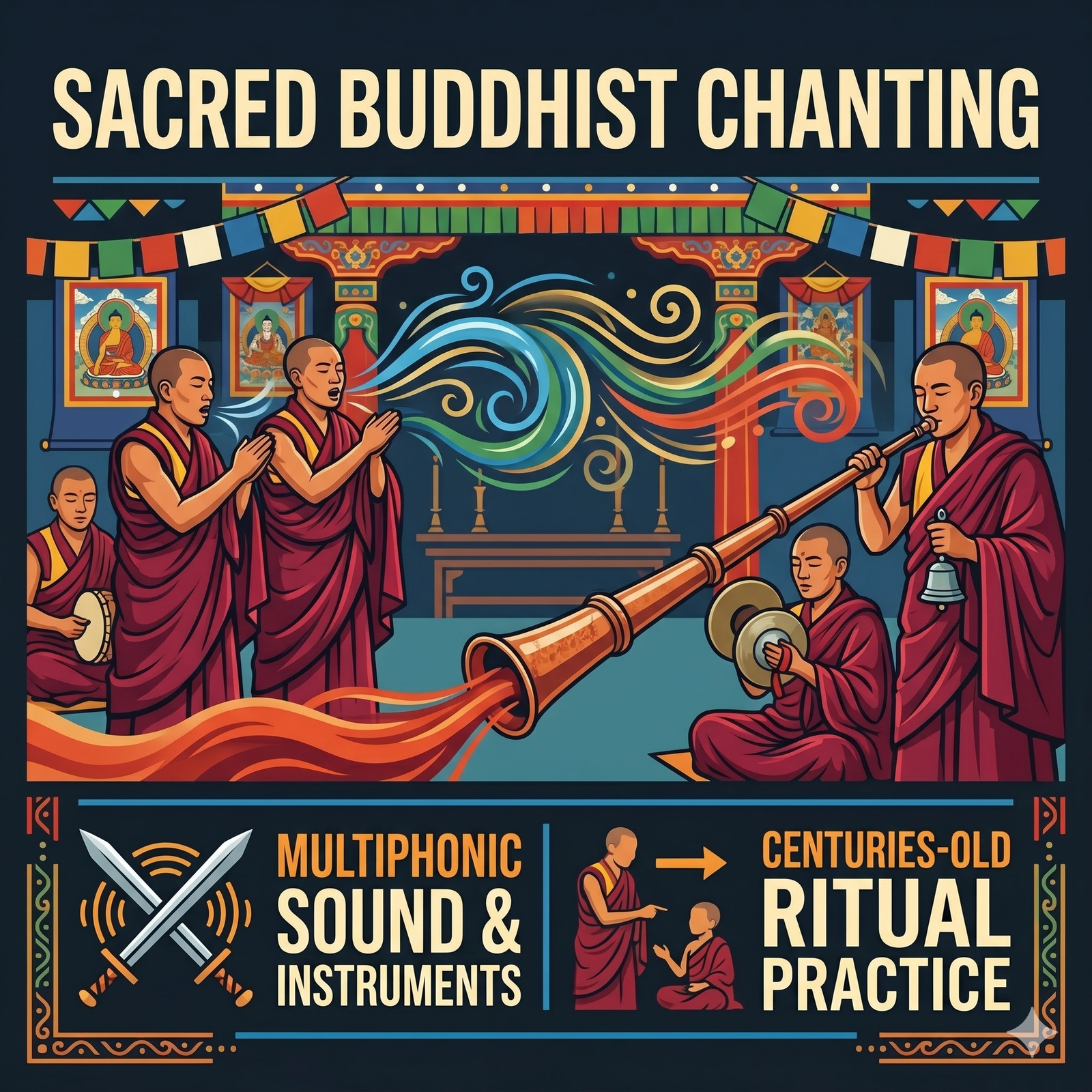
The Buddhist monasteries of Ladakh sustain one of the oldest and most acoustically sophisticated chanting traditions in the world. Monks at Hemis, Thiksey, Diskit and Spituk perform ritual chanting as part of daily monastic life and major ceremonies, using multiphonic vocal techniques, ritual instruments and precise textual recitation. Within the Tibetan Buddhist understanding, these sounds are not incidental to the rituals. They are the rituals themselves.
The Monasteries That Hold the Tradition
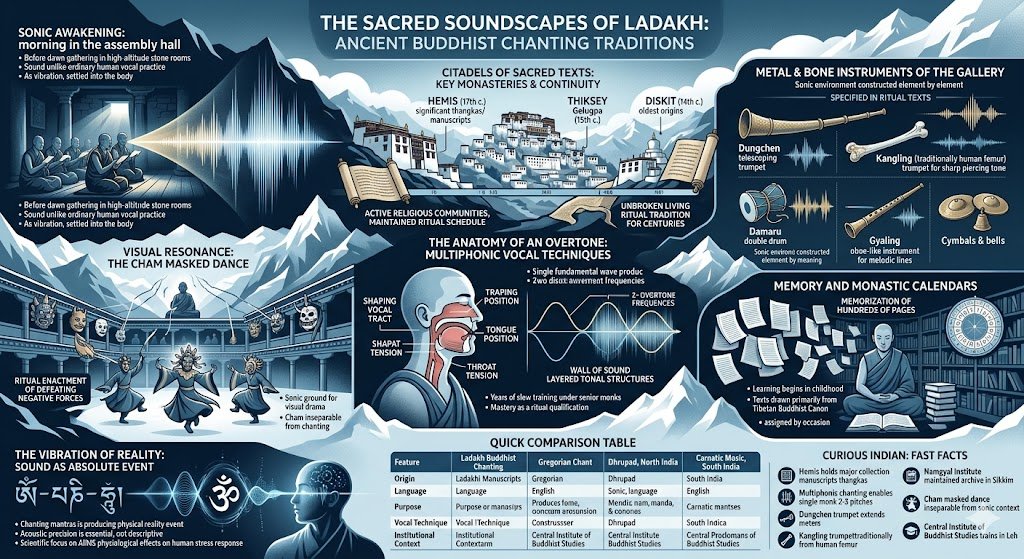
Ladakh’s Buddhist monasteries are among India’s oldest continuously functioning religious institutions. Hemis, the largest, was founded in the seventeenth century and houses significant collections of Buddhist manuscripts, thangkas and ritual objects. Thiksey, built on a hill above the Indus Valley, became a center of Gelugpa Buddhism in the fifteenth century. Diskit in the Nubra Valley traces its origins to the fourteenth century, making it the oldest monastery in Ladakh. Spituk has maintained its own chanting tradition for centuries.
These are not museums. The monks who chant at Hemis or Thiksey today recite the same texts in the same sequences with the same instrumental accompaniment as their predecessors hundreds of years ago. This continuity is fundamental to how the tradition understands its own power.
The Namgyal Institute of Tibetology in Sikkim has documented the chanting traditions of Ladakh as part of efforts to record the living ritual practices of Himalayan Buddhism. Scholars recognize that these traditions are susceptible to ecological and demographic pressures that could disrupt their transmission.
Multiphonic Chanting and the Shaping of Sound
The most immediately distinctive acoustic feature of Ladakh Buddhist chanting is multiphonic technique. Trained monks shape the vocal tract, tongue, throat and nasal passages to amplify specific overtones, making them audible as distinct pitches above the fundamental tone. A single voice produces what sounds like two or three simultaneous pitches. When a full assembly performs this technique together, the result is a layered wall of sound with tonal structures that interact in ways conventional harmonic music does not.
This technique takes years to master. Within the tradition, the capacity to produce specific tones correctly is understood as a ritual qualification. A monk who has not mastered the tonal requirements of a specific text cannot perform that text in ceremonies where it is required. The voice is not merely a delivery mechanism for words. It is a component of the ritual action itself.
How Kodava Celebrates Weapons During Kailpodh Festival
The Ritual Instruments
Ladakh Buddhist chanting is almost never performed without instrumental accompaniment. Each instrument has a specified role assigned in the ritual texts.
The dungchen is a long telescoping trumpet that can extend to several meters in length. It produces a deep resonant tone used to open ceremonies and mark significant ritual transitions. Its sound summons protective beings and clears the ritual space.
The kangling is a shorter trumpet traditionally made from human femur bone. Its sharper, more piercing tone is associated with specific tantric rituals. The gyaling, a double-reed instrument similar to an oboe, carries melodic lines within the chanting. The damaru is a small double-headed drum. Larger monastery drums, cymbals and bells mark rhythmic structure and ritual divisions.
The combination of voices and instruments creates what the tradition understands not as a performance but as a construction. The ceremony is being built in sound according to a plan worked out over centuries of accumulated knowledge.
The Texts and the Monastic Calendar
The texts chanted by Ladakhi monks come primarily from the Tibetan Buddhist canon, a vast collection of translated Sanskrit texts and original Tibetan compositions that constitute the doctrinal and ritual foundation of the tradition.
A morning chanting session might include invocations of protective deities, recitations of the Buddha’s teachings and prayers for the community. Major ceremonial occasions involve longer and more complex textual sequences performed by the full assembly with the complete instrumental complement.
Young monks who enter the monastery as children begin memorizing texts from their first years. By the end of a decade of training, a monk will have committed hundreds of pages of Tibetan text to memory, along with the specific melodic contours, rhythmic patterns and tonal requirements associated with each text in each of its ritual contexts.
The Central Institute of Buddhist Studies in Leh trains monks and scholars in the Ladakhi Buddhist tradition and has documented and standardized the transmission of chanting texts and techniques, ensuring that knowledge held by senior monks is captured for future practitioners.
The Elaborate Parsi Sky Burials and Towers of Silence
The Cham Dance and Its Sonic Ground
The most publicly visible expression of Ladakhi Buddhist ritual is the Cham dance, performed at major monastery festivals including the annual Hemis festival. Monks wearing elaborate masks representing dharmapalas, protective deities and death symbols move through the monastery courtyard. The Cham enacts the defeat of negative forces through movement performed in sound and space simultaneously.
The chanting and instrumental performance from the monastery galleries creates the sonic environment within which the dance takes place. Without the chanting, the Cham becomes a costume display. With it, the combination works on the nervous system of those present in ways that exceed what the eyes alone can produce.
Sound as Reality in Buddhist Philosophy
Within Tibetan Buddhist philosophy, sound holds a specific and significant place in the understanding of consciousness and reality. The tradition holds that certain sounds—most fundamentally the syllable Om and the various mantra syllables throughout Buddhist liturgical texts—are not conventional signs pointing to meanings elsewhere. They are themselves instances of the reality they refer to.
To chant Om correctly is not to describe Om. It is to produce Om as a physical event in the world.
This understanding elevates the acoustic precision of ritual chanting far beyond musical performance. If the sounds themselves are the ritual action, then producing them incorrectly is not a musical error. It is a ritual failure. The careful transmission of chanting techniques, the long years of training, the institutional structures of the monastery—all exist in service of acoustic precision that carries consequences beyond the aesthetic.
Researchers studying the physiological effects of specific chanting frequencies on human stress response and neurological function have added a scientific dimension to what the tradition has always claimed experientially: that specific sounds produce specific effects on the human mind and body.
Intricate Kolam Floor Art Drawn Daily in South Indian Homes
The Continuity in the Stone Halls
The chanting of Ladakh’s Buddhist monks is one of the oldest surviving examples of sound used as a precise ritual technology. Within the tradition, the sounds are understood as having specific effects on consciousness, on the ritual space and on the relationship between the human and the divine.
What makes this tradition remarkable is the sophistication of the understanding that produced it. The Tibetan Buddhist tradition thought carefully about sound, developed detailed theories of its relationship to consciousness and reality, and created institutional structures capable of transmitting that thinking across generations with sufficient precision that the tradition remains recognizably itself.
The monasteries of Ladakh are cold, high and far from most places where decisions about cultural preservation are made. What is being maintained in those stone assembly halls each morning is a form of knowledge about what sound can do that the rest of the world has not yet fully learned to value.
Danda Nata: Twenty One Days of Sacred Suffering in Odisha
If you think you have remembered everything about this topic take this QUIZ
This quiz no longer existsWhat is the multiphonic chanting technique practiced by Ladakhi Buddhist monks?
Multiphonic chanting involves shaping the vocal tract in specific ways to amplify overtones within the sound, allowing a single singer to produce two or three audible pitches simultaneously. The technique is learned over years of training under senior monks and is not merely a vocal skill but a ritual qualification within the tradition. The capacity to produce specific tones correctly is understood as essential to the efficacy of the ritual texts in which they appear.
Which monasteries in Ladakh are most significant for the chanting tradition?
Hemis, Thiksey, Diskit and Spituk are among the most significant monasteries sustaining the chanting tradition in Ladakh. Hemis is the largest and houses major manuscript collections. Thiksey is a major Gelugpa institution in the Indus Valley. Diskit in the Nubra Valley is the oldest monastery in Ladakh, tracing its origins to the 14th century. All maintain active ritual chanting schedules as part of daily monastic life.
What instruments accompany the chanting in Ladakhi Buddhist rituals?
The primary instruments include the dungchen, a long telescoping trumpet that opens ceremonies and marks ritual transitions, the kangling, a shorter trumpet associated with tantric rituals, the gyaling, a double-reed instrument carrying melodic lines, the damaru, a small double-headed drum, larger monastery drums and cymbals. Each instrument has a specific role assigned in the ritual texts, and the combination creates a total sonic environment understood as essential to the ceremony.
What is the Cham dance and how does it relate to the chanting tradition?
The Cham is a masked dance performed at major monastery festivals including the annual Hemis festival. It enacts the defeat of negative forces through movement by monks wearing elaborate masks representing dharmapalas and other figures. The chanting and instrumental performance by monks in the monastery galleries creates the sonic environment within which the dance takes place. The two elements are inseparable within the ritual context, with the chanting providing the acoustic ground for the visual drama.
How are chanting traditions being preserved in Ladakh?
The Central Institute of Buddhist Studies in Leh trains monks and scholars in the Ladakhi Buddhist chanting tradition and has been involved in documenting and standardizing the transmission of chanting texts and techniques. The Namgyal Institute of Tibetology in Sikkim maintains archival records of Tibetan Buddhist ritual materials. The living transmission through senior monks training younger practitioners in the monasteries themselves remains the most essential preservation mechanism.
Sources & References
Tibetan Buddhist sacred texts and philosophical documentation — Tibetan Buddhist canon (translated Sanskrit texts and original Tibetan compositions), understanding of Om and mantra syllables as instances of reality, theories of sound’s relationship to consciousness and the structure of reality.
Ladakh monasteries and their histories — Hemis monastery (founded 17th century, manuscript and thangka collections), Thiksey monastery (15th century, Gelugpa Buddhist tradition), Diskit monastery (14th century, oldest in Ladakh), Spituk monastery, and their role as active religious communities maintaining unbroken ritual traditions.
Multiphonic chanting technique documentation — vocal methodology for producing simultaneous pitches through vocal tract shaping, training timelines and mastery requirements, ritual qualification standards, and acoustic effects of ensemble multiphonic chanting.
Ritual instruments and their functions — dungchen (long telescoping trumpet, ceremony opening and transitions), kangling (femur-made trumpet, tantric rituals), gyaling (double-reed melodic instrument), damaru (double-headed drum), monastery drums, cymbals and bells; their specified roles in ritual texts and combined sonic construction.
Tibetan Buddhist ritual and the Cham dance — masked dance tradition at Hemis festival, dharmapalas and protective deities represented, integration of sonic and movement elements in ritual enactment, role of chanting as acoustic ground and context.
Institutional preservation and training — Namgyal Institute of Tibetology in Sikkim (archival records of Tibetan Buddhist materials), Central Institute of Buddhist Studies in Leh (monk and scholar training, documentation of chanting texts and techniques), transmission through senior monks to younger practitioners.
Physiological research on chanting frequencies — research on effects of specific chanting frequencies on stress response and neurological function, scientific documentation of traditional understanding of sound’s effects on consciousness and the human body.