Ellora, the eighth century: a queen swore she would not eat until she saw the top of a temple. The builders said it would take months. One man said a week
The story goes like this.
A king in the western Deccan fell ill with a sickness that no one could cure. In one version it came on him every night, and it was a punishment for something he had done in a past life. His queen, Manikavati, went to pray to Shiva at the shrine of Ghrishneshwar, near a place called Elapura. She made him a promise. If her husband was cured, she would build Shiva a temple. And she would eat nothing until she had seen its shikhara, the tower that crowns a temple.
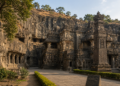
Related to article: The Queen Who Would Not Eat · Source: Wikimedia Commons · Evilvoldy · CC BY-SA 4.0
The king went hunting in the hills nearby. He bathed in a tank at a place called Mahisamala, and he got better.
Now the queen had to keep her word, and she had stopped eating.
She would eat nothing until she had seen the temple’s shikhara.
Sixteen months
The king called for builders. They came, looked at the problem and gave him the honest answer. A temple is built from the ground up. The shikhara goes on last. Even a quick job would take at least sixteen months before there was a tower for the queen to look at.
Nobody could fast for sixteen months.
Then a craftsman named Kokasa came from Paithan, on the Godavari, a famous shilpi with a large team of artisans behind him. In one telling there were seven thousand of them. He told the king that the queen would see her shikhara within a week.
Related to article: The Queen Who Would Not Eat · Source: Wikimedia Commons · Evilvoldy · CC BY-SA 4.0
He did not plan to build the temple. He planned to cut it out of the hill, and to start at the top.
The Surprising Health Benefits Of Black Rice Of Manipur
The Ethics Of Entomophagy In Northeast India
Cutting down
That is the part of the story that is true.
The hill at Ellora is a long slope of basalt, dark volcanic rock, running for about two kilometres. Over several centuries, Buddhist, Hindu and Jain monks and patrons cut thirty-four caves into it. Most of them go into the cliff: halls, monasteries, shrines with the rock left as ceiling overhead.
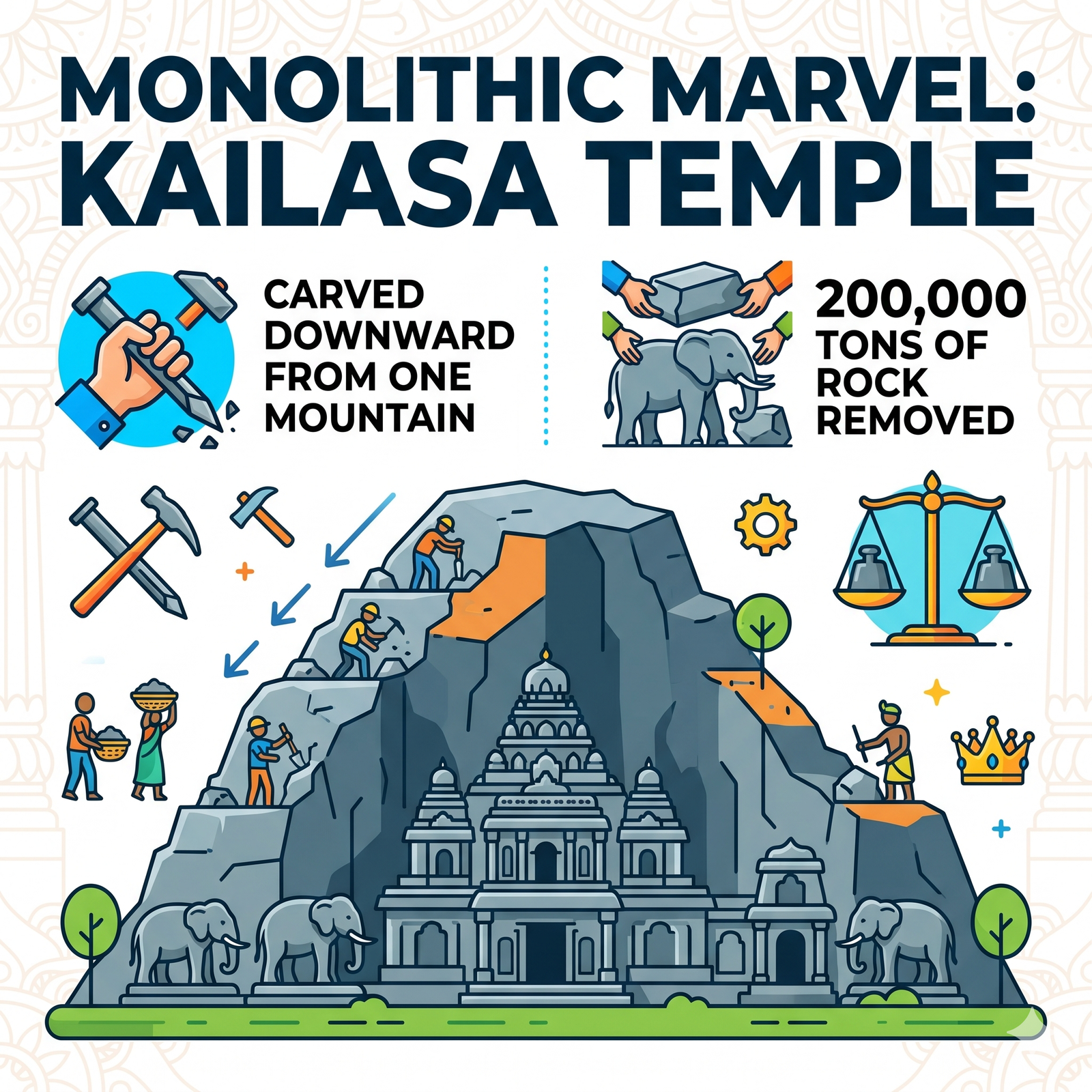
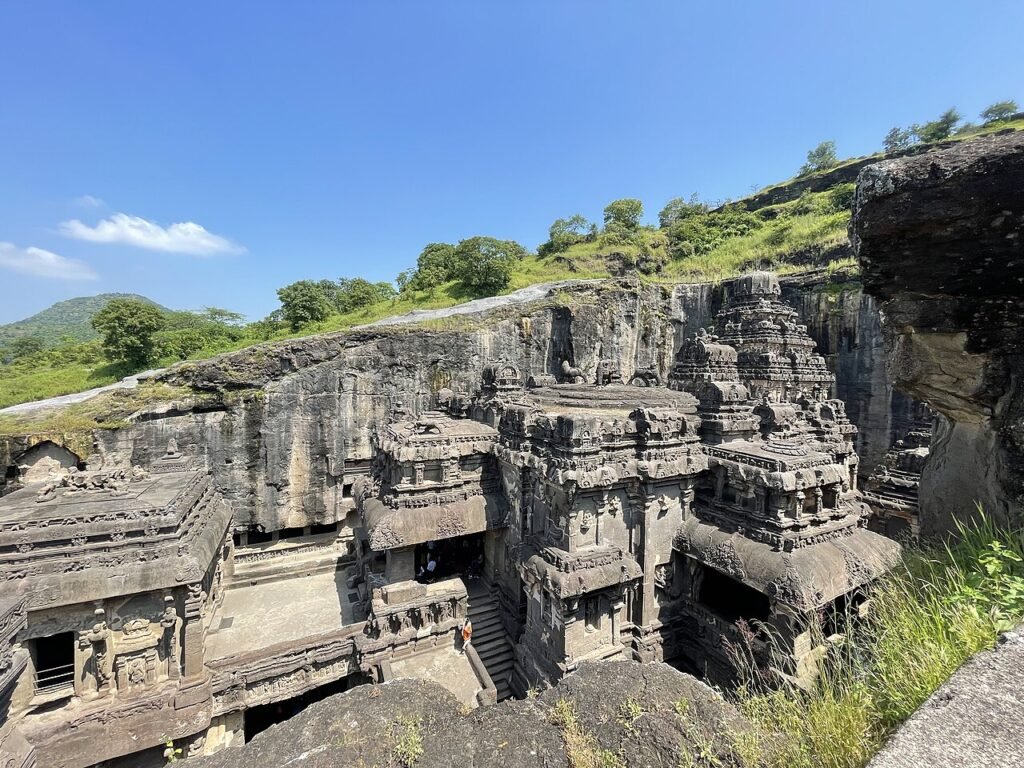
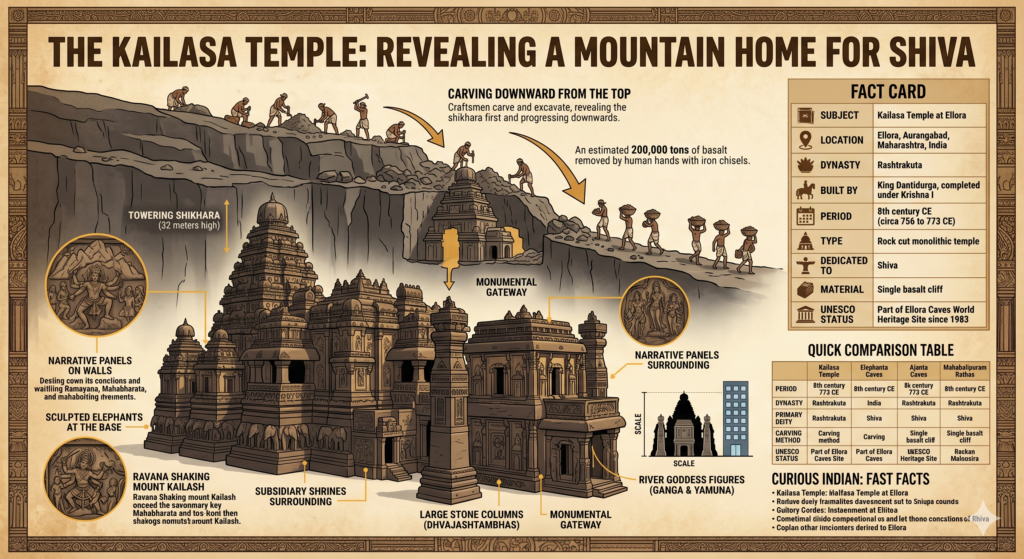
Cave 16 does something else. The carvers began on top of the hill and cut three great trenches straight down into it, on three sides of a block of rock. Then they kept going down. What was left standing in the middle, they shaped into a temple.
Nothing was added. Every pillar, every staircase, every elephant and every god is rock that was left behind when everything around it was taken away. The courtyard they cleared is about 82 metres by 46. The top of the shrine stands 32.6 metres above its floor.
Working from the top also meant the finished parts were carved first. The shikhara really would have appeared early, long before the halls at its feet were done.
It also meant there was no fixing a mistake. A chisel that went too deep could not be undone.
Every pillar, every staircase, every elephant and every god is rock that was left behind.
What the plates say
The temple itself carries no inscription saying who made it. The best clue sits far away, on copper.
Around 812 CE, a Rashtrakuta prince in Gujarat, Karkaraja II, issued a land grant on copper plates, which were found near Vadodara. In the course of praising his family, the grant mentions a king called Krishnaraja and a temple he made at Elapura. It says the temple was so wonderful that the gods were astonished. So was the architect who made it.
Most historians take this to mean the Kailasa temple, and the king to be the Rashtrakuta ruler Krishna I, who reigned from about 756 to 773. Parts of the temple were probably added later, including its most famous panel, which shows the demon king Ravana trying to shake Mount Kailasa off its foundations. The temple may have taken its name from that panel.
It was a huge job, though perhaps less impossible than it looks. The archaeologist M. K. Dhavalikar worked out that if each worker cut about four cubic feet of rock a day, 250 of them could have finished the temple in about five and a half years. Cutting it from the hill was also easier than quarrying that much stone somewhere else and hauling it in. He thought the carvers may have been brought from the south after Krishna’s wars, since the shrine looks very like the Virupaksha temple at Pattadakal.
The Baffling Mystery Of The MV Jian Seng Ghost Ship
Kokasa
The queen’s story was first written down in Marathi, in a book called the Katha-kalpataru, by Krishna Yajnavalki. He lived around 1470 to 1535, some seven hundred years after the temple was cut. Nobody knows how long people had been telling the story before him.
Kokasa, though, may be more than a character in it. Inscriptions from central India in the eleventh to thirteenth centuries speak of architects proud to be born into the family of Kokasa. Dhavalikar thought a master builder of that name may really have designed Kailasa.
In the story, the temple was named Manikeshwar after the queen, and the town that grew up around it was named Elapura after the king. Today the town is Ellora.
The plates of 812 say only that the gods and the architect were astonished. The queen’s story adds the one thing a copper plate would never record: that someone was waiting, hungry, for the first sight of the shikhara.
Where Is The Lost Wealth Of Mir Osman Ali Khan
Finding Answers To The Disappearance Of The Sarasvati River
If you think you have remembered everything about this topic take this QUIZ
Results


#1. The Kailasa temple at Ellora was built by which dynasty in the 8th century CE?
#2. Which king began the Kailasa project, and who oversaw its completion?
#3. What unique construction method did the craftsmen use to build the Kailasa temple?
#4. Approximately how many tons of rock did craftsmen remove to reveal the temple complex?
#5. Which institution studied the structural logic of the excavation and found evidence of sophisticated planning like survey marks and pilot trenches?
#6. What does the most celebrated narrative sculptural panel at the Kailasa temple depict?
#7. . In which year was the Ellora caves complex, including the Kailasa temple, designated as a UNESCO World Heritage Site?
#8. According to the Quick Comparison Table, which dynasty is associated with the Mahabalipuram Rathas?
Why is the Kailasa temple considered the largest rock cut structure in the world?
The Kailasa temple surpasses all other rock cut structures in the combination of volume excavated, structural complexity and sculptural coverage. Approximately 200,000 tons of basalt were removed from a single cliff to create the complex, which includes a main temple rising 32 meters above the courtyard floor, subsidiary shrines, gateways, columns and continuous sculptural programs covering every available surface.
How long did it take to build the Kailasa temple?
The construction is generally dated to between approximately 756 and 773 CE, suggesting a core period of around 17 years. However, some scholars believe the sculptural programs were extended and refined over a longer period following the completion of the main structural excavation. The project spanned at least the reigns of two Rashtrakuta kings, Dantidurga and Krishna I.
How did the craftsmen plan such a complex project without modern technology?
Evidence suggests that the craftsmen used detailed survey marks and pilot trenches cut into the cliff surface before the main excavation began, transferring an architectural plan onto the rock itself. The entire design had to be conceived completely in advance because the top-down carving method allowed no structural corrections once begun. The sophistication of the planning is one of the most remarkable aspects of the Kailasa project.
Is the Kailasa temple still used for religious worship?
The Kailasa temple at Ellora is maintained as an archaeological monument by the Archaeological Survey of India and receives enormous numbers of tourists and pilgrims. Some ritual activity continues at the site. The temple remains dedicated to Shiva and retains its sacred character for Hindu devotees who visit it.
What is the significance of the Ravana shaking Mount Kailash panel?
The panel depicts the demon king Ravana attempting to uproot Mount Kailash while Shiva sits above in complete composure and presses the mountain back into place with his toe. It is considered one of the finest narrative sculptural reliefs in Indian art. At the Kailasa temple specifically, the scene carries additional resonance because the temple itself is a carved mountain, making the story of a mountain’s stillness resisting force directly applicable to the monument that houses the carving.
Sources & References
M. K. Dhavalikar, “Kailasa — The Stylistic Development and Chronology,” Bulletin of the Deccan College Research Institute 41 (1982) — dating, the labour estimate, the Pattadakal link and the Kokasa hypothesis.
M. K. Dhavalikar, Ellora (Oxford University Press, 2003) — the temple’s plan and sculpture.
Lisa Owen, Carving Devotion in the Jain Caves at Ellora (Brill, 2012), pp. 135–136 — the Vadodara copper plates of Karkaraja II and the attribution to Krishnaraja.
H. Goetz, “The Kailāsa of Ellora and the Chronology of Rāshtrakūta Art,” Artibus Asiae 15 (1952) — later additions, including the Ravana panel.
Himanshu Prabha Ray and Carla M. Sinopoli, Archaeology as History in Early South Asia (ICHR, 2004), p. 109 — the legend in Krishna Yajnavalki’s Katha-kalpataru.
UNESCO, “Periodic Report on the State of Conservation of Ellora Caves” (2003) — courtyard dimensions and the layout of the complex.
Live History India, “Ellora’s Kailasa Temple: Built from the Top” (2020) — the queen’s vow and Kokasa of Paithan.
M. K. Dhavalikar’s scholarship on the Kailasa temple’s chronology and the medieval Katha-Kalpataru tradition — the story of the queen’s vow and Kokasa belongs to later legend and should not be read as a contemporary construction record.