Tuesday, April 7, 2026
Curious Indian
  • Arts & Culture
  • Festivals of India
  • Indian History
  • Indian Politics
  • Biography
    • Entertainment Personalities
    • Science Personalties
  • More
    • Unsolved India
No Result
View All Result
  • Arts & Culture
  • Festivals of India
  • Indian History
  • Indian Politics
  • Biography
    • Entertainment Personalities
    • Science Personalties
  • More
    • Unsolved India
No Result
View All Result
Curious Indian
No Result
View All Result
Home Indian History

The Great Forest Uprising 1917: When the Kuki Tribes Said No to the British Empire

paripurnadatta by paripurnadatta
in Indian History
Reading Time: 24 mins read
0 0
A A
Anglo-Kuki War
Share on FacebookShare on Twitter

Table of Contents

Toggle
  • The Anglo-Kuki War 1917 to 1919 CE: The Great Forest Uprising
    • Who Are the Kuki People?
    • RelatedPosts
    • Anglo-Manipuri War 1891: When Manipur Chose to Fight to the Last Man
    • Pa Togan Nengminza: The Garo Resistance Against British Annexation
    • The Jaintia Rebellion: The Farmer Who Defied the British Empire
    • The Kuki Hills Before the War
    • World War One and the Labour Corps Demand
    • The Decision to Fight
    • The Guerrilla War in the Forest
    •  
    • The British Response: Columns and Scorched Earth
  • Numit Upa: The Kuki Name for Their Own History
    • The End of the Uprising and Its Aftermath
    • The Kuki Uprising and World War One: The Global Connection
    • The Legacy of the Anglo-Kuki War in Modern India
  • Quick Comparison Table: Anglo-Kuki War vs. Other Northeast India Colonial Resistance Movements
  • Curious Indian: Fast Facts
  • Conclusion
  • If you think you have remembered everything about this topic take this QUIZ
  • Results
    • #1. What was the immediate trigger for the 1917–1919 uprising of the Kuki tribes?
    • #2. What did the Kuki people call the uprising in their own language?
    • #3. Based on the text, who was the most important figure in Kuki social life, responsible for the wellbeing of the village?
    • #4. Which of the following leaders were among the prominent chiefs who led the Kuki resistance?
    • #5. What primary military tactic did the Kuki warriors use against the British forces?
    • #6. How did the British military respond to the uprising to make the cost of resistance too high for the Kuki communities?
    • #7. What was the outcome for many of the captured Kuki leaders after the uprising was suppressed in 1919?
    • #8. On what date is Kuki National Day observed to commemorate the history of the uprising?
    • How is the Anglo-Kuki War remembered today?
    • How did the Kuki tribes fight the British?
    • Who were the main leaders of the Anglo-Kuki War?
    • Why did the Kuki tribes resist British labour recruitment?
    • What was the Anglo-Kuki War and when did it happen?
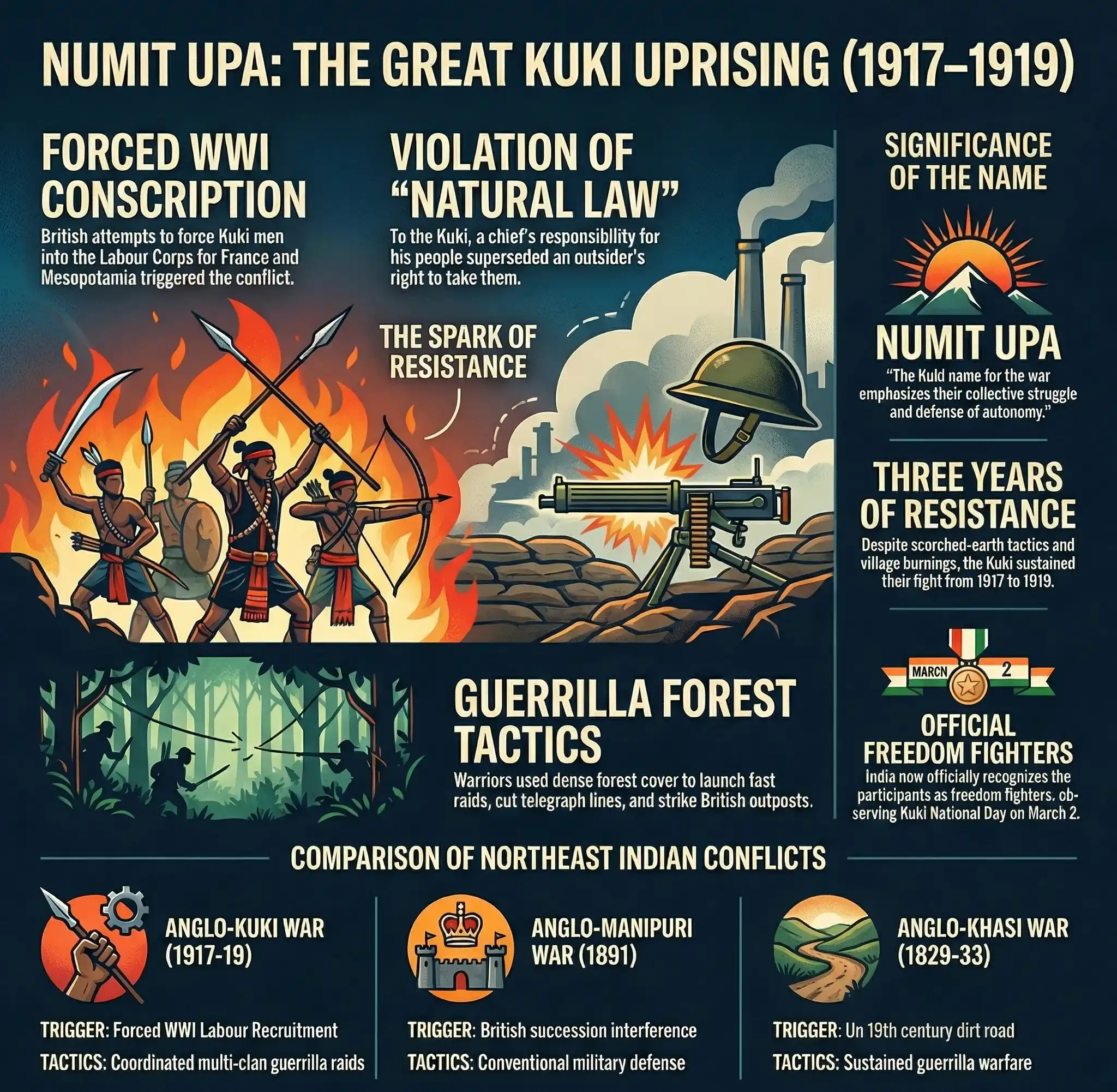
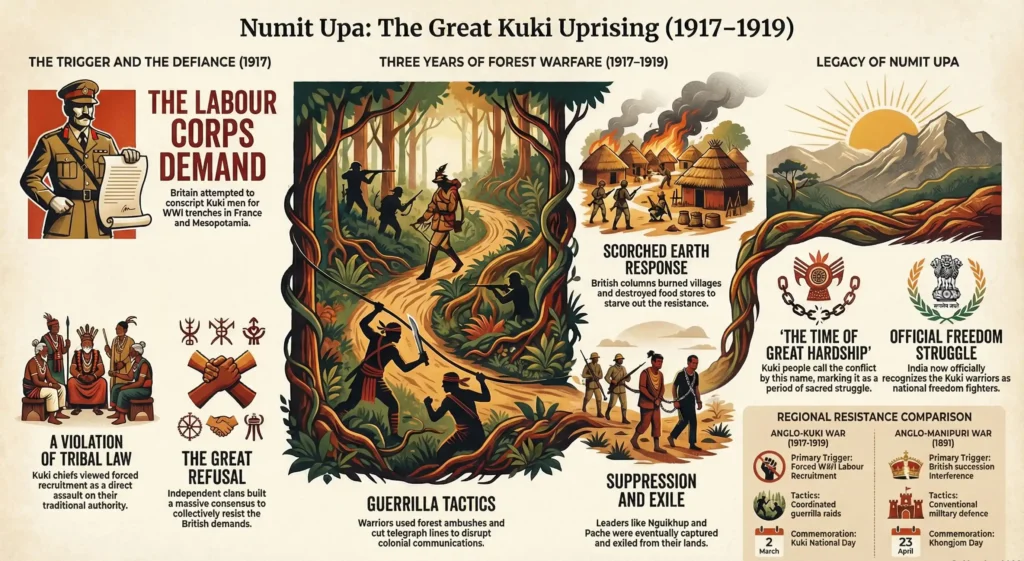
Between 1917 and 1919 CE, the Kuki tribes of Manipur, the Lushai Hills, and the surrounding forested regions of Northeast India launched a coordinated armed uprising against the British administration. The immediate trigger was the British attempt to conscript Kuki men as labourers to serve in the Labour Corps on the battlefields of World War One in France and Mesopotamia. For the Kuki people, this was not simply an inconvenient demand. It was a fundamental violation of the terms under which they had accepted a degree of British administrative presence in their hills and of the natural law of their own world, which said that a chief's people were his responsibility and no outsider had the right to take them away. Under leaders including Ngulkhup, Pache, Khotinthang, and others, Kuki warriors from dozens of different clans coordinated their attacks across a vast stretch of territory, striking British outposts, cutting communication lines, and disappearing back into the forest with a skill and speed that left colonial administrators deeply shaken. The British called it a rebellion. The Kuki people called it Numit Upa, meaning the time of great hardship or the great uprising. Historians today recognise it as one of the largest and most geographically widespread armed resistances to British rule in the entire northeastern region of India.
DetailInformation
WarAnglo-Kuki War, also called the Kuki Uprising or Numit Upa
Period1917 CE to 1919 CE
LocationManipur, Lushai Hills, Chin Hills, Northeast India
Primary CauseForced British labour recruitment for World War One
Kuki LeadersNgulkhup, Pache, Khotinthang, Lunkim, and others
British AdministrationPolitical Agent of Manipur, Bengal and Assam administrations
Kuki WeaponsDao, spears, bows, traditional shields
TacticsCoordinated guerrilla raids, forest ambushes, communication disruption
OutcomeBritish military suppression, leaders captured and exiled
LegacyRecognised as freedom struggle, Kuki National Day observed on 2 March

The Anglo-Kuki War 1917 to 1919 CE: The Great Forest Uprising

Anglo-Kuki War

Who Are the Kuki People?

Before the story of the war can be told, the people who fought it must be understood. The Kuki are a broad family of related tribal communities who live across the forested hills of Manipur, the Lushai Hills of what is now Mizoram, the Chin Hills of Myanmar, and parts of Nagaland and Assam. They speak languages belonging to the Tibeto-Burman family and are closely related to the Mizo and Chin peoples of the surrounding regions.

The Kuki are not a single unified tribe with one chief and one government. They are a collection of many clans and sub-groups, each with its own chief, its own village, and its own identity. What they share is a common cultural framework, a common set of values about how communities should be governed, and a common language of kinship that made communication and cooperation between different Kuki clans possible even across great distances of forested hill country.

RelatedPosts

Anglo-Manipuri War 1891: When Manipur Chose to Fight to the Last Man

Pa Togan Nengminza: The Garo Resistance Against British Annexation

The Jaintia Rebellion: The Farmer Who Defied the British Empire

The most important figure in Kuki social life is the chief, called the Haosa or Lal depending on the specific community. The chief’s authority over his village and his people is not just political. It is spiritual, social, and deeply personal. A Kuki chief is responsible for the wellbeing of every person in his village. He feeds his people in times of hardship, leads them in times of war, and speaks for them in all dealings with the outside world. In return, his people owe him loyalty, labour, and military service. This is a relationship built on mutual obligation, not on force.

This understanding of the chief’s authority and the community’s place within it is the key to understanding why the British demand for labour recruitment in 1917 CE provoked the response it did. It was not just a demand for workers. It was a direct assault on the most fundamental organising principle of Kuki society.

The Kuki Hills Before the War

The relationship between the Kuki people and the British administration had been building tension for decades before 1917 CE. The British had been pushing into the hills of Manipur and the surrounding regions throughout the second half of the 19th century. The Anglo-Manipuri War of 1891 CE had established British paramountcy over the Imphal Valley, but the surrounding hill communities, including the Kuki villages that lived in the forested ranges above the valley, were brought under colonial administration through a more gradual and piecemeal process.

By the early 20th century, the British had established a system of indirect administration over much of the Kuki hill country. They worked through the existing chief system to a degree, requiring Kuki chiefs to maintain order in their villages, to allow British officials to pass through their territory, and to provide labour for specific purposes such as road building and porterage. In return, the chiefs received a degree of recognition and some chiefs received small payments.

This arrangement was uncomfortable but tolerable for many Kuki communities as long as the demands it placed on them remained within limits that the chiefs could manage. The chiefs retained enough authority and the villages retained enough of their own way of life that outright resistance was not the immediate response to British administrative presence.

READ MORE:  Reign of Muhammad bin Tughluq: When Brilliance Met Disaster

But the limits of what was tolerable had a boundary. When the British crossed that boundary in 1917 CE, they discovered where it was.

World War One and the Labour Corps Demand

In 1914 CE, the British Empire entered the First World War. By 1917 CE, the war had consumed an enormous number of men and the British administration in India was under pressure from London to find additional manpower for the war effort. The fighting forces were one part of this demand. But the industrial-scale warfare of World War One also required huge numbers of non-combatant labourers: men to dig trenches, carry supplies, move ammunition, tend the wounded, and perform the thousand physical tasks that kept a modern army in the field.

The British organised these men into units called Labour Corps and they looked to India, including its most remote hill communities, to supply them. The Kuki hills of Manipur and the surrounding regions were identified as a source of potential recruits. The Political Agent of Manipur and the relevant British district officials were instructed to organise the recruitment of Kuki men for service in the Labour Corps, to be deployed to the battlefields of France and Mesopotamia.

The Integration of Princely States: The Making of a United India
For the British administrators who issued these instructions, this probably seemed like a straightforward extension of the existing system by which Kuki villages already provided labour for local colonial purposes. They did not understand, or chose not to understand, how completely different this demand was from anything that had come before.

Sending a young man to dig roads in Manipur was one thing. Sending him across the ocean to dig trenches in France while shells exploded around him was something of an entirely different nature. The Kuki chiefs understood this immediately. Their young men would be taken out of the hills, away from their villages and their families, to serve in a distant war for a foreign empire in conditions that no one could predict or control. There was no guarantee they would come back. There was very limited information about where they were going or what they would face. And there had been no consultation, no negotiation, no request. There had been a demand.

The chiefs said no.

The British, accustomed by this point to getting what they wanted in the hills through a combination of administrative pressure and the implicit threat of military force, pushed harder. The response was the Great Forest Uprising.

The Decision to Fight

The decision to resist the labour recruitment was not taken by a single leader acting alone. This is one of the most important and often overlooked aspects of the Anglo-Kuki War. The uprising was coordinated across dozens of different Kuki clans and villages spread across a very large geographic area. Getting that many independent chiefs with their own villages and their own calculations to agree on a common course of action was not a simple matter. It required communication, trust, and a shared understanding of what was at stake that ran deeper than any individual chief’s personal situation.

The Kuki chiefs met and discussed. They sent messengers through the forest paths between villages. They built a consensus that what the British were demanding crossed a line that no chief could accept and remain a chief in the sense that their culture understood that word. A chief who allowed his young men to be taken to a foreign war without his consent was not a chief. He was a colonial officer with a title.

The uprising that began in 1917 CE was therefore not a spontaneous outbreak of anger. It was a considered, organised, and collectively decided act of resistance. The chiefs who led it had thought about what they were doing and what it would cost. They chose to do it anyway.

Among the most prominent leaders of the uprising were Ngulkhup, Pache, Khotinthang, and Lunkim. These were not obscure figures. They were senior chiefs with real authority over their communities, men whose decision to resist carried the weight of their clans behind them. Their names are the ones that history has recorded but behind each name stood an entire village community that had also made the choice to resist.

The Guerrilla War in the Forest

The tactics that the Kuki warriors used in the Anglo-Kuki War were the same tactics that hill communities across Northeast India had been using against outside invaders and colonial armies for centuries: use the forest, strike fast, disappear faster.

The Kuki hills are not easy ground for a conventional army. The forests are dense. The paths are narrow and winding. The hills rise and fall sharply and the valleys between them can be deep enough to completely hide movement even from observers on nearby ridges. Rain, which falls heavily across this region for much of the year, reduces visibility and turns paths into mud. For Kuki warriors who had grown up in this landscape and knew every track and stream crossing from childhood, it was a familiar and comfortable world. For British soldiers marching in from the plains, it was exhausting, disorienting, and full of places where an ambush could come from any direction without warning.

The Kuki attacks followed a consistent pattern. Small groups of warriors would strike a British outpost, a supply line, or a communication installation and then vanish back into the forest before British forces could organise an effective response. They targeted the things that British administration depended on: the roads that connected outposts, the telegraph lines that allowed communication between British stations, and the small isolated outposts where British officials lived and worked with only limited protection.


1 of 3
– +
Anglo-Kuki War
Anglo-Kuki War
Anglo-Kuki War

The coordination of these attacks across such a large area was itself remarkable. Villages that were many days walk apart were striking their targets at roughly the same time, preventing the British from concentrating their forces in any one area. When the British moved troops to deal with an outbreak in one part of the hills, the Kuki fighters in another area would intensify their activity. It was a form of distributed guerrilla warfare that the British found deeply difficult to counter with the conventional military methods they preferred.

British outposts were attacked and destroyed. Several British officials and soldiers were killed. Supply lines were cut repeatedly. The colonial administration in Manipur and the surrounding districts found itself managing a genuine military crisis across a front that was far too large and far too complex for its existing resources to handle comfortably.

The British Response: Columns and Scorched Earth

The British response to the Kuki uprising followed a pattern that colonial armies had used against hill resistances across Northeast India and indeed across the empire. They organised military columns to move through the hills and attack the villages of chiefs who were leading or supporting the resistance.

These column operations were not simply about capturing individual leaders. They were about making the cost of resistance too high for the community to bear. British forces burned villages, destroyed food stores, confiscated livestock, and fined communities that were found to be connected to the uprising. The aim was to deprive the fighters of their base of support, their food supply, and the shelter of communities that would otherwise hide and feed them.

READ MORE:  Pa Togan Nengminza: The Garo Resistance Against British Annexation

This was brutal and effective in a narrow sense. Villages that were burned could not provide food and shelter to fighters. Communities that were fined and impoverished had less capacity to sustain a long resistance. But it also deepened the hatred and resentment that had driven the uprising in the first place and it created a pattern of destruction and suffering in the Kuki hills that communities remembered for generations.

The British also deployed forces from multiple directions simultaneously, using the same multi-column approach that had worked against Manipur in 1891 CE. Columns moved into the Kuki hills from Manipur, from the Lushai Hills, and from the Chin Hills side, attempting to squeeze the resistance from multiple directions at once and prevent Kuki fighters from simply moving away from the pressure and reforming elsewhere.

Even with these methods, the British found the Kuki uprising extraordinarily difficult to fully suppress. The terrain favoured the defenders. The community support for the resistance was deep and widespread. And the Kuki fighters had the enormous tactical advantage of being willing to simply wait in the forest until an opportunity presented itself, something that a conventional military force with supply lines and schedules and reporting obligations could not match.

The uprising lasted three years, from 1917 to 1919 CE. Three years of forest warfare in some of the most difficult terrain in Northeast India. Three years of British columns moving through the hills trying to find and fix an enemy that refused to stand still. Three years of Kuki villages burning and Kuki fighters regrouping and striking again. The sheer duration of the resistance is a testament to the determination and resilience of the Kuki people.

The Burmese Invasions and the Treaty That Ended the Ahom Kingdom

Numit Upa: The Kuki Name for Their Own History

The Kuki people did not call what happened between 1917 and 1919 CE a rebellion. They called it Numit Upa. Different translations of this phrase exist across the various Kuki language communities but the essential meaning is something like the great hardship, the difficult time, or the time of great struggle. The choice of this name is significant. It acknowledges the suffering that the uprising brought without in any way suggesting that the choice to resist was wrong.

This distinction between the British and Kuki understandings of the same events matters enormously. In British official records, the Kuki uprising was a criminal rebellion, a lawless attack on legitimate authority that needed to be suppressed. In Kuki memory, it was Numit Upa, a time of great collective effort and suffering in defence of something that every Kuki chief and community understood was worth defending. These are not just different words for the same thing. They are two completely different frameworks for understanding what happened and why.

The Kuki name for their own history survived the British suppression of the uprising and it survives to this day. When Kuki communities in Manipur, Mizoram, and the surrounding regions commemorate the events of 1917 to 1919 CE, they are commemorating Numit Upa, their own story told in their own language.

The End of the Uprising and Its Aftermath

By 1919 CE, the combination of British military pressure, the burning of villages, the destruction of food supplies, and the exhaustion of three years of continuous resistance had broken the organised military campaign that the Kuki chiefs had sustained. One by one, the leaders of the uprising were captured or surrendered. Ngulkhup, Pache, Khotinthang, and other prominent chiefs were arrested and tried by the British administration.

The sentences handed down were severe. Most of the captured leaders were exiled from their home territories and confined to distant locations where they could not maintain their influence over their communities. Some were imprisoned. The exile of the chiefs was not simply a punishment. It was designed to remove from the Kuki communities the very figures whose authority had made the coordinated resistance possible in the first place.

The aftermath of the uprising also saw the British administration impose a new and stricter framework of control over the Kuki hill communities. The degree of autonomy that Kuki chiefs had previously enjoyed in managing their own villages was reduced. The administrative presence of the British in the hills was strengthened. And the movement of people and information between villages was monitored more closely to prevent any future coordination of the kind that had made the 1917 uprising possible.

For the Kuki communities, the years after the uprising were years of rebuilding. Burned villages had to be reconstructed. Communities that had been disrupted and displaced had to find their way back to some form of normal life. The young men whose refusal to be sent to France had triggered the whole conflict stayed in their hills. They had not been sent to die in a foreign war. That much the uprising had achieved.

U Tirot Sing: The Khasi Chief Who Fought an Empire for Four Years

The Kuki Uprising and World War One: The Global Connection

One of the things that makes the Anglo-Kuki War particularly interesting to think about is its connection to World War One. The uprising in the forested hills of Manipur and the titanic industrial slaughter on the Western Front in Europe were, on the surface, about as different as two things can be. And yet they were directly connected.

The suffering in the trenches of France and Flanders had a direct line to the forests of Northeast India. The British need for more men, more labour, more bodies to feed into the machinery of a war that was consuming humans at an industrial rate reached all the way to the Kuki hills and said: your sons are needed. And the Kuki chiefs, who knew nothing of Flanders and the Somme but understood perfectly well what it meant to have your people taken away, said no.

In this sense, the Kuki uprising is a reminder that the effects of World War One were not contained within the European theatre. They rippled outward to every corner of the British Empire and wherever those ripples became demands, some communities pushed back. The Kuki push back was among the most organised and sustained of any such response in Asia.

It is also a reminder of something that colonial empires prefer not to acknowledge: that the people who were ruled without their consent did not consent. The Kuki chiefs had not agreed to send their people to France. They had not been asked. And when the demand came anyway, they demonstrated, at great cost to themselves, that their lack of consent was real and meant something.

READ MORE:  The Jaintia Rebellion: The Farmer Who Defied the British Empire

Pa Togan Nengminza: The Garo Resistance Against British Annexation

The Legacy of the Anglo-Kuki War in Modern India

The Anglo-Kuki War took a very long time to receive the official recognition it deserved. For much of the post-independence period in India, the uprising was not widely taught or celebrated in the national historical mainstream. It was known in Kuki communities and among scholars of Northeast Indian history, but it did not have the same profile as the resistance movements of the independence era that were based in the more visible parts of the subcontinent.

In recent decades, this has been changing. The Government of India has moved to recognise the participants in the Anglo-Kuki War as freedom fighters, acknowledging the uprising as part of the broader Indian resistance to colonial rule rather than as the criminal rebellion that the British administration had labelled it.

The Kuki community observes 2 March as Kuki National Day, a date connected to the history of the uprising and the collective Kuki identity that it forged and expressed. This day is marked across Kuki communities in Manipur, Mizoram, and other states where significant Kuki populations live. It is a day of remembrance for Numit Upa, for the chiefs who led it, for the villages that burned, and for the principle that the Achik people’s connection to their hills was not something any empire could simply requisition.

The story of the Anglo-Kuki War also has a particular resonance in the context of modern discussions about the rights of indigenous peoples, the responsibilities of states toward the communities they govern, and the difference between consent and coercion. The Kuki chiefs of 1917 CE articulated, through their actions rather than their words, a principle that is now part of international human rights law: that communities have the right not to have their members conscripted for the purposes of a distant state without their agreement.

They articulated it with spears and dao blades in the forests of Manipur. But they articulated it clearly enough that it has never been forgotten.

Quick Comparison Table: Anglo-Kuki War vs. Other Northeast India Colonial Resistance Movements

FeatureAnglo-Kuki War 1917 to 1919Anglo-Manipuri War 1891Anglo-Khasi War 1829 to 1833
PeopleKuki tribesMeitei, ManipurKhasi
LocationManipur, Lushai and Chin HillsImphal Valley, ManipurKhasi Hills, Meghalaya
DurationThree yearsWeeksFour years
TriggerForced labour recruitment for World War OneBritish succession interferenceBritish road construction
Primary TacticCoordinated multi-clan guerrilla raidsConventional defenceSustained guerrilla warfare
LeadershipMultiple chiefs across many clansMajor Paona Brajabasi, Tikendrajit SinghU Tirot Sing Syiem
OutcomeBritish suppression, chiefs exiledBritish victory, executionsBritish victory, U Tirot Sing exiled
RecognitionKuki National Day, 2 MarchKhongjom Day, 23 AprilU Tirot Sing Day, Meghalaya

Curious Indian: Fast Facts

The Anglo-Kuki War is one of the very few colonial resistance movements in Indian history that was directly connected to a global conflict. The British demand for Labour Corps recruits was driven entirely by the needs of World War One, making the Kuki uprising one of the most unexpected consequences of the fighting in France and Mesopotamia.

Kuki National Day is observed on 2 March every year across Kuki communities in Manipur, Mizoram, and other northeastern states of India. It commemorates Numit Upa and the collective identity that the uprising expressed and strengthened.

The uprising involved not just Manipur but communities across the Lushai Hills and Chin Hills, making it one of the most geographically widespread colonial resistance movements in the entire Northeast Indian region.

The coordination of attacks across dozens of independent Kuki clans and villages over a three-year period without a centralised command structure or modern communications technology stands as one of the most remarkable organisational achievements in the history of Northeast Indian resistance.

The Government of India has officially recognised participants in the Anglo-Kuki War as freedom fighters, formally placing Numit Upa within the national story of India’s resistance to colonial rule.

Baptist Christianity had already begun spreading among some Kuki communities by 1917 CE, meaning that some of the chiefs who led the uprising were Christian converts. This adds another layer of complexity to a resistance that is sometimes framed purely in terms of traditional Kuki culture.

The Labour Corps to which the British wanted to send Kuki men was deployed to some of the most dangerous and brutal theatres of World War One. Indian Labour Corps units served in France, Mesopotamia, East Africa, and other fronts, in conditions that killed large numbers of men through enemy action, disease, and exhaustion. The Kuki chiefs’ refusal to send their people into this was, in hindsight, as much an act of protection as an act of defiance.

Major Paona Brajabasi: Manipur’s Hero of the Last Stand at Khongjom

Conclusion

The Great Forest Uprising of 1917 to 1919 CE is the story of a people who understood, with complete clarity, what was being asked of them and what it would mean if they said yes. The British demand for Labour Corps recruits was, in the language of the empire, a reasonable wartime measure applied to a colonial population. In the language of the Kuki hills, it was an announcement that the lives of Kuki young men belonged to the British Empire rather than to their chiefs, their villages, and their families. The Kuki chiefs replied in the only language that made their disagreement impossible to ignore: the language of spears and dao blades in the forest at night. They could not win the war. They knew they could not win the war. What they could do was make the British understand that taking Kuki people without Kuki consent was going to cost something real every single time it was attempted. Three years of forest warfare was the price they were willing to pay to make that point. Numit Upa ended. But it was never forgotten. And in the forests of Manipur and Mizoram, it never will be.

If you think you have remembered everything about this topic take this QUIZ


Results

Share your score!
Tweet your score!
Tweet your score!
Share to other
QUIZ START

#1. What was the immediate trigger for the 1917–1919 uprising of the Kuki tribes?

Previous
Next

#2. What did the Kuki people call the uprising in their own language?

Previous
Next

#3. Based on the text, who was the most important figure in Kuki social life, responsible for the wellbeing of the village?

Previous
Next

#4. Which of the following leaders were among the prominent chiefs who led the Kuki resistance?

Previous
Next

#5. What primary military tactic did the Kuki warriors use against the British forces?

Previous
Next

#6. How did the British military respond to the uprising to make the cost of resistance too high for the Kuki communities?

Previous
Next

#7. What was the outcome for many of the captured Kuki leaders after the uprising was suppressed in 1919?

Previous
Next

#8. On what date is Kuki National Day observed to commemorate the history of the uprising?

Previous
Finish

How is the Anglo-Kuki War remembered today?

The Kuki community observes Kuki National Day on 2 March every year across Manipur, Mizoram, and other northeastern states. The Government of India has officially recognised participants in the Anglo-Kuki War as freedom fighters. The Kuki name for the uprising, Numit Upa, remains in active use across Kuki communities as the preferred way of describing this period of their history.

How did the Kuki tribes fight the British?

Kuki warriors used coordinated guerrilla tactics, striking British outposts, supply lines, and communication installations with small fast-moving groups and then retreating into the forest. Attacks were coordinated across a wide geographic area simultaneously, preventing the British from concentrating their forces effectively. The Kuki used traditional weapons including the dao, spears, and bows.

Who were the main leaders of the Anglo-Kuki War?

The uprising was led by multiple chiefs across dozens of clans rather than a single commander. Among the most prominent were Ngulkhup, Pache, Khotinthang, and Lunkim. The fact that so many independent clan leaders coordinated their resistance across a very large geographic area without a centralised command structure is one of the most remarkable features of the uprising.

Why did the Kuki tribes resist British labour recruitment?

The Kuki chiefs refused to allow their men to be taken to distant battlefields in France and Mesopotamia without their consent. In Kuki society, the chief is responsible for the wellbeing of every person in his village. Allowing the British to remove young men to a foreign war without negotiation or agreement was a fundamental violation of the authority and responsibility that defined what a Kuki chief was.

What was the Anglo-Kuki War and when did it happen?

The Anglo-Kuki War, also known as the Kuki Uprising or Numit Upa, was a coordinated three-year guerrilla war fought between 1917 and 1919 CE by Kuki tribes of Manipur, the Lushai Hills, and surrounding regions against the British Imperial administration. It was triggered by British attempts to forcibly recruit Kuki men as labourers for World War One.

Tags: Indian Freedom FightersKuki ManipurLushai HillsNortheast India historyNumit UpaWorld War One India
ShareTweetPin
paripurnadatta

paripurnadatta

Related Posts

Anglo-Manipuri War
Indian History

Anglo-Manipuri War 1891: When Manipur Chose to Fight to the Last Man

April 5, 2026
Pa Togan Nengminza
Indian History

Pa Togan Nengminza: The Garo Resistance Against British Annexation

April 5, 2026
The Jaintia Rebellion: The Farmer Who Defied the British Empire
Indian History

The Jaintia Rebellion: The Farmer Who Defied the British Empire

April 6, 2026
No Result
View All Result

Stay Updated

TAGS

Ahom Kingdom Akbar Ancient India Architectures of India Arthashastra Ashoka Ayurveda History Bollywood Icon Bollywood legend British East India Company Buddha Buddhism Chandragupta Maurya Chola dynasty Dadasaheb Phalke Award Dadasaheb Phalke Awardee Delhi Sultanate Events That Changed History Festivals film director Gupta Empire Harappa History of Science Indian cinema Indian Cinema History Indian Freedom Fighters Indian History Indian National Congress Indian Scientists Indira Gandhi Mahatma Gandhi Mathematics Mauryan Empire Mughal Empire Music Icon National Award Winner Northeast India history Oscar Winner Parallel cinema Partition of India Pataliputra Rigveda Swadeshi Movement Tamil cinema Unsolved India

Archives

  • April 2026
  • March 2026
  • February 2026
  • December 2025
  • November 2025
  • October 2025
  • September 2025
  • August 2025
  • April 2025
  • March 2025
  • July 2017
Facebook Twitter Youtube RSS
Curious Indian Logo

Explore the soul of Bharat with Curious Indian. A definitive guide to Indian history, arts, culture, biographies, and the events that defined our future.

Follow us on social media:

Recent News

  • The Great Forest Uprising 1917: When the Kuki Tribes Said No to the British Empire
  • Anglo-Manipuri War 1891: When Manipur Chose to Fight to the Last Man
  • Pa Togan Nengminza: The Garo Resistance Against British Annexation

Category

  • Arts & Culture
  • Battles of India
  • Biography
  • Entertainment Personalities
  • Festivals of India
  • Indian History
  • Indian Politics
  • More
  • Places
  • Science Personalties
  • Unsolved India

© 2025 Curious Indian- Everything about India

Welcome Back!

Login to your account below

Forgotten Password?

Retrieve your password

Please enter your username or email address to reset your password.

Log In

Add New Playlist

No Result
View All Result
  • Arts & Culture
  • Festivals of India
  • Indian History
  • Indian Politics
  • Biography
    • Entertainment Personalities
    • Science Personalties
  • More
    • Unsolved India

© 2025 Curious Indian- Everything about India

This website uses cookies. By continuing to use this website you are giving consent to cookies being used. Visit our Privacy and Cookie Policy.
Are you sure want to unlock this post?
Unlock left : 0
Are you sure want to cancel subscription?
×