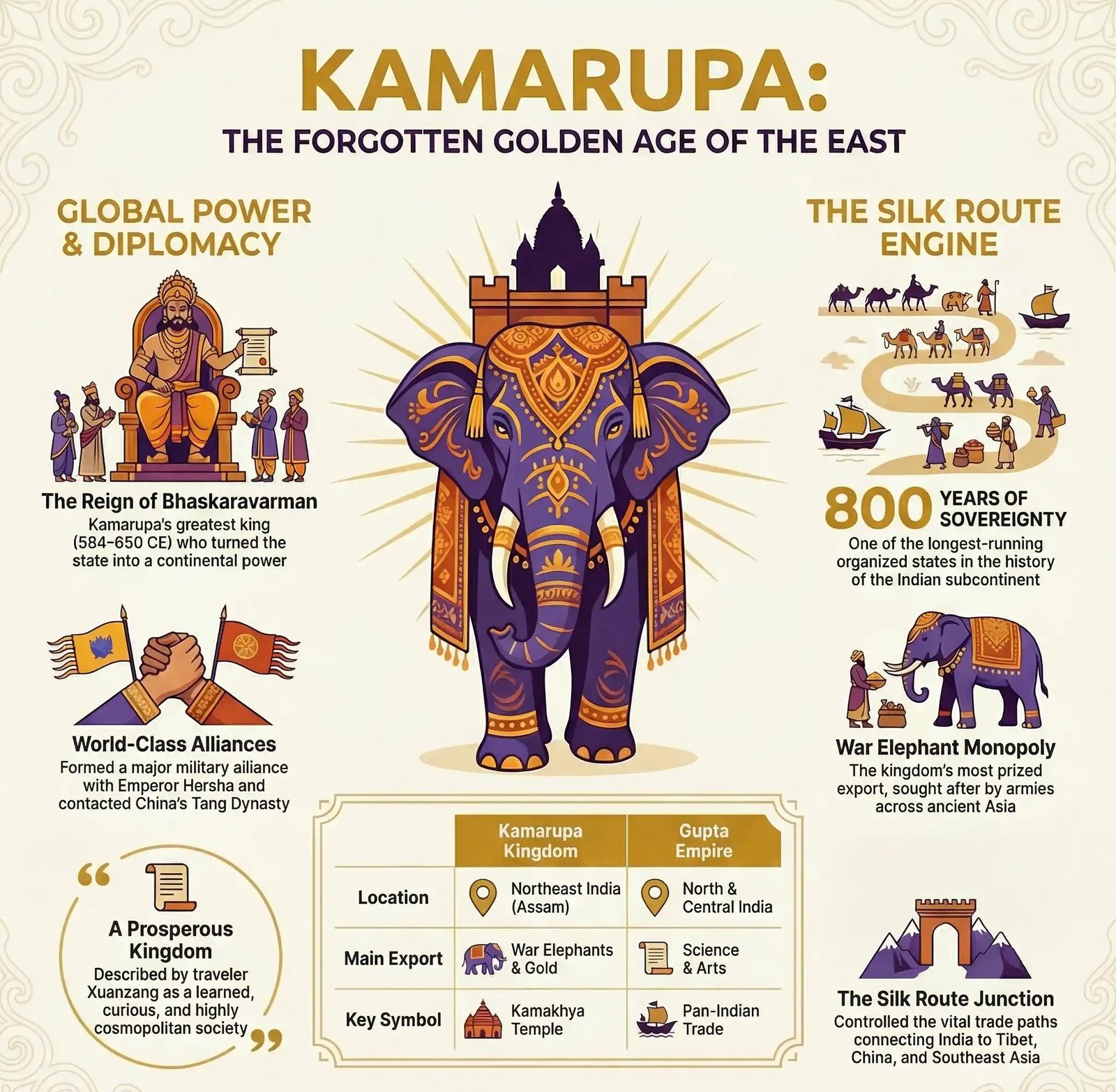
Between roughly 350 CE and 1140 CE, the Kamarupa Kingdom stood as the most powerful political force in all of Northeast India. It was the first organised state in the entire region and it lasted for nearly eight hundred years. The kings of Kamarupa built temples, supported scholars, traded with distant civilisations, and formed alliances with the most powerful empires of their time. The most celebrated of all Kamarupa kings was Bhaskaravarman, who befriended the great Emperor Harsha of North India and welcomed the famous Chinese traveller Xuanzang to his court. Kamarupa was not a quiet, forgotten corner of ancient India. It was plugged into the ancient Silk Route, it sent elephants and precious goods across Asia, and it left behind a legacy that shaped the culture of Assam to this day.
| Detail | Information |
|---|---|
| Kingdom Name | Kamarupa |
| Period | c. 350 CE to 1140 CE |
| Location | Present-day Assam, parts of Bengal, Bhutan, Bangladesh and Myanmar |
| First Dynasty | Varman Dynasty (founded by Pushyavarman) |
| Greatest King | Bhaskaravarman (c. 594 to 650 CE) |
| Capital Cities | Pragjyotishpura (early period) and Durjaya (later period) |
| Language | Sanskrit (court), Prakrit (common people) |
| Religion | Shaivism, Shaktism, with periods of Buddhist influence |
| Famous For | Ancient Silk Route trade, alliance with Emperor Harsha, Kamakhya Temple |
The Kamarupa Ascendancy: Assam’s Golden Age
The Land Before the Kingdom
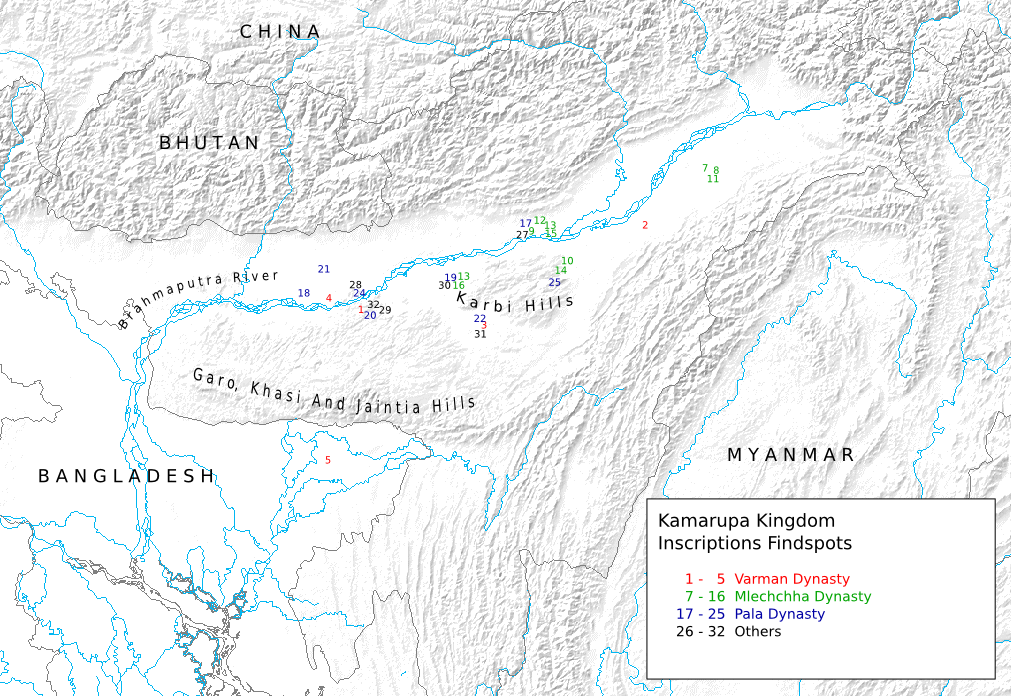
To understand Kamarupa, you first need to picture the land. Imagine a vast region of rivers, forests, and hills sitting at the far eastern edge of the Indian subcontinent. To the north are the Himalayas. To the east are the mountains of Myanmar. To the south are the forested hills of what is now Meghalaya and Bangladesh. And through the middle of it all runs the mighty Brahmaputra river, one of the largest rivers in the world.
This land had been home to people for thousands of years before Kamarupa was born. Ancient Indian texts call it Pragjyotisha, meaning “the land of the eastern light.” The Mahabharata and other early texts mention it as a real and important place, full of people with their own kings and their own gods. The great god Shiva is said to have connections to this land, and the goddess Kamakhya, whose temple still stands on a hill in Guwahati, was worshipped here long before any kingdom rose to organise the region.
Around 350 CE, something changed. A king named Pushyavarman brought together the many small chieftainships of this region and formed a single organised state. He called it Kamarupa. Scholars believe the name comes from “Kama,” the god of love in Hindu mythology, and “rupa,” meaning form or shape. According to one legend, the god Kama was reborn in this very land. Whatever the origin of the name, the kingdom it described would go on to shape the entire history of Northeast India.
Gupta Empire: When India Led the World in Science and Culture
The Varman Dynasty: Building the Foundation
Pushyavarman started a ruling family called the Varman dynasty. The Varman kings ruled Kamarupa for roughly three hundred years and laid the foundations for everything that followed.
These early kings were devoted followers of Shiva. They built temples, supported Brahmin priests, and used Sanskrit as the language of their court. They issued copper plate grants, which were official royal documents written on sheets of copper, recording gifts of land to temples and scholars. Many of these copper plates have survived to this day and they are among the most important historical records we have of early Northeast India.
The Varman kings also understood something very important. Kamarupa sat at a crossroads. To its west lay the great kingdoms of North India. To its east and north lay the mountain passes that connected India to Tibet, China, and Southeast Asia. Any king who controlled Kamarupa controlled the movement of goods, soldiers, and ideas across a vast and important part of the world. The Varman kings used this position wisely.
Bhaskaravarman: The Greatest King of Kamarupa
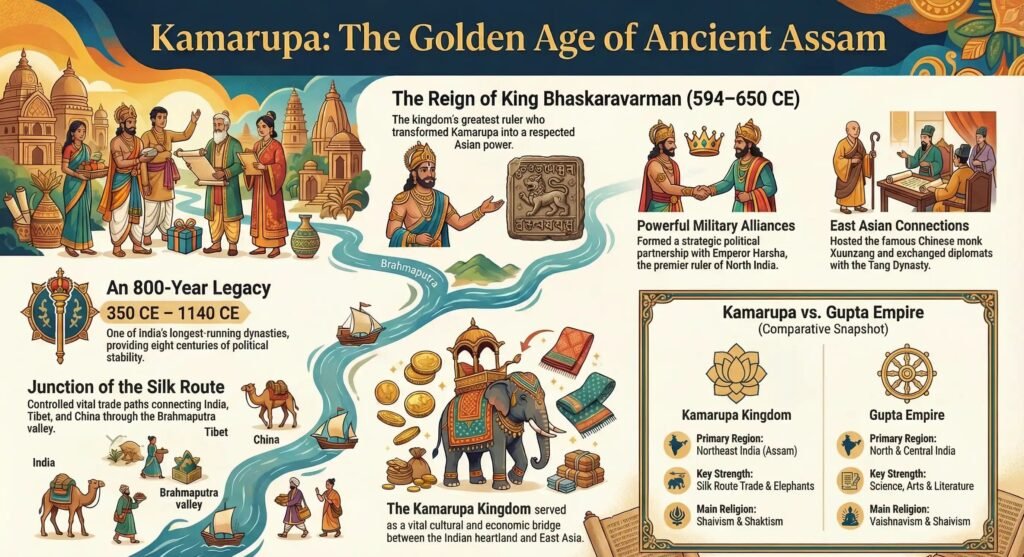
If there is one name you must remember from the history of Kamarupa, it is Bhaskaravarman. He ruled from approximately 594 CE to 650 CE and he took the kingdom to its greatest heights. By the time Bhaskaravarman sat on the throne, Kamarupa was already a well-established state. But it was Bhaskaravarman who turned it into a kingdom that the whole of India and much of Asia had to take seriously.
Bhaskaravarman was a skilled diplomat. He understood that a king who can make powerful friends is stronger than a king who only relies on his army. His most important friendship was with Emperor Harsha of Kanauj, the most powerful ruler in North India at the time. Harsha’s empire stretched across most of the Gangetic plain and he was respected from one end of India to the other.
The two kings formed a military and political alliance. Together they challenged a powerful and aggressive king named Shashanka of Gauda, who ruled Bengal and who was a threat to both of them. The alliance between Bhaskaravarman and Harsha is one of the earliest documented political partnerships in the history of Northeast India, and it shows that Kamarupa was not a passive bystander in Indian politics. It was an active player.
Bhaskaravarman also sent a diplomatic mission to the imperial court of the Tang dynasty in China. He exchanged letters and gifts with Emperor Taizong of Tang, one of the most powerful rulers in Chinese history. This was not a small gesture. It was a statement that Kamarupa was a kingdom that belonged on the world stage.
Vedic Period: From Nomadic Hymns to Iron Age Kingdoms
Xuanzang Visits Kamarupa
One of the most remarkable moments in the story of Kamarupa happened when a Chinese Buddhist monk named Xuanzang came to visit the court of Bhaskaravarman around 642 CE. Xuanzang was one of the greatest travellers of the ancient world. He had walked from China all the way to India to collect Buddhist scriptures, and on his long journey he visited courts, monasteries, and cities all across the subcontinent.
When Xuanzang reached the court of Bhaskaravarman, he was received with great warmth. Bhaskaravarman was himself a Hindu, a devotee of Shiva, but he respected Buddhism and welcomed the monk with full royal honours. Xuanzang spent time at the Kamarupa court and later wrote detailed descriptions of the kingdom in his famous travel diary.
His account tells us a great deal. He describes a large and prosperous kingdom with a population of well-built people. He notes that the king was learned, curious, and eager to debate religious ideas. He also records that Bhaskaravarman asked him many questions about China and about the wider world. This picture of a Hindu king engaging warmly with a Chinese Buddhist monk at his court speaks volumes about the open and cosmopolitan character of Kamarupa at its peak.
Xuanzang’s visit is also historically important because it confirms that Kamarupa was connected to the great intellectual and religious networks of 7th century Asia. Buddhist pilgrims, Hindu scholars, and merchants from many lands all passed through or made contact with this kingdom at the eastern edge of India.
Kamarupa and the Ancient Silk Route
Most people think of the Silk Route as a road connecting China to Rome through Central Asia. But the Silk Route was not one single road. It was a vast web of trade paths that spread across Asia in many directions, including a southern branch that passed through India, Bengal, and into the hills of the Northeast.
Kamarupa sat right at the junction of this southern branch of the Silk Route and the mountain routes leading up into Tibet and onward to China. This gave the kingdom extraordinary economic importance. Goods flowing between India and China had to pass through or around Kamarupa. Kings who controlled Kamarupa collected taxes on this trade and grew rich from it.
What did Kamarupa send along these trade routes? The most prized export was war elephants. Kamarupa was famous across ancient Asia for its elephants, which were larger, stronger, and better trained than those found elsewhere. Kings and armies across India and Southeast Asia paid enormous sums to get Kamarupa elephants. Along with elephants, Kamarupa exported fine silk, rhinoceros horn, incense, rare forest products, and gold. In return, the kingdom received horses from Central Asia, silk from China, spices from Southeast Asia, and luxury goods from the Mediterranean world.
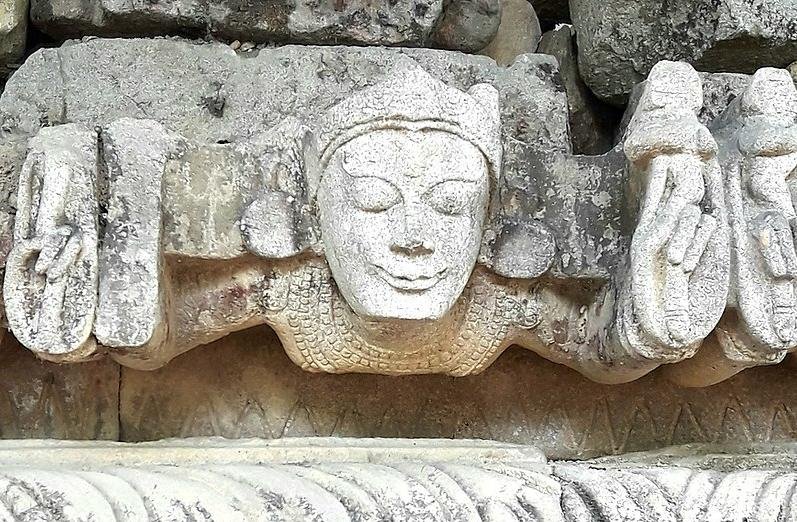
This trade gave Kamarupa something beyond wealth. It gave it connections. Ideas, religions, artistic styles, and technologies all travelled along with the merchants and their goods. The temples of Kamarupa show influences from both North Indian and Southeast Asian art. The copper plates of its kings contain Sanskrit verses that match the finest literary traditions of the Indian heartland. Kamarupa was not isolated. It was integrated.
Mature Harappan Phase: When India Built the World’s First Planned Cities
The Kamakhya Temple and the Shakti Tradition
No account of Kamarupa would be complete without talking about the Kamakhya Temple. This ancient temple dedicated to the goddess Kamakhya sits on Nilachal Hill in what is now Guwahati, the largest city of Assam. It is one of the most important and powerful temples in all of India.
The worship of Kamakhya goes back much further than the Kamarupa Kingdom itself. The goddess was worshipped by the tribal and indigenous communities of the region long before any organised state existed. When the Kamarupa kings came to power, they adopted Kamakhya as their royal goddess. By associating themselves with this ancient and beloved deity, the kings of Kamarupa won the loyalty of both the Brahmin scholars of the plains and the tribal communities of the hills.
This was a very clever move. Kamarupa was always a kingdom of many peoples. Its borders included not just the Brahminised communities of the Brahmaputra valley but also many hill tribes and forest communities with their own traditions. The Kamakhya cult provided a shared religious identity that held these different groups together under one royal umbrella.
The Shakti tradition of goddess worship that was cultivated in Kamarupa eventually spread far beyond Assam. The Tantric traditions associated with Kamakhya became influential across the whole of South and Southeast Asia, and Assam became one of the most important centres of Tantric scholarship and practice in the ancient world.
After the Varman Dynasty: Mlechchha and Pala Kings
After the Varman dynasty ended in the early 7th century, Kamarupa continued under new ruling families. The Mlechchha dynasty took power around 655 CE and ruled for several generations. They were followed by the Pala dynasty of Kamarupa, who are different from the more famous Pala dynasty of Bengal and Bihar.
The Kamarupa Pala kings continued to support Sanskrit learning and temple worship. They maintained the kingdom’s trade connections and its influence over the surrounding hill peoples. But by the 10th and 11th centuries, Kamarupa was facing new pressures from the south and west. The rise of powerful kingdoms in Bengal and the gradual fragmentation of political authority within the Brahmaputra valley began to weaken the old kingdom.
The end came around 1140 CE when the last ruler of the Kamarupa line was overthrown and the kingdom broke apart into smaller regional powers. The eight-hundred-year story of Kamarupa as a single unified state had come to an end. But the civilisation it had built did not disappear. It simply transformed into what we now recognise as the distinctive culture of Assam.
10 Lessons from the Battle of Walong 1962 Mystery
Quick Comparison Table: Kamarupa vs. Contemporary Indian Kingdoms
| Feature | Kamarupa | Gupta Empire | Harsha’s Empire |
|---|---|---|---|
| Period | c. 350 to 1140 CE | c. 320 to 550 CE | c. 606 to 647 CE |
| Location | Northeast India (Assam) | North and Central India | North India |
| Religion | Shaivism and Shaktism | Vaishnavism and Shaivism | Buddhism and Shaivism |
| Trade Strength | Silk Route (eastern branch) | Pan-Indian trade networks | Gangetic plain trade |
| Famous For | Elephants, Kamakhya Temple | Golden Age of science and arts | Religious tolerance |
| Script | Sanskrit copper plates | Sanskrit inscriptions | Sanskrit literature |
Curious Indian: Fast Facts
The Kamarupa Kingdom lasted for approximately 800 years, making it one of the longest-running royal dynasties in the history of India.
The kingdom’s name comes from “Kama,” the Hindu god of love, who according to legend was reborn in this land.
Bhaskaravarman sent a diplomatic mission to the Tang Emperor of China, making Kamarupa one of the very few Indian kingdoms to have direct contact with the Tang imperial court.
The Kamakhya Temple on Nilachal Hill in Guwahati was the royal goddess temple of the Kamarupa kings and remains one of the most visited pilgrimage sites in India today.
Kamarupa was one of the most important exporters of war elephants in the ancient world. Armies from across India and Southeast Asia prized Kamarupa elephants above all others.
The Chinese monk Xuanzang’s description of Bhaskaravarman’s court in the 7th century is one of our most important historical records of what life in Kamarupa actually looked like.
The copper plate land grants issued by Kamarupa kings are among the oldest surviving written records from Northeast India and are still studied by historians today.
Conclusion
The story of the Kamarupa Ascendancy is the story of how one kingdom, sitting quietly at the eastern edge of India, became a bridge between worlds. For eight hundred years, the kings of Kamarupa kept the lights of learning, trade, and culture burning in a region that the rest of India has often overlooked. They sent elephants to distant armies, welcomed monks from China, allied with emperors from Kanauj, and built temples that still stand today. Kamarupa did not just survive. It shaped the culture of an entire region and left footprints in the history of Asia that have never fully faded. The golden age of Assam is not a myth. It happened right here, in the land of the eastern light.
The Integration of Princely States: The Making of a United India
If you think you have remembered everything about this topic take this QUIZ
Results


#1. Which of the following is considered the first historical kingdom of Assam?
#2. Who is mentioned in the Allahabad Pillar inscription of Samudragupta as a frontier ruler of Kamarupa?
#3. The rulers of the Kamarupa kingdom traditionally traced their lineage back to which mythological figure?
#4. Which famous Chinese traveler visited Kamarupa during the reign of Bhaskaravarman in the 7th century?
#5. What were the three major dynasties that ruled the Kamarupa kingdom in succession?
#6. Which city served as the capital of the Kamarupa kingdom during the Varman dynasty?
#7. What term was used in the Kamarupa administration to refer to a collection of villages?
#8. Which of the following was a unique architectural feature of Kamarupa as noted by historical records?
What was the Kamarupa Kingdom?
Kamarupa was the first major organised kingdom of Northeast India, ruling over most of present-day Assam and surrounding areas from around 350 CE to 1140 CE. It was founded by King Pushyavarman of the Varman dynasty.
Who was the greatest king of Kamarupa?
King Bhaskaravarman, who ruled from approximately 594 CE to 650 CE, is considered the greatest king of Kamarupa. He formed an alliance with Emperor Harsha of North India, exchanged diplomatic letters with the Tang Emperor of China, and welcomed the Chinese traveller Xuanzang to his court.
How was Kamarupa connected to the Silk Route?
Kamarupa sat at the junction of the southern branch of the Silk Route and the mountain trade routes leading to Tibet and China. The kingdom exported war elephants, gold, silk, and forest products, and imported horses, Chinese silk, and goods from across Asia.
What is the connection between Kamarupa and the Kamakhya Temple?
The Kamakhya Temple on Nilachal Hill in Guwahati was the royal temple of the Kamarupa kings. They adopted the goddess Kamakhya, who was already worshipped by local communities, as their patron deity. This helped them unite the many different peoples of their kingdom under one shared religious identity.
Why did the Kamarupa Kingdom end?
By the 11th and 12th centuries, Kamarupa faced growing pressure from powerful kingdoms in Bengal and increasing political fragmentation within the Brahmaputra valley. Around 1140 CE, the last ruler of the Kamarupa line was overthrown and the kingdom broke into smaller regional powers.