Naseeruddin Shah published a memoir in which the least forgivable person is the author, and he did not soften any of it
In 2014, at sixty-four, he published a book covering his life up to the age of thirty-two.
And Then One Day is a good memoir for the ordinary reasons, being well written and often funny, and a strange one for a particular reason. Film autobiographies are usually managed documents. The failures are other people’s, the marriages end mutually, and the hard years are there to make the good ones taste better.
His is not arranged that way. The most poorly behaved person in it is the man writing it, and he does not offer himself any of the available excuses.
Their daughter Heeba was born a year later. In the memoir he describes being no use at all during the pregnancy, with what he calls “total oblivion to what was expected of me”, and he goes on to describe the years afterwards in which he was an absent and indifferent father. He does not spread the blame around.
Purveen Murad, also known as Manara Sikri, was the sister of the actress Surekha Sikri, and the marriage was a defiance of both families at the time. It did not survive the decade. There is a gentler version of this in circulation, in which he was a devoted father despite the heartbreak of a failed marriage. That version is not his. He wrote the other one down and put his name on it.
The second confession in the book is the one that costs him more, and almost nobody notices it.
He is known, and has been for decades, for his low opinion of popular Hindi cinema. It is his most quoted public position. In the memoir he writes that he was never suited to that kind of filmmaking, and that his contempt for it was functioning as a defence mechanism.
It is also, once you have read it, obviously true. The scorn was doing a job for him, and it had been doing that job in public for thirty years. That is a man taking apart the stance that makes him look most principled. People protect that stance. He filed a correction against it.
The work behind the honesty is not a small thing to be honest about.
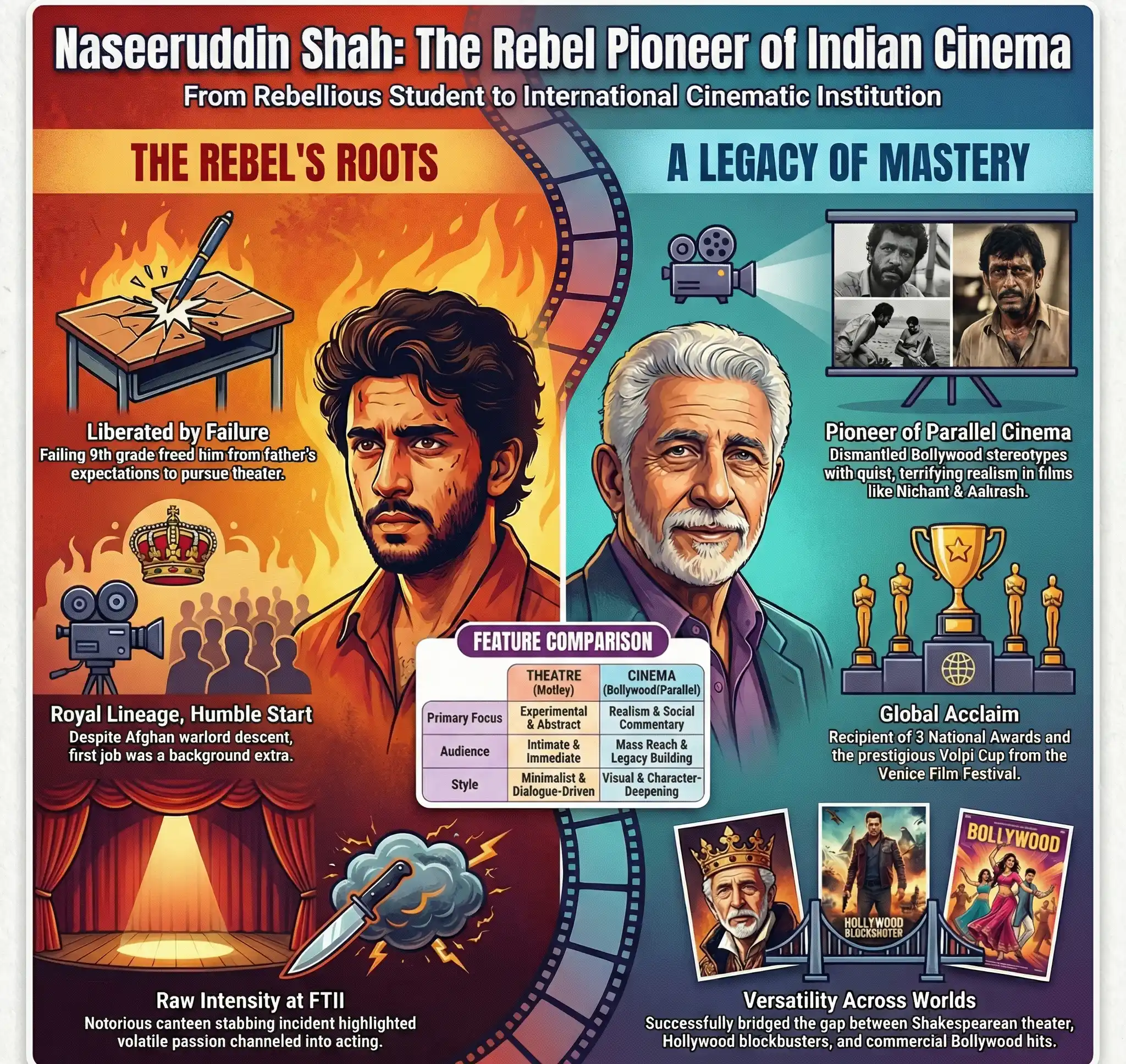
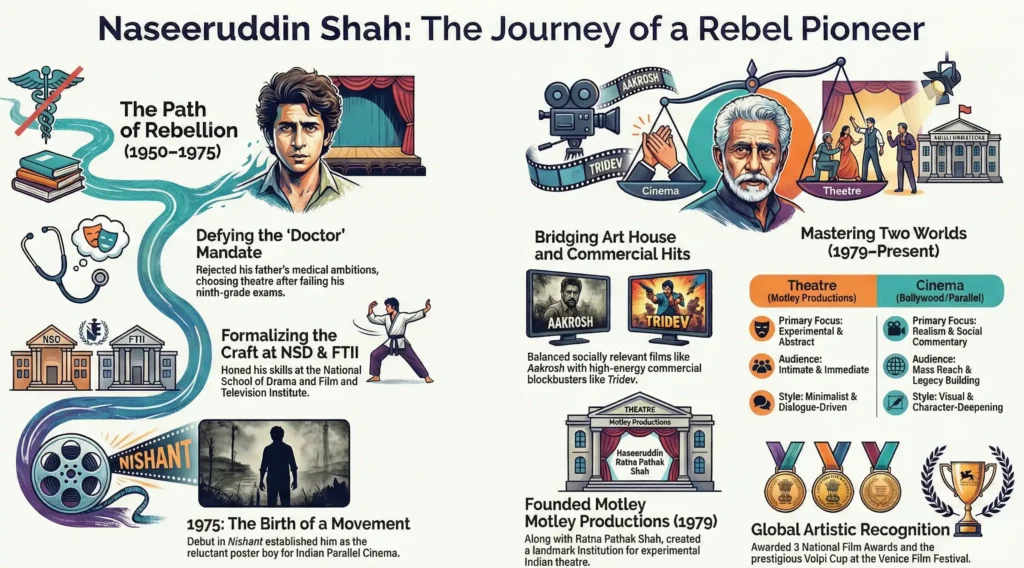
He trained at the National School of Drama under Ebrahim Alkazi and then at the film institute at Pune, and made his debut in Shyam Benegal’s Nishant in 1975, alongside Shabana Azmi and Smita Patil. What followed is most of the canon of Indian parallel cinema: Sparsh, Aakrosh, Ardh Satya, Mandi, Mirch Masala, Jaane Bhi Do Yaaro, Paar.
Those are not supporting parts in somebody else’s movement. For about a decade he was the face of the argument that Indian films could be about ordinary people in ordinary trouble. Paar took him the Volpi Cup for best actor at Venice in 1984. He has three National Film Awards, the Padma Shri from 1987 and the Padma Bhushan from 2003.
Motley
In 1977 he started a theatre company with Tom Alter and Benjamin Gilani and called it Motley Productions.
Their first production was Waiting for Godot, staged at Prithvi Theatre in 1979. He has kept the company going for close to fifty years, through Shakespeare, through Ismat Chughtai and Saadat Hasan Manto, and it has never made anybody involved in it wealthy. He was doing it through the years when he could have been taking every film offer that came.
That is the clearest statement he has made about what he thinks acting is for, and he made it with five decades rather than a sentence.
Afterwards
He married the actress Ratna Pathak in 1982, which is roughly where the memoir stops.
Their sons Imaad and Vivaan act. So does Heeba, who came back into his life and is now part of the same working family. In 2023 all five of them appeared in the same production.
The book does not present that as a resolution, and it is the better for it. He wrote down what he did, left it on the page unimproved, and let the reader decide what the later part is worth.t the stubborn refusal to compromise on one’s identity. As he continues to grace both the stage and the screen, Shah remains a reminder that true artistry is timeless, and the most powerful role one can play is that of their authentic self.
If you think you have remembered everything about this topic take this QUIZ
Results
QUIZ START
#1. Naseeruddin Shah is a direct descendant of which 19th-century Afghan warlord?
Previous
Next
#2. At the age of 14, which character did Naseeruddin Shah play in his first stage performance?
Previous
Next
#3. Which film marked Naseeruddin Shah’s debut in 1975?
Previous
Next
#4. Which prestigious international award did Naseeruddin Shah win at the Venice Film Festival?
Previous
Next
#5. What is the name of the theatre group founded by Naseeruddin Shah and Ratna Pathak Shah in 1979?
Previous
Next
#6. Naseeruddin Shah played the role of Captain Nemo in which international blockbuster film?
Previous
Next
#7. What is the title of Naseeruddin Shah’s candid autobiography?
Previous
Next
#8. Naseeruddin Shah was considered for the lead role in which classic film but lost it to Ben Kingsley?
Previous
Finish
What is Naseeruddin Shah most famous for?
He is most famous for pioneering the Parallel Cinema movement in India with films like Nishant and Aakrosh, as well as for his versatile roles in commercial hits like Tridev and A Wednesday.
Who is Naseeruddin Shah’s wife?
Naseeruddin Shah is married to the acclaimed actress Ratna Pathak Shah. They got married in 1982. He was previously married to Manara Sikri.
Did Naseeruddin Shah win any international awards?
Yes, he won the Volpi Cup for Best Actor at the Venice Film Festival in 1984 for his performance in the film Paar.
What is the controversy involving Naseeruddin Shah at FTII?
During his student days at FTII, Shah was involved in a serious altercation involving the stabbing of a fellow student in the canteen, an event he has candidly discussed in his memoir as a moment of youthful rage.
Which theatre group did Naseeruddin Shah found?
He founded Motley Productions in 1979 along with fellow actors Tom Alter and Benjamin Gilani. Their first play was Samuel Beckett’s Waiting for Godot.
Sources & References
Naseeruddin Shah, And Then One Day: A Memoir (2014) — his own account of his first marriage, his early fatherhood and his view of popular cinema.
Encyclopaedia Britannica (“Naseeruddin Shah”) — his career, Motley Productions and his family.
La Biennale di Venezia — the Volpi Cup for Best Actor awarded for Paar in 1984.
Directorate of Film Festivals, Government of India — his National Film Awards.
Exploring the Soul of Bharat through History, Science, Culture, and its Diversity
Our Mission
Curious Indian is a definitive knowledge portal dedicated to chronicling the events, personalities, and cultural shifts that defined the Indian subcontinent. From the ancient Vedic Period to the complexities of 21st-century politics, our goal is to provide deep-dive analysis that inspires.
Editorial Standards & E-E-A-T
Every article published under our brand undergoes a rigorous fact-checking process. We prioritize primary historical records, academic citations, and credible archives to ensure our readers receive accurate, high-authority information.
Historical IntegrityDirectly sourcing from ASI archives and academic journals.
Topical AuthorityComprehensive clustering of Indian Science, Biographies, and Wars.
Managed by Paripurna Datta and TEAM | Dedicated to the Knowledge of India.