Rekha arrived in Bombay at fifteen unable to speak Hindi, and ended up dubbing for actresses who could not manage it
Sawan Bhadon came out in 1970 and did good business, which was awkward, because its leading lady could not speak the language it was in.
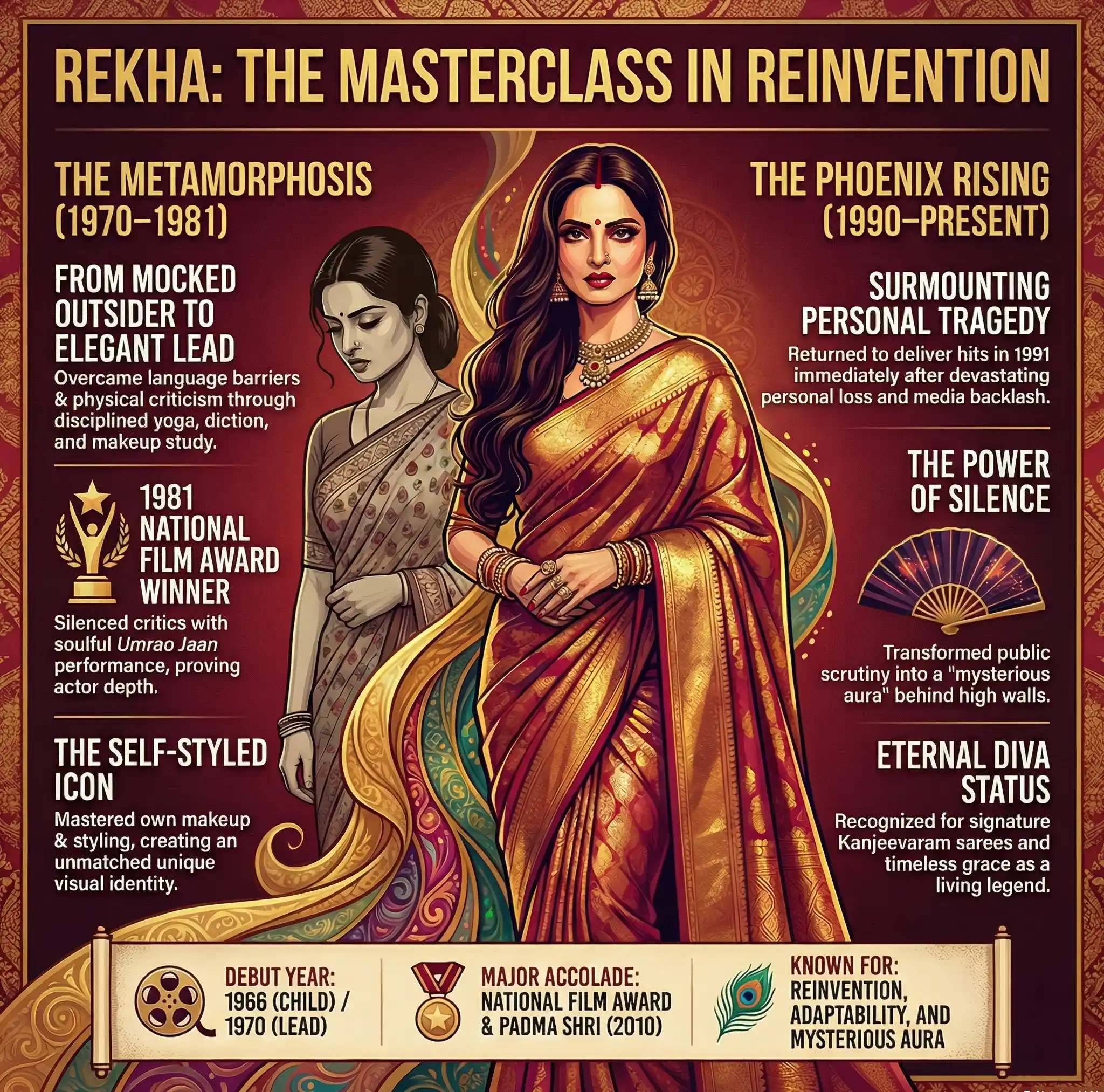
Rekha was fifteen, from Madras, and had been put in front of a Hindi film camera without any of the equipment the job requires. She learned her lines phonetically, by sound, the way you would learn a song in a language you do not have. She did not know what most of them meant.
The press noticed her, and what it noticed was her complexion, her weight and her clothes. It went on noticing those things for about five years.
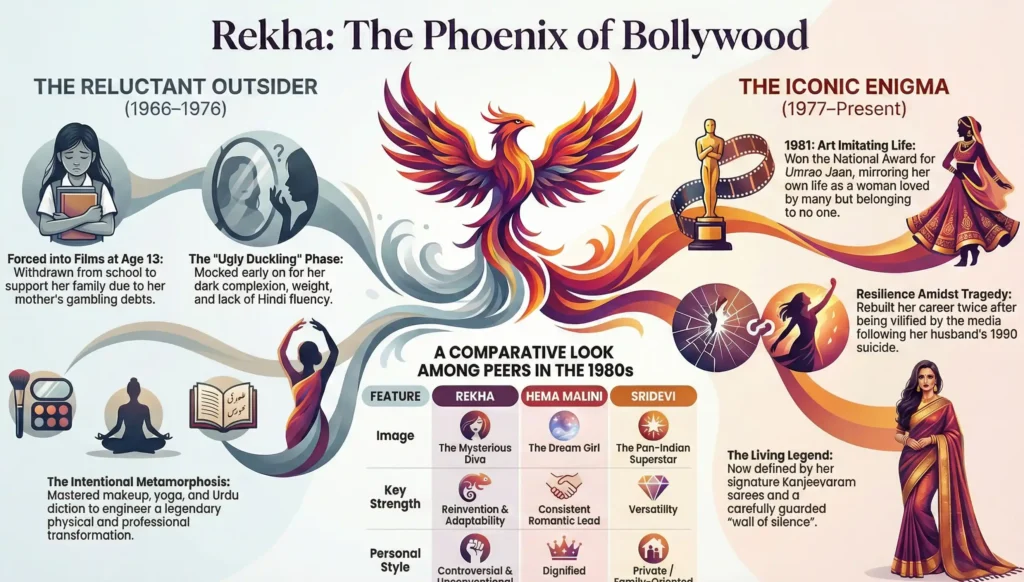
She was born Bhanurekha Ganesan in 1954 to the Tamil star Gemini Ganesan and the Telugu actress Pushpavalli, who were not married. He did not acknowledge her for a long time. The household needed money, and she was working in Telugu films as a child to bring some in.
The Hindi film industry of 1970 was a north Indian, Hindi-speaking, fair-skinned business with settled ideas about what a heroine looked like, and it did not adjust them for newcomers.
She arrived in Bombay as an outsider in every sense that mattered there: South Indian, dark, not thin, and unable to hold a conversation in Hindi.
Her own description of the period is the one most often quoted.
“I was called the ugly duckling of Hindi films,” she said later, and the taunts she remembered were about her complexion and her South Indian features. Colleagues made fun of her on set. The film magazines were worse and more public.
It is worth being clear that this was not a private difficulty. The commentary about her appearance was printed, repeatedly, in national magazines, about a girl who had turned sixteen.
The parts followed the verdict. She was cast as the rustic girl, again and again, through more than a dozen films between 1971 and 1976, most of which did nothing for her at all.
The project
What she did next is usually written up as a blossoming, which gets it exactly backwards.
It was a work programme, carried out deliberately over several years. She took up yoga and dance. She studied how film makeup and lighting actually worked, rather than waiting to be made to look good by somebody else. Most of all she went at the language, properly, until she could act in it rather than recite it.
She got good enough at Hindi to be hired to dub for other actresses who could not speak it. That is the detail worth holding on to. The outsider who did not know what her own lines meant in 1970 was later supplying the voice for people with the same problem.
1981
For Umrao Jaan in 1981 she went further still, and trained specifically in Urdu diction for the part.
Muzaffar Ali’s film required her to play a nineteenth century Lucknow courtesan reciting poetry, in a register that a native Hindi speaker would have found demanding. She won the National Film Award for Best Actress for it, announced in February 1982.
The turn had been building for a while. Do Anjaane in 1976 and Ghar in 1978 were the films that made the industry treat her as an actor rather than a face, and Umrao Jaan settled the argument.
She was asked to recite from it at a festival abroad a few years ago, decades on, and did it from memory while the hall recited along with her.
Khubsoorat in 1980 had already shown she could carry a film on comic timing alone, and Khoon Bhari Maang in 1988 won her another Filmfare award.
She has appeared in something over a hundred and eighty films across five decades. She received the Padma Shri in 2010, and was nominated to the Rajya Sabha in 2012 for a six year term, during which her attendance was frequently criticised.
Reinvention is the word that gets used about her, and it is too passive. She was told at fifteen that she was the wrong colour, the wrong size and the wrong language for the work, and she went and fixed the one of those that was actually fixable.
If you think you have remembered everything about this topic take this QUIZ
Results
QUIZ START
#1. What is Rekha’s real birth name?
Previous
Next
#2. Rekha is the daughter of which South Indian superstar who initially refused to acknowledge her?
Previous
Next
#3. For which 1981 film did Rekha win the National Film Award for Best Actress?
Previous
Next
#4. What tragic event occurred in Rekha’s life in 1990 involving her husband Mukesh Agarwal?
Previous
Next
#5. Rekha shocked the nation in 1980 by wearing sindoor (vermilion) to whose wedding?
Previous
Next
#6. Unlike most modern stars, what unique habit does Rekha maintain regarding her public appearances?
Previous
Next
#7. In 2012, Rekha was nominated to which house of the Indian Parliament?
Previous
Next
#8. Which 1980 film proved Rekha’s ability to carry a movie entirely on her comic timing?
Previous
Finish
Who was Rekha’s husband?
Rekha married Mukesh Agarwal, a Delhi-based businessman, in 1990. Unfortunately, the marriage was short-lived as Mukesh committed suicide seven months later due to clinical depression.
This is one of Bollywood’s biggest mysteries. Rekha has stated in interviews that she wears it as a fashion statement because it suits her, and in her culture, it isn’t strictly reserved for married women. However, fans often speculate it symbolizes her undying love for an unrequited flame.
Did Rekha and Amitabh Bachchan act together after Silsila?
No. Silsila (1981) was the last film where they were paired together. The intense rumors regarding their relationship reportedly made it impossible for them to work together again.
How is Rekha related to Pushpavalli?
Pushpavalli, a famous Telugu actress, was Rekha’s mother. Rekha was born out of Pushpavalli’s relationship with Tamil superstar Gemini Ganesan.
Which is Rekha’s most acclaimed performance?
While she has many hits, Umrao Jaan (1981) is considered her finest performance, earning her the National Film Award for Best Actress.
Sources & References
Encyclopaedia Britannica (“Rekha”) — her career in Hindi cinema and her critical standing.
Directorate of Film Festivals, Government of India — the National Film Award for Best Actress for Umrao Jaan.
Tejaswini Ganti, Bollywood: A Guidebook to Popular Hindi Cinema (2004) — the early typecasting and the press treatment of her.
Rajya Sabha, Government of India — her nomination to the House in 2012 and her term.
Exploring the Soul of Bharat through History, Science, Culture, and its Diversity
Our Mission
Curious Indian is a definitive knowledge portal dedicated to chronicling the events, personalities, and cultural shifts that defined the Indian subcontinent. From the ancient Vedic Period to the complexities of 21st-century politics, our goal is to provide deep-dive analysis that inspires.
Editorial Standards & E-E-A-T
Every article published under our brand undergoes a rigorous fact-checking process. We prioritize primary historical records, academic citations, and credible archives to ensure our readers receive accurate, high-authority information.
Historical IntegrityDirectly sourcing from ASI archives and academic journals.
Topical AuthorityComprehensive clustering of Indian Science, Biographies, and Wars.
Managed by Paripurna Datta and TEAM | Dedicated to the Knowledge of India.