How one stray arrow restored the Mughal Empire
On the afternoon of 5 November 1556, a man who had begun life selling saltpetre from a cart was minutes away from ruling the whole of North India.
His name was Hemu. His army was winning. The boy-emperor’s soldiers were breaking apart in front of him.
And then a single arrow, loosed by someone whose name we will never know, found his eye.
In that one instant the battle turned, a dynasty was saved, and India was set on a road it would follow for the next three hundred years. This is the story of the strangest twist of luck in Indian history.
A boy, a death, and an empty throne
It began with a fall down a staircase.
In January 1556, the Mughal emperor Humayun slipped on the stone steps of his library in Delhi and died. His heir was his son Akbar — a boy of just thirteen, far away in Punjab with his guardian and general, Bairam Khan.
A thirteen-year-old on a shaky throne is an invitation. The Mughals had only just clawed their way back into India, and now their emperor was a child. Their enemies could smell the weakness.
The old Afghan power the Mughals had pushed aside, the Suri dynasty, saw its chance. And it had exactly the right man to take it.
Battle of Talikota 1565: The Fall of the Vijayanagara Empire
The salt-seller who became a king
That man was Hemu, and his life story is astonishing.
He was not born to armies or palaces. He came from a merchant family and, by many accounts, once made his living selling saltpetre — a raw material for gunpowder — from the town of Rewari. He was not a noble. He was not a soldier by birth. He simply turned out to be brilliant at war.
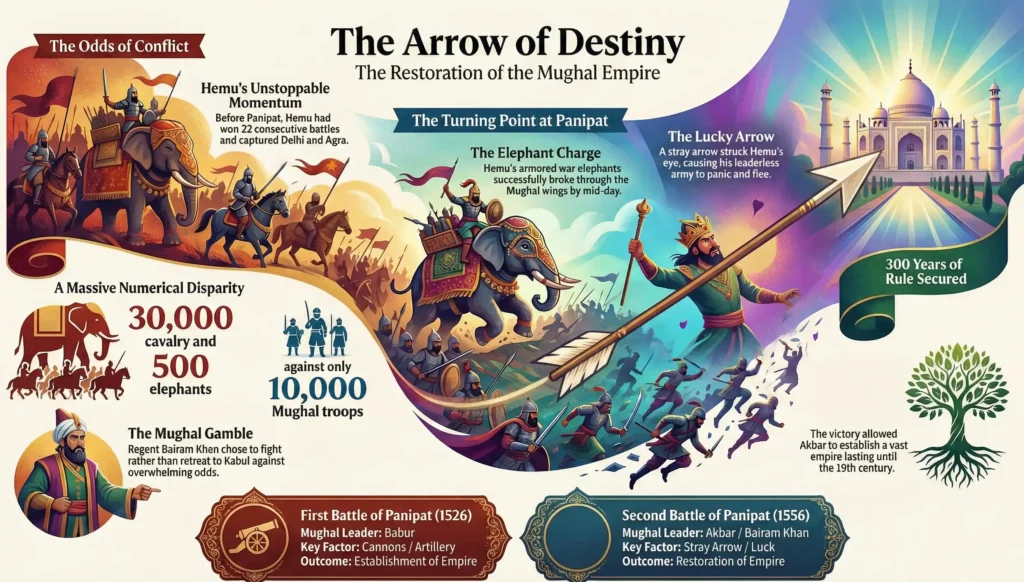
Hemu is said to have won twenty-two battles in a row. A trader’s son with no royal blood had become the most successful general in the land.
In the chaos after Humayun’s death, Hemu marched on the Mughal-held capital. On 7 October 1556 he beat their governor and took Delhi itself.
Then he did something bold. He did not rule in someone else’s name. He crowned himself, taking the old and glorious title of Vikramaditya — and became, by common reckoning, the last Hindu ruler to sit on the throne of Delhi.
The gamble
When the news reached the Mughal camp, most of Akbar’s generals gave the sensible advice. Delhi was lost, the enemy was stronger, the emperor was a boy — fall back to Kabul and wait.
Bairam Khan refused.
He was so determined to stop the rot that he had one Mughal commander, who had fled Delhi rather than fight, put to death as a warning. Then he turned the army around and marched it to the one place that already had a reputation for deciding the fate of India: the plain at Panipat, where Akbar’s grandfather Babur had won his empire thirty years before.
Around ten thousand Mughals, shaken and unsure, against Hemu’s thirty thousand and his five hundred war elephants. On paper, it was no contest.
Third Battle of Panipat 1761: The Day the Maratha Dream Died
The battle
On the morning of 5 November, the two armies met.
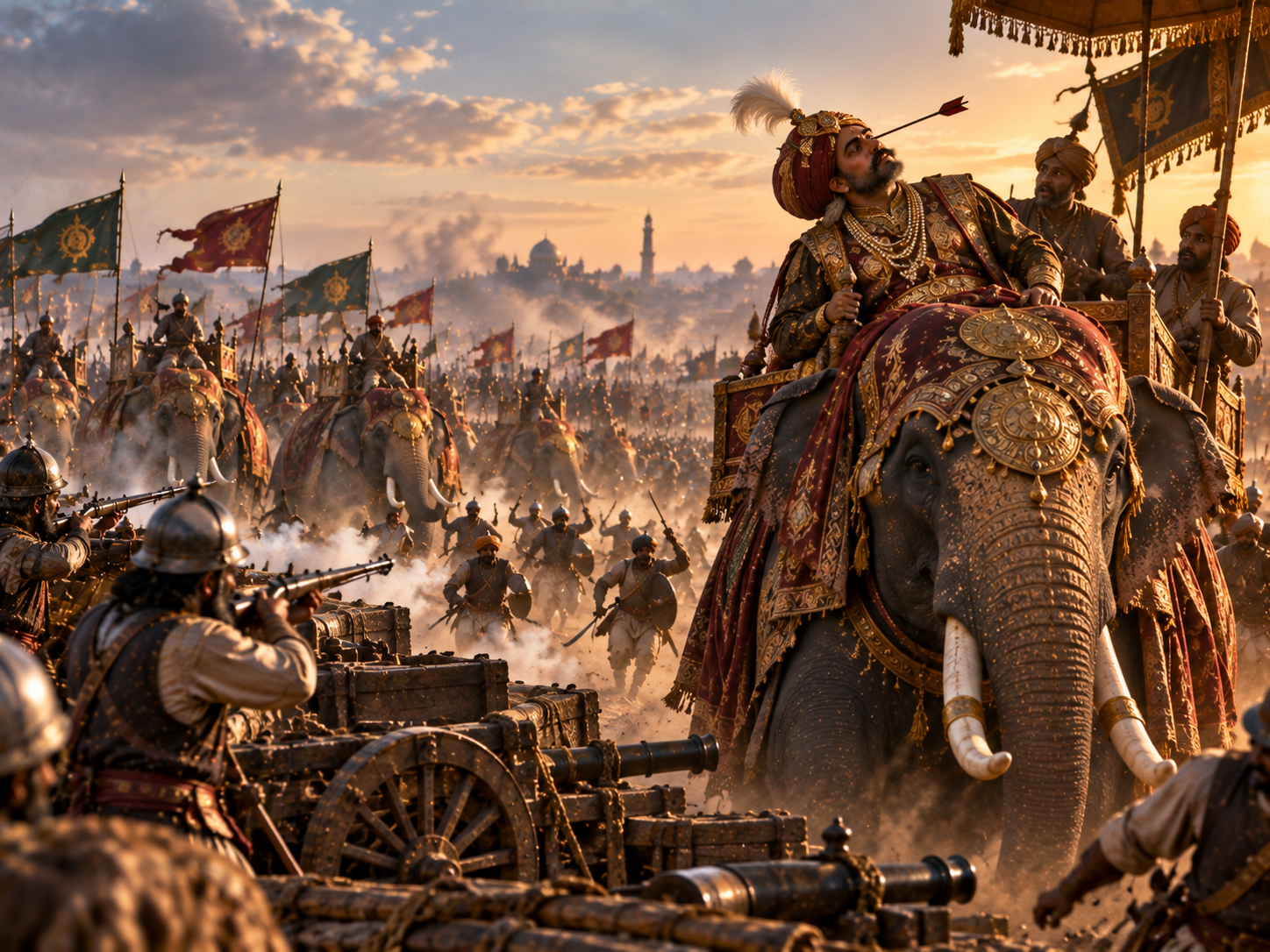
Hemu’s strength was his elephants — huge, armoured animals that came crashing into the Mughal lines. He rode at the head of his army on a great elephant of his own, and for a while it worked exactly as he hoped. His beasts smashed into the Mughal wings and began to fold them back.
Bairam Khan had kept the young Akbar well to the rear, safe and away from the fighting. And he had given his archers a cold, clever order: do not waste arrows on the wall of elephants. Aim instead for the men steering them, and for the commanders.
By the middle of the day, that order had not yet saved him. Hemu was winning. One more push and the boy-emperor’s army would break for good.
One arrow
And then came the arrow.
A single shaft, fired by an unknown Mughal archer, struck Hemu in the eye and drove deep. He crumpled, unconscious, inside the covered seat on his elephant’s back.
One arrow, one eye. And a winning army, in the space of a few minutes, fell completely apart.
This is the part that shows how much a battle can hang on a single man. Hemu was not just leading his army; to his soldiers he was the reason they were winning. When they looked up and saw his elephant wandering with no one guiding it, a whisper became a roar: Hemu is dead.
The panic was instant. The same troops who had been moments from victory turned and ran. A near-certain win became a total rout, almost in the blink of an eye.
Hemu, still breathing, was captured and carried to the Mughal camp. What happened next, the sources tell differently. In one version, Bairam Khan urged the thirteen-year-old Akbar to strike the killing blow and earn a warrior’s honour, and the boy refused to kill a helpless dying man — so Bairam Khan did it himself. In another, Akbar did strike. Either way, Hemu did not leave that camp alive.
Reign of Akbar 1556-1605: The Golden Age of the Mughal Empire
The great “what if”
It is hard to think of a moment in Indian history that turned on something so small.
If that one arrow had flown a few inches wide, Hemu might well have won. The child Akbar’s reign could have ended before it truly began, and a new dynasty — Hemu’s own — might have ruled from Delhi instead of the Mughals.
Instead, the arrow found its mark. Akbar survived to grow up, and he grew up to become perhaps the greatest of all the Mughal emperors, the ruler who would spend nearly fifty years building a vast, mixed, surprisingly tolerant empire across the subcontinent.
There is a hard lesson tucked inside the story, and an old saying gets it about right. We like to believe that fortune favours the brave. Hemu was brave, and clever, and self-made, and he still lost everything. Sometimes, it turns out, fortune simply favours the lucky.
Reign of Aurangzeb 1658-1707: The Zenith and Decline of the Mughals
If you think you have remembered everything about this topic take this QUIZ
Results


#1. The Second Battle of Panipat was fought on which date?
#2. Who commanded the Mughal forces as the Regent for the young Emperor Akbar?
#3. What ancient title did Hemu adopt after capturing Delhi and declaring himself King?
#4. What was the specific turning point that led to the defeat of Hemu’s army?
#5. Before rising to power as a general and king, what was Hemu’s original profession?
#6. How old was Emperor Akbar at the time of the Second Battle of Panipat?
#7. Which Mughal general was executed by Bairam Khan before the battle to instill discipline in the army?
#8. What was the fate of Hemu after he was captured in the battle?
Who fought the Second Battle of Panipat?
It was fought between Akbar’s Mughal forces (led by Bairam Khan) and Hemu Vikramaditya.
When was the battle fought?
It was fought on November 5, 1556.
How did the Mughals win the battle?
They won when a stray arrow hit Hemu in the eye, causing him to fall unconscious and his army to panic.
Who was Bairam Khan?
He was the Regent and Guardian of the young Akbar and the brilliant general who led the Mughal forces to victory.
What happened to Hemu after the battle?
He was captured unconscious and beheaded by Bairam Khan (or Akbar) in the Mughal camp.
Sources & References
- Encyclopaedia Britannica (“Akbar”) — Humayun’s death, Akbar’s succession at the age of thirteen under the regency of Bairam Khan, and the victory at Panipat that restored Mughal rule.
- Indian Culture portal, Ministry of Culture (indianculture.gov.in) — the rise of Hemu (Hemchandra Vikramaditya) from humble origins to general, and his capture of Delhi in 1556.
- Panipat district administration (panipat.gov.in) — the date of 5 November 1556 and the battlefield at Panipat, the plain that repeatedly decided control of Delhi.
- Know India, National Portal of India (knowindia.india.gov.in) — the long era of Mughal rule under Akbar and his successors that followed the victory.
Author


Exploring the Soul of Bharat through History, Science, Culture, and its Diversity
Our Mission
Curious Indian is a definitive knowledge portal dedicated to chronicling the events, personalities, and cultural shifts that defined the Indian subcontinent. From the ancient Vedic Period to the complexities of 21st-century politics, our goal is to provide deep-dive analysis that inspires.
Editorial Standards & E-E-A-T
Every article published under our brand undergoes a rigorous fact-checking process. We prioritize primary historical records, academic citations, and credible archives to ensure our readers receive accurate, high-authority information.
Historical Integrity Directly sourcing from ASI archives and academic journals.Topical Authority Comprehensive clustering of Indian Science, Biographies, and Wars.Managed by Paripurna Datta and TEAM | Dedicated to the Knowledge of India.