Mauryan Empire: How Chandragupta and Chanakya Built India’s First Great Empire
The Mauryan Empire (c. 324–187 BCE) unified vast tracts of the subcontinent under Chandragupta Maurya, Bindusara, and Ashoka, developing a centralized administrative framework documented by Kautilya’s Arthashastra, Greek envoys like Megasthenes, and Ashokan inscriptions.
How Chandragupta and Chanakya forged India’s first empire, and why its greatest kings walked away from it
For most of its early history, India was not one country at all, but many. It was a crowded patchwork of kingdoms, forever squabbling, forever at war with one another.
And then, a little over two thousand years ago, two men came along who welded that whole patchwork, for the very first time, into a single vast empire. One of them was a young man of humble and obscure birth, a nobody from nowhere in particular. The other was a brilliant and furious teacher with a bitter grudge to settle. Together, this most unlikely pair built India’s first great empire, the Mauryan Empire. And it would go on to be ruled, at its very height, by two of the most extraordinary kings who ever sat upon a throne. This is its story.
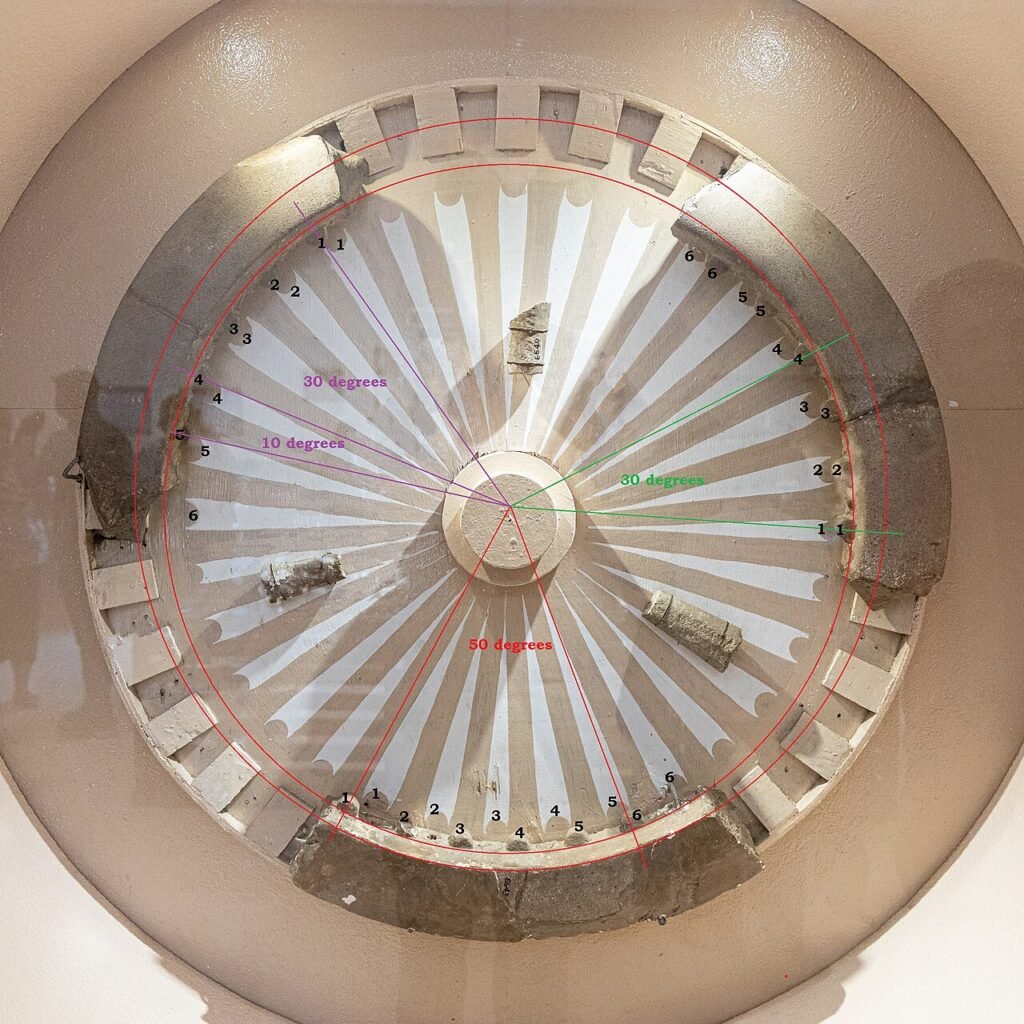
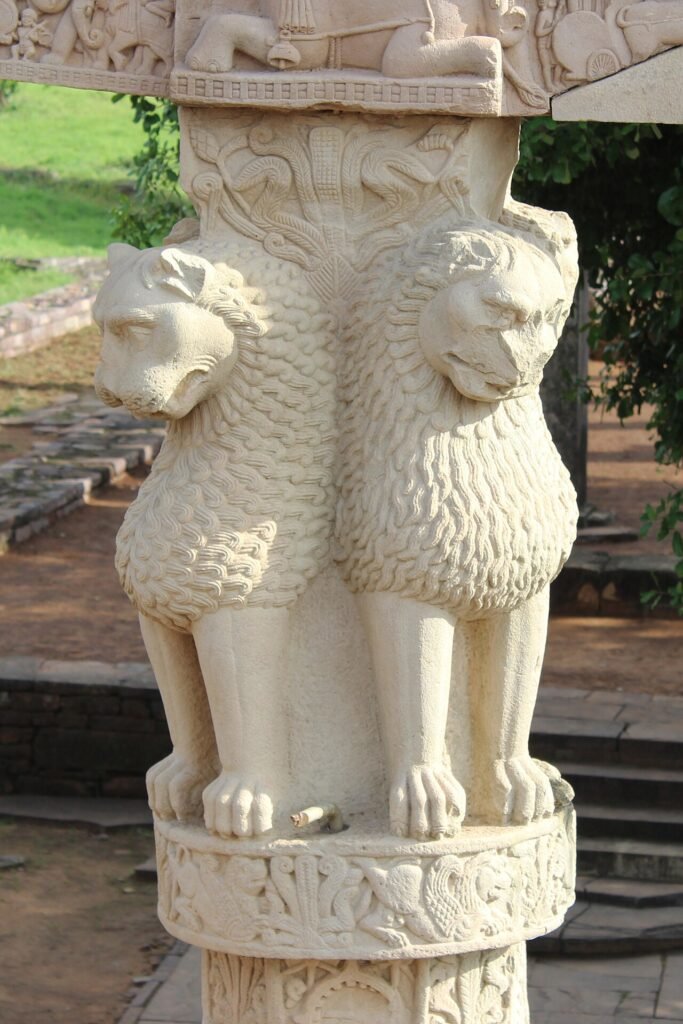
Lion Capital of Ashoka at Sarnath, one of the most enduring works of Mauryan stone sculpture. Source: Wikimedia Commons · Kevin Standage · CC BY-SA 4.0
A teacher’s revenge
The genius came first. His name was Chanakya, and he was a professor at one of the ancient world’s great universities, a man of dazzling and rather cold intelligence.
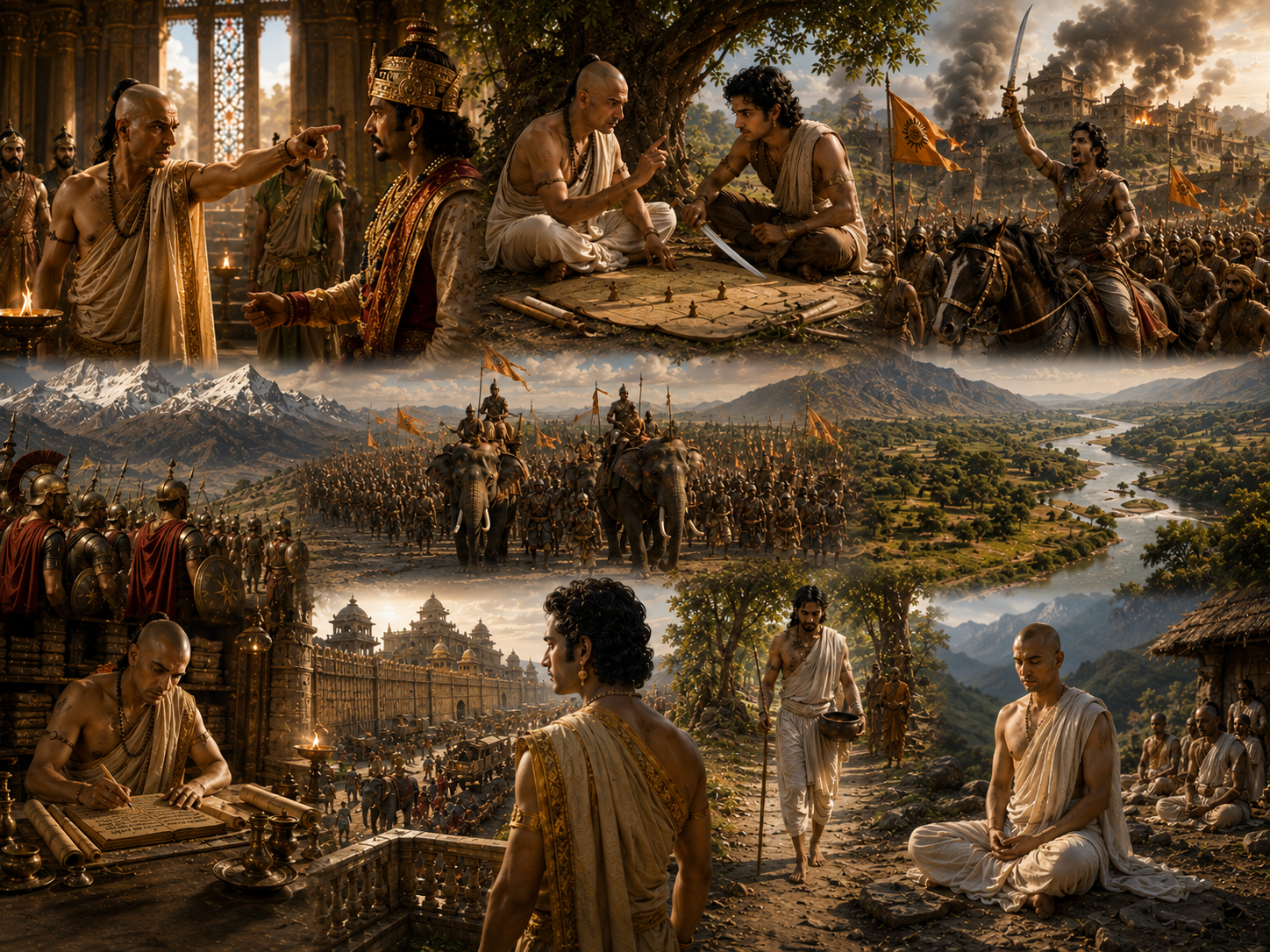
As the story goes, Chanakya was insulted and thrown out of the court of the powerful king who then ruled the rich kingdom of Magadha. Humiliated and disgraced, he made a quiet, icy vow to himself: he would destroy that king and his entire dynasty. But to overthrow a king, a man needs a king of his own. And so Chanakya went out looking, and he found a young man named Chandragupta, of humble birth, but with a sharp mind and a natural gift for leadership. Chanakya took the young man under his wing, trained him, and pointed him squarely at the throne.
A humiliated teacher swore to destroy a king. He found a nobody, made him into an emperor, and together they built India’s first great empire.
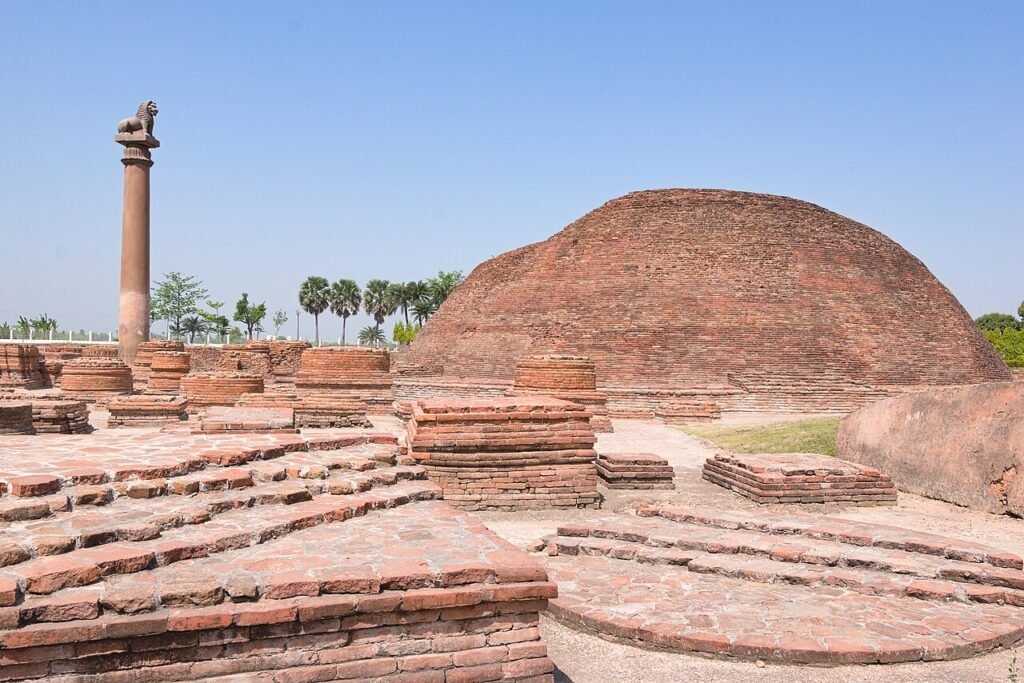
An Ashokan pillar, evidence of the Mauryan state’s monumental inscription programme. Source: Wikimedia Commons · Rohit Sharma · CC BY-SA 4.0
And together, they actually did it. Through clever strategy, striking first at the distant edges of the kingdom and then slowly closing in on its centre, they overthrew the old dynasty, and in 322 BCE, Chandragupta made himself the master of Magadha. Chanakya had his revenge at last, and India had itself a brand-new emperor.
Chandragupta did not stop there. To the northwest, the great conqueror Alexander the Great had recently swept through the land and then departed, leaving his soldiers still holding the frontier behind him. Chandragupta drove them out.
The Great Stupa at Sanchi, whose early core is traditionally associated with Ashoka. Source: Wikimedia Commons · Suyash Dwivedi · CC BY-SA 4.0
Later, when one of Alexander’s most powerful successors marched east again to try to reclaim the region, Chandragupta defeated him as well, and won an enormous stretch of new territory in exchange for a gift of five hundred war elephants. By the end of it all, his empire reached from the mountains of Afghanistan in the far west, all the way across to Bengal in the east. It was quite simply the largest empire India had ever seen, and one of the very largest anywhere in the whole world at that time.
The manual of power
Behind all of this stood the cold brilliance of Chanakya, who took care to write it all down. He produced a book called the Arthashastra, a startling and clear-eyed manual on exactly how to seize and hold power, how to run a state, how to fill a treasury, and how to defeat an enemy.
It is practical to the point of ruthlessness, packed with hard, unsentimental advice about spies, taxes, warfare, and the careful management of people. Written more than two thousand years ago, it still reads like the work of a mind that understood precisely how power really works in the world, with no comforting illusions about it at all. To this day, it remains one of the most remarkable books on statecraft ever written, in any land.
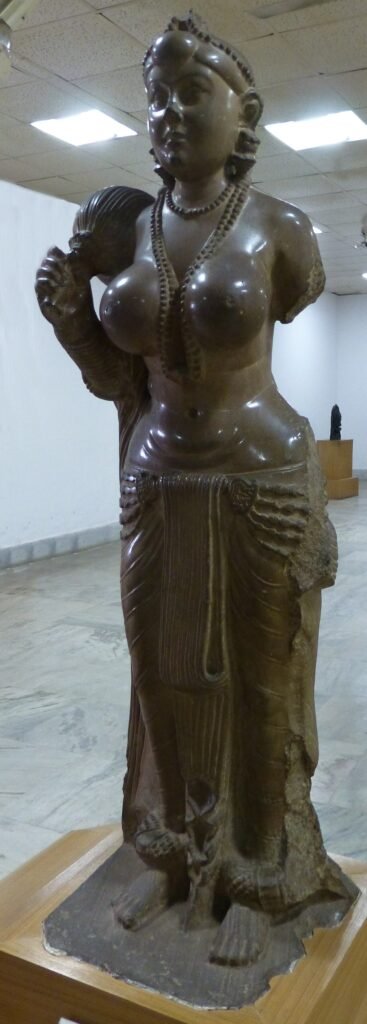
The Didarganj Yakshi, famous for the highly polished stone surface associated with early historic Indian sculpture. Source: Wikimedia Commons · Anandajoti · CC BY 3.0
And the empire that the two of them built was no loose, careless collection of conquered lands. It was a machine.
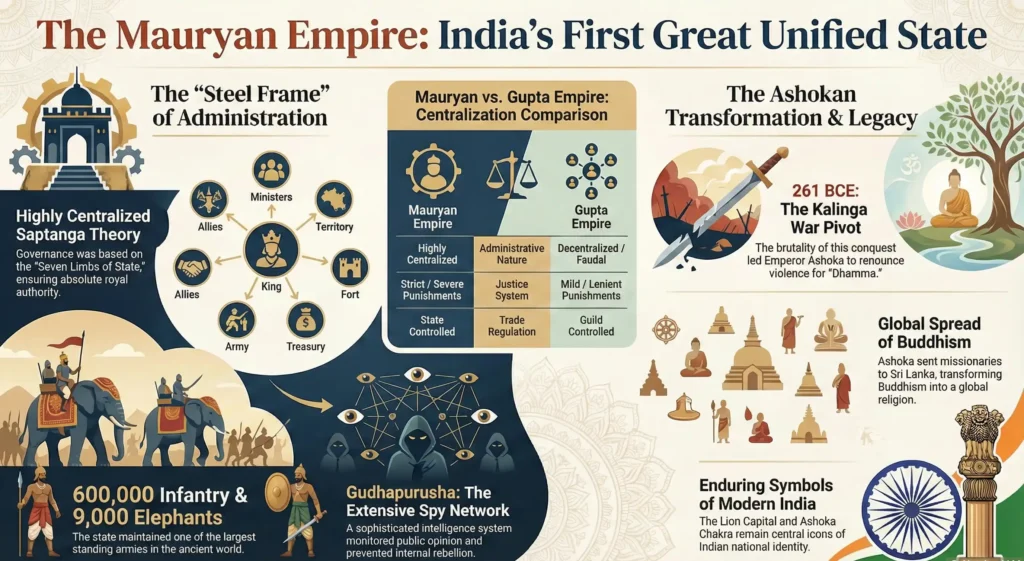
From the magnificent capital city of Pataliputra, a huge and highly organised government reached out across the entire empire: governors ruling over the provinces, officials busily collecting taxes, great roads carrying soldiers and messages back and forth, and a vast, silent network of spies keeping the emperor’s watchful eyes just about everywhere. A Greek ambassador named Megasthenes, who actually lived for a time at Chandragupta’s court, wrote home in real astonishment about the sheer size and splendour of the city and the sophistication of its rule. This was, without doubt, one of the best-organised states anywhere in the entire ancient world.
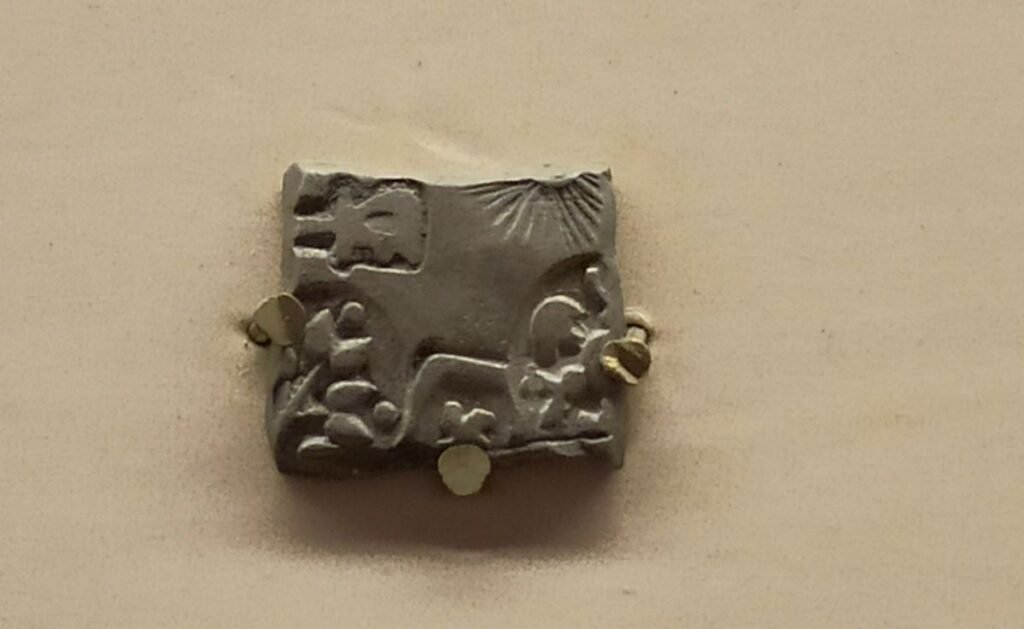
Punch-marked coins of ancient India, representative of the monetary world in which the Mauryan Empire operated. Source: Wikimedia Commons · SpeakingArch · CC BY-SA 4.0
The emperor who starved himself
And now the story takes the first of two truly astonishing turns.
Chandragupta, the nobody who had conquered a whole subcontinent and built one of the world’s great empires, did something that almost nobody could have expected. In his later years, he gave the whole of it up. He grew deeply drawn to the gentle, world-renouncing faith of Jainism, and one day he simply set down his heavy crown, handed the empire over to his son, and walked away from all of it. He travelled far to the south of India, became a wandering Jain monk, and there, following the very strictest path of his new faith, he ended his own life by slowly fasting until he died.
The most powerful man in India gave up his throne, became a Jain monk, and ended his life by fasting until he died. He chose to leave the world with nothing at all.
The mightiest man in all of India chose to leave this world not seated upon a golden throne, but as a thin, starving holy man who owned absolutely nothing.
The grandfather, the father, and the grandson
The empire then passed to Chandragupta’s son, Bindusara, a capable king who pushed its borders further south still and kept the great machine ticking along smoothly. But it was the third emperor, Bindusara’s own son, who would become the most famous of them all. His name was Ashoka.
Ashoka fought one last, terrible war to complete the empire, against the kingdom of Kalinga, and the sheer scale of the slaughter broke something deep inside him. Sickened to his core by what he had done, this mighty conqueror laid down his sword forever and turned instead to the teachings of the Buddha, spending the rest of his long reign trying to rule his people by kindness rather than by fear. His is a whole great story of its own.
The grandfather gave up his empire to become a Jain monk. The grandson gave up war itself to follow the Buddha. India’s mightiest empire was book-ended by two rulers who each walked away from power at its very height.
After Ashoka died, the great empire did not last very much longer. His successors were weaker men, and the enormous territory, which had really been held together all along by the strength and cleverness of just a few remarkable people, slowly began to crack and fall apart. Province by province, it shrank.
And in 185 BCE, less than fifty years after Ashoka’s death, the very last Mauryan emperor was struck down by his own army commander, who seized the throne for himself. The empire that a nobody and a genius had once raised up out of nothing was gone.
But it had left something behind that India would never quite forget. For a little over a century, the Mauryas had managed to do a thing that no one had ever done before them. They had shown that this vast, diverse, and quarrelsome land could in fact be made into a single whole, that there truly could be such a thing as one India, governed from one throne. Every later empire that ever dreamed of uniting the subcontinent, right down to modern times, was in some quiet sense following a road that the Mauryas had been the first to cut.
It had all begun with two unlikely men: a boy from nowhere, and the sharp-tongued teacher who chose to believe in him. Between the two of them, they built the first great empire India had ever known. And in the strangest twist of the whole tale, two of the mighty kings who ruled that empire looked out over everything they had conquered, over everything that power itself could possibly offer, and quietly decided that there was something worth still more. That, perhaps, is the real legacy of the Mauryas. Not only that they proved India could be made one, but that even at the very summit of the ancient world, its greatest rulers went looking for something higher than a crown.
If you think you have remembered everything about this topic take this QUIZ
Results
QUIZ START
#1. Who founded the Mauryan Empire after replacing the Nanda Dynasty?
Previous
Next
#2. What was the capital city of the Mauryan Empire?
Previous
Next
#3. Which Greek ambassador visited the Mauryan court and wrote the text Indica?
Previous
Next
#4. Which brutal conflict in 261 BCE led Emperor Ashoka to renounce violence and adopt Dhamma?
Previous
Next
#5. What was the name of the primary currency used during the Mauryan Empire?
Previous
Next
#6. The Mauryan administration’s ‘Seven Limbs of State’ (Saptanga Theory) is detailed in which text authored by Kautilya?
Previous
Next
#7. What term was used to describe the Crown lands where the state controlled agriculture?
Previous
Next
#8. Who was the last Mauryan emperor, assassinated by his general Pushyamitra Shunga in 185 BCE?
Previous
Finish
Who was the last Mauryan Emperor?
Brihadratha was the last emperor, assassinated in 185 BCE.
What is the Saptanga Theory?
It is Chanakya’s theory that a state has seven limbs: King, Minister, Territory, Fort, Treasury, Army, and Ally.
Who wrote the Indica?
Megasthenes, the Greek ambassador to Chandragupta’s court.
Did Ashoka ban the death penalty?
No, but he granted a three-day respite to prisoners on death row to prepare for the afterlife.
What was the main currency of the Mauryans?
The Karshapana (Punch-marked silver coin).
Sources and references
World History Edu and Anantam IAS (“Chandragupta Maurya”) — Chandragupta’s humble origins, Chanakya’s vow of revenge after being insulted by the Nanda king, the peripheral-to-centre strategy of overthrowing the Nandas in 322 BCE, and Chandragupta’s later embrace of Jainism and death by sallekhana at Shravanabelagola.
Grokipedia and IJRAR (“Chandragupta Maurya”) — the empire as the first to unify most of the subcontinent, the defeat of Alexander’s satraps and of Seleucus I (the 500-war-elephant treaty extending the empire to Afghanistan), and Chanakya’s authorship of the Arthashastra.
New World Encyclopedia and careers360 — Chanakya as a Brahmin professor at Takshashila, the partnership in which he designed strategy, administration and espionage while Chandragupta led, and the installation of Chandragupta as king in 321 BCE.
Chegg India (“Mauryan Dynasty”) — the dynasty’s span (322–185 BCE), the capital at Pataliputra, Megasthenes as Greek ambassador, Bindusara’s administration, Ashoka’s transformative rule, and the overthrow by Pushyamitra Shunga in 185 BCE.
Curious Indian’s own overview (“Mauryan Empire”) and standard histories — the centralized administration and spy network, the Kalinga War and Ashoka’s turn to Buddhism, and the rapid decline after Ashoka’s death.