The Bitter Debate over the Deal and the Enduring Mystery of How the Prime Minister Died Signing It
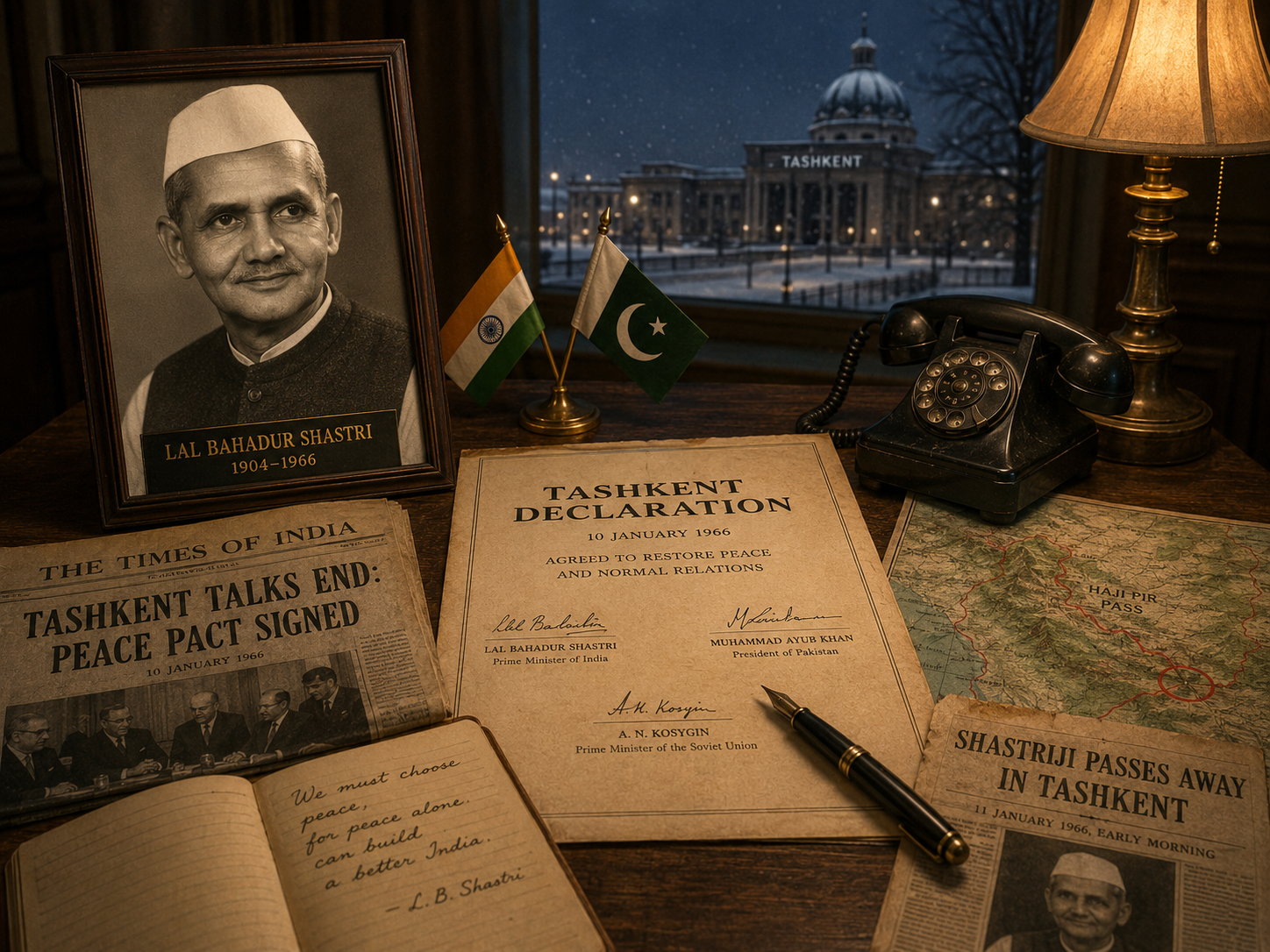
In January 1966, a small, soft-spoken man travelled to a cold city far from home to end a war. His name was Lal Bahadur Shastri, and he was the Prime Minister of India, a leader so humble that he had once taken out a bank loan simply to buy a modest little car, a loan he would not live long enough to repay.
He went to the city of Tashkent. He made a hard and unpopular peace. He signed his name to it. And a few hours later, alone and far from home, he was dead. India got its peace treaty back. It did not get its Prime Minister back. And to this very day, the country is still arguing about both the deal he made and the way he died.
A War Nobody Quite Won
The trouble had started the year before. In 1965, India and Pakistan fought their second war, mostly over the long-disputed land of Kashmir. It was fierce and bloody, and after a few weeks both exhausted armies were forced to stop fighting under heavy pressure from the world’s great powers.
Both countries proudly told their own people that they had won.
In truth, the 1965 war ended in a stalemate. It finished roughly where it had begun, with many thousands of soldiers dead and no clear victor at all.
Reign of Emperor Ashoka: The Transformation of a Tyrant
The Table at Tashkent
Stopping a war on the battlefield is one thing. Ending it properly, on paper, is quite another. The powerful Soviet Union, keen to keep peace and quiet on its own doorstep, offered to host talks and to help the two sides reach a settlement.
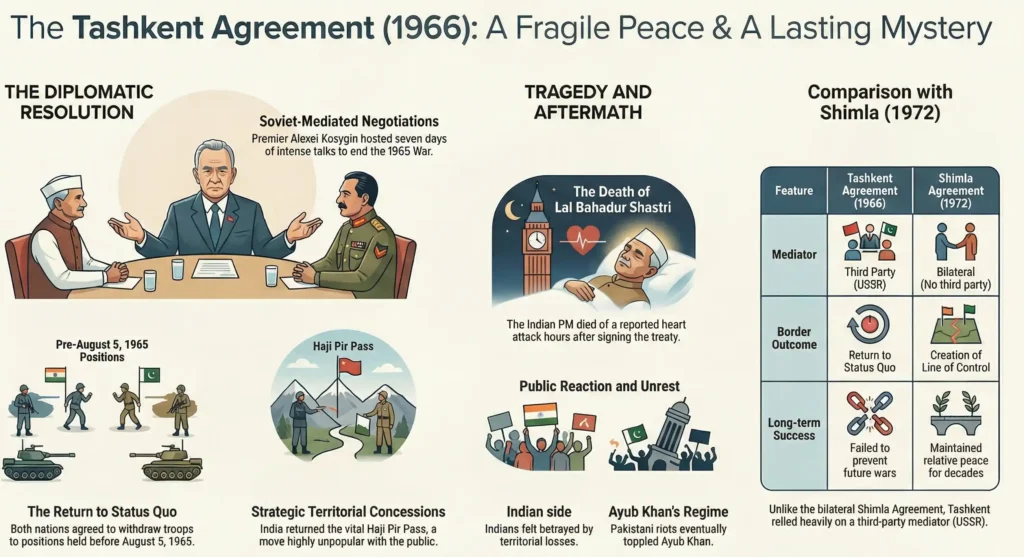
So in January 1966, Shastri and Pakistan’s President, Ayub Khan, both travelled to the Soviet city of Tashkent, in what is now Uzbekistan. There the Soviet Prime Minister sat between the two rivals and coaxed them, day after difficult day, towards an agreement. The deal they finally reached was, on the face of it, a sensible one. Both sides would pull their armies back to exactly where they had stood before the war. Both would hand back the land they had captured. And both would restore normal relations and promise to settle their future quarrels with talk rather than tanks.
The Pass that was Won and Given Back
But folded inside that fair-sounding deal was a bitter pill for India.
During the war, Indian soldiers had fought hard, and died, to capture a mountain pass of great strategic value called Haji Pir. Now, under the terms of the agreement, India would have to hand it straight back. Shastri had at first flatly refused, saying his soldiers had bled for that ground. But the whole deal only worked if both sides returned what they held: India would give back Haji Pir, and in exchange, Pakistan would give back the stretches of Indian land its own army was sitting on. In the end, Shastri agreed.
This is where the great argument begins, and it has never truly ended.
Indian soldiers had died to capture the Haji Pir pass. At Tashkent, India agreed to hand it straight back.
To many Indians, it felt like a betrayal. Their soldiers had won that ground with their lives, and here was their own government calmly giving it away at a negotiating table. They felt India had won the war, only to lose the peace. But to many others, Shastri had done the wise and honourable thing. The land was returned on both sides, not only India’s. Carrying on the war would have cost countless more lives. A leader who chooses a fair peace over clinging to a patch of mountain, they argued, is not a traitor at all, but a statesman.
Strikingly, the very same fury erupted on the other side of the border. In Pakistan, too, angry crowds took to the streets, feeling that their leader had surrendered at the table what they had been told he had won on the field. Neither nation, it turned out, felt that it had come home a winner.
Subramania Bharati: The Mahakavi of Indian Nationalism
The Night in Tashkent
On the evening of the 10th of January, Shastri signed the agreement. That night he attended a grand reception and, by every account, seemed perfectly well and in good spirits.
A few hours later, in the small hours of the morning, alone in his room in a foreign land, the Prime Minister of India was dead. The official cause given was a heart attack. He was sixty-one years old.
Kalinga War c. 261 BCE: The Battle That Changed Ashoka Forever
The Mystery that Would not Rest
And here the story slips from history into one of India’s most stubborn mysteries. Several things about that sudden death troubled people at the time, and trouble them still.
No post-mortem examination was ever carried out on his body while it was in the Soviet Union. When he was brought home, members of his family said they saw strange dark marks on his skin, and his widow openly wondered whether he had been poisoned. And in the years that followed, the government kept many of the records about his death sealed away, saying their release could damage India’s relations with other countries, which, to an already suspicious public, only looked as though something was being hidden.
Out of all this grew a thick tangle of conspiracy theories: that he had been poisoned by a foreign spy agency, or by rivals at home, that the timing was simply too neat. Here it is worth being very careful and very clear.
Despite all the suspicion, and all the years that have passed, no solid evidence has ever been found that Lal Bahadur Shastri was murdered.
A government inquiry was held long afterwards, but its findings were never made public. The honest answer is that we do not know for certain what happened in that room that night. And not knowing is simply not the same thing as proof of foul play.
Reign of Akbar 1556-1605: The Golden Age of the Mughal Empire
Two Questions, still Open
So Tashkent left India with two deep wounds that never quite healed.
The first is an argument that can never really be won, because it is a matter of judgment rather than fact. Did Shastri make a brave and decent peace, or did he give away too much for it? Thoughtful people still disagree, and very likely always will. The second is a genuine, unsolved mystery. How did a healthy man, at the very height of his power, come to die so suddenly and so far from home, on the very night of his greatest and most difficult act?
Perhaps the saddest thing of all is this. Lal Bahadur Shastri was, by every account, one of the most honest and humble men ever to lead India, a man who repaid his small debts down to the last rupee and asked almost nothing for himself. He gave his country a peace, and he gave his life in the making of it, and then he was not there to explain his choice, to defend it, or to grow old and slowly be understood. The peace he made came home to India. The quiet man who made it never did.
Second Battle of Tarain 1192: The Turning Point of Indian History
If you think you have remembered everything about this topic take this QUIZ
Results


#1. On what date was the Tashkent Agreement signed?
#2. Which Soviet Premier acted as the mediator for the Tashkent Agreement?
#3. The Tashkent Agreement formally marked the end of which conflict?
#4. Under the terms of the agreement, India had to return which highly strategic captured pass to Pakistan?
#5. What was the official cause of death given for Prime Minister Lal Bahadur Shastri, who passed away hours after signing the treaty?
#6. Which 1977 committee was formed to look into the controversial death of Lal Bahadur Shastri?
#7. According to the comparison table, how did the Shimla Agreement (1972) differ from the Tashkent Agreement regarding mediation?
#8. Who were the two primary signatories of the Tashkent Agreement?
Who mediated the Tashkent Agreement?
The Soviet Union, represented by Premier Alexei Kosygin.
What was the most controversial term for India?
The agreement to return the strategic Haji Pir Pass to Pakistan.
When did Lal Bahadur Shastri die?
He died on January 11, 1966, just hours after signing the agreement.
Did the Tashkent Agreement solve the Kashmir issue?
No, it only restored the status quo and did not provide a permanent solution to Kashmir.
Who signed the agreement for Pakistan?
President Ayub Khan.
Sources and References
- Britannica (“Tashkent Declaration”) and the US State Department historical records — the declaration signed on 10 January 1966 by Shastri and Ayub Khan, mediated by Soviet Premier Alexei Kosygin, requiring withdrawal to pre-5-August-1965 positions by 25 February 1966 and the restoration of relations.
- LegalClarity and Edukemy — the Soviet Union’s Cold War interest in mediating, the January 1966 talks, the mutual withdrawal and return of captured territory, and the failure to resolve the core Kashmir dispute.
- The Asian Age and Curious Indian’s own overview — Shastri’s initial refusal to give up the strategically vital Haji Pir Pass, Kosygin’s insistence on mutual withdrawal (India from Haji Pir, Pakistan from Chhamb), and the unpopularity of the deal in both countries, including riots in Pakistan against Ayub Khan.
- Curious Indian (“The Tashkent Agreement” and “The Lal Bahadur Shastri Death Mystery”) — Shastri’s death hours after signing, the absence of a post-mortem, his family’s suspicions of poisoning, the sealed inquiry records, and the persistence of conspiracy theories without concrete evidence.
- General accounts of the 1965 war — Operation Gibraltar, the escalation toward Lahore, the UN-mandated ceasefire, and the exhausted stalemate that neither side clearly won.
Author


Exploring the Soul of Bharat through History, Science, Culture, and its Diversity
Our Mission
Curious Indian is a definitive knowledge portal dedicated to chronicling the events, personalities, and cultural shifts that defined the Indian subcontinent. From the ancient Vedic Period to the complexities of 21st-century politics, our goal is to provide deep-dive analysis that inspires.
Editorial Standards & E-E-A-T
Every article published under our brand undergoes a rigorous fact-checking process. We prioritize primary historical records, academic citations, and credible archives to ensure our readers receive accurate, high-authority information.
Historical Integrity Directly sourcing from ASI archives and academic journals.Topical Authority Comprehensive clustering of Indian Science, Biographies, and Wars.Managed by Paripurna Datta and TEAM | Dedicated to the Knowledge of India.