This article delves into the extraordinary life of K. Asif, a man who rose from humble beginnings in Etawah to become a titan of the Indian film industry. It chronicles his unwavering dedication to his craft, particularly during the grueling sixteen-year production of the magnum opus Mughal-e-Azam. By examining his unique filmmaking style and personal sacrifices, the narrative reveals how his passion redefined the standards of storytelling and grandeur in world cinema.| Feature | Details |
| Birth Name | Karimuddin Asif |
| Born | June 14, 1922 (Etawah, United Provinces, British India) |
| Died | March 9, 1971 (Bombay, Maharashtra, India) |
| Primary Vocation | Film Director, Producer, Screenwriter |
| Most Famous Work | Mughal-e-Azam (1960) |
| Artistic Trademark | Uncompromising realism and opulent set designs |
The Tailor of Dreams: The Journey of K. Asif
The history of world cinema is often written by those who dared to dream bigger than their budgets, but legendary filmmaker K. Asif belonged to a different category altogether—he was a man who lived entirely within his vision, regardless of the cost to his health, wealth, or reputation. Born in 1922 in the small town of Etawah, young Karimuddin Asif did not begin his life surrounded by the glitz and glamour of movie cameras. Instead, he learned the meticulous art of tailoring under his uncle in Bombay. It was this early grounding in patience and the assembly of intricate details that would later define his masterpiece filmmaking style. He didn’t just want to make a movie; he wanted to stitch together a reality so vibrant that the audience would forget the passage of time.
In the mid-1940s, the Golden Age of Bollywood was just beginning to find its voice, and Asif was determined to be its loudest tenor. His directorial debut, Phool (1945), was a commercial success, but even then, his mind was already fixated on a story that had haunted him for years: the tragic romance of Prince Salim and the court dancer Anarkali. This was the seed that would eventually grow into Mughal-e-Azam, a project that would consume nearly a third of his life and set a benchmark in Indian cinema history that remains unsurpassed to this day.
10 Remarkable Facts About Meghnad Saha Life and Achievements
A Vision Interrupted by History
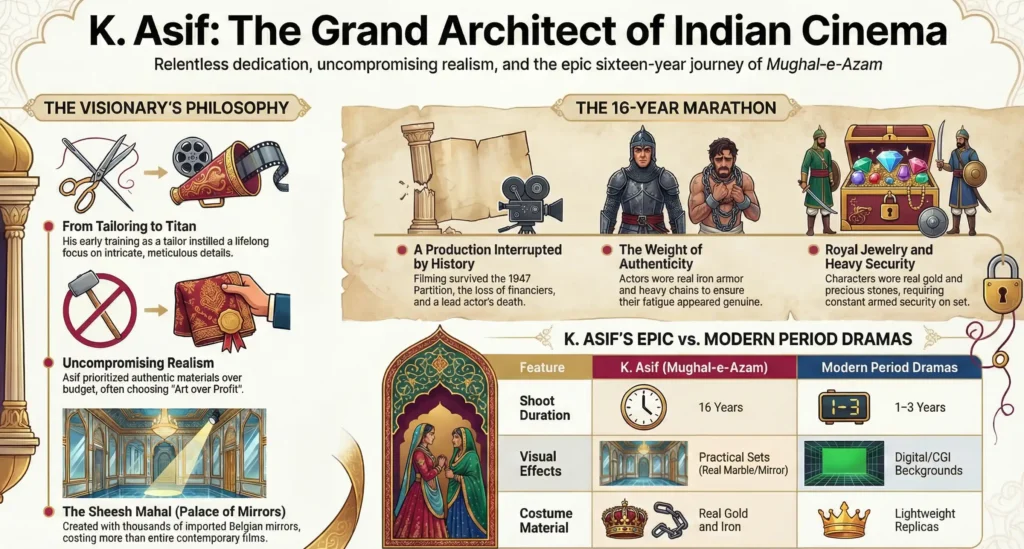
The road to greatness is rarely a straight line, and for Asif, it was interrupted by one of the most tumultuous events in human history: the Partition of 1847. When he first began filming his epic in the mid-40s, his lead actor was Chandramohan and his financier was Shiraz Ali Hakim. However, the political upheaval saw Hakim migrate to Pakistan, and the sudden death of Chandramohan left the project in tatters. Most directors would have seen this as a sign from the heavens to move on. Asif, however, viewed it as a temporary pause. He spent the following years gathering new resources, eventually finding a new financier in Shapoorji Pallonji and a new cast that included the likes of Prithviraj Kapoor, Madhubala, and Dilip Kumar.
The Sixteen-Year Marathon
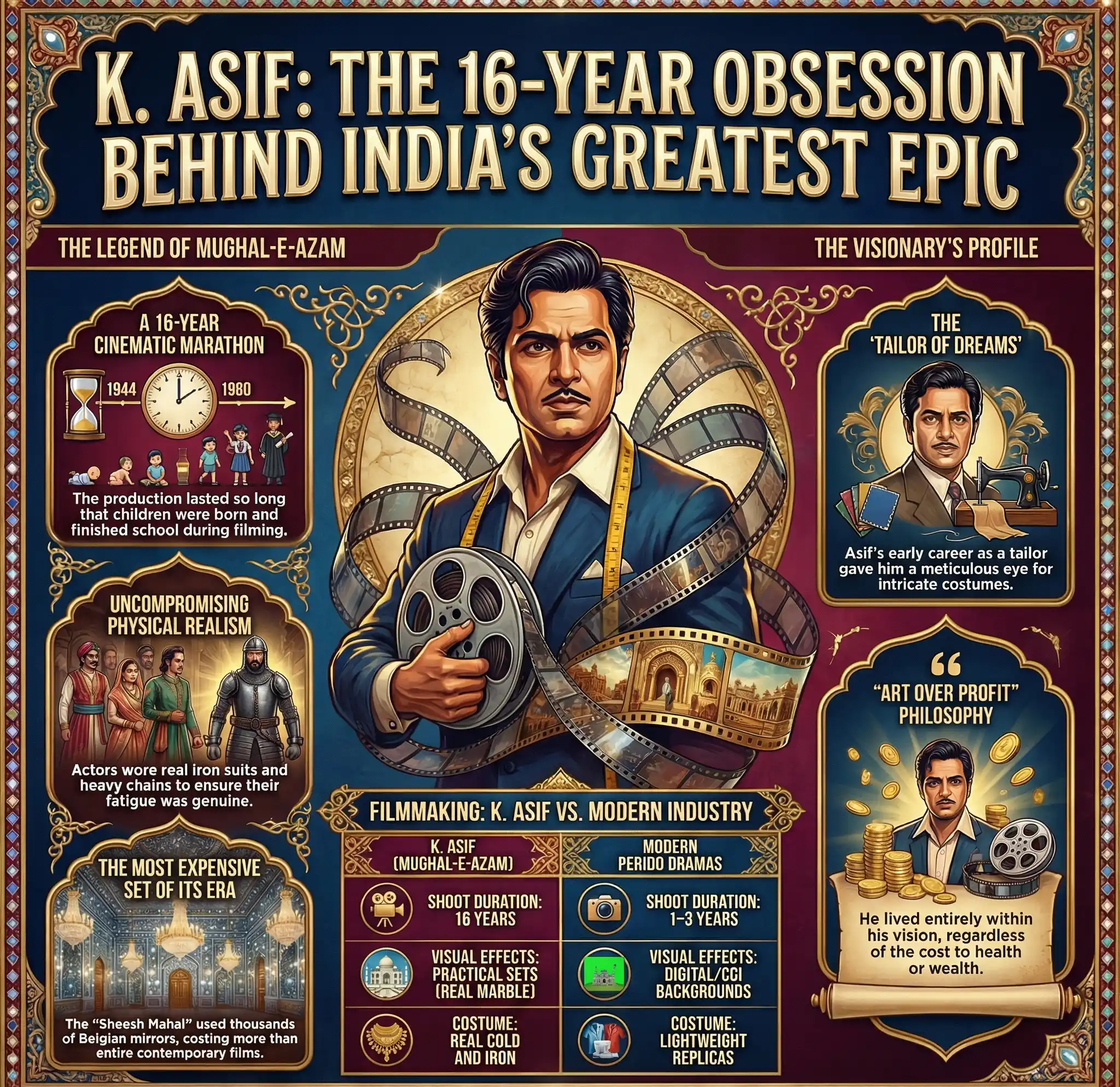
What followed was a cinematic obsession that bordered on the legendary. The production of Mughal-e-Azam lasted sixteen years. To put that in perspective, children were born, grew up, and entered high school in the time it took Asif to finish a single film. He was a director who refused to take shortcuts. When he needed jewelry for Madhubala, he didn’t go to a costume shop; he commissioned authentic pieces from the finest goldsmiths. When he needed armor for the battle scenes, he requested the Indian Army’s involvement and used real iron suits that weighed the actors down, ensuring their fatigue on screen was genuine.
This commitment to realism led to some of the most iconic moments in film history. The “Sheesh Mahal” (Palace of Mirrors) song, Pyar Kiya To Darna Kya, cost more than the entire budget of most contemporary films of that era. Asif insisted on using thousands of tiny mirrors imported from Belgium. When the cinematographers complained that the reflections were making it impossible to light the scene, Asif didn’t simplify the set—he challenged them to find a new way to film. This relentless drive is exactly why he is remembered as a legendary filmmaker K. Asif, a man who forced the world to adapt to his imagination rather than the other way around.
7 Incredible Facts in the Satyendra Nath Bose Biography
The Heart Behind the Grandeur
While he was often viewed as a “madman” by his financiers due to his spending habits, Asif was a man of deep empathy. He treated his set workers with a dignity that was rare in the industry. During long night shifts, he was known to sit with the technicians and junior artists, sharing their tea and listening to their stories. He understood that a film of such magnitude wasn’t just built by the director and the stars, but by the sweat of the carpenters, the painters, and the light boys.
His storytelling was deeply personal. Despite the elephants, the thousands of soldiers, and the marble palaces, Asif kept the focus on the human heart—the conflict between a father’s duty and a son’s love. He painted on a massive canvas, but his brushstrokes were intimate and delicate. This balance is what allowed the film to resonate across generations, transcending language and cultural barriers to become a global symbol of Indian artistry.
The Unfinished Symphony and a Final Farewell
Asif’s life was tragically cut short at the age of 48. After the monumental success of Mughal-e-Azam, one might have expected him to retire into a life of luxury. Instead, he immediately began work on his next obsession: Love and God (Laila Majnu). He wanted this to be his first full-color film, and once again, he spared no expense. However, destiny had other plans. In March 1971, he passed away, leaving the film incomplete.
It took over twenty years for his widow, Akhtar Asif, to finally piece together the footage and release Love and God in 1986. While it couldn’t capture the full brilliance of what Asif had intended, it served as a poignant reminder of his scale of thought. He was a man who lived between “Action” and “Cut,” a visionary who proved that a single lifetime is sometimes not enough to contain a dream as big as his. Today, his work is preserved as a national treasure, a reminder to every “Curious Indian” that perfection is a journey, not a destination.
8 Fascinating Facts in the Homi Jehangir Bhabha Biography
Quick Comparison: K. Asif’s Epic vs. Modern Filmmaking
| Feature | K. Asif (Mughal-e-Azam) | Modern Period Dramas |
| Duration of Shoot | 16 Years | 1–3 Years |
| Visual Effects | Practical Sets (Real Marble/Mirror) | Digital/CGI Backgrounds |
| Costume Authenticity | Real Gold and Iron | Lightweight Replicas |
| Cast Recruitment | Chosen for gravitas and Urdu diction | Often chosen for social media following |
| Budget Philosophy | “Art over Profit” | Return on Investment (ROI) focused |
Curious Indian: Fast Facts
- Royal Jewelry: The jewelry worn by the characters in Mughal-e-Azam was made of real gold and precious stones, guarded by heavy security on set.
- The Chain of Pain: In the scenes where Anarkali is imprisoned, Madhubala wore real, heavy iron chains. Asif refused to use wooden replicas to ensure her struggle looked authentic.
- A Tailor’s Beginning: Asif’s first job in Bombay was as a tailor, which many believe gave him his eye for the intricate costumes that became his hallmark.
- Technicolor Transformation: Mughal-e-Azam was originally intended to be entirely in color, but when the process proved too expensive and slow, only parts of it (including the Sheesh Mahal song) were shot in color.
- The Lost Sequel: Asif had planned a film called Sasta Khoon, Mehenga Paani, which never moved past the conceptual stage due to his early demise.
Conclusion
The legacy left behind by legendary filmmaker K. Asif is a testament to the power of unwavering belief. He did not merely direct movies; he sculpted history out of light and sound. His life serves as a beacon for anyone who feels their dreams are “too big” or “too expensive.” Through Mughal-e-Azam, he ensured that as long as there is a screen to project upon, the grandeur of India’s past and the depth of its creative spirit will never be forgotten.
8 Remarkable Secrets in the Jagadish Chandra Bose Biography
If you think you have remembered everything about this topic take this QUIZ
Results


#1. Before becoming a filmmaker, what was K. Asif’s profession in Bombay?
#2. K. Asif’s directorial debut in 1945 was a commercially successful film titled:
#3. How many years did it take to complete the production of Mughal-e-Azam?
#4. Which major historical event interrupted the early production of Mughal-e-Azam?
#5. For the iconic “Sheesh Mahal” set, where did K. Asif import thousands of tiny mirrors from?
#6. To ensure authenticity, what did K. Asif insist Madhubala wear during the imprisonment scenes?
#7. Which businessman stepped in to finance the film after the original financier migrated to Pakistan?
#8. Which incomplete film of K. Asif was finally released by his widow in 1986?
Why is K. Asif called a legendary filmmaker?
He earned this title primarily due to his uncompromising dedication to his craft, specifically for spending 16 years to perfect Mughal-e-Azam, which is widely considered the greatest Indian film ever made.
Was K. Asif related to Dilip Kumar?
Yes, they were related by marriage. K. Asif was married to Akhtar Asif, who was the sister of the legendary actor Dilip Kumar.
What was K. Asif’s last movie?
His last released film during his lifetime was Mughal-e-Azam (1960). His final project, Love and God, was released posthumously in 1986 in an incomplete version.
Did K. Asif win any awards?
Yes, Mughal-e-Azam won the National Film Award for Best Feature Film in Hindi and several Filmfare Awards, cementing his status in Indian cinema history.
Where was K. Asif born?
He was born in Etawah, Uttar Pradesh, and later moved to Bombay to pursue his career in the film industry.
Read More: https://curiousindian.in/jyothika-october-1978-present/