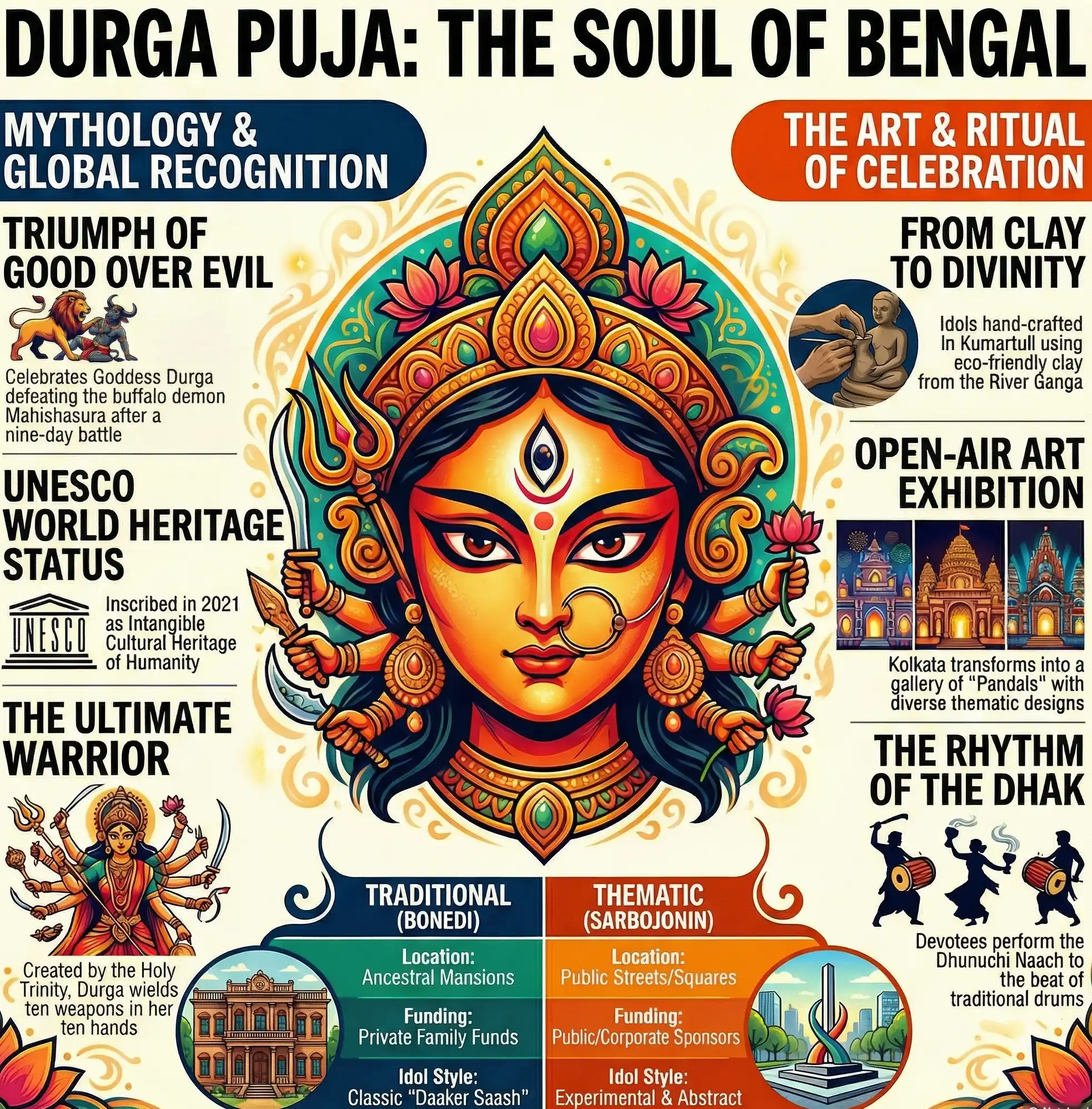
Durga Puja is the most iconic festival of West Bengal, celebrating the victory of Goddess Durga over the buffalo demon Mahishasura, symbolizing the triumph of good over evil. The festival spans ten days (Navaratri), with the main festivities occurring from the sixth (Shashthi) to the tenth day (Dashami). What began as a private celebration in the courtyards of aristocratic (Bonedi) families in the late 16th century evolved into massive community festivals (Sarbojonin) during the colonial era to unite the masses. Today, Kolkata transforms into an open-air art exhibition with thousands of thematic Pandals (temporary shrines). In 2021, Kolkata's Durga Puja was inscribed on the UNESCO Representative List of the Intangible Cultural Heritage of Humanity.| Feature | Details |
| Festival Focus | Goddess Durga’s victory over Mahishasura |
| Duration | 10 Days (Main rituals from 6th to 10th day) |
| Key Location | West Bengal (Epicenter: Kolkata) |
| Idol Makers Hub | Kumartuli (Kolkata) |
| Key Rituals | Bodhon, Pushpanjali, Sandhi Puja, Bisorjon |
| Key Instrument | Dhak (Traditional Bengali Drum) |
| Famous Dance | Dhunuchi Naach (Incense dance) |
| Global Recognition | UNESCO Intangible Cultural Heritage (2021) |
| Economic Impact | Estimated ₹32,000 crore ($3.9 billion USD) |
The Mythology and Origins
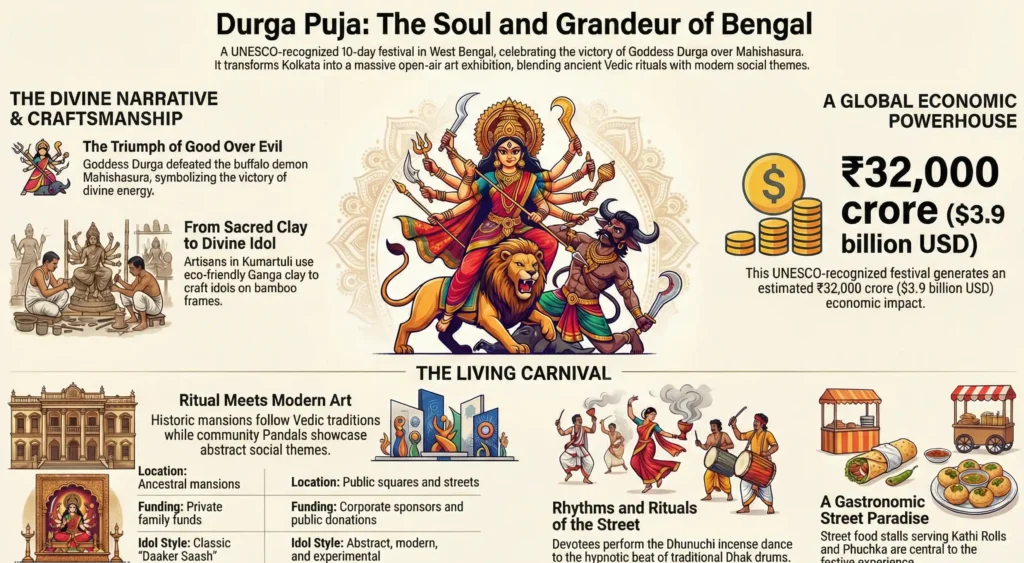
According to Hindu mythology, the powerful buffalo demon Mahishasura defeated the gods and took over heaven. Unable to kill him due to a boon, the holy trinity (Brahma, Vishnu, and Shiva) combined their divine energies to create the ultimate female warrior: Goddess Durga. Armed with ten weapons in her ten hands and riding a lion, she battled Mahishasura for nine days and killed him on the tenth (Vijayadashami). While the roots go back to Vedic times, the grandeur of Bengal’s Durga Puja started in the courtyards of wealthy Zamindars (landlords) in the 16th century. In the 20th century, it shifted to the streets as Sarbojonin (community) pujas, funded by public subscription, playing a key role in the Indian freedom struggle by bringing people together.
Ganesh Chaturthi: Honoring the Elephant-Headed God
Kumartuli: Where Clay Becomes Divine
Months before the festival, the narrow lanes of Kumartuli (the traditional potters’ quarter in North Kolkata) buzz with activity. * The Process: The idols are eco-friendly, made using a bamboo frame (Kathamo), wrapped in straw, and layered with clay collected from the banks of the River Ganga (Hooghly).
- Chokkhu Daan: The final and most sacred touch is the painting of the Goddess’s eyes on the day of Mahalaya, which signifies breathing life into the clay.
Onam: Kerala’s Harvest Festival
The Five Days of Festivity
While the mood sets in on Mahalaya (when the famous Mahishasura Mardini audio is broadcast at dawn), the main rituals are compressed into five days:
- Shashthi (6th Day): The Goddess is welcomed into the Pandal, and her face is unveiled. The ritual of Bodhon (awakening) takes place.
- Saptami (7th Day): The Kola Bou (a banana plant dressed as a bride, symbolizing Ganesha’s wife or nature) is bathed in the river and placed next to Lord Ganesha.
- Ashtami (8th Day): The most auspicious day. Crowds gather for Pushpanjali (floral offerings). The day ends with Sandhi Puja, the exact moment Durga transitioned into her fierce Chamunda form to slay the demons Chanda and Munda. 108 lotus flowers and 108 oil lamps are lit.
- Navami (9th Day): The final day of battle. It is a day of feasting, with community meals (Bhog) of Khichuri and Labra being served to all.
- Dashami (10th Day): The day of farewell.
The Carnival: Pandals, Dhunuchi, and Sindoor Khela
- Pandal Hopping: The temporary bamboo structures (Pandals) are architectural marvels. They range from exact replicas of the Eiffel Tower to abstract installations discussing climate change, women’s rights, or forgotten folk arts. People stay awake all night hopping from one pandal to another. * Dhunuchi Naach: In the evenings, devotees dance to the hypnotic beats of the Dhak (drum) while holding clay pots filled with burning coconut husks and camphor (Dhunuchi). * Sindoor Khela & Bisorjon: On Dashami, before the idol is taken for immersion, married women smear vermilion (Sindoor) on the Goddess and then on each other, celebrating sisterhood and marital bliss. The idol is then immersed in the river (Bisorjon), signifying Durga’s return to Mount Kailash to her husband, Lord Shiva.
Nil Darpan: The Mirror of Indigo
Quick Comparison Table: Traditional vs. Thematic Puja
| Feature | Traditional (Bonedi Bari) Puja | Thematic (Sarbojonin) Puja |
| Location | Ancestral mansions / Courtyards | Public squares / Streets |
| Idol Style | Daaker Saash (Classic, large eyes) | Abstract, Modern, Experimental |
| Focus | Strict Vedic rituals and heritage | Artistic expression and social themes |
| Pandal | Minimalist / Permanent structure | Massive, elaborate temporary structures |
| Funding | Private family funds | Corporate sponsors, Public donations |
Curious Indian: Fast Facts
- The Sacred Soil: Tradition dictates that a handful of soil (Punya Mati) from the courtyard of a sex worker’s house must be mixed with the clay of the Ganges to make the Durga idol. This symbolizes the inclusion of marginalized women and the belief that the Goddess absorbs the purity of society.
- The Mother’s Children: Durga does not come alone. She is accompanied by her four children: Lakshmi (wealth), Saraswati (knowledge), Kartikeya (valor), and Ganesha (success).
- Asura’s Face: Historically, the demon Mahishasura was depicted with traditional features, but during the British Raj, some artisans subtly modeled the demon’s face to look like British officers as a silent protest!
- Street Food Paradise: Durga Puja is the ultimate gastronomic festival. From Kathi Rolls and Fish Fry to Phuchka and Mishti Doi, the street food stalls outside pandals are as important as the idols inside.
Conclusion
Durga Puja is not just a religious ritual; it is the soul of Bengal on display. It blurs the lines between religion and art, devotion and carnival, elite and commoner. When the heavy clay idol sinks into the dark waters of the Hooghly River on Dashami, it leaves behind a tearful city, chanting “Asche bochor abar hobe” (It will happen again next year)—a promise of the eternal return of the Mother, and the resilience of human joy.
Sunayani Devi: A Woman’s Voice in the Bengal School
If you think you have remembered everything about this topic take this QUIZ
Results


#1. In what year was Kolkata’s Durga Puja inscribed on the UNESCO Representative List of the Intangible Cultural Heritage of Humanity?
#2. Which traditional potters’ quarter in North Kolkata is famous for crafting the eco-friendly clay idols of the Goddess?
#3. The sacred ritual of “Chokkhu Daan” performed on Mahalaya signifies breathing life into the clay. What specific action does this involve?
#4. During Sandhi Puja on the eighth day (Ashtami), exactly how many lotus flowers and oil lamps are lit?
#5. What is the name of the traditional dance performed by devotees holding clay pots filled with burning coconut husks and camphor?
#6. On Dashami, before the idol is immersed, married women celebrate sisterhood and marital bliss by smearing which substance on the Goddess and each other?
#7. 7. According to the comparison table, how are the traditional “Bonedi Bari” pujas primarily funded?
#8. 8. Tradition dictates that a handful of soil (Punya Mati) must be mixed with the clay of the Ganges to make the idol. Where is this soil traditionally collected from?
Why is Durga Puja celebrated?
It celebrates the victory of Goddess Durga over the buffalo demon Mahishasura, symbolizing the triumph of good over evil.
What is the significance of the “Dhak”?
The Dhak is a traditional Bengali drum. Its rhythmic beating is essential to all Durga Puja rituals and dances, acting as the heartbeat of the festival.
What happens on Dashami (the 10th day)?
Dashami marks the end of the festival. Women participate in Sindoor Khela (smearing vermilion), followed by the immersion (Bisorjon) of the idol in the river.
What is a “Pandal”?
A Pandal is a temporary, elaborately decorated structure made of bamboo and cloth that houses the idol during the festival.
Why did Kolkata’s Durga Puja get UNESCO recognition?
It was recognized for its role in safeguarding living culture, promoting collective creativity, and acting as an inclusive, large-scale public art installation.