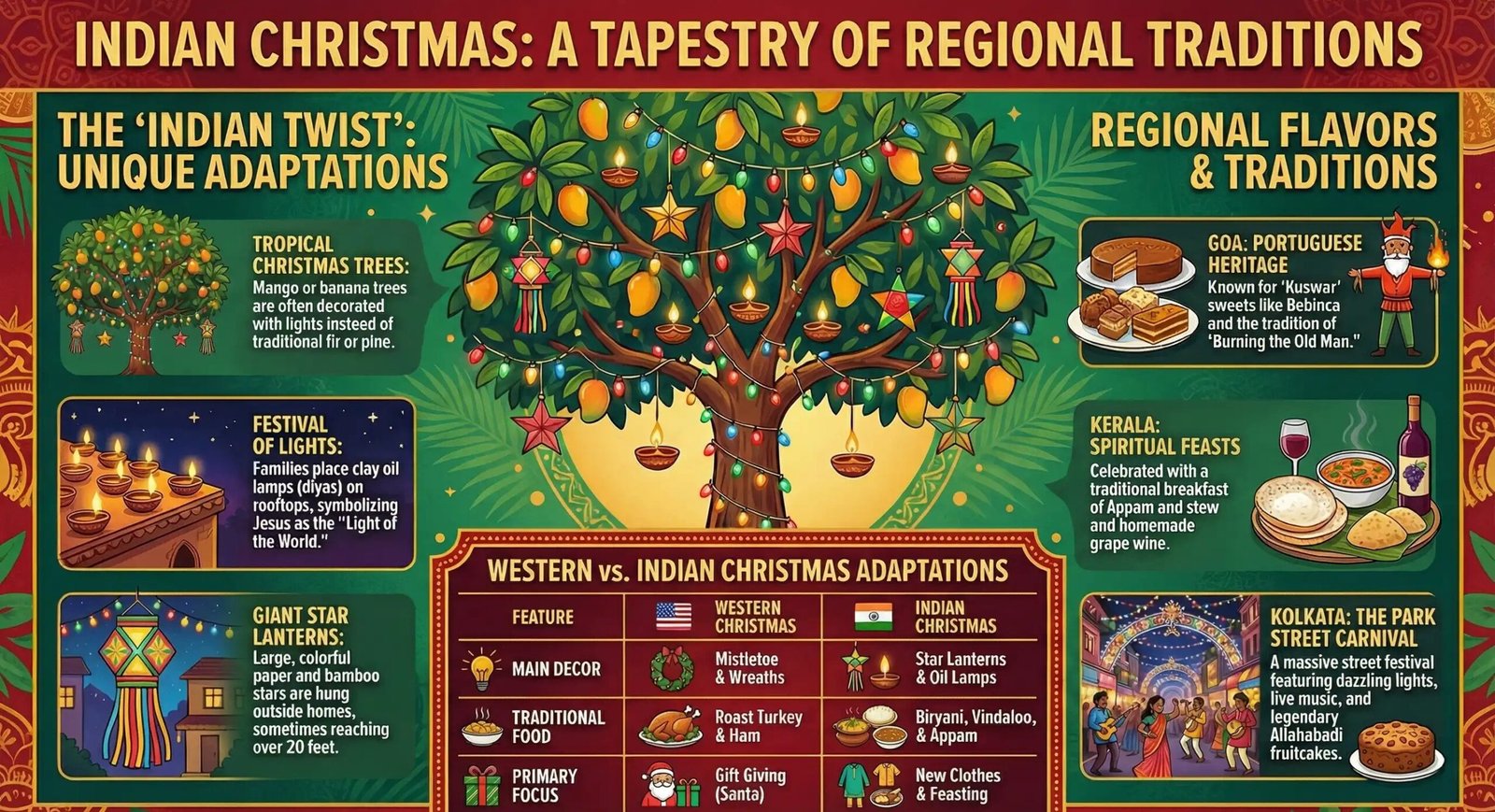
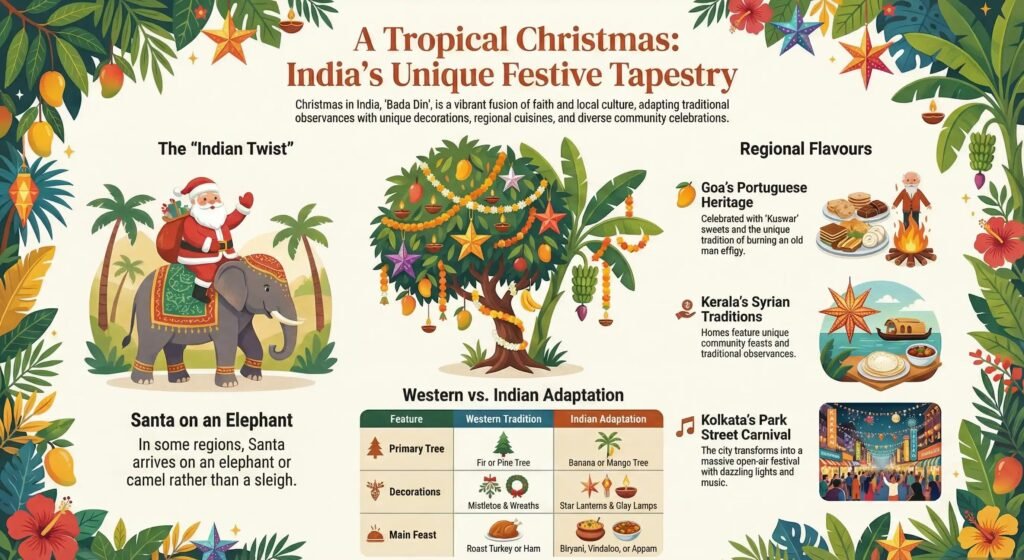
Christmas in India is a vibrant tapestry of global Christian traditions and regional Indian customs. Celebrated on December 25th, it honors the birth of Jesus Christ. While the core religious observance—Midnight Mass—remains central, the cultural expression varies wildly across the subcontinent. In Goa, Portuguese influences dominate with Kuswar sweets and carnivals; in Kerala, Syrian Christian traditions blend with local aesthetics like oil lamps and Appam-Stew; in the Northeast, especially Shillong, community feasts and gospel choirs take center stage; and in Kolkata, the festival becomes a carnival of lights on Park Street. Uniquely, Indian Christmas often features Banana or Mango trees decorated instead of Pine trees, and Clay Oil Lamps placed on rooftops to symbolize Jesus as the light of the world.| Feature | Details |
| Date | December 25 |
| Key Regions | Goa, Kerala, Meghalaya (Shillong), Kolkata, Mumbai |
| Indian Twist | Banana/Mango trees as Christmas Trees |
| Decorations | Star Lanterns (Paper/Bamboo), Clay Oil Lamps (Diyas) |
| Traditional Food | Kuswar (Goa), Appam & Stew (Kerala), Allahabadi Cake |
| Key Sweets | Bebinca, Kulkuls, Rose Cookies, Plum Cake |
| Religious Event | Midnight Mass (Missa de Galo) |
| Famous Spot | Park Street (Kolkata), Basilica of Bom Jesus (Goa) |
A Mosaic of Faiths
Christianity in India is as old as the religion itself, with the Apostle St. Thomas believed to have arrived in Kerala in 52 CE. Over centuries, Portuguese, French, and British influences added layers to this heritage. Today, Christmas is not just a Christian festival but a secular celebration of joy, lights, and food, embraced by people of all faiths.
Eid al-Fitr and Eid al-Adha: Celebrating Faith and Community
The Indian Touch: Mango Leaves and Oil Lamps
While the West has snow and fir trees, India adapts the festival to its tropical climate and culture.
- The Trees: In many South Indian homes, you won’t find a pine tree. Instead, a banana tree or a mango tree in the courtyard is decorated with lights and ornaments.
- The Lights: In Kerala and Tamil Nadu, Christians often light small clay oil lamps (Diyas) on their rooftops and boundary walls, a tradition borrowed from the Hindu festival of Diwali, symbolizing Jesus as the “Light of the World.”
- The Crib: The Nativity scene or “Crib” is a competitive affair in neighborhoods. These often feature local elements—sand, mustard seeds sprouted to look like grass, and figurines made of local clay.
Regional Celebrations: One Festival, Many Flavors
1. Goa: The Rome of the East
Goa comes alive with a carnival atmosphere deeply rooted in its Portuguese heritage.
- Missa de Galo: The Midnight Mass is the main event, often held in historic churches like the Basilica of Bom Jesus.
- Kuswar: This is a collection of traditional Christmas sweets exchanged among neighbors. It includes Bebinca (a layered egg pudding), Dodol (jaggery toffee), Kulkuls (sugar-glazed curls), and Neureos (stuffed pastries).
- Burning the Old Man: On New Year’s Eve, effigies of an old man (symbolizing the old year) are burnt, a unique Goan tradition.
2. Kerala: God’s Own Country
In Kerala, Christmas is a family-centric, spiritual affair.
- The Star: Huge, colorful paper stars are hung outside every Christian home weeks before Christmas.
- The Feast: Christmas breakfast is traditionally Appam (rice pancakes) with Mutton or Vegetable Stew. Lunch is often a grand Biryani or a meat roast.
- Home Wine: Most families brew their own grape wine and bake rich Plum Cakes soaked in rum or brandy.
3. Shillong & The Northeast: A Musical Christmas
Shillong is often called the “Scotland of the East,” and its Christmas is musical.
- Community Feasts: Tribes gather for community feasts where pork dishes like Dohneiiong are served.
- Music: Gospel bands and choirs perform in every street corner. The cold winter air is filled with the sound of guitars and carols sung in English and local dialects.
4. Kolkata: The City of Joy
In Kolkata, Christmas is a “Boro Din” (Big Day) for everyone.
- Park Street: The entire street is illuminated with dazzling lights. It becomes a walking carnival with food stalls and live music.
- Bow Barracks: The Anglo-Indian community here hosts open-air parties with dance and music that go on all night.
- Flurys: A queue outside this legendary bakery for their Christmas cake is a yearly ritual.
Reign of Akbar 1556-1605: The Golden Age of the Mughal Empire
Foodways: The Christmas Table
Indian Christmas food is a spicy departure from the bland roasts of the West.
- Allahabadi Cake: A unique Indian fruitcake from the Anglo-Indian community, made with petha (candied ash gourd), marmalade, and ghee instead of butter.
- Rose Cookies: Known as Achappam in Kerala, these are deep-fried, flower-shaped crispy snacks.
- Meat Dishes: Depending on the region, the main course could be Pork Vindaloo (Goa), Duck Roast (Kerala), or Mutton Biryani (Hyderabad).
Rise of Jainism and Buddhism 6th Century BCE
Quick Comparison Table: Western vs. Indian Christmas
| Feature | Western Christmas | Indian Christmas |
| Tree | Fir / Pine Tree | Banana / Mango / Artificial Pine |
| Decor | Mistletoe, Wreaths | Star Lanterns, Oil Lamps, Mango Leaves |
| Main Food | Roast Turkey, Ham | Biryani, Pork Vindaloo, Appam & Stew |
| Sweets | Gingerbread, Pudding | Kuswar, Rose Cookies, Plum Cake |
| Weather | Winter / Snow | Tropical / Mild Winter |
| Focus | Gift Giving (Santa) | New Clothes & Feasting |
Curious Indian: Fast Facts
- Did Akbar celebrate Christmas? The Mughal Emperor Akbar was very tolerant and curious about other faiths. He received Jesuit missionaries from Goa in his court, who introduced him to Christian art and the story of the Nativity.
- The Giant Star: In Kerala, inter-church competitions for making the largest and most intricate “Christmas Star” are common, with some stars measuring over 20 feet!
- Santa on an Elephant? In some tourist areas or processions, you might see Santa Claus arriving on an elephant or a camel instead of a sleigh!
- Midnight Mass Timing: In many Indian cities, due to noise regulations or safety, the “Midnight” mass is often held around 8:00 PM or 10:00 PM.
Conclusion
Christmas in India is a beautiful example of how a global faith can find a local home. It is a festival that has shed its foreign skin to wear a colorful Indian sari. Whether it is the sound of carols in a tribal dialect in Meghalaya or the taste of spicy pork sorpotel in Goa, Indian Christmas is a celebration of diversity, warmth, and the universal spirit of giving.
Sunayani Devi: A Woman’s Voice in the Bengal School
If you think you have remembered everything about this topic take this QUIZ
Results


#1. According to the source material, which figure is traditionally believed to have brought Christianity to India in 52 CE?
#2. In the tropical climate of South India, which plants are frequently decorated as alternatives to traditional pine trees?
#3. What is the symbolic meaning behind lighting clay oil lamps (Diyas) on rooftops during an Indian Christmas?
#4. Which unique Goan tradition is performed on New Year’s Eve to mark the end of the year?
#5. What distinguishes an ‘Allahabadi Cake’ from traditional Western fruitcakes?
#6. In Kerala, what is the traditional breakfast served on Christmas morning?
#7. Which city is famous for transforming Park Street into a carnival of lights and hosting parties in Bow Barracks?
#8. Why is the traditional ‘Midnight Mass’ often held as early as 8:00 PM or 10:00 PM in many Indian cities?
How do Indians say “Merry Christmas”?
While “Merry Christmas” is widely used, in Hindi it is “Bada Din Mubarak” (Happy Big Day).
What is “Kuswar”?
Kuswar is a collection of traditional Christmas sweets and snacks prepared in Goa and Mangalore, including items like Bebinca, Kulkuls, and Neureos.
Which Indian city is famous for its Christmas carnival on Park Street?
Kolkata (West Bengal).
Do non-Christians celebrate Christmas in India?
Yes, widely! People of all religions visit churches to see the decorations, eat cake, and enjoy the holiday atmosphere.
What is the traditional Christmas breakfast in Kerala?
Appam (rice hoppers) with Stew (chicken, mutton, or vegetable).