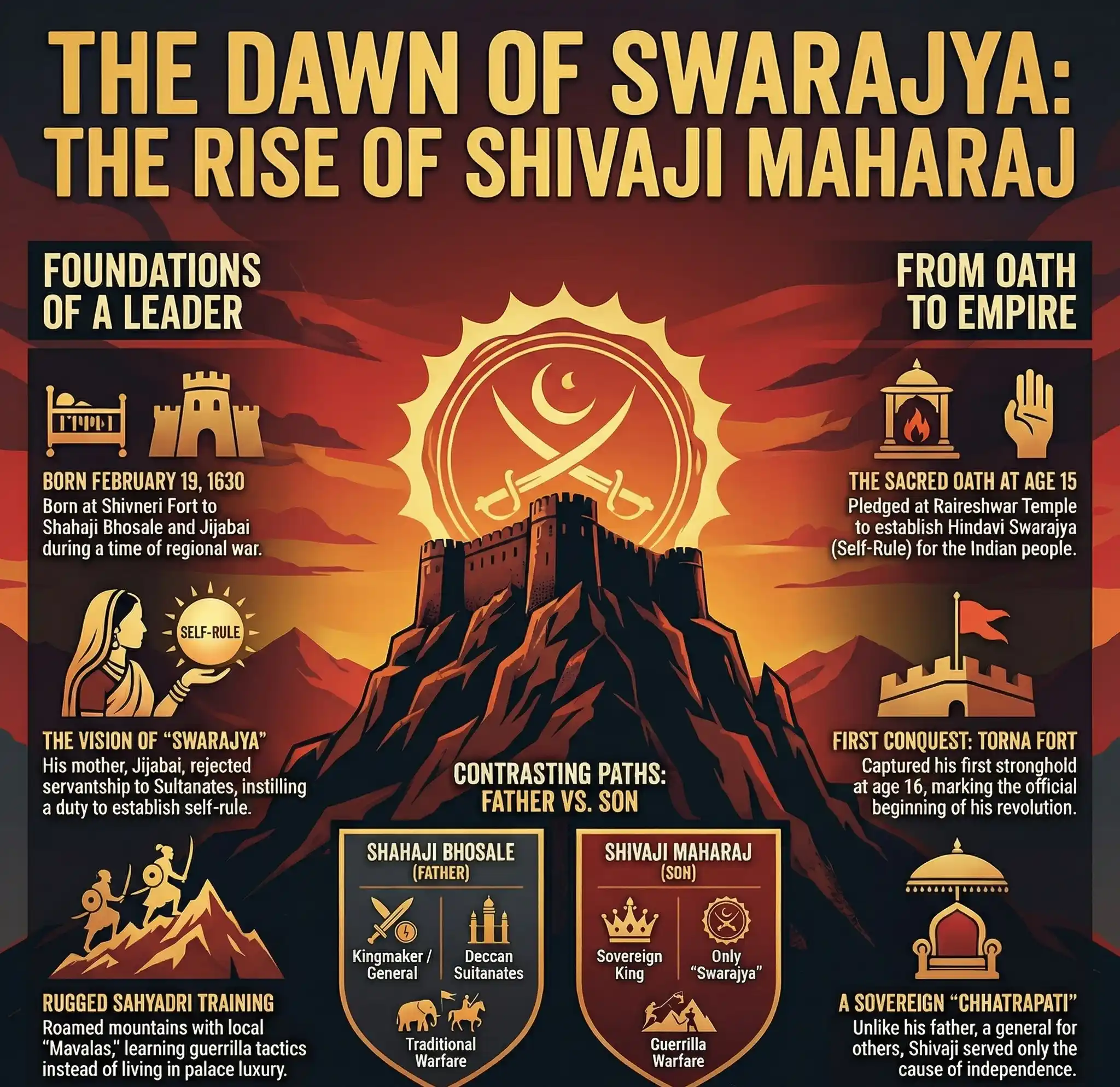
Chhatrapati Shivaji Maharaj was born on February 19, 1630, at the hill fort of Shivneri, near Junnar in the Pune district. He was born to Shahaji Bhosale, a high-ranking Maratha general who served various Deccan Sultanates, and Jijabai, a devout and strong-willed woman from the Jadhav clan of Sindkhed Raja. His birth came at a time of immense political instability, with the Deccan being torn apart by wars between the Nizam Shahi, Adil Shahi, and the invading Mughals. Named after the local goddess Shivai, to whom his mother had prayed for a son, Shivaji was raised primarily by his mother and his guardian Dadoji Konddeo, who instilled in him the values of Swaraj (Self-Rule) and righteousness (Dharma) that would later define his kingdom.| Feature | Details |
| Date of Birth | February 19, 1630 (Official Government Date) |
| Birthplace | Shivneri Fort, Junnar (Pune District) |
| Father | Shahaji Bhosale |
| Mother | Jijabai (Rajmata) |
| Named After | Goddess Shivai |
| Mentor/Guardian | Dadoji Konddeo |
| Clan | Bhonsle (Maratha) |
| First Conquest | Torna Fort (at age 16) |
A Child of Turbulent Times
The early 17th century in the Deccan was a period of chaos. The Mughal Empire, under Shah Jahan, was aggressively pushing south, trying to crush the local Sultanates of Ahmednagar (Nizam Shahi) and Bijapur (Adil Shahi). Shahaji Bhosale, Shivaji’s father, was a kingmaker in this region, constantly shifting alliances to protect his jagir (land grants) and the independence of the Deccan states.
It was in this atmosphere of war and uncertainty that a pregnant Jijabai was moved to the safety of Shivneri Fort, a formidable stronghold surrounded by steep cliffs.
Establishment of the British Raj 1858: The Dawn of Imperial India
The Prayers to Goddess Shivai
Jijabai had lost several children in infancy and was desperate for a healthy heir who could stand against the oppression of the foreign rulers. She prayed fervently to the local deity of the fort, Goddess Shivai. On February 19, 1630, her prayers were answered. A son was born, and in gratitude, she named him Shivaji.
Unlike typical royal births celebrated with pomp, Shivaji’s birth was quiet. His father, Shahaji, was away on a military campaign, pursued by Mughal forces. For the first few years of his life, Shivaji and his mother lived a nomadic existence, moving from fort to fort to evade capture.
Death of Tipu Sultan: The Fall of the Tiger of Mysore
The Making of a King: Jijabai’s Influence
While Shahaji was busy with politics in Bangalore (where he later established a separate court), Shivaji was left in Pune under the care of Jijabai. This separation was crucial. Jijabai became the single most influential figure in his life.
- Stories of Valor: Instead of fairy tales, she told him stories from the Ramayana and Mahabharata, instilling in him the idea that it was his duty to destroy evil and establish righteousness.
- Vision of Swaraj: She famously told him, “You are not born to be a servant of the Sultans like your father. You are born to establish Swarajya for your people.”
The Training Ground: Pune
When Shivaji moved to Pune, the city was in ruins, having been devastated by Adil Shahi raids. Under the administration of his guardian, Dadoji Konddeo, the city was rebuilt.
- The Golden Plough: To symbolize the restoration of order, a golden plough was driven through the fields of Pune.
- Martial Arts: Shivaji was not trained in the comfort of a palace. He roamed the Sahyadri mountains with the Mavalas (local peasant boys). He learned every valley, pass, and cave in the region. These Mavalas—Yesaji Kank, Tanaji Malusare, and Baji Pasalkar—became his most trusted generals.
The Oath of Swaraj
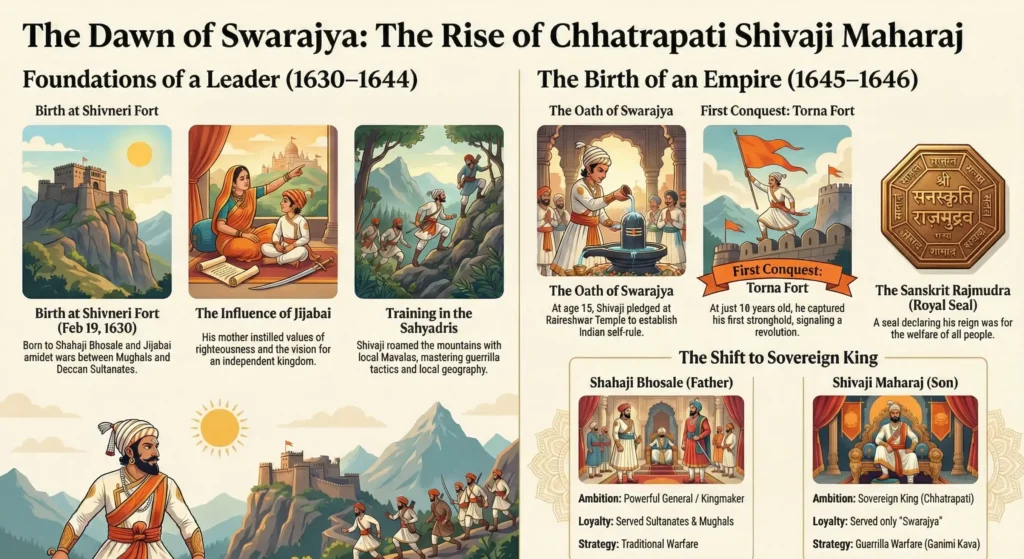
At the young age of 15, Shivaji gathered his friends at the Raireshwar Temple. In front of the Shiva Lingam, he cut his little finger and smeared blood on the deity, taking a solemn oath to establish Hindavi Swarajya (Self-Rule of Indian people). This was not just a rebellion; it was a revolution. Shortly after, in 1646, he captured his first fort, Torna, marking the beginning of the Maratha Empire.
Third Battle of Panipat 1761: The Day the Maratha Dream Died
Quick Comparison Table: Shahaji vs. Shivaji
| Feature | Shahaji Bhosale (Father) | Shivaji Maharaj (Son) |
| Ambition | Kingmaker / Powerful General | Sovereign King (Chhatrapati) |
| Loyalty | Served Deccan Sultanates & Mughals | Served only “Swarajya” |
| Base | Bangalore / Mobile | Pune / Raigad |
| Strategy | Traditional Warfare | Guerrilla Warfare (Ganimi Kava) |
| Legacy | Great General | Founder of an Empire |
Curious Indian: Fast Facts
- The Date Debate: While the Maharashtra government officially celebrates Shiv Jayanti on February 19, some historians argue for April 6, 1627, based on different astrological calculations (Bakhar records).
- The Tiger Claw: Shivaji is famous for using the Wagh Nakh (Tiger Claw) weapon to kill Afzal Khan later in life, a skill he likely honed during his training in the Sahyadris.
- No Palace Childhood: Unlike Mughal princes who grew up in harems and luxury, Shivaji grew up in the rugged terrain of the Western Ghats, which made him physically tough and mentally agile.
- The Seal: Shivaji’s royal seal (Rajmudra) was in Sanskrit, unlike the Persian seals used by his father and other rulers of the time. It read: “This seal of Shiva, son of Shahaji, shines for the welfare of all, like the new moon.”
Conclusion
The Birth of Shivaji Maharaj was the birth of a new idea in India. Before him, Maratha warriors were mercenaries fighting for others. Shivaji gave them a cause to fight for themselves. His upbringing at Shivneri and Pune, far from the corrupting influence of the royal courts, allowed him to build a kingdom that was rooted in the soil of Maharashtra. He proved that a king doesn’t need a golden spoon; he needs a golden vision.
Reign of Aurangzeb 1658-1707: The Zenith and Decline of the Mughals
If you think you have remembered everything about this topic take this QUIZ
Results


#1. What is the name of the hill fort where Chhatrapati Shivaji Maharaj was born on February 19, 1630?
#2. Shivaji was named after which local deity to whom his mother, Jijabai, had fervently prayed for a healthy heir?
#3. Who was Shivaji’s guardian and mentor that helped administer the rebuilding of Pune and instilled in him the values of Swaraj?
#4. What symbolic act was performed in the fields of Pune to represent the restoration of order after it was devastated by raids?
#5. At the age of 15, Shivaji and his friends took a solemn oath to establish Hindavi Swarajya at which temple?
#6. According to the comparison table, what type of warfare strategy was Shivaji famous for utilizing, which contrasted with his father’s traditional methods?
#7. What was the name of the very first fort Shivaji captured at the young age of 16, marking the beginning of the Maratha Empire?
#8. Unlike the Persian seals used by his father and other rulers of the time, in what language was Shivaji’s royal seal (Rajmudra) inscribed?
When was Shivaji Maharaj born?
He was born on February 19, 1630.
Where was Shivaji Maharaj born?
He was born at Shivneri Fort, near Junnar in Pune district.
Who were Shivaji Maharaj’s parents?
His father was Shahaji Bhosale and his mother was Jijabai.
Why was he named Shivaji?
He was named after the local deity Goddess Shivai, to whom his mother had prayed for a son.
Who was Shivaji’s teacher/guardian?
Dadoji Konddeo was his guardian and administrator who trained him in statecraft and warfare.