The first day of Chaitra, observed as Gudi Padwa in Maharashtra and Ugadi across Karnataka, Andhra Pradesh, and Telangana, is one of the most mythologically dense dates in the Hindu calendar. It is simultaneously the Hindu New Year of the lunisolar tradition, the day associated with Brahma's act of creation at the beginning of the current cosmic cycle, the day of Rama's return to Ayodhya, and most significantly the day commemorating Vishnu's victory over the demon king Bali through the Vamana avatar, the fifth of Vishnu's ten principal incarnations. The mythology of Vamana and Bali is not simply a story of divine triumph over demonic power. It is a complex theological narrative about the nature of cosmic order, the paradox of righteous demonic virtue, the mechanism of divine grace, and the sacrifice of sovereignty that is encoded in the ritual objects, foods, and practices of both Gudi Padwa and Ugadi in ways that reveal how deeply the festival's observance is rooted in its mythological foundation.| Detail | Information |
| Festival Name | Gudi Padwa (Maharashtra) / Ugadi (Karnataka, Andhra Pradesh, Telangana) |
| Observed On | First day of Chaitra month, Shukla Pratipada, Hindu lunisolar calendar |
| Typical Gregorian Date | March to April, varying annually with the lunar calendar |
| Primary Communities | Marathi Hindus, Kannada Hindus, Telugu Hindus, Konkani communities |
| Central Mythological Event | Vishnu’s victory over the demon king Bali through the Vamana avatar |
| Secondary Mythological Associations | Brahma’s creation of the universe, Rama’s return to Ayodhya after defeating Ravana |
| Central Ritual Object | Gudi, a decorated staff raised outside homes on the festival morning |
| Regional Name Variants | Gudi Padwa, Ugadi, Yugadi, Samvatsaradi, Chaitra Shukla Pratipada |
The Demon King Who Was Too Generous
The story of Bali is one of the most theologically nuanced narratives in the entire Puranic tradition, and understanding it is essential to understanding why his defeat defines one of the most important festival days in the Hindu calendar.
Bali, also called Mahabali or Maveli, was the grandson of the great devotee Prahlada and the great-grandson of Hiranyakashipu. He was a demon king, an asura, by birth and by cosmic classification. He was also, by character and by practice, a ruler of extraordinary virtue. His kingdom was governed with justice. His subjects lived in prosperity and equality. He was renowned across the three worlds for his generosity, a quality so absolute that it was understood as beyond the capacity of even the most virtuous of the devas to match. He performed the great Vishwajit yajna, the conquest sacrifice, and through this ritual accumulated power so vast that he displaced Indra from his throne, took control of the heavens, and established a sovereignty over all three worlds that the devas could not challenge through any conventional means.
Ancient Agricultural Myths That Shape the Magh Bihu Harvest Festival
This is the problem that the Vamana story addresses. Bali was not evil. He was righteous and generous and capable, and his dominion over the three worlds was, in the strict terms of earned power, entirely legitimate. But his sovereignty disrupted the cosmic order that required the devas to maintain their designated positions in the hierarchy of the three worlds. The disruption was real even though its cause was virtuous. The cosmos required rebalancing even though Bali himself did not require punishment in any moral sense.
This theological complexity is what makes the Vamana avatar one of the most philosophically interesting of Vishnu’s incarnations. Vishnu did not descend to defeat a tyrant. He descended to address a cosmic imbalance caused by a virtue so extreme that it had overflowed its designated boundaries.
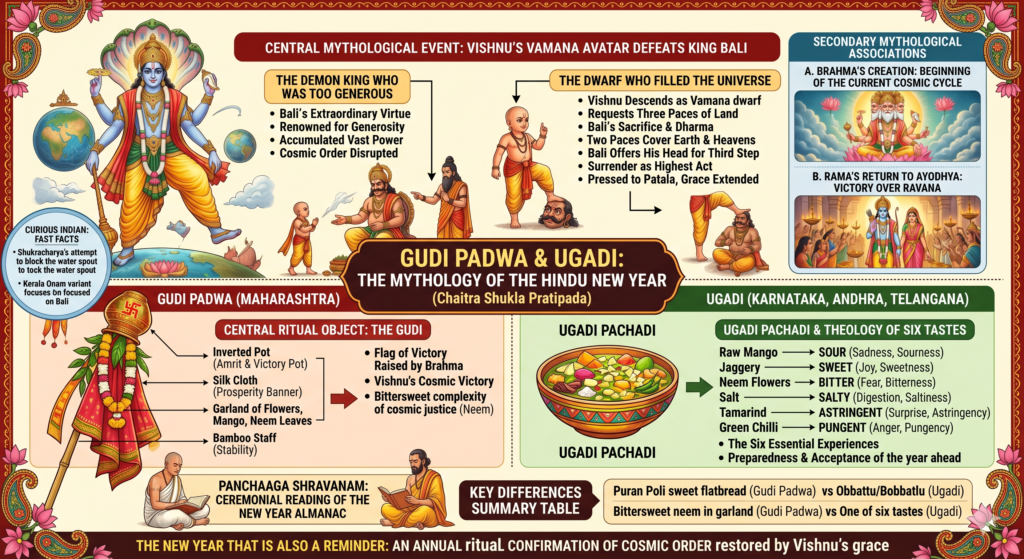
The Dwarf Who Filled the Universe
Vishnu was born as Vamana, the dwarf, to the sage Kashyapa and his wife Aditi, who was the mother of the devas and who had performed a great penance asking Vishnu to intervene and restore her sons to their rightful positions. Vamana appeared as a small brahmin boy, simple in appearance, carrying only a water pot, an umbrella, and a staff.
He traveled to the great sacrifice that Bali was performing under the guidance of his guru Shukracharya, the preceptor of the asuras, and asked to be granted a boon. Bali, whose generosity was absolute and whose practice was to refuse no supplicant who came to him during a sacrifice, agreed before hearing what the boon would be. Vamana asked for three paces of land, measured by his own small feet.
Shukracharya, who recognized Vamana immediately as Vishnu in disguise, warned Bali not to grant the boon. Bali refused to withdraw his promise. A king who granted a boon and then withdrew it, he said, was a king who had abandoned his dharma. His generosity was not a strategy. It was his nature. He could no more withdraw the boon than he could withdraw his character. He took the ritual water vessel and poured the water of formal gift-giving over Vamana’s hands.
How Goa’s Shigmo Festival Carries Myths Older Than Its Own Name
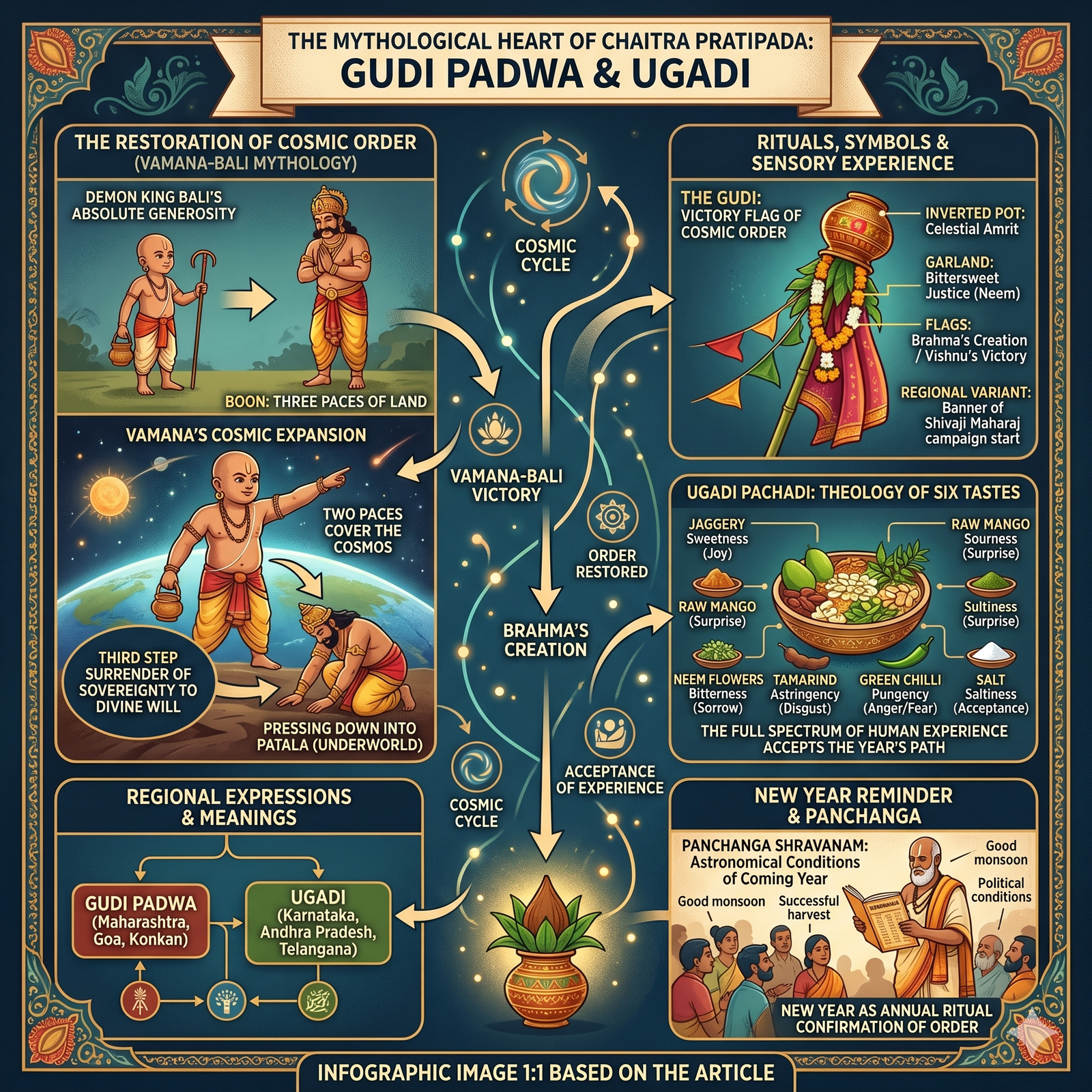
At that moment Vamana began to grow. The small brahmin boy expanded beyond the boundaries of the material world, his form filling the entire cosmos until his first step covered the earth and his second step covered the heavens. There was nowhere left for the third step. The entire sovereignty of the three worlds had been encompassed in two paces, and the third pace had no territory to fall on except Bali himself.
Bali, understanding what was happening and understanding it with complete clarity, bowed his head and offered it to Vamana for the third step. He had given his word. His word encompassed everything he had, including himself. Vishnu placed his foot on Bali’s head and pressed him down into the underworld, the Patala, granting him sovereignty there and, in some versions of the narrative found in the Bhagavata Purana, granting him the boon that Vishnu himself would stand guard at the door of his underworld kingdom as his personal doorkeeper.
According to scholarship maintained by the Bhandarkar Oriental Research Institute in Pune, which holds one of the most significant collections of Sanskrit Puranic manuscripts in India, the Vamana-Bali narrative appears in its fullest form in the Bhagavata Purana’s eighth skandha and in the Vamana Purana, with significant variations in the theological emphasis placed on Bali’s virtue and Vishnu’s grace across different textual traditions, reflecting the narrative’s central importance to theological debate about the relationship between cosmic order, individual dharma, and divine intervention.
Why This Day and Not Another
The connection of the Vamana-Bali narrative to the first day of Chaitra is not arbitrary. The Shukla Pratipada of Chaitra, the first day of the bright fortnight of the first month of the Hindu lunisolar year, is understood in Vedic astronomical tradition as the day when the current cosmic cycle, the present Kalpa or the present Manvantara, began its count. It is the day of beginnings in the most fundamental cosmic sense, the moment when ordered time commenced its current iteration.
The restoration of cosmic order that the Vamana-Bali narrative enacts is therefore most appropriately commemorated on the day that most fully embodies the principle of cosmic order recommencing. The victory of Vishnu over Bali’s disruption of the three-world hierarchy is a story of order restored. The first day of Chaitra is the day on which order, in the most cosmic possible sense, originally began. The festival at the intersection of these two principles is not simply a New Year celebration. It is an annual ritual confirmation that the cosmic order established at the beginning of time and restored by Vishnu’s intervention continues to hold, that the arrangement of the three worlds is intact, and that the current year begins under the protection of that arrangement.
The Gudi and What It Proclaims
The most distinctive ritual object of Gudi Padwa is the Gudi itself, the decorated staff that Maharashtrian Hindu households raise outside their homes, typically at the entrance or from a window or rooftop, on the morning of the festival.
The Gudi is constructed from a long bamboo staff topped with a bright silk cloth, usually in red, yellow, or green, over which a garland of flowers, mango leaves, and neem leaves is arranged, with a copper or silver pot inverted over the top as the crown of the assembly. The completed Gudi is raised upright and tied in place so that it is visible from the street, a proclamation made in physical form by the household raising it.
The symbolism of the Gudi connects directly to the Vamana-Bali mythology through the concept of the victory flag. In the tradition of the festival, the Gudi represents the flag of victory raised by Brahma to mark the beginning of creation, and simultaneously the flag raised to commemorate Vishnu’s cosmic victory in the Vamana avatar. The inverted pot at its crown is understood as the celestial pot of amrit, the nectar of immortality, placed in position of honor at the summit of the victory symbol. The garland of neem leaves, whose bitterness is one of the defining tastes of the festival’s food traditions, references the bittersweet complexity of cosmic justice, the fact that Bali’s defeat was simultaneously a loss for a virtuous being and a necessary restoration of order.
Some interpretations within the Marathi tradition also connect the Gudi to the banner raised by the Maratha king Chhatrapati Shivaji Maharaj at the beginning of a successful military campaign, adding a historical and martial layer to the mythological symbolism that reflects the festival’s significance in the Maharashtrian cultural identity beyond its Puranic foundation.
Mythological Origins of the Kumbh Mela and Descent of the Ganga
The Ugadi Pachadi and the Theology of Six Tastes
The most theologically precise expression of the Vamana-Bali mythology’s emotional complexity in the festival’s food traditions is the Ugadi Pachadi, the ritual preparation consumed on the morning of Ugadi across Karnataka, Andhra Pradesh, and Telangana.
The Ugadi Pachadi is a mixture of six distinct tastes prepared from six specific ingredients. Raw mango contributes sourness. Jaggery contributes to sweetness. Neem flowers contribute bitterness. Salt contributes to saltiness. Tamarind contributes astringency. Green chilli contributes pungency. All six are mixed together and consumed together, the six tastes experienced simultaneously in a single preparation.
The theological meaning of the Ugadi Pachadi is explicit and deliberate. The six tastes represent the six essential experiences of a human life, joy and sorrow, surprise and disgust, fear and anger, the full range of what a year of living will contain. Consuming all six tastes together at the beginning of the new year is an act of preparedness and acceptance, an acknowledgment that the year ahead will contain everything, not just the sweetness of Bali’s generosity or the triumph of Vishnu’s cosmic victory but the bitterness of Bali’s loss, the astringency of Shukracharya’s unheeded warning, the pungency of the moment when Bali bowed his head.
The Ugadi Pachadi encodes the Vamana-Bali story’s moral complexity in a preparation eaten by millions of people who may not consciously articulate that connection but who absorb its theological teaching through the act of tasting all six flavors together on the first morning of the year. It is one of the most elegant examples anywhere in Indian festival culture of mythology transmitted through sensory experience rather than through narrative.
According to research compiled by the Karnataka Janapada Vishwavidyalaya, the folk and tribal university of Karnataka that functions as the state’s primary institution for the documentation of Karnataka’s traditional cultural knowledge systems, the Ugadi Pachadi preparation and its associated theological interpretation represent one of the oldest continuously transmitted food-based ritual practices in the Deccan, with references to the six-taste ritual preparation appearing in pre-medieval Kannada literary sources.
The New Year That Is Also a Reminder
The new year dimension of Gudi Padwa and Ugadi is inseparable from the mythological dimension, and understanding this inseparability is key to understanding what the festival actually does for the communities that observe it.
A secular new year is a calendar marker. It tells you a count has advanced, a number has changed, a new accounting period has begun. The new year of Chaitra Shukla Pratipada does something categorically different. It tells you that the current cosmic cycle, established by Brahma’s creative act at the beginning of ordered time, has completed another year of its operation. It tells you that Vishnu’s restoration of cosmic order in the Vamana avatar continues to hold, that the arrangement of the three worlds is intact as the new count begins. It tells you, through the bitterness of the neem in the Gudi’s garland and the Ugadi Pachadi’s six tastes, that the year you are entering will contain the full spectrum of experience and that wisdom consists of accepting rather than resisting that fullness.
The Panchanga Shravanam, the ceremonial reading of the new year almanac by a priest or elder on Ugadi morning, extends this understanding into the practical domain. The Panchanga details the specific astrological and astronomical conditions of the coming year, the rains, the agricultural prospects, the political conditions, the health outlook, all read from the positions of the celestial bodies at the moment of the new year’s beginning. This reading connects the mythological new year to the lived agricultural year in the same gesture, anchoring the cosmic narrative of Vamana and Bali to the practical concerns of the farming communities for whom a good monsoon and a successful harvest are the most immediate expressions of the cosmic order being in the state that the festival confirms.
Goddess Kamakhya and Mythology Behind the Ambubachi Mela
The Brahma Dimension
The Vamana-Bali narrative is the most specific mythological content attached to Chaitra Shukla Pratipada, but it shares the day with an equally ancient and equally significant cosmic event in Hindu mythological tradition, the act of creation by Brahma that initiated the current universal cycle.
The first day of Chaitra is understood in the Puranic tradition as the day on which Brahma began the process of creation at the start of the current Kalpa, the current day of Brahma in the vast cyclical time scale of Hindu cosmology. This creative act established the fundamental conditions of the world as it currently exists, including the relationships between the devas and asuras, the structure of the three worlds, and the conditions that would eventually require Vishnu’s intervention in the Vamana avatar to restore.
The Brahma creation narrative and the Vamana-Bali narrative are therefore not competing mythological explanations for the same festival day. They are sequential chapters in the same cosmic story. Creation establishes the order. Disruption challenges the order. Restoration confirms the order. The first day of Chaitra commemorates all three movements simultaneously, making it one of the most cosmologically complete festival days in the Hindu calendar.
Quick Comparison Table
| Aspect | Gudi Padwa | Ugadi |
| Primary Region | Maharashtra, Goa, Konkan | Karnataka, Andhra Pradesh, Telangana |
| Central Ritual Object | Gudi, decorated bamboo staff with inverted pot | Ugadi Pachadi, six-taste ritual preparation |
| Mythological Emphasis | Victory flag of Vishnu and Brahma’s creation | Six-taste theology of Bali narrative’s complexity |
| New Year Almanac | Panchanga read at temple or by family priest | Panchanga Shravanam, public ceremonial reading |
| Food Tradition | Puran Poli sweet flatbread, neem-jaggery mixture | Ugadi Pachadi, Obbattu or Bobbatlu sweet flatbread |
| Neem Significance | Bittersweet complexity of cosmic justice | One of six tastes in Ugadi Pachadi |
| Community Range | Marathi Hindu, Konkani | Kannada, Telugu Hindu communities |
Curious Indian: Fast Facts
- The Vamana avatar is the fifth of Vishnu’s Dashavatara, the ten principal incarnations, and is the only one in which Vishnu takes a form specifically described as small and unimposing, making the cosmic expansion that follows one of the most dramatic transformations in Puranic narrative.
- Shukracharya, the guru of the asuras who warned Bali not to grant the boon to Vamana, is said to have used his supernatural power to block the spout of Bali’s ritual water vessel to prevent the formal gift-giving gesture from being completed, but Vamana cleared the blockage with a blade of grass.
- The inverted copper or silver pot placed at the crown of the Gudi is understood in different regional interpretations as representing the celestial pot of amrit, the head of the demon Ravana defeated by Rama, and the vessel of cosmic abundance placed in the position of honor at the victory symbol’s summit.
- The Ugadi Pachadi’s six tastes correspond directly to the six rasas of classical Indian aesthetics and culinary philosophy, connecting the festival’s food theology to one of the oldest systematic frameworks for understanding human sensory and emotional experience in Sanskrit intellectual tradition.
- Bali’s grant of the third step of land as his own head is interpreted in the Bhagavata Purana as the highest possible act of surrender to divine will, making his defeat simultaneously his greatest spiritual achievement and the moment at which Vishnu’s grace was most fully extended to him.
- The Panchanga Shravanam ceremony of Ugadi, in which the new year almanac is read publicly, is one of the few surviving examples of a civic ritual in which astronomical and astrological calculation is performed in a publicly shared ceremonial context rather than as a private consultation.
- In the Kerala version of the Bali mythology, celebrated as Onam in the month of Chingam, Bali is remembered not as a defeated demon but as a beloved king whose annual return his subjects still await, reflecting a regional mythological tradition in which Bali’s virtue rather than Vishnu’s victory is the emotional center of the narrative.
Conclusion
The first day of Chaitra is not a simple new year. It is an annual confrontation with questions that have no comfortable answers. The Vamana-Bali story does not offer a morality tale in which the villain is defeated and virtue is rewarded. It offers something considerably more difficult, a narrative in which a genuinely righteous being is defeated by a genuinely righteous deity for the sake of a genuinely necessary cosmic rebalancing, and in which the virtue of the defeated party is acknowledged, honored, and ultimately rewarded in a form that transcends conventional victory and defeat.
The Gudi raised on a Maharashtrian doorstep on the morning of Gudi Padwa does not simply proclaim victory. It proclaims the complexity of what victory means when it is cosmic rather than military, when the defeated party is also a devotee, and when the grace extended to the defeated exceeds in its depth anything that conventional triumph could offer.
The neem in the garland and the six tastes in the Ugadi Pachadi say the same thing in a different register. The year you are entering will not be only sweet. It will be bitter and sour and astringent and pungent and salty alongside its sweetness. Wisdom is not the elimination of difficult tastes. It is the capacity to receive all of them together, as Bali received the three steps of Vamana, without withdrawing the open hand.
That teaching, encoded in a ritual preparation eaten on a festival morning by millions of people across Maharashtra, Karnataka, Andhra Pradesh, and Telangana, is what the first day of Chaitra has been saying for as long as anyone has been listening.
Vishwakarma Puja and the Ancient Theology Behind Worship of Tools
If you think you have remembered everything about this topic take this QUIZ
Results


#1. According to the text, which central mythological event is commemorated on Gudi Padwa and Ugadi?
#2. What theological reason does the text give for Vishnu intervening to defeat King Bali?
#3. In which specific text does the Vamana-Bali narrative appear in its fullest form according to scholarship mentioned?
#4. Why is the first day of Chaitra considered the most appropriate date to commemorate the Vamana-Bali narrative?
#5. What does the inverted copper or silver pot at the crown of the Gudi symbolize in the festival tradition?
#6. Which of the following correctly pairs an ingredient of the Ugadi Pachadi with the specific taste it contributes?
#7. Which institution is noted for researching the Ugadi Pachadi preparation as one of the oldest continuously transmitted food-based rituals in the Deccan?
#8. How does the regional mythological tradition of Bali differ in the Kerala festival of Onam compared to the Chaitra New Year celebrations?
What is the mythological connection between the first day of Chaitra and the Vamana avatar?
The first day of Chaitra, Shukla Pratipada, is associated with Vishnu’s cosmic victory over the demon king Bali through the Vamana avatar, the fifth of his ten principal incarnations. Bali’s dominion over the three worlds had disrupted the cosmic order that required the devas to maintain their designated positions. Vishnu descended as Vamana, a dwarf brahmin, asked Bali for three paces of land, expanded to fill the entire cosmos in two steps, and pressed Bali into the underworld with the third, restoring cosmic order. The day commemorates this restoration simultaneously with the Brahma creation narrative and Rama’s return to Ayodhya.
Who was Bali and why is his defeat theologically complex?
Bali was a demon king of extraordinary virtue, the grandson of the great devotee Prahlada, who governed his kingdom with justice, maintained absolute generosity, and accumulated cosmic power through righteous sacrifice. His dominion over the three worlds was legitimate by the standards of earned power but disrupted the cosmic hierarchy that required the devas to occupy their designated positions. His defeat by Vishnu was not a moral punishment but a cosmic rebalancing, and his virtue was acknowledged by Vishnu granting him sovereignty over the underworld and, in some Puranic versions, standing as his personal doorkeeper.
What is the Ugadi Pachadi and what does it mean theologically?
The Ugadi Pachadi is a ritual preparation consumed on Ugadi morning across Karnataka, Andhra Pradesh, and Telangana, made from six ingredients representing six tastes: raw mango for sourness, jaggery for sweetness, neem flowers for bitterness, salt for saltiness, tamarind for astringency, and green chilli for pungency. The six tastes represent the full range of experience a year of life will contain. Consuming all six together is an act of acceptance and preparedness that encodes the moral complexity of the Vamana-Bali narrative, acknowledging that the year ahead will contain joy and sorrow, triumph and loss, in inseparable combination.
What does the Gudi represent in Gudi Padwa?
The Gudi is a decorated bamboo staff topped with bright silk cloth, flower garlands, neem and mango leaves, and an inverted copper or silver pot, raised outside Maharashtrian homes on the morning of Gudi Padwa. It represents the victory flag raised to commemorate Vishnu’s cosmic triumph in the Vamana avatar and simultaneously the flag raised by Brahma to mark the beginning of creation. The inverted pot at its crown represents the celestial pot of amrit placed in honor at the summit of the victory symbol. The neem in its garland references the bittersweet complexity of cosmic justice embedded in the Bali narrative.
How does the Bali mythology of Chaitra differ from the Kerala Onam tradition?
While Gudi Padwa and Ugadi frame the Vamana-Bali narrative as a cosmic victory requiring annual commemoration, the Kerala Onam tradition centers on Bali’s virtue rather than Vishnu’s triumph. In the Kerala mythological tradition, Bali is remembered as a beloved king whose just and prosperous reign his subjects still await his annual return to witness. Vishnu is understood in this tradition to have granted Bali the boon of returning annually to visit his kingdom, and Onam is the celebration of that annual return, making the same narrative yield a completely different emotional and theological center depending on which element of the story is held as primary.