Pashmina is among the most technically refined and historically layered textile traditions on earth. Woven from the extraordinarily fine undercoat fiber of the Changthangi goat on the high-altitude Changthang plateau of Ladakh, Kashmiri Pashmina carries an origin story that historians, craft scholars, and the weaving communities themselves continue to debate. The most widely cited historical anchor is the reign of Sultan Zain-ul-Abidin in fifteenth century Kashmir, who is credited with bringing weavers from Central Asia and Persia to establish the craft formally in the valley. But evidence of fine wool use in the region predates this period considerably, and the deeper origins of the Pashmina tradition reach into geographies, trade networks, and cultural exchanges that no single historical record fully captures. What emerges from this complexity is not just the story of a fabric but the story of a civilization built around one of nature's most improbable raw materials.| Detail | Information |
| Textile Name | Pashmina (from Persian “pashm” meaning soft gold) |
| Fiber Source | Changthangi goat (Capra hircus), Changthang plateau, Ladakh |
| Fiber Fineness | 12 to 16 microns (human hair averages 70 microns) |
| Historical Origin Period | Debated, documented references from 15th century sultanate period |
| Key Historical Figure | Sultan Zain-ul-Abidin, ruled Kashmir 1418 to 1470 |
| GI Tag | Kashmiri Pashmina awarded GI tag in 2008 |
| UNESCO Recognition | Kani weaving of Kashmir on UNESCO Intangible Cultural Heritage list |
| Primary Weaving Centers | Srinagar, Kanihama village, Kashmir Valley |
From Mountain Goat to One of History’s Most Disputed Textiles
Pashmina is among the most technically refined and historically layered textile traditions on earth. Woven from the extraordinarily fine undercoat fiber of the Changthangi goat on the high-altitude Changthang plateau of Ladakh, Kashmiri Pashmina carries an origin story that historians, craft scholars, and the weaving communities themselves continue to debate. The most widely cited historical anchor is the reign of Sultan Zain-ul-Abidin in fifteenth century Kashmir, who is credited with bringing weavers from Central Asia and Persia to establish the craft formally in the valley. But evidence of fine wool use in the region predates this period considerably, and the deeper origins of the Pashmina tradition reach into geographies, trade networks, and cultural exchanges that no single historical record fully captures. What emerges from this complexity is not just the story of a fabric but the story of a civilization built around one of nature’s most improbable raw materials.
How Phulkari Embroidery Became a Celebration of Womanhood in Punjab
The Fiber That Should Not Exist
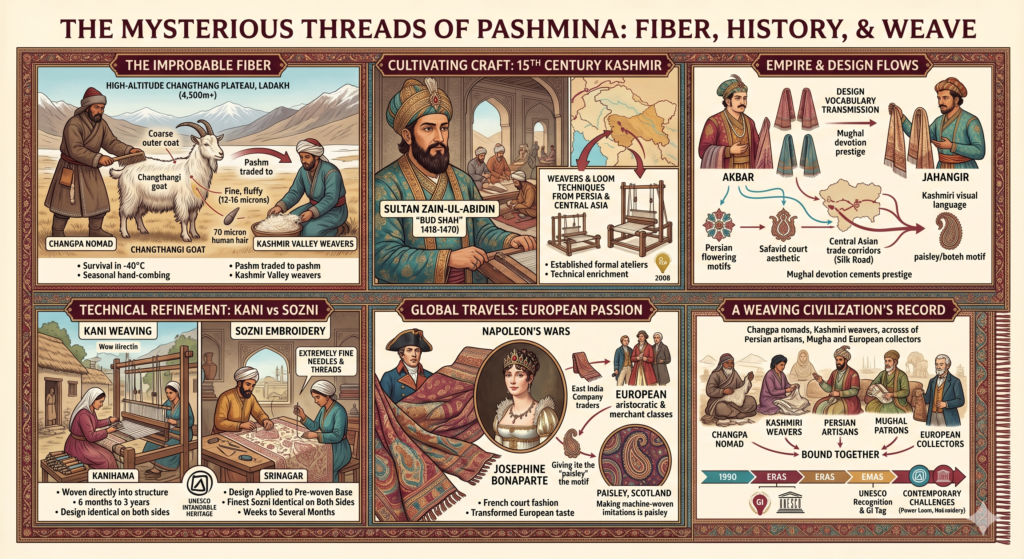
At an altitude of over 4,500 meters on the Changthang plateau, where winter temperatures drop below minus 40 degrees Celsius and the landscape offers almost nothing in the way of shelter or sustenance, the Changthangi goat grows something extraordinary. Beneath its coarse outer coat, pressed close to the skin for thermal survival, is an undercoat of fiber so fine that a single strand measures between 12 and 16 microns in diameter. A human hair, by comparison, averages around 70 microns. This undercoat, called pashm in Persian, is what Pashmina is made from.
The fiber’s fineness is a direct biological response to an extreme environment. The Changthangi goat did not develop this undercoat for human benefit. It developed it because survival at that altitude in those temperatures required the most efficient thermal insulation biology could produce. The fact that this same insulating property makes the resulting textile incomparably light, warm, and soft against human skin is a coincidence of natural engineering that humans were fortunate enough to discover and skilled enough to exploit.
The Changthang plateau sits across Ladakh and extends into Tibet, and the pastoral communities who have herded Changthangi goats across this landscape for centuries are the Changpa nomads. Their relationship with the goat is foundational to their entire way of life. The Changpa do not weave Pashmina. They produce the raw fiber through a seasonal combing process during spring, when the goats naturally shed their winter undercoat. This raw pashm is then traded downward through Ladakh into the Kashmir Valley, where a completely separate community of specialized weavers transforms it into the textile that the world knows as Pashmina. This geographic and cultural division between fiber producer and weaver is one of the defining structural features of the Pashmina tradition and one that is rarely fully understood by people outside the craft economy. The Changpa and the Kashmiri weaver have been bound together by this trade relationship for centuries, each entirely dependent on the other, neither able to produce the finished textile alone.
Where Is The Lost Wealth Of Mir Osman Ali Khan
The Sultan Who May Have Started Everything
The most commonly cited origin point for organized Pashmina weaving in Kashmir is the reign of Sultan Zain-ul-Abidin, who ruled the Kashmir Valley from 1418 to 1470. Known to Kashmiris as Bud Shah, meaning the Great King, Zain-ul-Abidin was a ruler of remarkable cultural breadth who actively brought craftsmen, scholars, and artisans from Persia, Central Asia, and other parts of the Islamic world to enrich Kashmiri cultural and economic life.
Historical chronicles of the period, referenced in scholarship maintained by the Jammu and Kashmir Academy of Art, Culture and Languages, credit Zain-ul-Abidin with establishing formal weaving workshops in the Kashmir Valley and bringing master weavers from Turkestan and Persia who introduced advanced loom techniques to local craftspeople. The specific weaving methodology that defines Kashmiri shawl production, including the twill tapestry technique used in Kani weaving, is believed to have arrived in the valley through these Central Asian connections during or around this period.
But here the historical certainty begins to soften. While Zain-ul-Abidin’s role in formalizing and scaling the craft is well supported by contemporary accounts, the question of whether fine wool weaving existed in Kashmir before his reign is considerably more complicated. References to fine shawls in pre-sultanate Kashmiri literature and in accounts of trade through the valley suggest that some form of the tradition may have predated the fifteenth century patronage that is typically credited as the origin point. What Zain-ul-Abidin may have done is not create something from nothing but recognize something already present and elevate it through institutional support and technical enrichment from outside.
This distinction matters because it shifts the origin of Pashmina from a single identifiable moment of creation toward something older, more diffuse, and more genuinely mysterious.
The Central Asian Thread
The design vocabulary of classical Kashmiri Pashmina shawls, particularly the iconic paisley or boteh motif that became synonymous with the tradition in European consciousness, did not originate in Kashmir. Its roots lie in the flowering plant motifs of Persian decorative arts, transmitted westward through the Safavid court aesthetic and eastward through Central Asian trade corridors that ran directly through the Kashmir Valley on their way between the Islamic heartlands and the Indian subcontinent.
Kashmir’s geographical position made it an inevitable meeting point for aesthetic influences from multiple directions. Sitting at the junction of the Silk Road’s southern branches, the valley received design ideas from Persia, Mughal India, Tibet, and Central Asia simultaneously, and the weavers who worked in its ateliers synthesized these influences into a visual language that became distinctly Kashmiri while remaining deeply cosmopolitan in its origins.
The Mughal emperor Akbar, who was famously devoted to Kashmiri shawls and reportedly owned hundreds of them, played a significant role in cementing the tradition’s prestige within the Indian subcontinent. According to records cited by the Victoria and Albert Museum in London, which holds one of the world’s most important collections of historical Kashmiri shawls, Akbar introduced the practice of using pairs of identical shawls worn together, a fashion that drove demand for production consistency and technical precision across the weaving workshops of the Kashmir Valley. His successors maintained and deepened this imperial patronage. Jahangir wrote of Kashmir’s shawls with a connoisseur’s specific appreciation in his memoirs, the Tuzuk-i-Jahangiri, noting particular qualities of fiber and design with a precision that demonstrates genuine textile knowledge rather than casual royal flattery. This Mughal documentation provides some of the most reliable historical evidence for the craft’s development between the sixteenth and seventeenth centuries, even as the deeper origins before the sultanate period remain contested.
Manipuri Phanek: Ancient Geometric Language Woven Into Its Cloth
The Two Hands of a Pashmina Shawl
There are two primary weaving techniques within the Kashmiri Pashmina tradition, and understanding them separately is essential to understanding the craft’s full complexity.
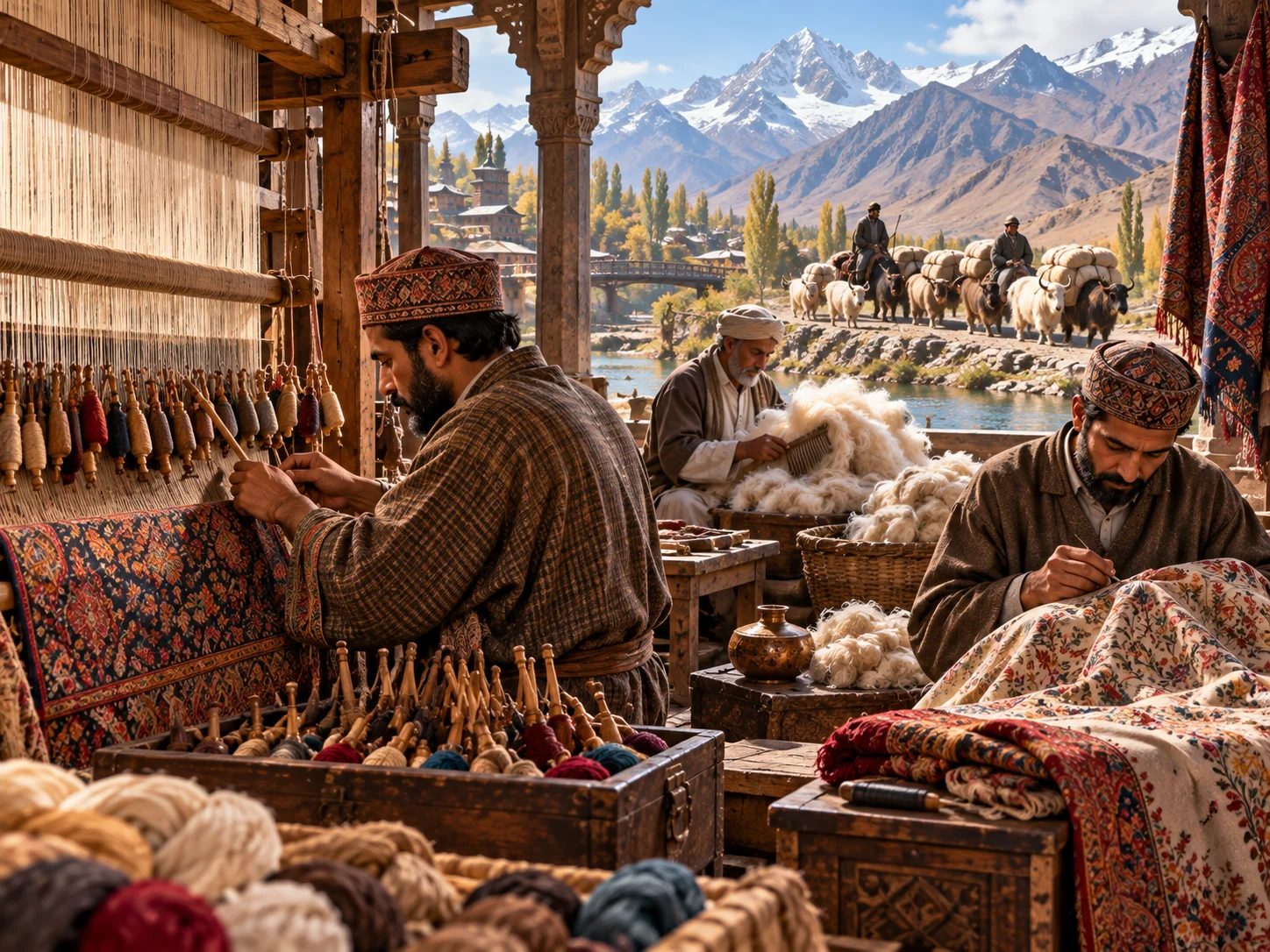
The first is Kani weaving, named after the village of Kanihama in the Kashmir Valley where the technique is most concentrated. Kani weaving uses small wooden spools called kanis instead of a conventional shuttle, with weavers interlocking dozens of these spools simultaneously to build up the design color by color, pass by pass, across the warp threads. A single Kani shawl can require anywhere from six months to three years to complete depending on the complexity of its design. The UNESCO Intangible Cultural Heritage list formally recognized Kani weaving of Kashmir, acknowledging it as one of the most technically demanding textile practices in the world.
The second technique is needle embroidery, known as Sozni, where the design is applied to a pre-woven Pashmina base by specialist embroiderers using extremely fine needles and threads. Sozni embroiderers work on different parts of the shawl simultaneously, each responsible for a section of the overall design, with a master craftsperson coordinating the work to ensure continuity across the completed piece. The finest Sozni work is executed with a stitch so small and so precisely placed that the embroidery is identical on both sides of the fabric, a technical achievement that requires years of dedicated practice to develop.
Both techniques produce textiles of extraordinary refinement. Both are also under pressure from mechanized production, power loom imitation shawls, and the use of machine embroidery that can replicate the surface appearance of Sozni work at a fraction of the time and cost. The Geographical Indications Registry entry for Kashmiri Pashmina in 2008 provides legal protection against misrepresentation, but enforcement across a global market remains a persistent and largely unresolved challenge.
What Napoleon’s Wars Did to a Kashmiri Shawl
The story of Pashmina’s relationship with Europe is one of the more improbable chapters in textile history. Kashmiri shawls reached Europe in significant quantities through the eighteenth century, carried by East India Company traders and returning colonial officers. They became objects of intense fashion desire among European aristocracy and the emerging merchant class, particularly in France and Britain.
When Napoleon’s Egyptian campaign of 1798 brought French officers into contact with fine Eastern textiles, the shawls they carried home ignited a passion for the Kashmir aesthetic that transformed European fashion for decades. Josephine Bonaparte was reportedly an avid collector of Kashmiri shawls, owning hundreds of pieces, and her influence on French court fashion made the shawl an essential accessory for women of status across the continent.
The European demand created an economic transformation in the Kashmir Valley. Production scaled dramatically to meet orders from European trading houses. Design vocabularies shifted in response to European taste, with Kashmiri weavers incorporating aesthetic elements specifically calibrated for Western buyers while maintaining the technical standards that justified the textile’s premium pricing. The paisley pattern, already present in Kashmiri design, became so associated with these exported shawls in European consciousness that the town of Paisley in Scotland, which produced machine-woven imitations to meet demand that Kashmir alone could not supply, gave the motif its English name.
This European chapter of Pashmina’s history is documented extensively in the collections and scholarship of the Victoria and Albert Museum, whose South Asia textile holdings include shawls commissioned specifically for European markets alongside pieces made for Mughal and Sikh court use, providing a comparative record of how the tradition adapted across different patronage contexts without losing its essential character.
The Roots Of The Naga National Council Struggle
Quick Comparison Table
| Aspect | Kani Weaving | Sozni Embroidery |
| Technique | Interlocking wooden spools on loom | Needle embroidery on pre-woven base |
| Time to Complete | Six months to three years | Weeks to several months depending on density |
| Design Integration | Woven directly into fabric structure | Applied to fabric surface after weaving |
| UNESCO Recognition | Yes, Intangible Cultural Heritage list | Not separately listed, part of broader Kashmiri craft heritage |
| Reversibility | Design identical on both sides inherently | Finest Sozni work also identical on both sides |
| Primary Center | Kanihama village, Kashmir Valley | Srinagar and surrounding villages |
| Market Vulnerability | High, due to power loom imitation | High, due to machine embroidery substitution |
Curious Indian: Fast Facts
- The word Pashmina derives from the Persian word pashm, which translates directly as soft gold, a name that reflects the fiber’s historical value in trade networks across Asia.
- A single Changthangi goat produces only between 80 and 170 grams of combable pashm fiber per year, which means the fiber from multiple goats is required to produce a single shawl.
- The Changpa nomads of the Changthang plateau conduct their annual pashm combing in spring, when goats naturally shed their winter undercoat, a process that must be done by hand to preserve fiber quality.
- Emperor Akbar reportedly owned more than a thousand Kashmiri shawls at the time of his death, a collection that represented one of the largest personal accumulations of luxury textiles in Mughal history.
- The town of Paisley in Scotland gave the boteh motif its English name after Scottish mills produced machine-woven imitations of Kashmiri shawls to meet European demand in the nineteenth century.
- A genuine handwoven Kani Pashmina shawl can take up to three years to complete and may contain millions of individual interlocking spool passes within its structure.
- Josephine Bonaparte’s collection of Kashmiri shawls at the height of her influence was reportedly valued at nearly 150,000 francs, an extraordinary sum that reflects the textile’s global premium status in the early nineteenth century.
The Mystery That Is the Truth
The origin of Pashmina is genuinely mysterious, and that mystery is appropriate for a textile this complex. It did not emerge from a single moment, a single culture, or a single act of invention. It emerged from a confluence of geography, biology, trade, patronage, and human skill that accumulated over centuries across the Changthang plateau, the Kashmir Valley, the Mughal court, the Silk Road, and eventually the drawing rooms of Napoleonic Europe.
What makes Pashmina remarkable is not just the fineness of the fiber or the technical demands of the weaving. It is the depth of the human story woven into it. The Changpa nomad combed a goat on a freezing plateau at 4,500 meters. The Kanihama weaver interlocked wooden spools for months to build a single design. The Sozni embroiderer worked both sides of a fabric simultaneously to produce stitches no machine can replicate. Sultan Zain-ul-Abidin recognized something worth cultivating and gave it institutional support. Akbar wore two identical shawls at once because he understood quality. Josephine collected them because she understood desire.
Double Ikat Patola of Patan and Why It Takes a Year to Weave
If you think you have remembered everything about this topic take this QUIZ
This quiz no longer existsWho is credited with establishing Pashmina weaving in Kashmir?
Sultan Zain-ul-Abidin, who ruled Kashmir from 1418 to 1470, is most widely credited with formalizing and institutionalizing Pashmina weaving in the Kashmir Valley. He brought master weavers from Central Asia and Persia to establish organized weaving workshops and introduce advanced loom techniques. However, some scholars believe forms of fine wool weaving existed in the region before his reign.
What is the difference between Kani and Sozni Pashmina?
Kani Pashmina is woven using small wooden spools called kanis, with the design built directly into the fabric structure during the weaving process. Sozni Pashmina involves needle embroidery applied to a pre-woven Pashmina base by specialist embroiderers. Kani weaving can take up to three years for complex pieces, while Sozni work varies depending on the density and complexity of the embroidery.
What is the origin of the word Pashmina?
The word Pashmina comes from the Persian word pashm, which means soft gold. This name reflects the extraordinary value placed on the fiber in historical trade networks across Central Asia, Persia, and the Indian subcontinent. The Persian linguistic connection also reflects the significant cultural influence of Persian court aesthetics on Kashmiri weaving traditions.
Why is the Changthangi goat fiber so rare and valuable?
The Changthangi goat produces only between 80 and 170 grams of usable pashm fiber per year, harvested by hand during spring shedding. The fiber measures between 12 and 16 microns in diameter, making it one of the finest natural fibers in the world. The extreme altitude and cold of the Changthang plateau where the goats live cannot be replicated elsewhere, making the fiber geographically irreplaceable.
How did Kashmiri Pashmina reach Europe and influence Western fashion?
Kashmiri shawls reached Europe through East India Company traders in the eighteenth century and became objects of intense fashion desire. Napoleon’s Egyptian campaign of 1798 accelerated this interest, and Josephine Bonaparte’s devotion to Kashmiri shawls made them essential accessories in European aristocratic fashion. The European demand was so great that Scottish mills in the town of Paisley began producing machine-woven imitations, inadvertently giving the boteh motif its English name.