Honoring Ancestors Through Ancestral Weapons
Kodagu is a small hill district in the Western Ghats of Karnataka, forested and cool, its landscape shaped by coffee plantations, rivers and the mist that rolls in from the Arabian Sea across the mountain ridges. The Kodava people who have inhabited this region for centuries are a small community by national standards, numbering perhaps a few hundred thousand. They carry a reputation for martial excellence and have shaped their culture in ways that are immediately visible to anyone who spends time among them.
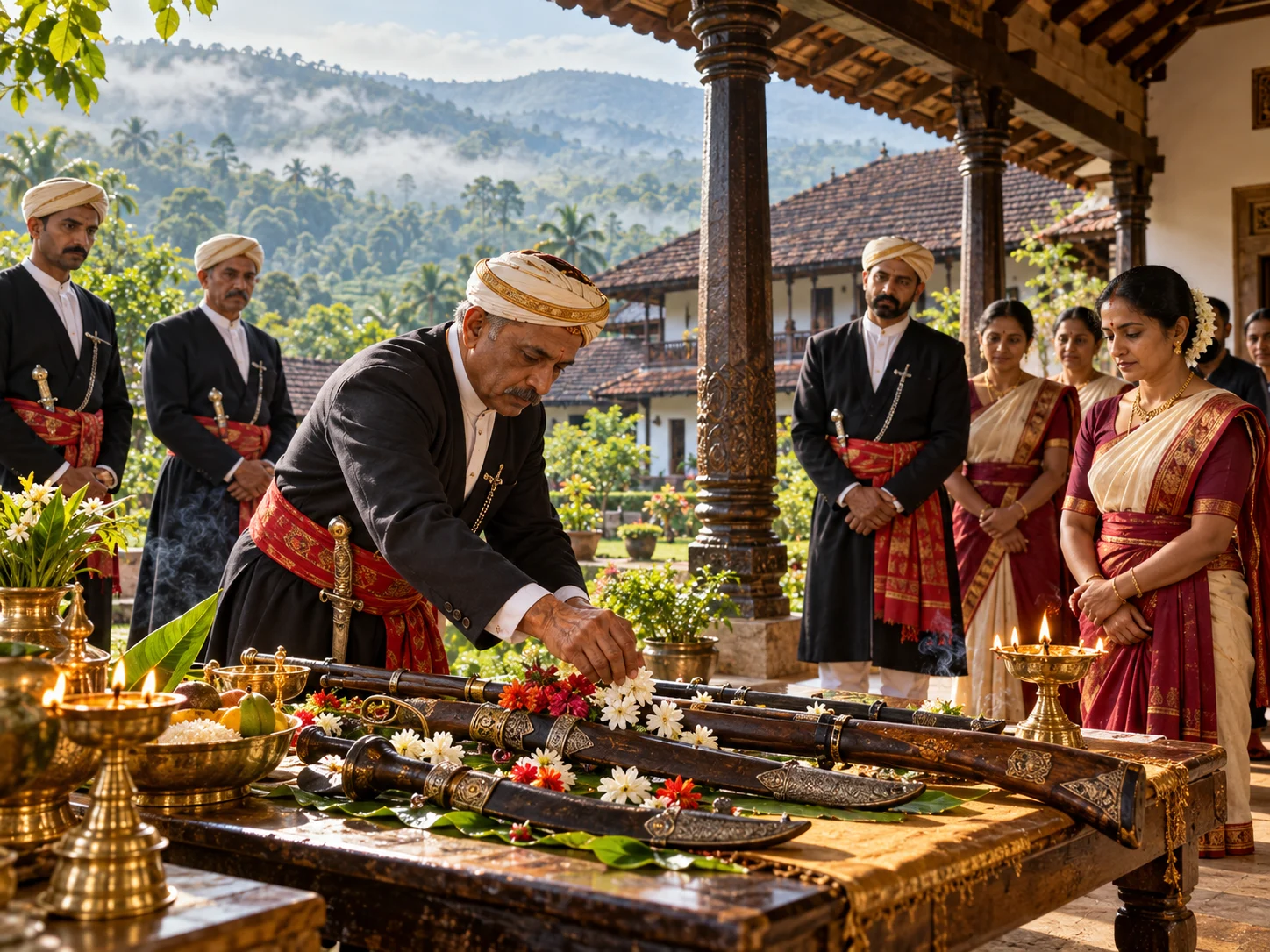
The most concentrated expression of that martial culture happens once a year during Kailpodh, when every Kodava household takes out its weapons, cleans and anoints them with oil and flowers, and worships them as sacred objects that connect the living to their ancestors and to the land those ancestors defended.
A Community Defined by Its Relationship to Weapons
To understand Kailpodh, it helps to understand the particular relationship the Kodava have historically had with weapons and military service. The Kodava are one of the few communities in India who carry weapons as an expression of identity, responsibility and ancestral connection. The right to bear arms is understood within the community as an inherent characteristic of what it means to be Kodava.
This identity has produced an extraordinary military tradition. Field Marshal K.M. Cariappa, the first Commander-in-Chief of the Indian Army after independence, was a Kodava from Kodagu. General K.S. Thimayya, one of the most celebrated Indian military figures of the twentieth century, was also Kodava. These achievements emerge from a culture in which military excellence has been valued, trained and celebrated for generations.
Kailpodh is the ritual moment at which this culture renews its relationship with its own martial tradition.
Why Toda Tribe Honors Their Sacred Buffaloes in Nilgiri Hills
What Actually Happens During Kailpodh
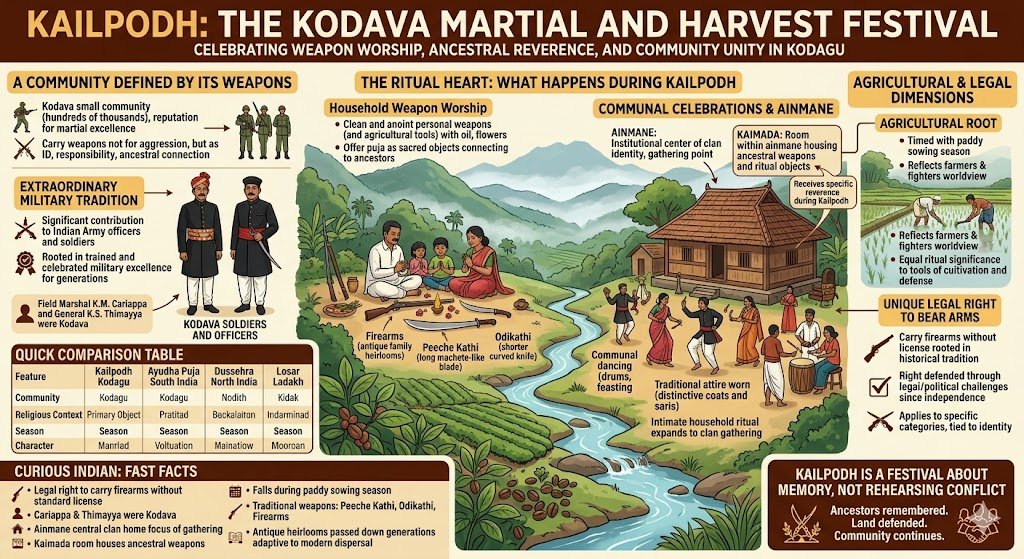
On the day of Kailpodh, which falls during the paddy sowing season and is connected to the agricultural calendar, Kodava households gather around the family’s weapons. These typically include the traditional Kodava weapons: the peeche kathi, a long machete-like blade; the odikathi, a shorter curved knife; and firearms that have been passed down through generations.
The weapons are brought out and laid on a clean surface. They are cleaned with care. They are anointed with oil, decorated with flowers and offered puja in the manner of sacred objects. The ritual is performed by the male head of the household but witnessed by the entire family, connecting children to the tradition from their earliest years.
After the weapon worship, the celebration moves outward from the household to the community. The Kodava perform their traditional dance, the kolata or martial-inflected group dances specific to Kailpodh, in the open space of the ainmane, the ancestral clan home that serves as the center of Kodava community life. Drums are played. The traditional Kodava attire is worn: the distinctive black coat and cummerbund for men and the distinctive sari style for women. Food is prepared and shared.
The celebration is simultaneously intimate and communal, beginning in the private space of the household weapon worship and expanding into the shared space of the clan gathering.
The Ainmane and Its Role in Kodava Identity
The ainmane, the ancestral clan home, is the institutional center of Kodava social and religious life. It is not simply an old house. It is the physical location where the clan’s ancestors are remembered and honored, where significant rituals are performed and where the clan’s identity is continuously renewed through collective gathering.
During Kailpodh, the ainmane becomes the gathering point for clan members who may have dispersed across Kodagu and beyond during the year. People return for the festival the way people in other traditions return for weddings or funerals, because the ainmane is the place where the clan is most completely itself. The weapon worship performed there has an additional layer of meaning beyond the household ritual, connecting the individual family’s weapons to the longer history of the clan and its relationship to the land and its defense.
The kaimada, the room within the ainmane that houses the ancestral weapons and ritual objects, is treated with specific reverence. Not everyone enters it at all times. During Kailpodh, the kaimada and its contents become the center of the clan’s ritual attention.
The Elaborate Parsi Sky Burials and Towers of Silence
The Agricultural Dimension of the Festival
Kailpodh is not only a weapon festival. It is also a harvest festival, connected to the paddy sowing season in a region where rice cultivation has been central to Kodava life for centuries. The worship of agricultural tools alongside weapons during Kailpodh reflects a worldview in which the same community that cultivates the land also defends it, and in which the tools of cultivation and the tools of defense carry equal ritual significance.
This dual character, martial and agricultural, is reflected in the timing of the festival. It is held at a moment in the agricultural calendar, connecting the renewal of the community’s relationship with its weapons to the renewal of its relationship with the land those weapons protect.
Scholars whose research is documented through the Karnataka Folklore University in Gotagodi have noted that this integration of martial and agricultural identity is characteristic of several communities in the Western Ghats region, where the geography of dense forest and difficult terrain created communities that were simultaneously farmers and fighters, with no sharp distinction between the two roles.
The Legal Right to Bear Arms
One of the most distinctive aspects of Kodava identity is the legal right to carry firearms without the license required of other Indian citizens. This right, which the Kodava community has defended through successive legal and political challenges since independence, is rooted in historical precedent established during the period of Kodava autonomy before the consolidation of the region under larger political structures.
The Kodava right to bear arms applies to specific categories of firearms and is tied to the community’s identity rather than being a general exemption from firearms regulation. But its existence as a continuing legal reality in modern India is itself a marker of how seriously the Kodava martial tradition has been taken by successive governing authorities.
During Kailpodh, the exercise of this right takes its most public and most culturally significant form. The traditional firearms that appear at Kailpodh celebrations are often antique pieces, family heirlooms passed down through generations. Their age and provenance make them sacred objects rather than simply weapons. When a Kodava man cleans and anoints a rifle that his grandfather carried, the weapon is being honored as a connection to a specific person, a specific time and a specific set of values that the community continues to hold.
The documentation of Kodava traditions including Kailpodh has been supported by the Karnataka State Department of Kannada and Culture, which has recognized the festival as a significant expression of the state’s diverse cultural heritage.
Danda Nata: Twenty One Days of Sacred Suffering in Odisha
Kailpodh in the Modern Context
The Kodava community today is significantly more urban and geographically dispersed than it was a generation ago. Many Kodava families have moved to Bangalore, to other Indian cities and to locations abroad while maintaining their connection to Kodagu through the ainmane and through festivals like Kailpodh. The festival has adapted to this dispersal. Families that cannot gather at the ainmane perform the weapon worship in their current homes. Community organizations in cities with significant Kodava populations organize collective celebrations.
This adaptability shows that the tradition’s meaning is genuinely held by its community rather than simply performed for external audiences. The Kodava celebrate Kailpodh because it is theirs.
Memory and Continuity
Kailpodh is a festival about memory as much as it is about weapons. When a Kodava family brings out its weapons on the day of the festival and lays them on a clean surface to be cleaned and worshipped, they are remembering everyone who carried those weapons before them, everyone who defended the land that the family still lives on or still returns to, everyone who understood the relationship between a community and the tools through which it has historically expressed its identity.
The Kodava are a small community in a large country. What they have maintained is the integrity of their traditions, including the tradition that says weapons deserve respect not because of what they can do but because of what they represent about who carried them and why.
Kailpodh holds that understanding in place once a year, in the ainmane, in the household, in the dancing and the food and the gathering of people who share the same ancestors and the same landscape. The weapons are cleaned. The flowers are laid. The ancestors are remembered. The community continues.
Intricate Kolam Floor Art Drawn Daily in South Indian Homes
Ceremonial Preparation of Karah Parshad in Sikh Gurdwaras
If you think you have remembered everything about this topic take this QUIZ
This quiz no longer existsWhat is Kailpodh and who celebrates it?
Kailpodh is a festival celebrated by the Kodava community of Kodagu district in Karnataka. It involves the ceremonial cleaning, anointing and worship of personal weapons and agricultural tools as sacred objects connecting the living to their ancestors and to the community’s martial and agricultural identity. It is held annually during the paddy sowing season, typically falling between September and October.
Why do the Kodava worship weapons during Kailpodh?
The Kodava relationship with weapons is rooted in a martial tradition that predates the colonial period. Weapons in Kodava culture are not simply tools or status symbols. They are sacred objects that connect the living to their ancestors, embody the community’s identity as defenders of their land and carry the memory of specific individuals who carried them in the past. Worshipping them during Kailpodh is an act of ancestral reverence as much as it is a martial ritual.
What is the ainmane and why is it important to Kailpodh?
The ainmane is the ancestral clan home that serves as the center of Kodava social and religious life. During Kailpodh, clan members who have dispersed across Kodagu and beyond return to the ainmane for the collective celebration. The kaimada, a specific room within the ainmane that houses ancestral weapons and ritual objects, becomes the center of ritual attention during the festival.
Do the Kodava really have a legal right to carry firearms without a license?
Yes. The Kodava community retains a legal right to carry specific categories of firearms without the standard license required of other Indian citizens. This right is rooted in historical precedent established during the period of Kodava autonomy before the region’s absorption into larger political structures. It has been maintained through successive legal and political challenges since Indian independence and is considered by the community as an expression of their distinctive identity.
How has Kailpodh adapted to the modern context of urban migration?
As many Kodava families have moved to cities within India and abroad, the festival has adapted to accommodate geographic dispersal. Families that cannot return to the ainmane for the festival perform the weapon worship in their current homes. Community organizations in cities with significant Kodava populations organize collective celebrations. This adaptability has allowed the festival to maintain its essential meaning and practice across a community that is increasingly dispersed from its geographic origin.
Sources & References
Kodava martial tradition and history — Field Marshal K.M. Cariappa as first Commander-in-Chief of Indian Army after independence, General K.S. Thimayya’s military service, and documented military officers from the community.
Kodava community history and geography — Kodagu district in Karnataka, Western Ghats location, population statistics, historical autonomy and consolidation under larger political structures.
Kailpodh festival documentation — paddy sowing season timing (September-October, Sravana/Bhadrapada), ritual protocols, weapon worship practices, ceremonial weapons (peeche kathi, odikathi), and ancestral firearms.
Ainmane (ancestral clan home) — structure and role in Kodava social and religious life, the kaimada (weapon/ritual room), and the role during Kailpodh celebrations.
Kodava legal rights and firearms — legal right to carry firearms without standard license, historical precedent rooted in Kodava autonomy, continued legal status post-independence.
Kodava cultural practices — kolata and martial dances, traditional attire (black coat and cummerbund for men, distinctive sari for women), household and community celebration protocols.
Academic documentation — Karnataka Folklore University in Gotagodi research, Karnataka State Department of Kannada and Culture recognition of Kailpodh as cultural heritage expression.