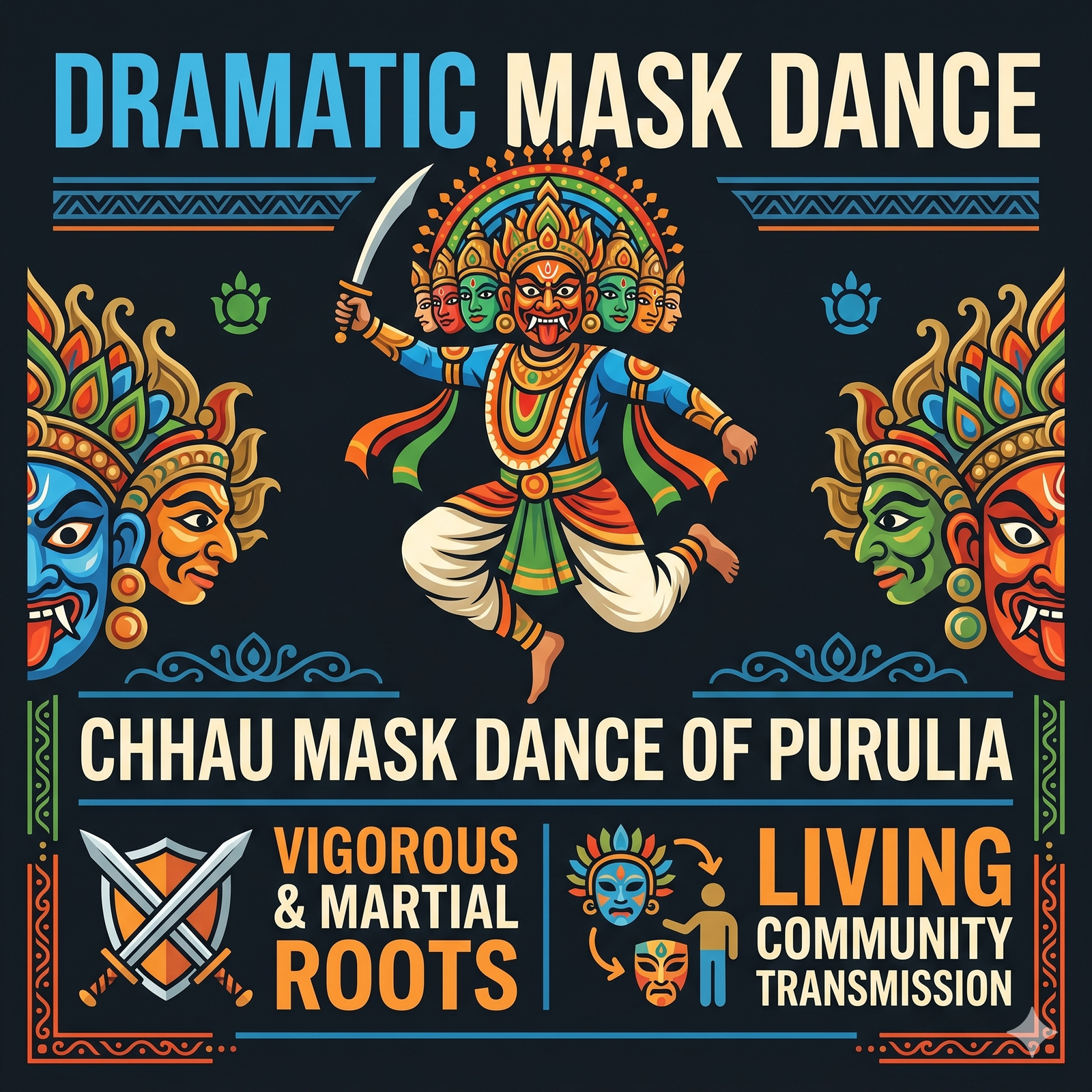
The Chhau mask dance of Purulia is one of the most visually and physically dramatic performing art traditions in India. Practiced in Purulia district of West Bengal, it uses enormous painted masks, acrobatic martial movement and stories drawn from the Ramayana, Mahabharata and Puranic mythology to create performances that blur the boundary between ritual and art. Inscribed on UNESCO Intangible Cultural Heritage list in 2010 alongside the Seraikella and Mayurbhanj variants, Purulia Chhau is the most vigorous and mask-centered of the three. This piece explores the martial origins of the form, the craft of the masks, the festival context in which the dance lives and what it means for a tradition of this power to survive in the modern world.| Detail | Information |
| Subject | Chhau Mask Dance of Purulia |
| Location | Purulia district, West Bengal, India |
| Type | Martial dance form with masks |
| Primary Festival | Chaitra Parva (Spring festival) |
| Primary Themes | Hindu epics, martial combat, nature spirits |
| UNESCO Status | Inscribed on Intangible Cultural Heritage list, 2010 |
| GI Tag | Purulia Chhau mask, granted |
| Associated Community | Tribal and rural communities of Purulia |
When Masks Invoke Spirits
The Chhau mask dance of Purulia is one of the most visually and physically dramatic performing art traditions in India. Practiced in Purulia district of West Bengal, it uses enormous painted masks, acrobatic martial movement and stories drawn from the Ramayana, Mahabharata and Puranic mythology. Inscribed on UNESCO’s Intangible Cultural Heritage list in 2010 alongside the Seraikella and Mayurbhanj variants, Purulia Chhau is the most vigorous and mask-centered of the three. The masks are not costumes. They are invocations. When a dancer puts on the painted face of Mahishasura or Durga or the demon of the forest, something shifts. The mask releases a martial energy, a connection to the mythological world, a willingness to embody forces larger than the individual body that carries them.
How Kodava Celebrates Weapons During Kailpodh Festival
The Festival and the Night
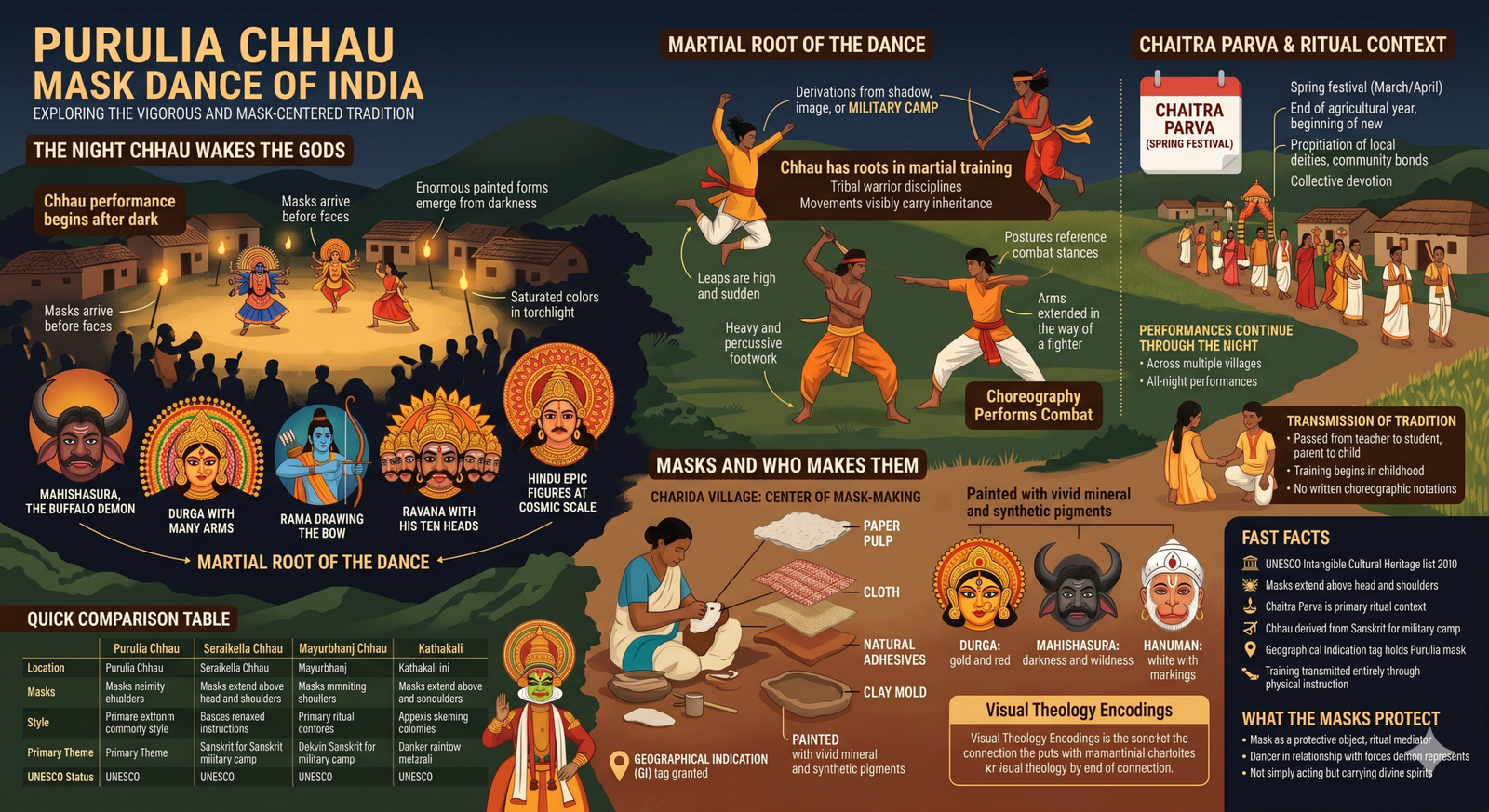
The performance begins after dark. Torches or electric lights illuminate a cleared space in the village. The drummers start with the dhol, shehnai and reed instruments whose sound is not background music but a physical presence, a vibration that prepares the body for something it does not experience in ordinary life.
Then the dancers appear. The masks arrive before the faces do—enormous painted forms emerging from darkness. Mahishasura, the buffalo demon. Durga with her many arms. Rama drawing the bow. Ravana with his ten heads. The figures of Hindu epics, rendered at a scale and with a physical energy that the original texts never quite describe but somehow always imply.
Purulia Chhau is most fully itself during the Chaitra Parva, the spring festival held in the Hindu month of Chaitra, typically falling in March or April. The festival marks the end of the agricultural year and the beginning of the new one, with ritual significance involving the propitiation of local deities and the renewal of community bonds. During Chaitra Parva, performances continue through the night across multiple villages.
The festival context is important because it establishes the non-optional character of the performance. Chhau during Chaitra Parva is not a cultural event that can be attended or skipped. It is a ritual obligation of the community, something that happens because it must happen, because the spirits being invoked through the masks and the movement require it. This ritual weight gives the performance a quality that concert hall performances, however technically accomplished, rarely replicate.
The Rhythmic Buddhist Chanting of the Monks of Ladakh
The Martial Roots
The word Chhau has multiple proposed etymologies, with scholars offering derivations from Sanskrit words for shadow, image or military camp. The military camp derivation most directly explains the character of the Purulia form. Chhau is understood to have roots in the martial training traditions of the region, in the physical disciplines practiced by tribal warriors and soldiers in what was once the forested borderland between Bengal, Bihar and Odisha.
The movements of Purulia Chhau carry this inheritance visibly. The leaps are high and sudden. The footwork is heavy and percussive. The postures reference combat stances, the body low and ready, the arms extended in the way of a fighter rather than a classical dancer. When a performer enacts the battle between Rama and Ravana or between Durga and the demon, the choreography does not merely suggest combat. It performs combat, using the full physical vocabulary of a tradition trained in the mechanics of fighting.
This martial character distinguishes Purulia Chhau from the Seraikella and Mayurbhanj variants, which share the same mythological subject matter but express it through more lyrical and refined movement vocabularies. Purulia Chhau is the roughest and the most physically demanding of the three forms. Its practitioners speak of the training required to perform it with the same language that martial artists use to describe their discipline.
Narendra Modi Becomes Prime Minister (2014): The Dawn of a New Era
The Masks and Their Makers
The masks of Purulia Chhau are made in a cluster of villages in Purulia district, most notably in Charida village, which has become the center of the mask-making tradition. Several generations of families have practiced the craft continuously there. The masks are made from paper pulp, cloth and natural adhesives, built up in layers over a clay mold and then painted with vivid mineral and synthetic pigments in the colors associated with specific characters.
The size of Purulia masks is one of their most immediately striking features. They are large, sometimes extending well above the dancer’s head and outward past the shoulders, creating a silhouette that is larger than any human face and that reads from a distance as exactly what it intends to represent: the face of a god or a demon, scaled to cosmic rather than human dimensions.
The painting of the masks follows conventions developed and refined over generations. Durga is painted in specific shades of gold and red. Mahishasura carries the coloring of darkness and wildness. Hanuman mask is white with specific markings. These conventions are not arbitrary. They encode a visual theology, a set of associations between color, character and cosmic function that the audience reads instinctively because they have grown up seeing these images in temple iconography.
The mask makers of Charida village have received recognition through the Sangeet Natak Akademi and through the broader frameworks of craft protection that followed the UNESCO inscription of the Chhau tradition in 2010. The Purulia Chhau mask also holds a Geographical Indication tag, formally recognizing it as a product of a specific community in a specific place.
Konyak Naga Facial Tattoos: History Written on Human Skin
The Transmission of Knowledge
Chhau is transmitted within families and communities through direct physical instruction. There are no written choreographic notations. The movements, the sequences, the specific ways of wearing the mask and moving through combat episodes are passed from teacher to student and from parent to child through years of practice that begin in childhood.
This mode of transmission is both the tradition’s greatest strength and its most significant vulnerability. Its strength is that it produces performers who carry the tradition in their bodies rather than in their heads, who have absorbed its martial logic at a physical level that cannot be faked or quickly approximated. Its vulnerability is that it depends on an unbroken chain of living transmission. When that chain breaks—for economic reasons, for migration, for the loss of a master teacher—what is lost cannot be recovered from a text or a recording.
The organizations working to support the living transmission of Chhau include the Sangeet Natak Akademi, which has funded documentation projects, master teacher programs and training initiatives designed to maintain the chain of living knowledge. The broader framework of the UNESCO Intangible Cultural Heritage inscription also creates obligations for the Indian government to support the tradition’s continuation, though the translation of those obligations into effective local support remains an ongoing challenge.
The Evolution of SS Rajamouli Cinematic Career
Quick Comparison Table
| Feature | Purulia Chhau | Seraikella Chhau | Mayurbhanj Chhau | Kathakali |
| Location | Purulia, West Bengal | Seraikella, Jharkhand | Mayurbhanj, Odisha | Kerala |
| Masks | Large, elaborate, painted | Smaller, refined | No masks used | Elaborate face paint |
| Style | Vigorous, martial, acrobatic | Lyrical, courtly | Pure movement, subtle | Classical, narrative |
| Primary Theme | Epics, martial spirits | Lyrical mythology | Abstract and epic | Hindu epics |
| UNESCO Status | Inscribed 2010 | Inscribed 2010 | Inscribed 2010 | Not separately listed |
Curious Indian: Fast Facts
- Purulia Chhau was inscribed on UNESCO Intangible Cultural Heritage list in 2010 alongside the Seraikella and Mayurbhanj variants
- The masks are primarily made in Charida village in Purulia district, where several generations of families have maintained the craft continuously
- Purulia Chhau masks can extend well above the dancer head and outward past the shoulders, making them among the largest performance masks in Indian tradition
- The Chaitra Parva spring festival is the primary ritual context for Chhau performance, with all-night performances continuing across multiple villages
- The word Chhau is proposed by some scholars to derive from the Sanskrit word for military camp, reflecting the martial roots of the tradition
- The Purulia Chhau mask holds a Geographical Indication tag, formally recognizing it as a product of the Purulia community
- Training begins in childhood and is transmitted entirely through direct physical instruction, with no written choreographic notation
- The Sangeet Natak Akademi has funded documentation and master teacher programs to support the living transmission of the tradition
What the Mask Protects
There is a dimension of Purulia Chhau that practitioners and long-term observers consistently point to. The mask is not simply a prop or a costume element. It is a protective object. The dancer who wears the mask of a demon is not simply acting the demon. They are in a relationship with the force the demon represents, a relationship that the mask mediates and makes safe.
This understanding of the mask as a ritual mediator rather than a theatrical device connects Purulia Chhau to a very ancient strand of human creative practice—the use of costume and performance to enter into relationship with forces that ordinary consciousness cannot approach directly. Across cultures and across centuries, the mask has served this function. In Purulia, it continues to do so.
The painted eyes of the Mahishasura mask staring out over a torchlit village clearing at midnight are not looking at an audience. They are looking at whatever the demon looks at when his story is being told in the language he was made to be told in. The dancer behind the mask is the medium through which that telling becomes possible. The martial spirits are invoked not despite the human body but through it, disciplined by years of training into something capable of carrying what the mask asks it to carry.
The Chhau mask dance of Purulia is one of those traditions that makes the categories of art, ritual and martial practice feel inadequate when applied separately. It is all three simultaneously, and the power of the form comes precisely from that simultaneity. When a dancer in Charida puts on the mask of Durga and leaps through a village clearing at midnight during Chaitra Parva, the leap is athletic, the mask is sacred and the story being enacted is as old as the culture that produced it. The survival of this tradition into the present is not guaranteed and not accidental. It has survived because families in Purulia district kept teaching it, because mask makers in Charida kept making the masks, because communities kept gathering for Chaitra Parva and because the martial spirits the dance invokes have remained worth invoking.
If you think you have remembered everything about this topic take this QUIZ
This quiz no longer existsWhat is Purulia Chhau and how does it differ from other Chhau variants?
Purulia Chhau is a martial mask dance tradition from Purulia district in West Bengal. It is distinguished from the Seraikella and Mayurbhanj variants primarily by its use of large elaborate painted masks and its vigorous, acrobatic movement vocabulary rooted in martial traditions. Seraikella Chhau uses smaller, more refined masks and a more lyrical movement style. Mayurbhanj Chhau uses no masks at all and relies entirely on movement and expression.
What are the masks made of and who makes them?
The masks are made from paper pulp, cloth and natural adhesives, built up in layers over a clay mold and painted with mineral and synthetic pigments. They are primarily made in Charida village in Purulia district, where families have maintained the craft across generations. The Purulia Chhau mask has received a Geographical Indication tag formally recognizing it as a product of this specific community.
What is the Chaitra Parva and why is it important to Chhau?
The Chaitra Parva is a spring festival held in the Hindu month of Chaitra, typically in March or April. It marks the end of the agricultural year and is the primary ritual context for Chhau performance in Purulia. During the festival, all-night performances are held across multiple villages, and the dance is understood as a ritual obligation of the community rather than a cultural event in the modern sense.
How is Chhau transmitted from one generation to the next?
Chhau is transmitted entirely through direct physical instruction within families and communities. There are no written choreographic notations. Training begins in childhood and involves years of physical practice through which the martial movement vocabulary, the mask handling techniques and the narrative sequences are absorbed at a bodily level. This mode of transmission makes the tradition highly authentic but also vulnerable to disruption if the chain of living teaching is broken.
What has UNESCO inscription meant for Purulia Chhau?
UNESCO inscribed Purulia Chhau on its Intangible Cultural Heritage list in 2010 alongside the other two Chhau variants. The inscription has brought greater international visibility to the tradition and has created formal obligations for the Indian government to support its continuation. Organizations including the Sangeet Natak Akademi have used the inscription as a framework for documentation and master teacher programs, though practitioners note that effective local support for living transmission remains the most critical and most challenging aspect of preservation.