Santiniketan, October 1949: an old artist was given two months to make a legal document into the story of India. He gave the job to his family
In the summer of 1949, the Constitution of India was nearly finished. Two years of drafting, two thousand amendments, a “bag of borrowings” from every democracy in the world. It was written in English. It was 392 pages long. It was going to be the longest constitution ever written.
By October, the Constituent Assembly had decided one more thing. This founding law needed to be beautiful.
So they went to Nandalal Bose.
The Romantic Soul of Kangra Miniature Paintings
The artist who belonged to Tagore
How Madam Bhikaiji Cama Unfurled India’s Flag in Germany
Nandalal Bose was seventy years old. He had been part of the India that Gandhi built, part of the Bengal Renaissance that Tagore led. He had started as a student of Abanindranath Tagore, taught by one of the great painters of modern India. Then Rabindranath Tagore himself had asked him to come to Santiniketan and make the art school there, Kala Bhavana, into a place where Indian art could find itself again.
For fifty years, he had been teaching students to see India not through British eyes but through their own. He had been influenced by the murals of Ajanta, by the way artists in that cave had painted stories into stone. He believed art had to mean something. It had to tell you who you were.
Now, three months before the Constitution would be signed, someone had an idea: why should the founding law of India not look like India?
For two months, they worked in a rush at Santiniketan.
The team
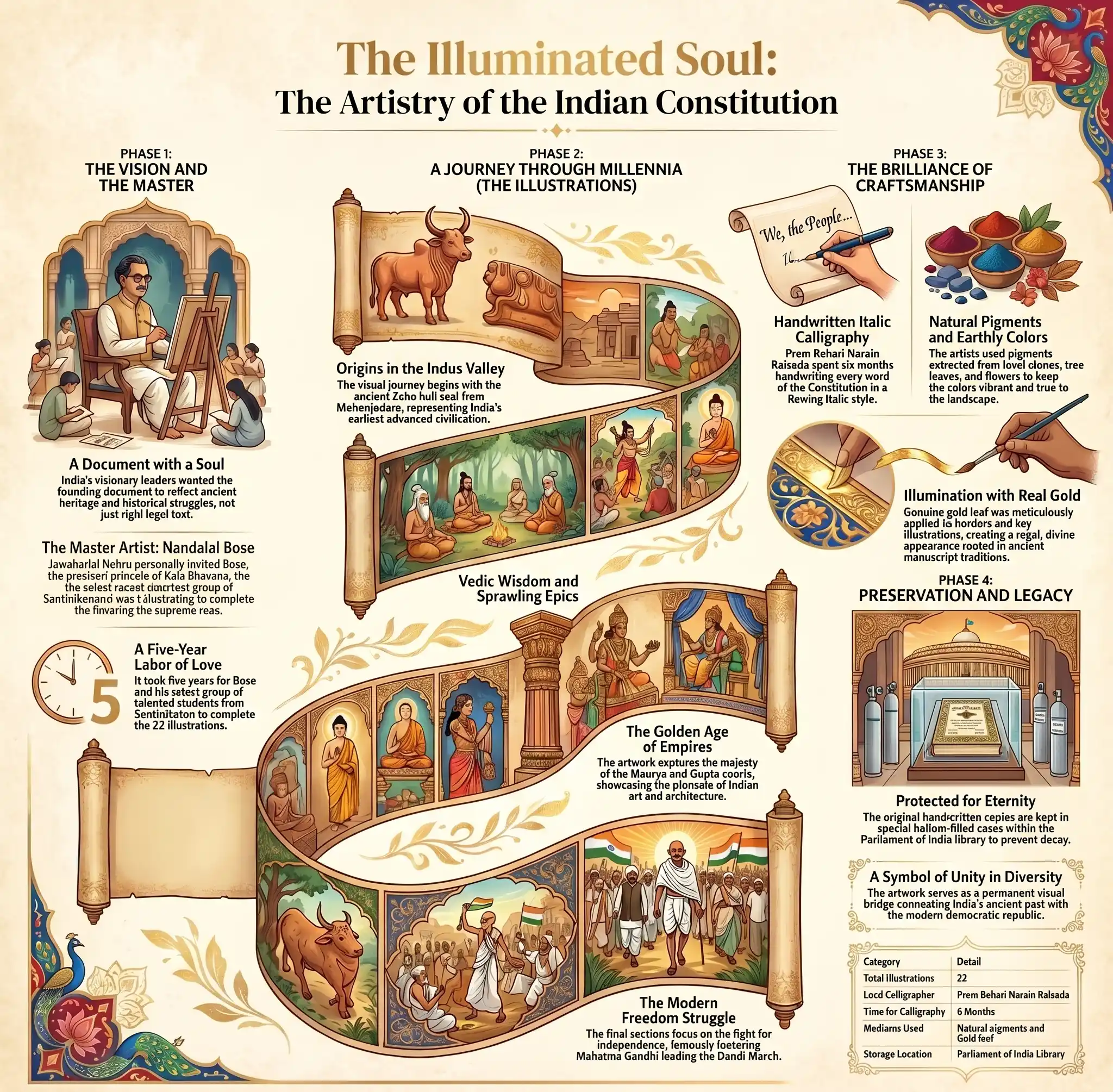
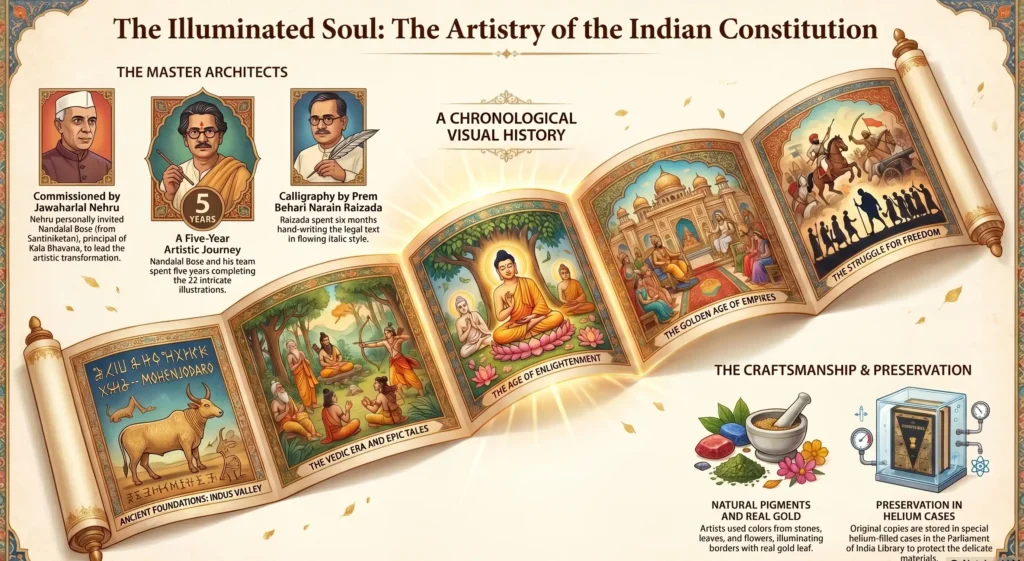
Nandalal looked at the document. Three hundred ninety-two pages. Each section needed an illustration. Twenty-two images, telling the story of India from the beginning to now.
He could not do this alone. He was old and his eyesight was failing. So he did what he had taught his students to do for fifty years: he gathered people around him and gave them work.
His son Biswarup. His daughters Gauri and Jamuna. His daughter-in-law Nivedita. His granddaughter Bani. Some of his oldest students. Some of his colleagues. Together, they made a team of sixteen artists.
He decided on the paper. He decided on the size. He decided on the decorative borders and the arrangement. He chose what each image would depict and in what order. Then he set them to work.
For two months, they worked in a rush at Santiniketan.
The images
The Final Letters of Khudiram Bose and Soul of Young Bengal
The Constitution needed to tell India’s story.
The Indus Valley Civilization. The Vedic period. The time of Buddha and Mahavira. The Maurya empire under Ashoka. The Gupta empire. The Chola dynasty. The Mughal emperors. The Mughals were there, and the Marathas, and the Sikhs. All of it.
And then the freedom struggle. That long arc of Indians saying no to being ruled by someone else. The photographs of that struggle, turned into paintings in the old style of Ajanta.
The Preamble page—the words that would begin everything, “We the People”—was decorated by Beohar Rammanohar Sinha. At the four corners were the great animals of India: the bull from the Indus seals, the horse, the tiger, the elephant. They were holding the words up, as if they were saying: this is what we have always been.
Each part of the Constitution began with one of these painted pages. Gold leaf and stone colours. The old techniques. As if the Constitution itself was not a new thing, but the latest chapter in a story that had been going on for five thousand years.
The choice
The Constitution was revolutionary: equal rights for everyone, women’s suffrage before most democracies, written in English because that was the only language the Assembly could all share.
Yet it would be dressed in India’s own clothes.
There was a man named Prem Behari Narain Raizada who did the calligraphy. He painted each word in the Constitution by hand, in beautiful script. When it was done, he asked Jawaharlal Nehru for payment. Nehru asked what he wanted. Raizada said: let me sign my name in the Constitution. And Nehru agreed. So Raizada’s name is written in the pages of India’s founding law.
The work was finished just in time. On January 24, 1950, the members of the Constituent Assembly signed the Constitution. Two hundred eighty-four of them wrote their names on pages that Nandalal Bose and his team had painted.
On January 26, 1950, India became a republic, and this hand-painted document became the law of the land.
Two copies
Today, there are two original manuscripts of the Constitution of India in Parliament—one in English, one in Hindi. They are kept in helium-filled cases. No one touches them. They are preserved in a completely secure condition.
Once a year, they are taken out and displayed. And people look at the gold leaf and the painted images and realise that when India became independent, it did not try to erase its past. It painted that past into its future.
An old artist was given two months. He gathered his family and his students. And together, they turned a legal document into a chronicle of a civilisation saying: this is who we have always been, and this is what we choose to be now.
Matangini Hazra: The Widow Who Walked Into Gunfire
If you think you have remembered everything about this topic take this QUIZ
Results


#1. Which master artist was personally entrusted by Jawaharlal Nehru to lead the illustration of the original Constitution of India?
#2. How many years did the lead artist and his dedicated group of students spend to complete the illustrations for the Indian Constitution?
#3. From which famous artistic institution at Visva-Bharati University did the team of artists originate?
#4. How many total illustrations are featured throughout the original Indian Constitution document?
#5. Which ancient civilization marks the beginning of the visual timeline in the Constitution’s illustrations, represented by a Zebu bull seal?
#6. Who was the talented calligrapher responsible for beautifully writing every single word of the legal text by hand in a flowing italic style?
#7. What material was meticulously applied by the artists to illuminate the intricate borders and give the pages a regal appearance?
#8. How are the original handwritten copies of the Indian Constitution stored today to preserve the delicate artwork from decaying?
Who illustrated the original Indian Constitution?
Master artist Nandalal Bose and his dedicated team of talented students from Kala Bhavana at Visva Bharati University in Santiniketan beautifully illustrated the entire document.
How long did it take to complete the artwork?
It took the artistic team nearly five long years of meticulous and painstaking effort to complete all the intricate borders and historical illustrations.
What kind of paint was used for the illustrations?
The artists primarily used natural pigments derived from stones, flowers, and leaves, along with genuine gold leaf to create the vibrant and lasting colors on the pages.
What historical periods are shown in the paintings?
The vivid artwork covers a vast timeline, starting all the way from the ancient Indus Valley civilization through to the massive Indian Freedom Struggle.
Where is the original illustrated document kept today?
The original handcrafted copies are safely preserved inside special helium filled glass cases located within the central library of the Parliament in New
Sources & References
Anil Divan Foundation, “Episode 1: Nandalal Bose” (2025) — October 1949 commission, two months to completion, Prem Behari Narain Raizada’s calligraphy and request to sign his name, the helium-filled cases in Parliament.
The Better India, “Portrait of Nandalal Bose: The man whose art adorns India’s Constitution” (2018) — Nandalal’s team of artists including his son, daughters, daughter-in-law and students, 22 illustrations, indigenous techniques of gold leaf and stone colours, the covers embossed with patterns reminiscent of Ajanta.
South Asia @ LSE, “The Burden and Promise of the Past: Nandalal Bose and the Art of the Constitution of India” (2025) — Preamble page design by Beohar Rammanohar Sinha, the four animals (bull, elephant, horse, tiger), the symbolism of strength vs elegance, the Constitution as visual artefact.
Wikipedia, “Nandalal Bose” — born 1882, died 1966, student of Abanindranath Tagore, invited by Rabindranath Tagore to be Principal of Kala Bhavana in 1922, influenced by Ajanta murals, part of Bengal School of Art.
Indian History Collective, “Illustrations from the Constitution” (2024) — Jawaharlal Nehru directed the project, the Bengal School’s rediscovery of local forms, the 392 pages and 22 illustrations arranged chronologically.
The Heritage Lab, “Nandalal Bose: The Man Who Illustrated the Constitution of India” (2024) — the chronological arrangement of illustrations depicting India’s journey and heritage, the team of 16 artists identified through signatures, the National Emblem by Dinanath Bhargava.