Sunday, May 17, 2026
19 °c
Columbus
Curious Indian
  • Arts & Culture
  • Festivals of India
  • Indian History
  • Indian Politics
  • Biography
    • Entertainment Personalities
    • Science Personalities
  • Unsolved India
No Result
View All Result
  • Arts & Culture
  • Festivals of India
  • Indian History
  • Indian Politics
  • Biography
    • Entertainment Personalities
    • Science Personalities
  • Unsolved India
No Result
View All Result
Curious Indian
No Result
View All Result
Home Biography Artists & Cultural Icons

Why Jamini Roy abandoned oil painting for Kalighat roots

paripurnadatta by paripurnadatta
in Artists & Cultural Icons, Arts & Culture, Biography, Paintings & Visual Arts
Reading Time: 9 mins read
0 0
A A
Jamini Roy

Jamini Roy

Share on FacebookShare on Twitter
This piece tells the deeply emotional story of a highly successful commercial painter who gave up his wealth to find his true artistic soul. We explore how he walked away from expensive oil paints and rich city clients to embrace the vibrant, simple folk art of rural Bengal. By making his own natural colors from the earth and painting the everyday lives of village people, he created a unique and profoundly modern Indian style that captured the true spirit of his homeland.
DetailInformation
Artist NameJamini Roy
Birth Year1887
BirthplaceBeliatore village Bengal
Early StyleEuropean classical oil painting
Final StyleBengal folk art and Kalighat Patachitra
Key MediumsEarth colors on woven mats and cheap paper
Famous SubjectsSanthal women Mother and Child village life
National HonorPadma Bhushan in 1954
Why Jamini Roy abandoned oil painting for Kalighat roots

Table of Contents

Toggle
  • The Empty Canvas of Success
  • Memories of a Village Childhood
  • Discovering the Temple Painters
  • Creating Colors from the Earth
  • The Santhal Inspiration
  • A Legacy of Pure Indian Identity
  • Quick Comparison Table
  • Curious Indian Fast Facts
  • Conclusion
  • If you think you have remembered everything about this topic take this QUIZ
    • Where was the painter born?
    • Why did he stop painting oil portraits?
    • What kind of materials did he use for his folk art?
    • Who were the primary subjects of his later paintings?
    • Why are his paintings so important to India?

The Empty Canvas of Success

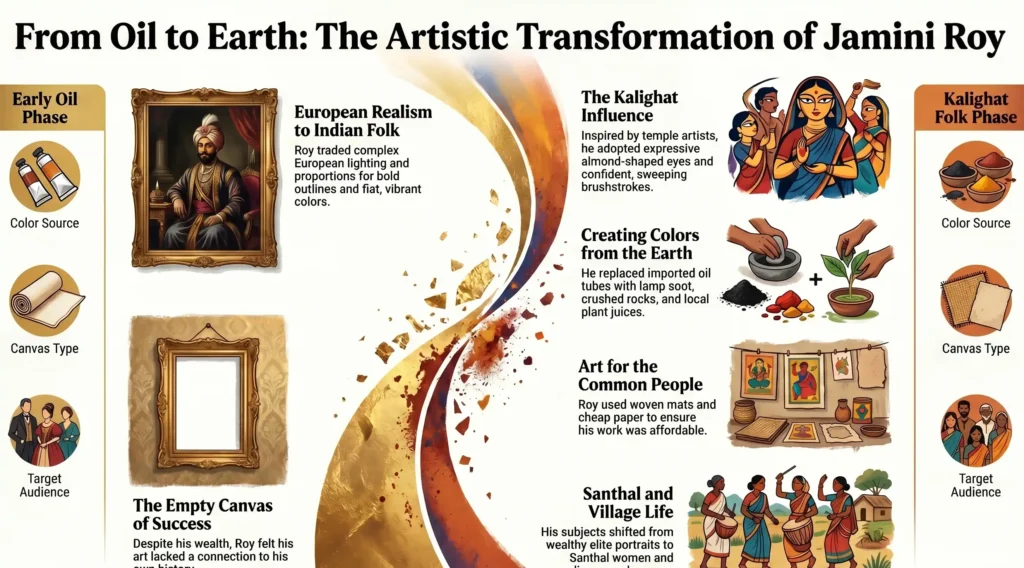
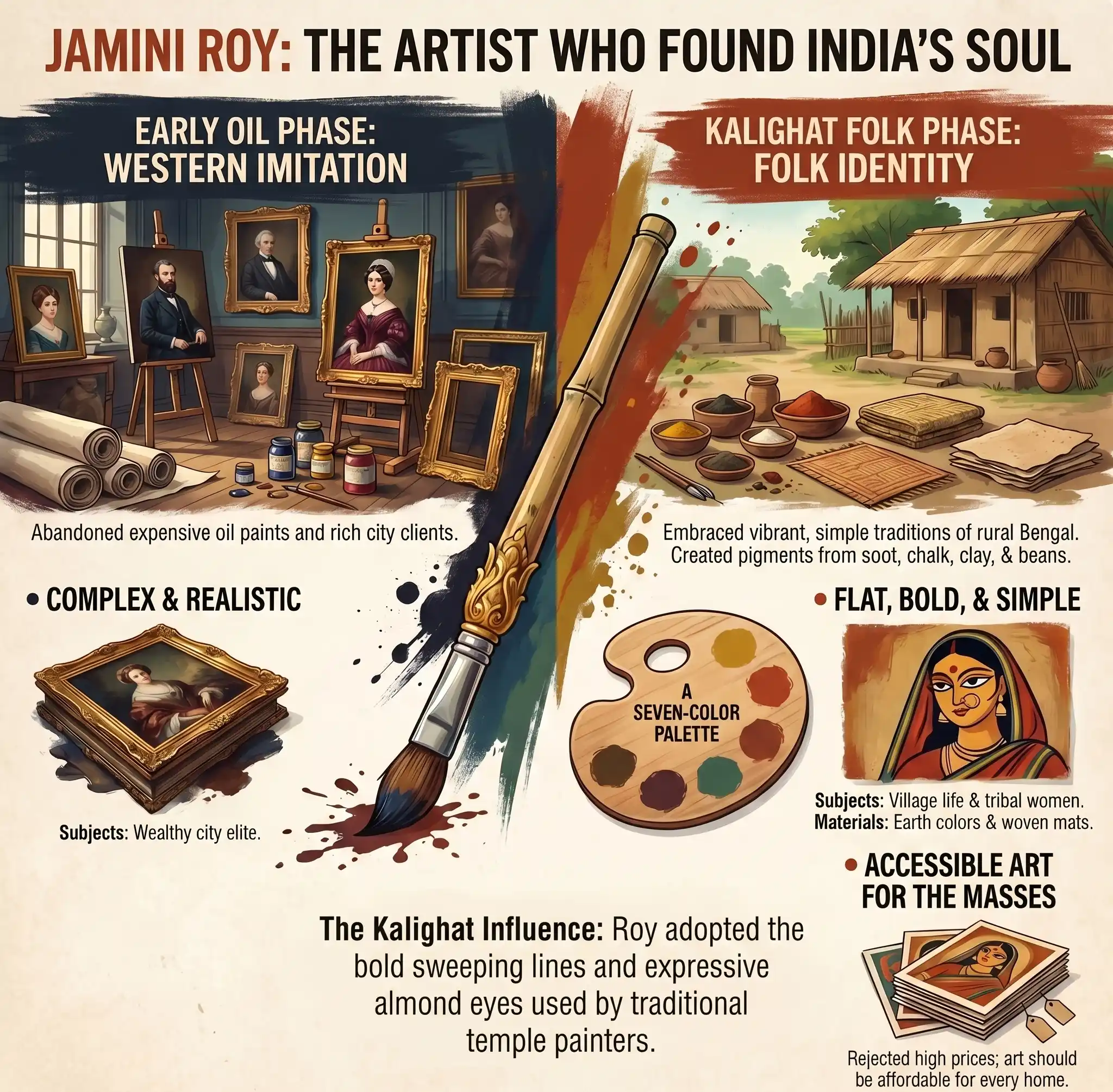
Jamini Roy had everything a young artist in the early twentieth century could possibly want. He lived in the bustling, wealthy city of Calcutta, completely surrounded by high society. He was highly trained at the prestigious Government School of Art, learning exactly how to capture perfect human proportions. Rich patrons paid him very well to paint their portraits in the classical European style. He used the finest imported oil colors and expensive fabric canvases brought in from overseas. People admired his perfect brush strokes and realistic, moody landscapes.

However, a deep sadness grew inside him. When he looked at his own beautiful paintings, his heart felt completely empty. He realized he was merely copying a foreign culture that had nothing to do with his own blood or his own history. His art had absolutely no connection to his own childhood or the rich soil of his country. He desperately wanted to paint the true face of India, not a European illusion created for the wealthy elite. This painful realization sparked a massive change in his life. He decided to throw away his expensive oil paints and start his career over completely.

READ MORE:  Kishore Kumar (1929–1987): The Eccentric Genius of Indian Cinema

Memories of a Village Childhood

To fully understand this dramatic and sudden change, we must look at where he originally came from. He was born in a small, quiet village named Beliatore in the Bankura district of Bengal. As a little boy, he grew up entirely surrounded by dedicated local craftspeople. He spent hours watching village potters mold wet clay into beautiful, useful shapes. He saw local weavers creating absolute magic with simple cotton threads. The humble mud walls of his village homes were beautifully decorated with bright and raw folk paintings that told ancient stories.

These early memories stayed safely hidden in his mind while he studied formally in the big city. When the emptiness of his commercial success became too much to bear, these vibrant village memories called him back home. He realized that true art does not need to be expensive or complicated to touch the human soul. The village artists painted with pure joy and simple devotion. He wanted to capture that exact same feeling in his own work. He knew that the traditional, humble painters of Bengal held the secret to authentic Indian expression.

Discovering the Temple Painters

Around the year nineteen twenty, his deep search for meaning led him straight to the Kalighat temple in Calcutta. Outside the busy temple doors, local rural artists called Patuas sat right on the dusty ground, painting quick and vibrant pictures for the passing pilgrims. These traditional paintings were completely different from the slow, dark, and highly detailed oil portraits he was used to making. The temple artists used incredibly bold and sweeping brush strokes. They painted their figures with large, expressive almond shaped eyes and smoothly rounded bodies.

He was completely mesmerized by their incredible speed and unwavering confidence. They did not care about perfect realistic shadows or complex European lighting rules. They painted engaging stories of gods, goddesses, and everyday village life with raw, unfiltered emotion. He saw clearly that these simple pictures held far more power than all his expensive city portraits combined. This was the exact defining moment he decided to fully adopt the folk traditions of his homeland. His work began to naturally parallel the deep nationalistic spirit beautifully seen in the Bharat Mata Painting 1905 The Icon of Indian Independence which deeply moved the masses to love their motherland.

Creating Colors from the Earth

Abandoning European art meant he also had to completely abandon European materials. He stopped buying fancy tubes of oil paint from the city stores. Instead, he became a humble student of the earth itself. He started making his very own colors using natural, raw ingredients found directly in Indian villages. He used crushed chalk to make a pure, brilliant white color. He collected the dark soot from burning oil lamps to create a deep, rich black. He crushed local rocks and soft river clay to get beautiful earthy reds and vibrant yellows. He even learned to use the fresh juice of local beans and crushed leaves to make his green shades.

READ MORE:  The Ethics Of Entomophagy In Northeast India

He also stopped using expensive imported canvas. He chose to paint on cheap paper, basic cloth, and woven floor mats. He wanted his art to be easily affordable for the common, everyday people of India, not just the wealthy elite locked in their mansions. By using local materials, his paintings literally contained the very soil of his country. This absolute dedication to natural and accessible art makes his personal journey truly inspiring. We see a very similar devotion to the preservation of ancient local skills and materials highlighted in the Assam Handloom Heritage The Magic of Muga Silk.

The Santhal Inspiration

As he patiently perfected his new folk style, he found immense visual inspiration in the Santhal tribal community. He deeply admired their incredibly simple way of life, their rhythmic group dances, and their profound, unbroken connection to nature. He began to paint Santhal women with thick dark outlines and flat, bright, beautiful colors. He removed all unnecessary background details from his paintings. He only kept the essential, flowing lines needed to clearly show the human spirit and pure emotion.

His painted figures looked robust, incredibly strong, and deeply rooted in the earth beneath their feet. He also painted beautiful, quiet scenes of mothers gently holding their children and strong farmers working the wet fields. His art became a brilliant, colorful celebration of ordinary Indian life. Another contemporary artist who found her unique and highly powerful voice by looking inward to local traditions was Sunayani Devi The Unsung Female Pioneer of the Bengal School of Art. Both of these incredible artists proved that true creativity always comes from deep within the culture, not from outside rules.

A Legacy of Pure Indian Identity

The formal art world was initially shocked by his massive transformation. Some strict critics simply did not understand why a master portrait painter was suddenly drawing like an uneducated village artist. But very soon, regular people recognized the absolute genius in his simplicity. His bold, sweeping lines and warm earthy colors spoke directly to the heart of the viewer. He had successfully created a visual language that was completely modern yet deeply and unmistakably traditional.

READ MORE:  Mughal Gardens: Where Geometry Meets Paradise

His unwavering dedication to expressing the true spirit of India is highly comparable to the fiery passion of Subramania Bharati Poet Who Ignited the Freedom Struggle. Both of these brilliant men used their immense talents to fully awaken the cultural pride of the nation during a very difficult time. Today, his beautiful paintings are considered highly protected national treasures. Just as the ancient, silent stone carvings tell timeless, emotional stories in the Khajuraho Temples Architecture Truth of Erotic Art, his simple, honest brushstrokes continue to tell the compelling story of rural India to the entire world.

Quick Comparison Table

FeatureEarly Oil PhaseKalighat Folk Phase
Subject MatterWealthy city clients and realistic landscapesVillage life gods tribal women
Color SourceExpensive imported oil color tubesNatural earth lamp soot and plant juices
Canvas TypeCostly imported fabric canvasesCheap paper woven mats and cloth
Artistic StyleComplex realistic with European lightingFlat bold colors thick outlines simple forms
Target AudienceRich elite buyersCommon Indian people

Curious Indian Fast Facts

  • He severely restricted his color palette to only seven basic earthy colors for most of his folk art career.
  • He strongly believed that art should be mass produced and sold very cheaply so absolutely every home could afford a painting.
  • Even though he was a practicing Hindu, he painted a famous series on the life of Jesus Christ using his signature village style.
  • He never sold his paintings for very high prices during his lifetime because he passionately hated the commercialization of art.
  • The Indian government officially declared his works as protected cultural heritage, meaning they cannot be taken out of the country without special government permission.

Conclusion

The incredible life journey of this great artist teaches us a highly timeless lesson about always staying true to ourselves. He had reached the absolute peak of financial success in the big city, but he possessed the rare courage to walk away when he realized his soul was not in his work. By looking back at the simple mud walls of his childhood and the vibrant temple art of his city streets, he found a completely new and profound way to express his creative genius.

He conclusively proved that you do not need expensive imported materials or complex foreign ideas to create something globally significant and truly beautiful. By grinding his own colors directly from the earth and painting the everyday lives of tribal people, he proudly elevated Indian folk traditions to the highest level of fine art. His bold outlines and bright colors continue to bring immense joy and cultural pride to millions of people today. He remains a glowing, inspiring reminder that the most profound beauty is very often found right in our own backyards, simply waiting to be rediscovered by a brave and curious heart.

If you think you have remembered everything about this topic take this QUIZ

Where was the painter born?

He was born in a small village named Beliatore located in the Bankura district of Bengal.

Why did he stop painting oil portraits?

He felt his realistic portraits lacked a true connection to his Indian roots and simply copied foreign European styles.

What kind of materials did he use for his folk art?

He used natural earth pigments, soot, plant juices, chalk, and painted on cheap paper, cloth, and woven mats.

Who were the primary subjects of his later paintings?

He primarily painted ordinary village people, Santhal tribal women, mothers and children, and local Hindu deities.

Why are his paintings so important to India?

They represent a crucial return to native Indian folk traditions and helped establish a completely unique, modern Indian artistic identity.

Tags: Bengal ArtCultural HeritageIndian PaintersJamini RoyKalighat Patachitra
ShareTweetPin
paripurnadatta

paripurnadatta

Related Posts

Bhimbetka rock shelters
Ancient Civilizations & The Vedic Age

Touching the Past at the Bhimbetka Rock Shelters

May 16, 2026
Nidhivan Enigma
Indian History

Reason No One Stays In The Nidhivan Enigma

May 14, 2026
Muhnochwa attacks
Post-Independence India

Why The 2002 Muhnochwa Attacks Still Terrify Us

May 14, 2026
No Result
View All Result

Stay Updated

  • Trending
  • Latest
Life of Mahavira: From Prince Vardhamana to Great Conqueror

Life of Mahavira: From Prince Vardhamana to Great Conqueror

April 11, 2026
Life of Buddha: The Journey to Enlightenment

Life of Buddha: The Journey to Enlightenment

April 11, 2026
Christmas in India

Christmas in India: A Festive Blend of Faith, Flavors, and Tradition

April 11, 2026
From Shimla to Stardom: The Complete Biography of Anupam Kher

From Shimla to Stardom: The Complete Biography of Anupam Kher

April 11, 2026
Jamini Roy

Why Jamini Roy abandoned oil painting for Kalighat roots

May 16, 2026
Bhimbetka rock shelters

Touching the Past at the Bhimbetka Rock Shelters

May 16, 2026
Son Bhandar Caves

The Mysterious Son Bhandar Caves Lost Gold Vault

May 6, 2026
Flight of Nana Saheb

The Flight Of Nana Saheb And The 1857 Uprising

May 6, 2026

Widget Title

Facebook Twitter Youtube RSS
Curious Indian Logo

Explore the soul of Bharat with Curious Indian. A definitive guide to Indian history, arts, culture, biographies, and the events that defined our future.

Follow us on social media:

Recent News

  • Why Jamini Roy abandoned oil painting for Kalighat roots
  • Touching the Past at the Bhimbetka Rock Shelters
  • The Mysterious Son Bhandar Caves Lost Gold Vault

Category

  • Ancient Civilizations & The Vedic Age
  • Architecture
  • Artists & Cultural Icons
  • Arts & Culture
  • Battles of India
  • Biography
  • Business & Industrialists
  • Colonial India
  • Cultural Insights
  • Dance & Music
  • Entertainment Personalities
  • Festivals of India
  • Freedom Fighters
  • Freedom Movement
  • Historical Events & Turning Points
  • Indian History
  • Indian Politics
  • Major Festivals
  • Medieval India
  • North East India
  • Paintings & Visual Arts
  • Political Leaders
  • Post-Independence India
  • Regional Culture
  • Religious & Spiritual Figures
  • Science Personalities
  • Scientific Discoveries
  • Sculpture
  • Social Issues
  • SOCIETY & MYSTERIES
  • Strange & Unknown Stories
  • Textiles & Handicrafts
  • Unsolved India
  • Unsung Heroes

© 2026 Curious Indian- Everything about India

Welcome Back!

Login to your account below

Forgotten Password?

Retrieve your password

Please enter your username or email address to reset your password.

Log In

Add New Playlist

No Result
View All Result
  • Arts & Culture
  • Festivals of India
  • Indian History
  • Indian Politics
  • Biography
    • Entertainment Personalities
    • Science Personalities

© 2026 Curious Indian- Everything about India

This website uses cookies. By continuing to use this website you are giving consent to cookies being used. Visit our Privacy and Cookie Policy.
Are you sure want to unlock this post?
Unlock left : 0
Are you sure want to cancel subscription?
×