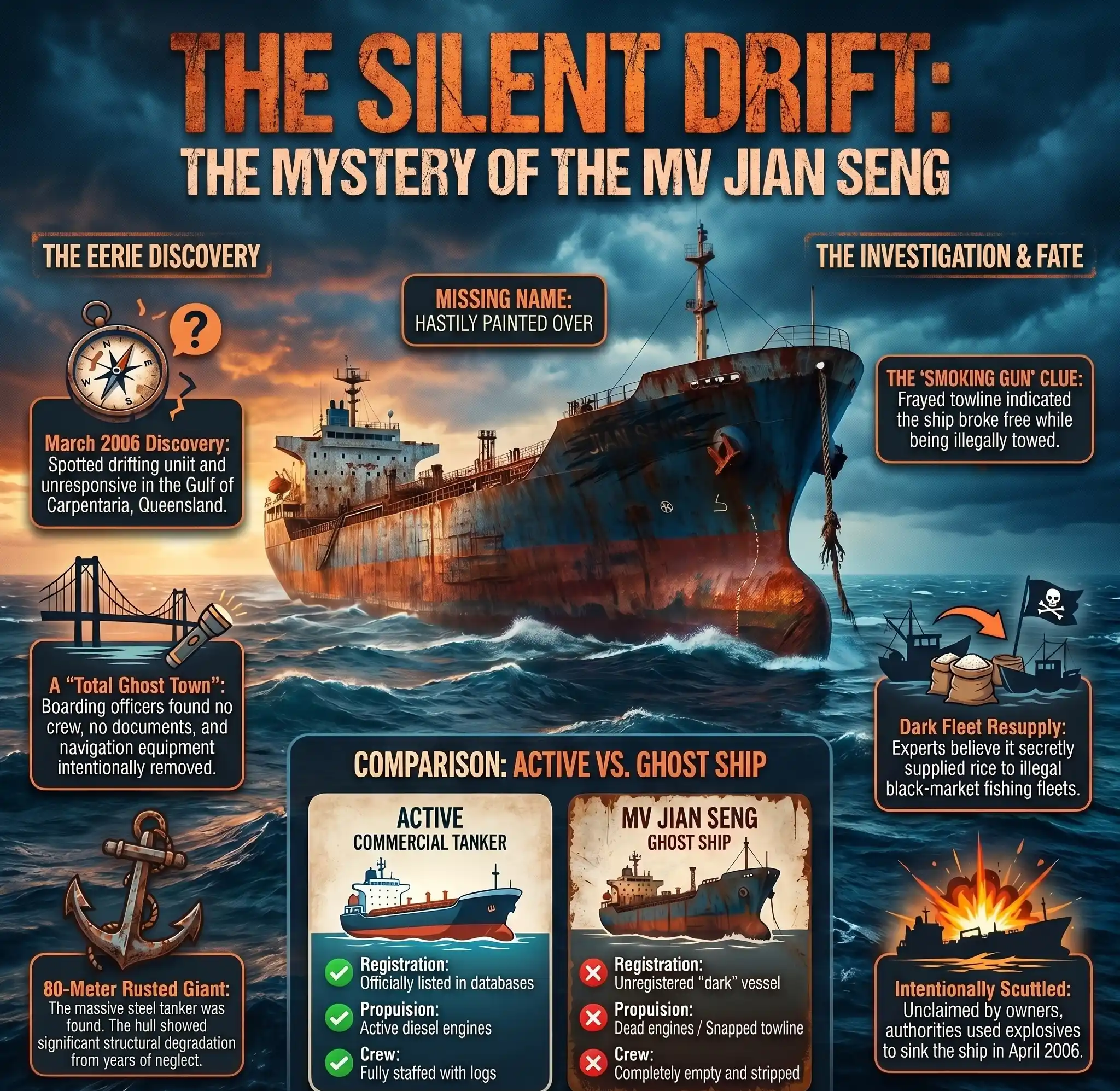
In the vast, unpredictable world of maritime travel, few things are more terrifying than a ghost ship. In March two thousand and six, an Australian coastwatch aircraft spotted a massive, rusted eighty-meter tanker drifting aimlessly in the Gulf of Carpentaria. When customs officials boarded the vessel, they found absolute silence. There was no crew, no cargo, no identifying documents, and the ship's name had been hastily painted over. Known only as the MV Jian Seng, investigators strongly suspected the ship had originated from the deep waters of the Indian Ocean, possibly breaking free from a towline while being dragged to a South Asian shipbreaking yard. The eerie tale of this massive, floating ghost remains one of the most fascinating unsolved maritime mysteries of the modern era.| Feature | Details |
| Ship Name | MV Jian Seng (hastily painted over) |
| Type of Vessel | 80-meter rusted tanker |
| Discovery Date | March 2006 |
| Discovery Location | Gulf of Carpentaria, Queensland, Australia |
| Probable Origin | Indian Ocean / Southeast Asian waters |
The open ocean is incredibly vast and unforgiving, easily capable of swallowing massive ships without leaving a single trace behind. But sometimes, the ocean does not swallow a ship; it simply spits it back out, completely empty and silent. This is exactly what happened in the spring of two thousand and six off the northern coast of Australia.
When a routine aerial patrol flew over the Gulf of Carpentaria, the pilots noticed a large, rusted tanker bobbing heavily in the dark blue water. It was completely unlit, and it was not responding to any emergency radio calls. The massive steel beast was drifting dangerously close to active shipping lanes and shallow coral reefs. What followed was a thrilling, real-life maritime investigation that pulled authorities into the shady, invisible underworld of Indian Ocean shipping.
Reason No One Stays In The Nidhivan Enigma
Boarding the Silent Giant
When the Australian Customs and Border Protection Service finally reached the drifting vessel, they prepared for the absolute worst. Boarding an unknown, unlit ship in the middle of the ocean is incredibly dangerous. The officers climbed up the rusted ladders with their weapons drawn, not knowing if they would find pirates, illegal smugglers, or a crew suffering from a deadly sickness.
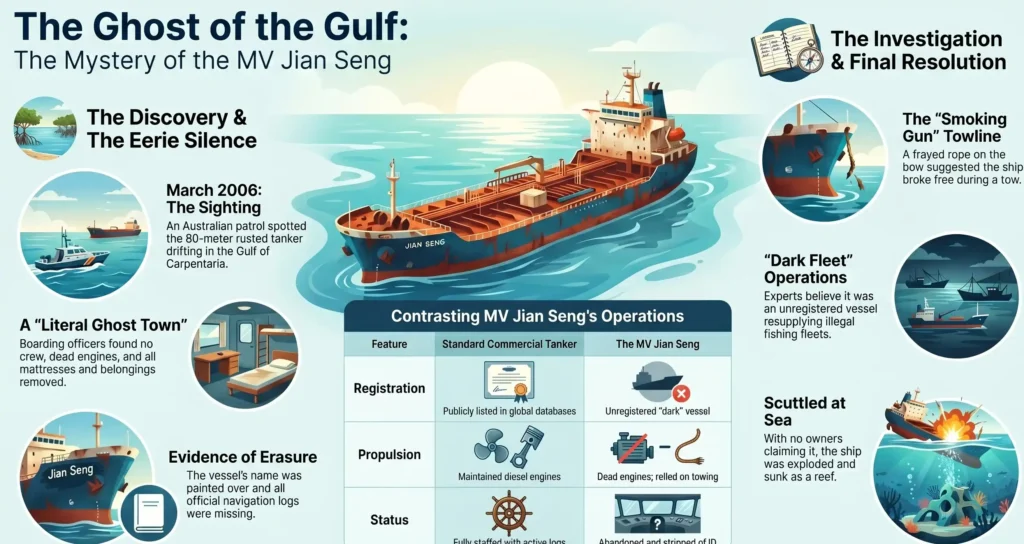
But what they found was far more chilling: absolutely nothing. The ship was a complete, literal ghost town. The heavy steel decks were completely empty. The engines were totally dead and had been non-operational for a very long time. The living quarters were completely stripped of mattresses, personal belongings, and food. Most suspiciously, the ship’s navigation equipment, radio logs, and official registration documents had been intentionally and carefully removed. Someone had gone to great lengths to completely erase the identity of this massive steel giant.
Vikram Sarabhai Biography: The Man Who Built India’s ISRO
The Indian Ocean Connection
As investigators scoured the rusted hull, they found a single, faint clue. Underneath a thick layer of fresh black paint, they could just barely make out the name “Jian Seng.” But searching global maritime databases for this name yielded absolutely zero concrete results. It was an unregistered “dark” vessel.
However, forensic maritime experts found a massive, frayed piece of heavy rope hanging off the front bow. This broken towline was the ultimate smoking gun. It indicated that the ship was not sailing under its own power; it was being towed. Based on the ocean currents and barnacle growth, authorities deduced that the ship had drifted thousands of miles from the Indian Ocean or deep Southeast Asian waters.
Many maritime historians heavily suspect that the Jian Seng was an illegal resupply vessel used by black-market fishing fleets in the Indian Ocean. When the ship finally became too old and rusted to use, it was likely being towed to the massive shipbreaking yards of South Asia, such as Alang in Gujarat, India.
Birbal Sahni: The Scientist Who Unlocked India’s Prehistoric Forests
The Shipbreaking Theory
Shipbreaking is a massive industry where dead vessels are violently torn apart for scrap metal. It is highly likely that during a massive Indian Ocean storm, the heavy towline simply snapped. Because the Jian Seng was totally empty and heavily rusted, the towing crew likely decided it was simply not worth the massive danger and cost to turn around and retrieve it. They abandoned it to the ocean currents, allowing it to slowly drift all the way to the Australian coastline. Organizations like the International Maritime Organization frequently track these hazardous, illegal tows because they pose a massive danger to active, passenger-filled ships in the dark.
The Search for the Owners
Even though the ship was a piece of junk, leaving an eighty-meter steel tanker floating in the ocean is highly illegal. The Australian government launched a massive international search to find the owners and force them to pay for the massive recovery costs. They broadcasted the ship’s description across the entire Asian and Indian maritime networks.
They waited for weeks, but the result was absolute silence. No shipping company, no private owner, and no government stepped forward to claim the rusted tanker. Claiming the ship would mean admitting to illegal, unregistered towing practices and facing massive environmental fines. The owners had completely washed their hands of the ghost ship.
Missing Key To The Indus Script Deadlock
A Watery Grave
Because the ship was heavily rusted, completely useless, and posed a massive environmental hazard if it crashed into the delicate Australian shoreline, the government had to make a tough decision. They could not sell it, and they could not leave it.
In April two thousand and six, the Australian authorities officially towed the silent MV Jian Seng out into deep, open water. They carefully rigged the rusted hull with heavy explosives and scuttled the ship. The massive ghost of the Indian Ocean finally sank to the dark bottom of the sea, transforming into a permanent, artificial reef for marine life. It took all of its dark, illegal secrets directly to its watery grave.
Quick Comparison Table
| Feature | Active Commercial Tanker | The MV Jian Seng Ghost Ship |
| Registration | Officially listed in global maritime databases | Unregistered “dark” vessel with painted-over name |
| Propulsion | Active, maintained heavy diesel engines | Dead engines, relying entirely on a snapped towline |
| Crew | Fully staffed with logs and communication | Completely empty and stripped of all personal items |
| Final Fate | Safely retired or legally sold for scrap | Abandoned, drifted for miles, and intentionally sunk |
Curious Indian Fast Facts
- The ship was found with large amounts of rice scattered in the cargo holds, heavily hinting that it was used to secretly supply food to illegal fishing boats at sea.
- Unregistered “dark fleet” ships often operate in the deep Indian Ocean because the massive waters make them incredibly difficult for authorities to track.
- Shipbreaking yards in South Asia are the final resting place for over seventy percent of the entire world’s retired commercial ocean vessels.
- A snapped towline is actually one of the most common reasons why modern ghost ships suddenly appear drifting in international waters.
- Before sinking the Jian Seng, authorities had to pump out massive amounts of toxic bilge water to ensure the ocean was not polluted.
Conclusion
The strange and chilling story of the MV Jian Seng is a powerful reminder that the massive oceans of our planet still hide incredible, unsolved mysteries. In an era where we can track a tiny mobile phone via global satellites, a massive eighty-meter steel tanker was able to slip through the cracks, sailing silently as a ghost across the Indian Ocean and into Australian waters.
While the ship now rests peacefully at the bottom of the sea, its story shines a massive, glaring spotlight on the dark, unregulated underworld of international shipping and illegal vessel disposal. The next time you look out over the vast, dark blue waters of the ocean, remember the silent ghost ship that drifted for thousands of miles, proving that the sea will always be full of secrets that absolutely refuse to be told.
When A Rumor Created The Monkey Man Of Delhi
If you think you have remembered everything about this topic take this QUIZ
Results


#1. In which year was the MV Jian Seng discovered?
#2. Where was the ghost ship spotted?
#3. What did customs officials find when they finally boarded the vessel?
#4. What clue on the front bow indicated the ship had not been sailing under its own power?
#5. Investigators suspected the ship was being dragged to which type of facility before it broke free?
#6. What was found scattered in the cargo holds, hinting at the ship’s possible use as a resupply vessel?
#7. Why did the Australian government decide to scuttle and sink the MV Jian Seng in April 2006?
#8. According to the text, what percentage of the world’s retired commercial vessels find their final resting place in South Asian shipbreaking yards?
What exactly is the MV Jian Seng?
The MV Jian Seng is the name of a massive, eighty-meter ghost ship that was found drifting completely empty and abandoned off the coast of Australia in 2006.
Where did the ghost ship originally come from?
Based on the broken towline and ocean currents, authorities strongly suspect it drifted from the Indian Ocean or Southeast Asian waters while being illegally towed to a shipbreaking yard.
Why was there no crew on board the ship?
The ship had been entirely stripped of its valuable equipment, identifying documents, and crew, heavily indicating that it was intentionally abandoned at sea after its towline snapped during a storm.
Did the authorities ever find the owners of the Jian Seng?
No. Despite a massive international search broadcasted across global maritime networks, absolutely no one stepped forward to claim the illegal, unregistered vessel.
What finally happened to the abandoned tanker?
Because it was a massive navigational hazard and too damaged to sell, the Australian government towed it into deep waters and intentionally sank it to create an artificial reef.