How Over 200 Tribal Dialects Are Disappearing and Why Linguists Are Racing to Save Them Before It’s Too Late
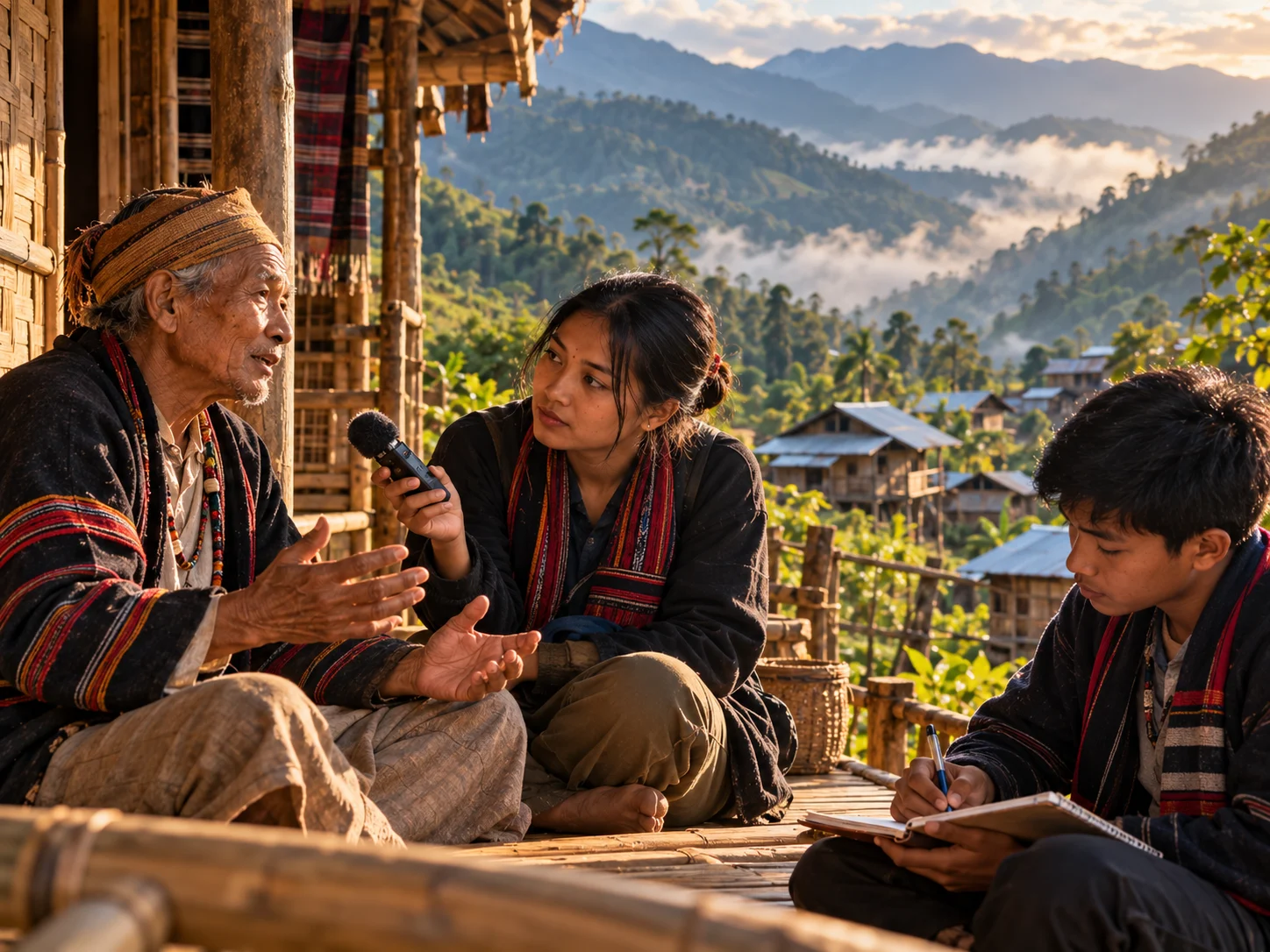
In the misty valleys and steep hills of Northeast India, something is happening in silence. Not the absence of sound, but the absence of words—ancient words that have been spoken for thousands of years, that carry within them entire ways of seeing the world, entire philosophies of how to live. Over two hundred different indigenous languages are fading. Some are spoken by fewer than a thousand people. Some are known by only the oldest generation, the elders who remember when these words filled the air of their villages. When these elders pass away, entire libraries of knowledge go with them—knowledge about local forests, traditional medicine, oral histories, the intimate understanding of how to live in harmony with the earth. The fight to save these languages is not an academic exercise. It is a race against time, a battle to preserve the soul of entire cultures before they disappear forever.
The Unconventional Journey of Irrfan Khan
A Linguistic Treasure Map: The Northeast’s Hidden Richness
To understand what is at stake, you must first understand what exists. Northeast India is not simply a region. It is one of the world’s greatest concentrations of human linguistic diversity. The landscape itself explains why. Thousands of years ago, communities settled in these lush valleys and steep hills, separated by thick jungles, massive rivers, and mountain ranges. These natural boundaries meant that neighboring villages—sometimes just a few kilometers apart—developed their own languages. Not just different accents or dialects, but completely different language families: Tibeto-Burman languages, Austroasiatic languages, each with its own structure, its own way of organizing meaning.
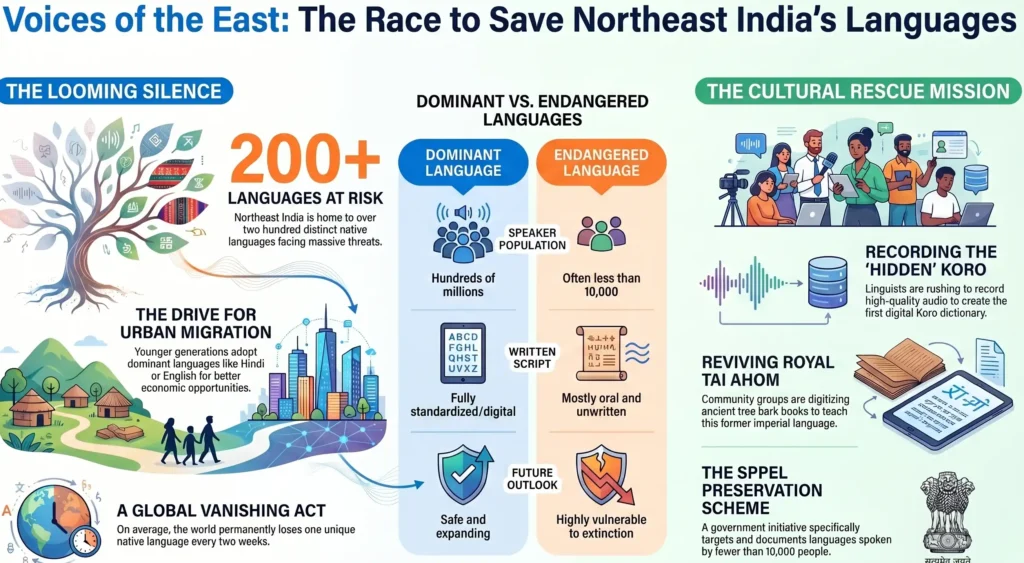
Today, the northeastern states of India are home to over two hundred distinct native languages. This is not a collection of slight variations on a common theme. These are languages as different from each other as English is from Mandarin. Each one represents thousands of years of cultural development, thousands of years of people thinking, creating, expressing themselves in their own unique way. According to reports from UNESCO, nearly a quarter of the world’s endangered languages are concentrated in this single region. India has approximately two hundred endangered languages altogether, and the overwhelming majority of them are in the northeast.
When we speak of endangered languages, we are speaking of a form of extinction. A language dies when it is no longer used in daily conversation, when parents stop teaching it to their children, when the youngest speakers are the last of a generation. The death of a language is absolute. Unlike a species that might theoretically be revived, a language that dies with the last elder who speaks it can only be recovered from the fragments left behind—recordings, written records, the memories of those who heard it as children.
Beyond Boundaries: The Complete Biography of Farhan Akhtar
The Discovery of Koro: A Language Hidden in Plain Sight
Sometimes the most significant discoveries happen by accident. In 2008, a team of linguists organized by the National Geographic Society traveled to a remote district in Arunachal Pradesh. Their mission was to document two known local languages: Aka and Miji. They set up camp in the villages, spent time on bamboo porches, recorded conversations, collected vocabulary. They were thorough and careful, doing the work that linguists do—listening, documenting, understanding.
But while they were recording the Aka language, they heard something unexpected. From the same villages, from people who lived alongside the Aka speakers, who shared the same food, wore the same clothes, participated in the same daily life, came a completely different sound. It was a language they had never heard before. It had no written form. It existed only in the daily speech of the people who spoke it. It was called Koro.
The discovery sent shockwaves through the linguistic world. An entirely unknown language, completely undocumented, had been hiding in plain sight. The Koro speakers numbered barely a thousand people, living interspersed among the larger Aka population. Despite the proximity, despite the shared culture, the languages were as distinct as English and Japanese. A mountain, called “phù” in Aka, was “nggõ” in Koro. The grammar was different. The sounds were different. Everything that made a language unique was unique in Koro.
The immediate implication was clear: Koro was endangered. Newly discovered and immediately vulnerable. The younger generation was already shifting to Hindi and other dominant languages for education and economic opportunity. The elders who carried Koro in their memory were aging. Organizations like the Living Tongues Institute for Endangered Languages understood that this was a moment of crisis. If nothing was done immediately, if the language was not recorded, documented, preserved in digital form, it would disappear. The world would lose something it had just discovered.
Tai Ahom: The Language of Kings
A.R. Rahman : The Musical Genius Who Conquered the Globe
Not all endangered languages belong to small, isolated communities in remote hills. Some were once the official voices of empires. Tai Ahom was the court language of the Ahom kingdom, one of the most powerful political entities in medieval India. For over six hundred years, the Ahom kings ruled Assam, resisting invasions, building a civilization, creating culture. Tai Ahom belonged to the Tai Kadai language family and had its own written script, its own tradition of literature and scholarship.
The Ahom elite wrote on tree bark. They created manuscripts of history, of sacred knowledge, of royal administration. The language was beautiful, structured, expressive. It was the voice through which an entire kingdom expressed itself. But languages do not exist in isolation. They rise and fall with the societies that speak them. As the Ahom kingdom evolved, as the rulers sought to connect with their subjects, they gradually adopted Assamese, the language of the broader population around them. Over centuries, Tai Ahom shifted from daily speech to ceremonial use. Eventually, it was preserved only in the sacred chants performed by traditional priests, passed down through ritual rather than daily conversation.
Today, Tai Ahom is critically endangered. But there is hope. Dedicated community groups and young scholars, many of whom have personal connections to Ahom history, have begun a project of revitalization. They are teaching Tai Ahom in weekend schools. They are working with linguistic institutes to develop grammars and educational materials. They are digitizing the ancient tree bark manuscripts, preserving them not just in memory but in accessible form. The language that was once the voice of kings is being brought back not as an instrument of power, but as an expression of cultural continuity and identity.
The Silence of Urban Migration: When Young People Leave
The story of how languages die in the modern world is not a story of catastrophe. It is a story of ordinary, understandable choices that lead to extraordinary loss. A young person grows up in a remote village, speaking only their mother tongue. They dream of opportunities beyond their community. They want an education, a good job, a life that offers possibilities. To achieve these things, they must leave. They must go to a city. They must learn Hindi or English or another dominant language.
When they move away, they stop speaking their mother tongue daily. The language begins to fade from their daily practice. When they have their own children, they face a choice: do they teach their children the old language, the language of their own childhood, a language that will not help them succeed in school or business? Or do they teach them Hindi or English, the languages of opportunity? It is not a difficult choice to understand. Parents want their children to succeed. They make the pragmatic decision. They teach them the languages that will open doors.
But this pragmatic choice, made by millions of parents over decades, adds up to extinction. The children grow up without hearing the mother tongue. They lose the ability to speak it. They cannot teach it to their own children. A language that survived thousands of years is lost in a single generation. The knowledge contained in that language—the specific names for local plants, the particular ways of expressing emotion, the accumulated wisdom of a culture—disappears.
The Race to Document: Preserving What Remains
Fortunately, linguists and conservationists have recognized the urgency of this moment. The Central Institute of Indian Languages, based in Mysuru, runs a program called the Scheme for Protection and Preservation of Endangered Languages. This initiative specifically targets languages spoken by fewer than ten thousand people. It is a direct intervention, designed to reverse the tide of extinction.
The work of preservation is not conducted in offices or libraries. Trained linguists travel to remote villages and spend months—sometimes longer—living within the communities whose languages they are trying to save. They are not tourists. They are not observers from the outside. They become part of the community, learning the rhythms of daily life, building relationships, earning trust. They sit with elders and record their voices. They collect folk songs, traditional stories, local myths, the oral narratives that carry cultural meaning. They listen to how the language is actually used, not how it appears in isolated vocabulary lists.
From these recordings and conversations, linguists work to create what was not there before: written scripts for languages that have existed only in speech. They develop grammar books. They create picture dictionaries for children. They build audio archives so that the sounds of the language, the rhythms and tones that give it life, are preserved in digital form. These materials become teaching tools. Young people who have grown up speaking dominant languages can reconnect with their heritage. Children can learn the words their grandparents spoke.
The Ministry of Development of North Eastern Region actively supports these preservation efforts, understanding that the true wealth of a nation lies in its human diversity, in the different ways its people have learned to see and understand the world. Every time a linguist presses record on their camera, every time they type out a grammar rule, every time they create a dictionary entry, they are engaged in an act of cultural preservation—ensuring that voices that might fade away will instead echo in digital archives, available to future generations.
From Jadoo to Javed: The Complete Biography of a Literary Giant
The Conversation That Never Ends
The fight to save endangered languages is ultimately about something more fundamental than words. It is about the right of a people to maintain their identity, to pass down their culture, to ensure that their way of understanding the world is not erased by the pressure of dominant languages and dominant cultures. When a language is preserved, what is preserved is not just vocabulary. It is a way of thinking, a way of seeing relationships between things, a unique way of being human.
Some of the specific words that exist in endangered Northeast languages cannot be translated into English or Hindi. They express concepts that are unique to that culture, to that landscape, to that way of life. A word for a particular type of forest plant that has no English equivalent but has deep medicinal significance. A word for a relationship between family members that does not exist in other languages. A word for a way of describing seasonal change that reflects thousands of years of observation of the local climate. When the language disappears, these expressions disappear with it.
The work of preservation is not about freezing languages in time, as if they were museum pieces. Living languages change and evolve. But change should be a choice, a natural evolution of how people speak. What is happening with endangered languages is not organic change. It is erasure driven by economic pressure, by the need to migrate to survive, by the dominance of larger languages and larger cultures. The preservation efforts being conducted across Northeast India are about ensuring that communities have the choice to maintain their languages if they wish, to pass them on, to let them continue to evolve in their own way.
The Voices Still Singing
Not all the news about Northeast India’s languages is tragic. There are successes. Tai Ahom is being revived. Young scholars are learning to read and write the ancient script. The Koro language has been recorded and documented. Archive projects are underway. Cultural organizations are working with communities to teach languages in schools. The Ministry is providing resources. International organizations are paying attention. The world is beginning to understand that when a language disappears, we all lose something.
The fight is not won. The pressure of globalization, of urbanization, of economic necessity, continues. But there are people who have chosen to stand on the other side of this tide. They are recording, documenting, teaching, preserving. They are saying that the voices of the Northeast matter, that the different ways of understanding the world matter, that diversity itself is a treasure worth protecting. The misty valleys of the northeast have always been a sanctuary for linguistic diversity. By protecting these ancient mother tongues, we ensure that the brilliant, colorful voices of India will never go completely silent.
Ashok Kumar (1911–2001): The Accidental Star Who Defined Bollywood
If you think you have remembered everything about this topic take this QUIZ
Results


#1. Approximately how many distinct native languages are found in the Northeast Indian region?
#2. Which “hidden” language was discovered by a National Geographic expedition as recently as 2008?
#3. What was the historical status of the Tai Ahom language in the state of Assam?
#4. According to UNESCO, how many endangered languages does India have in total?
#5. What is the primary cause for the rapid disappearance of ancient tribal dialects today?
#6. The SPPEL scheme focuses on protecting mother tongues spoken by fewer than how many people?
#7. Which organization is leading the national effort to record dictionaries and map grammars of these languages?
#8. According to the “Fast Facts,” how often does the world permanently lose a unique native language?
What makes a language officially endangered?
A language is considered endangered when its speakers stop using it in daily life parents stop teaching it to their children and it faces a very high risk of becoming completely extinct.
How was the Koro language discovered?
It was discovered entirely by accident in two thousand and eight by a team of linguists who traveled to Arunachal Pradesh to study a different language but suddenly heard a completely unknown dialect being spoken on the village porches.
Why do young people stop speaking their native tribal languages?
Young people often shift entirely to dominant languages like Hindi or English because those languages are absolutely necessary for higher education getting modern jobs and surviving in big urban cities.
What is the SPPEL program?
The Scheme for Protection and Preservation of Endangered Languages is a massive government program run by the Central Institute of Indian Languages to formally document and digitize native languages spoken by fewer than ten thousand people.
Can a completely extinct language be brought back to life?
Yes it is incredibly difficult but possible. With proper historical documentation dedicated community effort and structural teaching an extinct language like Tai Ahom can slowly be revived into active use.
Sources & References
Northeast India as a linguistic hotspot containing over 200 endangered indigenous languages with concentration of Tibeto-Burman and Austroasiatic language families — Northeast India is home to over 200 distinct indigenous languages making it one of the world’s greatest concentrations of human linguistic diversity, with nearly 25% of India’s 200 endangered languages concentrated in this region, featuring language families including Tibeto-Burman and Austroasiatic groups developed over thousands of years across communities separated by geographical barriers.
The discovery of the Koro language in 2008 by linguists during a National Geographic Society expedition to document Aka and Miji languages in Arunachal Pradesh — In 2008, a linguistic team organized by the National Geographic Society working in remote Arunachal Pradesh to document Aka and Miji languages discovered an entirely unknown language called Koro, spoken by barely 1,000 people living among the larger Aka population, with distinct phonology and grammar as different as English and Japanese, and immediately classified as highly endangered due to younger generation shift to Hindi.
Tai Ahom as the endangered court language of the Ahom kingdom with over 600 years of historical significance and current revival efforts through community teaching and manuscript digitization — Tai Ahom, the official court language of the historically powerful Ahom kingdom that ruled Assam for over 600 years, belonged to the Tai Kadai language family and produced manuscripts written on tree bark, but declined to ceremonial use in sacred priestly chants as Assamese became dominant, and is now being revived through weekend school instruction and digitization of ancient manuscripts.
Language endangerment patterns driven by urban migration and economic pressure as younger generations shift to dominant languages for education and employment opportunities — Northeast India’s endangered languages face extinction due to younger generation migration from remote villages to cities where dominance of Hindi and English for education and business opportunity makes indigenous languages economically disadvantageous, causing parents to cease teaching mother tongues to children and resulting in loss of language transmission within a single generation.
The Scheme for Protection and Preservation of Endangered Languages (SPPEL) run by the Central Institute of Indian Languages targeting languages with fewer than 10,000 speakers and involving linguistic fieldwork, documentation, grammar development, and digital archiving — The Central Institute of Indian Languages in Mysuru operates the Scheme for Protection and Preservation of Endangered Languages (SPPEL) that targets indigenous languages spoken by fewer than 10,000 people, involving trained linguists conducting extended fieldwork in communities to record oral narratives, develop written scripts, create grammar books and picture dictionaries, and build digital audio archives for language preservation and community education.