Assam, April 2020: lockdown had taken away most of the spring festival. For one man near Kaziranga, a nest of red ant larvae brought it back. Eating insects, and the questions it raises, in the north-east
In April 2020, India was in lockdown, and Bohag Bihu, Assam’s great spring festival, was a quiet affair.
In Da-gaon, a village near Kaziranga National Park, Bitu Gogoi could not perform many of the usual rituals. Preparations were limited. Pork, a festival staple, was off the menu.
But one thing still made it feel like Bihu. “A whole nest of amroli poruar tup made my bihu,” he told The Wire.
Amroli poruar tup is the larvae of the red weaver ant. They look a little like puffed rice, taste sour, and are gathered in spring. For generations, many of Assam’s indigenous communities have eaten them at Bohag Bihu.
They look a little like puffed rice, taste sour, and are gathered in spring.
For many Indians, eating insects sounds strange, even shocking. In the north-east, it is simply part of food.
Researchers have recorded around 255 species of edible insects in India, and most of that eating happens in the north-eastern states. One study in Nagaland alone documented 106 insect species that local communities regard as health foods.
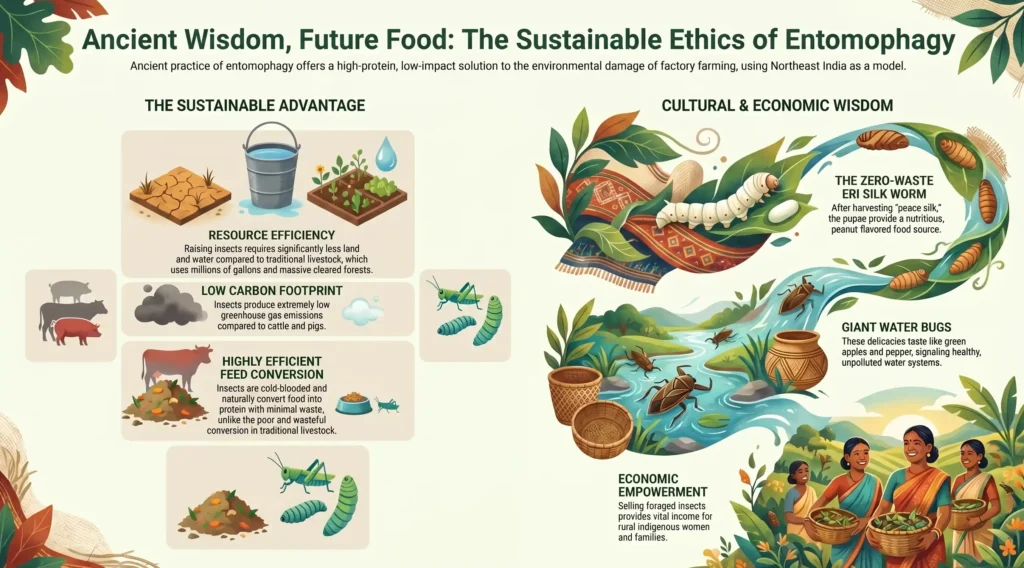
The menu is long. Crickets, grasshoppers, beetles, termites, dragonflies. The larvae and pupae of bees, wasps and hornets. Weaver ants, whose eggs and larvae are boiled or cooked with spices, while the adults are ground into a chutney with chilli, salt and dried fish. And silkworms: the larvae and pupae of the eri and muga silkworms, the same creatures that give Assam its famous silks, fried, roasted or eaten with salt and chilli as a snack.
Some of these insects are collected from the wild. Some, like the eri and muga silkworms and the honeybee, are reared. Hornets and wasps are semi-domesticated, their nests tended in their natural homes.
The first question: disgust
Hema Malini: From Cinema’s Darling to Mathura’s MP
Is it wrong to eat insects? That is the first question many people ask, and it is worth asking why.
Across the world, around two billion people are thought to eat insects regularly. What seems disgusting in one place is a delicacy in another; many Indians eat prawns, which are relatives of insects, without a second thought. The disgust that people from outside the region sometimes feel towards north-eastern food, whether fermented bamboo shoot or roasted silkworms, often says more about the person who is disgusted than about the food. And it has too often been used to mock and exclude people from the north-east.
So the first ethical point is simple: respect. A food eaten for generations by a community is not a curiosity or a joke.
The disgust people feel often says more about the person who is disgusted than about the food.
The more serious ethical question is not whether to eat insects, but how many, and how.
Here, traditional practice has a lot to teach. In Nagaland, researchers found that when people collect the nests of bees and wasps, they leave the queen and some of the workers behind, so the colony can recover and produce again. This habit of restraint has been passed down through generations.
But demand is changing. Roasted silkworms and other insect dishes now sell quickly in local markets, and have turned up at tourism festivals, where people from outside the region try them for the first time. As more people want them, especially those collected from the wild, the old rules of restraint matter more than ever. A traditional harvest can become an over-harvest if the market grows faster than the forest can recover.
The third question: the future
There is also a bigger argument, one that scientists around the world are making. Insects convert feed into protein far more efficiently than cattle, pigs or chickens. Rearing them needs little land and water. Some researchers believe that edible insects could help feed a growing world with less damage to the planet.
If that is true, then the north-east is not behind the times. It may be ahead of them, holding knowledge about which insects are safe, how to rear them, and how to harvest without destroying them, that the rest of the world is only beginning to learn.
None of this was on Bitu Gogoi’s mind in April 2020. He had lost most of his festival to the pandemic. What he had left was a nest of sour, puffed-rice-white larvae, gathered in spring, as his community had done for generations.
That, perhaps, is the heart of the matter. Before it is a question of ethics or the future of food, eating insects in the north-east is a question of home: of a taste that tells you, even in the strangest year, that Bihu has come.
Are silk worms and water bugs actually safe to eat?
Yes they are completely safe and highly nutritious when they are gathered from clean environments and properly cooked or roasted over a fire.
Why is eating insects considered better for the environment?
Insects require a tiny fraction of the land water and feed compared to traditional farm animals like cows making their environmental footprint incredibly small.
What do giant water bugs actually taste like?
When properly roasted they do not taste like mud. They have a very unique complex flavor that many people describe as a mix of sweet green apples and spicy black pepper.
Do people in Northeast India eat insects out of necessity?
No it is not done out of desperation or poverty. It is a highly respected cultural tradition and these insects are often considered expensive delicacies reserved for special meals.
Sources & References
The Wire Science, “In India’s Northeast, a Rich Tradition of Insect Foods” (2020) — Bitu Gogoi’s Bihu, red ant larvae, the insects commonly eaten, silkworm dishes, and the growing market.
“Traditional Knowledge of the Utilization of Edible Insects in Nagaland, North-East India”, Foods 9(7): 852 (2020) — the 106 species, weaver ant preparations, reared and semi-domesticated insects, and the practice of leaving the queen behind.
“Utilization of edible insect as food in Northeast India”, Indian Entomologist 1(2) (2020) — the 255 species recorded in India.
Food and Agriculture Organization of the United Nations, Edible Insects: Future Prospects for Food and Feed Security (2013) — global insect consumption and the resource efficiency of insect protein.
Paripurna Datta is the founder and editor of Curious Indian, an independent editorial publication focused on Indian history, culture, science, society, and the stories behind them. He oversees research, editorial standards, and the publication's long-term direction.
Paripurna Datta is the founder and editor of Curious Indian, an independent editorial publication focused on Indian history, culture, science, society, and the stories behind them. He oversees research, editorial standards, and the publication's long-term direction.