Guru Dutt made a film about a director the industry discarded, the industry discarded it, and he never took a directing credit again
Kaagaz Ke Phool opened on 2 January 1959 and was the first Indian film shot in CinemaScope.
It is about a film director whose career falls apart, whose marriage fails, and who ends up unrecognised and unemployable on the edge of the industry that had made him famous. Guru Dutt produced it, directed it and played the director.
It failed so completely that it nearly took his company down with it, and he never officially directed a film again. He was thirty-three.
He was born Vasanth Kumar Padukone in Bangalore in 1925, spent three years training in dance at Uday Shankar’s centre at Almora, and drifted into films through Prabhat in Poona, where he met Dev Anand. Dev Anand gave him his first film to direct, Baazi, in 1951.
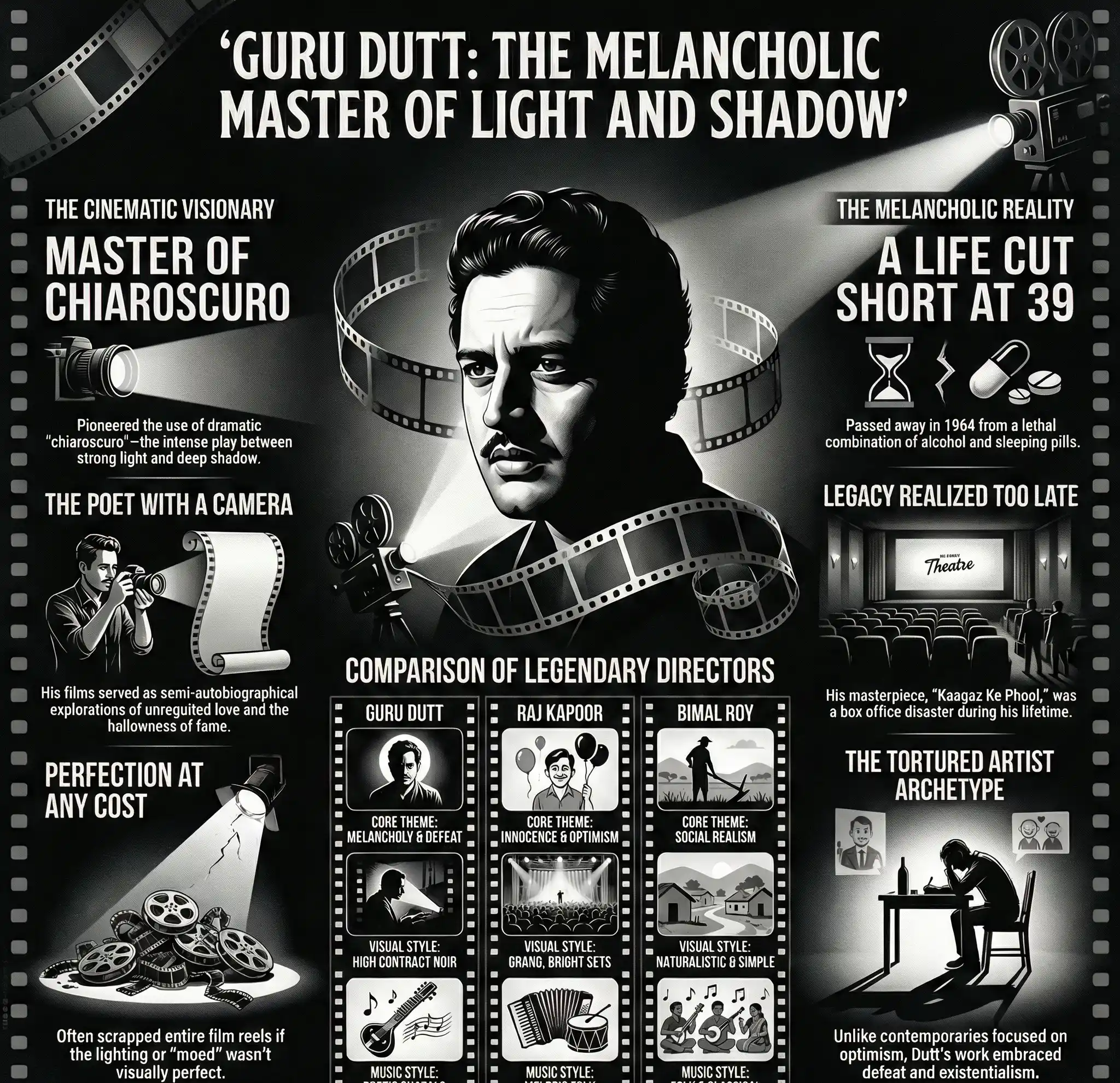
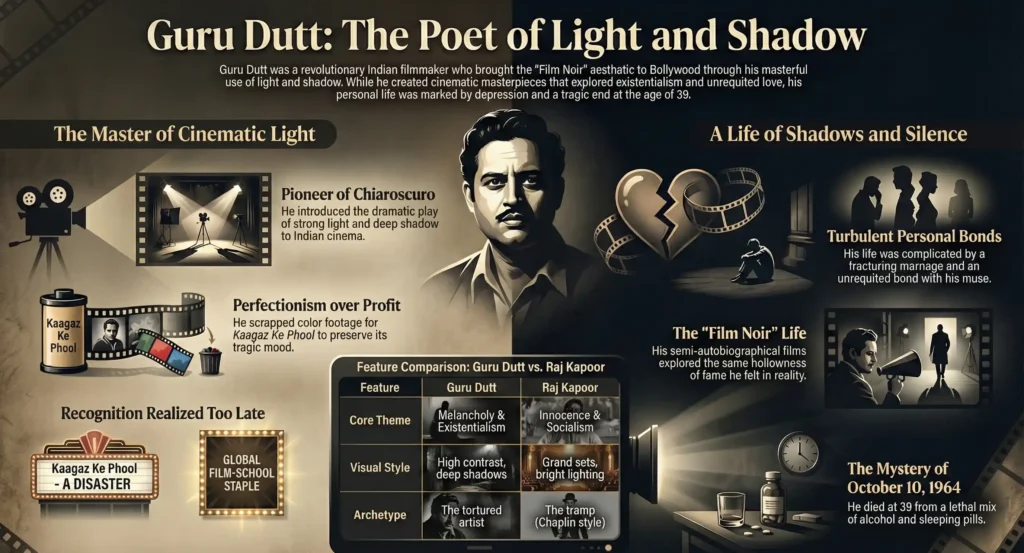
His films had a look that nobody else in Bombay was getting: deep blacks, hard shafts of light, faces half in shadow. Pyaasa, about a poet the world has no use for until he is presumed dead, is the film where the manner and the subject lock together.
Then came Aar Paar, Mr. and Mrs. ’55, C.I.D. and, in 1957, Pyaasa, which was a hit at the time and has since turned up on international lists of the best films ever made.
The strangest part of Kaagaz Ke Phool is that everybody could see how good it looked.
It was shot by V.K. Murthy, a former violinist who had been jailed as a freedom fighter, and it contains the most famous single image in Indian cinema: a shaft of light crossing an empty studio, which they made using mirrors rather than any lighting rig.
Murthy shot exclusively for him from then until the end, and was given the Dadasaheb Phalke Award in 2008, which is about as high as the country goes.
Murthy won the Filmfare award for cinematography for it. The film itself was a commercial disaster. Audiences would not pay to watch a director being destroyed, and the general view afterwards was that the subject was simply not one people wanted.
What he did next
He kept working and stopped putting his name on the direction.
Chaudhvin Ka Chand in 1960, which he produced and someone else directed, was a hit and covered the company’s losses, which is a mundane sentence covering about two years of considerable strain. He used the money to buy the rights to the book that became Sahib Bibi Aur Ghulam.
It is a nineteenth century story about a zamindar’s wife who starts drinking to keep her husband at home, with Meena Kumari in the part and Murthy shooting it.
That film came out in 1962 and won the National Film Award for the best Hindi feature, along with Filmfare awards for best film, best director, best cinematography and best actress. The director’s credit went to Abrar Alvi. Guru Dutt was credited for the songs.
People have argued for sixty years about who actually directed Sahib Bibi Aur Ghulam.
The suspicion has always been that Dutt did a great deal more of it than the credits say. Alvi maintained for the rest of his life that the work was his, and the people who were on that set did not all agree with each other. There is no way now to resolve it, and both men are gone.
What can be said is what it cost. Alvi had the credit and the awards, and the controversy attached to them meant he never built the directing career they should have given him. He wrote for another thirty years and directed almost nothing.
Twenty-five years late
Guru Dutt died in Bombay on 10 October 1964, at thirty-nine. The cause was never conclusively established.
In the 1980s Kaagaz Ke Phool was re-released in Europe and found the audience it had not found at home. It is now routinely listed among the great Indian films, and he has a serious following in France, Germany and Japan.
He made a film about a director whose work is only valued once he is no longer around to see it. The reception of that film is the single most literal thing that has ever happened to an Indian director.
If you think you have remembered everything about this topic take this QUIZ
Results
QUIZ START
#1. What was Guru Dutt’s real birth name before it was changed?
Previous
Next
#2. With which famous actor did Guru Dutt make a pact at Prabhat Studios to help each other’s careers?
Previous
Next
#3. Who was the ace cinematographer responsible for the distinct “light and shadow” (chiaroscuro) visual style in Guru Dutt’s films?
Previous
Next
#4. Which Guru Dutt film was a colossal box office disaster upon release but is now considered a masterpiece?
Previous
Next
#5. Who was Guru Dutt’s wife, a celebrated playback singer with whom he had a turbulent marriage?
Previous
Next
#6. Guru Dutt originally wanted which actor to play the lead role of Vijay in the movie Pyaasa?
Previous
Next
#7. Which comedian did Guru Dutt discover on a bus, impressed by his ability to entertain passengers?
Previous
Next
#8. Guru Dutt passed away at the young age of 39 due to:
Previous
Finish
Was Guru Dutt’s death a suicide or an accident?
The official verdict remains ambiguous. While it was ruled an overdose of sleeping pills and liquor, many close associates and biographers believe it was a suicide due to his history of depression and two previous attempts. Family members, however, have often stated it could have been an accidental overdose due to insomnia.
After the crushing commercial failure of Kaagaz Ke Phool (1959), Guru Dutt was heartbroken. He lost confidence in his ability to connect with audiences as a director and decided to produce and act only, though he reportedly ghost-directed Sahib Bibi Aur Ghulam.
What was the relationship between Guru Dutt and Waheeda Rehman?
While never officially confirmed as a romance, they shared a deep professional and personal bond. Guru Dutt was her mentor and launched her career. Their closeness is widely believed to have caused friction in Guru Dutt’s marriage, though Waheeda Rehman has always maintained that he was her mentor and nothing more.
Which is Guru Dutt’s most famous movie?
Pyaasa (1957) is widely considered his magnum opus. It was named one of the “100 Best Films of All Time” by Time magazine.
Who completed Guru Dutt’s last film?
At the time of his death, Guru Dutt was shooting for Baharen Phir Bhi Aayengi. After his passing, the lead role was reshot with actor Dharmendra.
Sources & References
Encyclopaedia Britannica (“Guru Dutt”) — his career, his films and his standing in Indian cinema.
Dinesh Raheja and Jitendra Kothari, Kaagaz Ke Phool: The Original Screenplay (2014) — the making of the film and interviews with its surviving cast and crew.
Directorate of Film Festivals, Government of India — the National Film Award for Best Feature Film in Hindi for Sahib Bibi Aur Ghulam.
Filmfare — V.K. Murthy’s cinematography awards for Kaagaz Ke Phool and Sahib Bibi Aur Ghulam.
Exploring the Soul of Bharat through History, Science, Culture, and its Diversity
Our Mission
Curious Indian is a definitive knowledge portal dedicated to chronicling the events, personalities, and cultural shifts that defined the Indian subcontinent. From the ancient Vedic Period to the complexities of 21st-century politics, our goal is to provide deep-dive analysis that inspires.
Editorial Standards & E-E-A-T
Every article published under our brand undergoes a rigorous fact-checking process. We prioritize primary historical records, academic citations, and credible archives to ensure our readers receive accurate, high-authority information.
Historical IntegrityDirectly sourcing from ASI archives and academic journals.
Topical AuthorityComprehensive clustering of Indian Science, Biographies, and Wars.
Managed by Paripurna Datta and TEAM | Dedicated to the Knowledge of India.