Assam: more than five hundred years ago, a young man painted seven heavens and staged them for his neighbours. The theatre he began, Bhaona, still fills Assamese prayer halls through the night
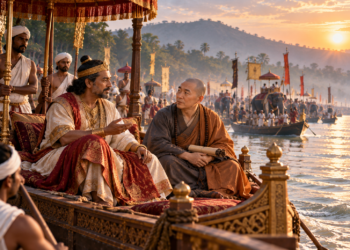
Late in the fifteenth century, in the village of Tembuwani, now Bardowa, in Assam, a young man put on a show that nobody there had seen before.
He had painted the scenery himself: seven Vaikunthas, the seven heavens of Vishnu, each with Vishnu presiding over it. The show was staged on a raised platform, against the painted backdrop. He took part in it himself, playing more than one role.
The young man was Srimanta Sankardev. The show is remembered as Chihna Yatra, and tradition dates it to 1468. It is counted as the first Bhaona.
He had painted the scenery himself: seven heavens, each with Vishnu presiding over it.
Why theatre
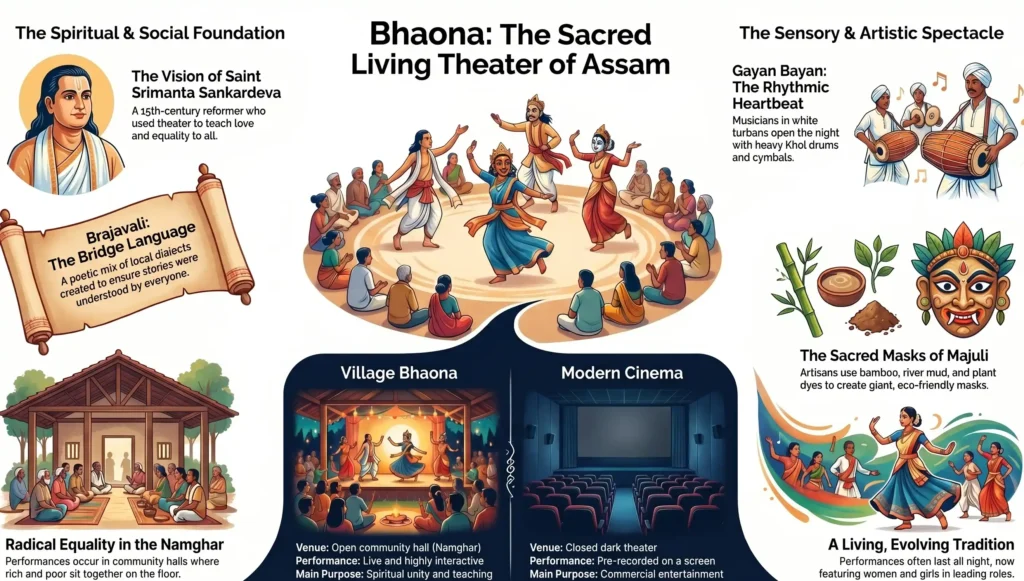
Sankardev was a religious reformer. He taught Ekasarana, devotion to one God, Krishna, open to everyone, whatever their caste, and free of heavy ritual. But he faced a practical problem. The sacred stories he wanted to share lived in Sanskrit texts, and most people around him could not read at all, let alone read Sanskrit.
So he took the stories off the page and put them in front of people. He had travelled widely on pilgrimage across India and seen its folk theatre. Out of what he saw, and out of Assam’s own traditions, he made something new.
He wrote plays, known as Ankiya Nat, drawn from the stories of Krishna and Rama: Krishna subduing the serpent Kaliya, the marriage of Rukmini, Rama’s victory. He wrote them in Brajavali, a literary language that mixed Assamese with Maithili and Braj. And he gave the whole performance a name that has lasted: Bhaona.
Meena Kumari (1933–1972): Sorrow and Stardom of the Tragedy Queen
Nargis Dutt (1929–1981): The Graceful Soul of Indian Cinema
How it works
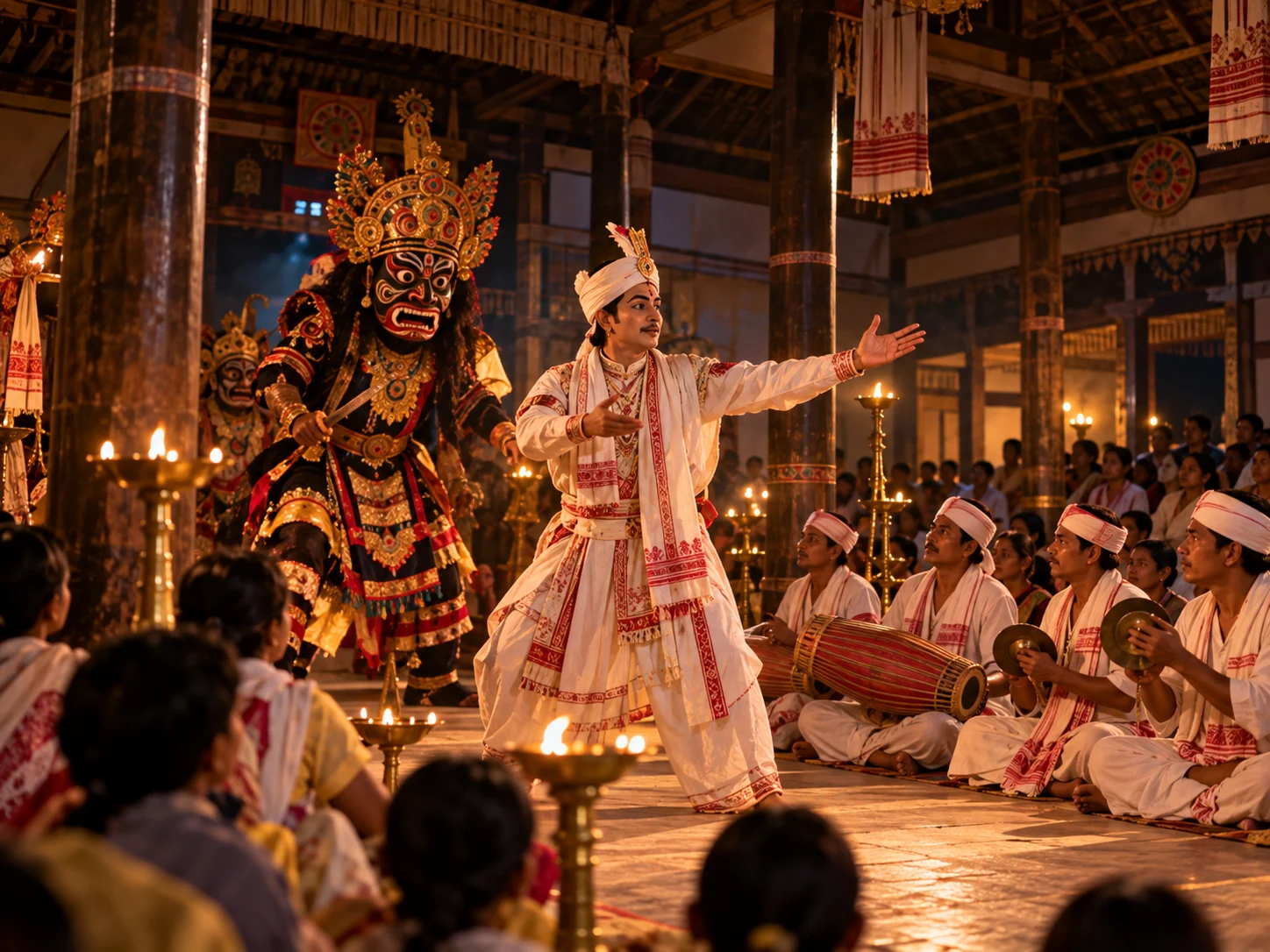
A Bhaona is not performed on a proscenium stage in a hall with rows of seats. Traditionally it takes place in a namghar, the village prayer hall, another of Sankardev’s creations. The audience sits on three sides of an open space in the middle. The fourth side, facing the shrine, the manikut, is kept open.
It begins with music. Before any actor appears, the gayan-bayan, the singers and drummers with their long khol drums and cymbals, perform a dance and song of their own, filling the hall with rhythm.
Then comes the most important figure in Bhaona: the Sutradhar. He is the narrator and the director at once. Dressed in a special costume, he introduces the story, explains it, and links each scene to the next with songs and verse. In Sankardev’s hands, the Sutradhar also carried the spiritual message, so that no one would miss the point.
Then the actors, the bhaoriya, arrive. Kings, queens, gods, animals and demons, in glittering costumes. The demons and monsters often wear huge painted masks, like those still made from bamboo and clay at the Samaguri Satra on Majuli. There are battles with bows and swords. The play is one continuous act, with no division into scenes. A full Bhaona can run for many hours, deep into the night.
That tradition is part of the wider world of Majuli’s monasteries and living art.
The Sutradhar introduces the story, explains it, and links each scene to the next, so that no one would miss the point.
Why it matters
Bhaona matters in Assam for reasons that go well beyond the stage.
It was, from the start, a people’s theatre. Sankardev built it to reach those who could not read, and to carry a message that devotion belonged to everyone. Watching a Bhaona, the whole village sits together on the floor of the same hall.
It is also a community’s work. A village Bhaona is not bought from a touring company. Villagers rehearse the roles, sew the costumes, make or borrow the masks, play the drums, and cook for the crowd. Children grow up watching their fathers and uncles as demons and kings, and one day take the roles themselves.
And it gave Assam a language of theatre centuries before modern drama arrived. Some historians count Sankardev’s plays among the earliest theatre in any modern Indian language.
Lata Mangeshkar (1929–2022): The Voice of the Millennium
The changes
Bhaona has changed over the centuries. Today many performances use everyday Assamese, the mother tongue, instead of Brajavali, so that audiences can follow every word. Some are staged on raised platforms. Some are streamed online.
But the heart has held. The drums still start before the actors. The Sutradhar still stands between the story and the people. And somewhere in Assam tonight, in a village namghar, men are painting their faces to become gods and demons, much as a young man once painted seven heavens for his neighbours at Bardowa, so that they could see what he could see.
Srikakulam District: The Spiritual & Historical Pearl of North Andhra
Mohammed Rafi (1924–1980): The Voice That Touched a Million Hearts
If you think you have remembered everything about this topic take this QUIZ
Results


#1. Who was the 15th-century saint and social reformer who created Bhaona?
#2. What is the name of the traditional village community hall where these plays are performed?
#3. Which special poetic language, a mix of Assamese and Maithili, was invented for these plays?
#4. What is the name of the magnificent musical introduction that begins a performance?
#5. Which two traditional instruments act as the “rhythmic heartbeat” of the performance?
#6. Which river island in Assam is world-famous for its master craftsmen who make Bhaona masks?
#7. What materials are traditionally used to make the vibrant masks for the performers?
#8. According to the text, what was the primary purpose of creating Bhaona?
What exactly is the main language spoken during these plays?
The actors speak a beautiful artificial literary language called Brajavali which was specifically invented to help people from different backgrounds understand the story easily.
Where do these traditional performances take place?
They take place inside a Namghar which is a traditional Assamese community prayer hall found in almost every single village across the state.
Are the bright colorful masks heavy to wear?
Surprisingly they are very light because the skilled artists make them using hollow bamboo frames and a very thin layer of river mud.
Who originally created this unique style of theater?
It was created in the fifteenth century by Srimanta Sankardeva a highly respected saint and social reformer who wanted to spread messages of equality and love.
Do I have to buy a ticket to watch a village performance?
No, these performances are completely free and open to everyone as they are funded collectively by the village residents to celebrate community unity.
Sources & References
Sanjib Kumar Borkakoti, “Creativity in Sattriya”, Society for Srimanta Sankaradeva (2016) — the Chihna Yatra as described in the Charita texts, the gayan-bayan and the Sutradhar.
Sanjib Kumar Borkakoti, “Ankiya Play and Bhaona of Srimanta Sankaradeva” — the date and place of the Chihna Yatra and the loss of its script.
Northeast Bullet, “Traditional Ankiya Naat Bhaona: Assam’s Theatrical Legacy” (18 November 2024) — why Sankardev turned to theatre and the influences on his work.
Ki Hikila, “Bhaona: The Essence of Assamese Culture” (17 August 2024) — the arrangement of the namghar, the Sutradhar’s costume and role, and modern changes.