Manipur, 23 April 1891: a small kingdom’s army dug in on a hill to stop a British column marching in from Burma. By the end of the day one of its commanders, a man of nearly sixty, was offered his life
On 23 April 1891, on a low hill at Khongjom in the valley of Manipur, the fighting was over.
The British guns had shelled the Manipuri position. Then the infantry had come up the hill. The few hundred men defending it had fought at close quarters, and fallen, until almost no one was left standing.
One who was still standing was their commander, Major Paona Brajabashi. He was about fifty-eight years old.
According to the story Manipur has told ever since, an officer came up to him with an offer. The officer was himself a Manipuri, serving in the British army. Paona, he said, could still come over to the British side. There would be a good position for him. His life would be spared.
The officer who made the offer was himself a Manipuri, serving in the British army.
A kingdom in the hills
Manipur in 1891 was a small, old kingdom in the hills between Assam and Burma. It had its own kings, its own army, and its own long memory of wars with Burma. It had been an ally of the British for decades, and it was still, in name, independent.
In 1890 there was a quarrel in the royal family. The Maharaja was pushed off the throne, and his brother Kulachandra became ruler, with another brother, the young and popular Tikendrajit, as senapati, commander of the army. The British decided to accept the new ruler, but only if Tikendrajit, whom they saw as the real power behind the change, was removed.
In March 1891 the Chief Commissioner of Assam, James Quinton, marched into Imphal with an escort of Gurkhas to see it done.
The Burmese Invasions and the Treaty That Ended the Ahom Kingdom
U Tirot Sing: The Khasi Chief Who Fought an Empire for Four Years
March 1891
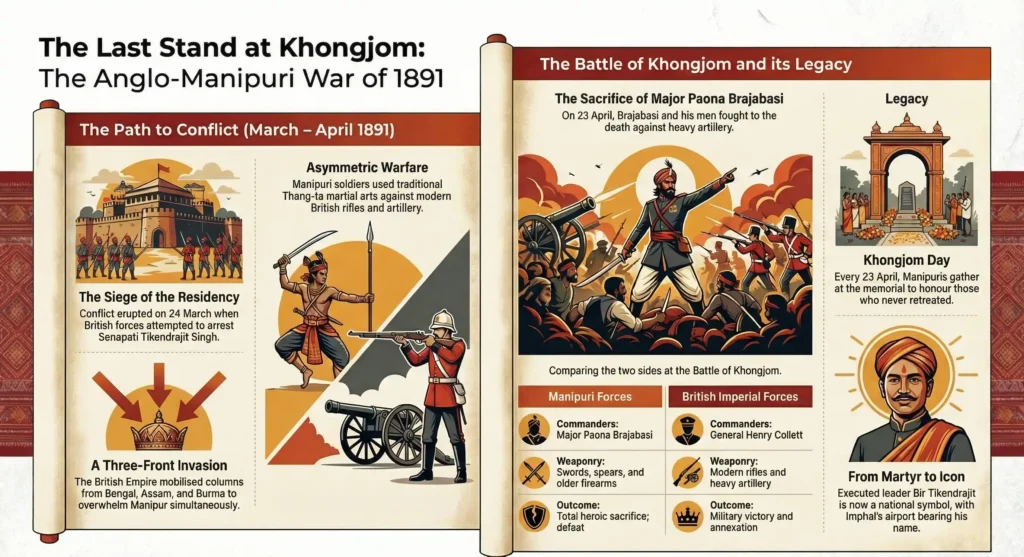
It went badly from the start. Tikendrajit would not come to the durbar where he was to be arrested. A British attempt to seize him in his own quarters was driven back, and the British residency was besieged. Quinton went to negotiate, with the Political Agent Frank Grimwood and other officers. The talks failed. On the way back, Grimwood was speared by a crowd. That night, Quinton and the other officers were put to death.
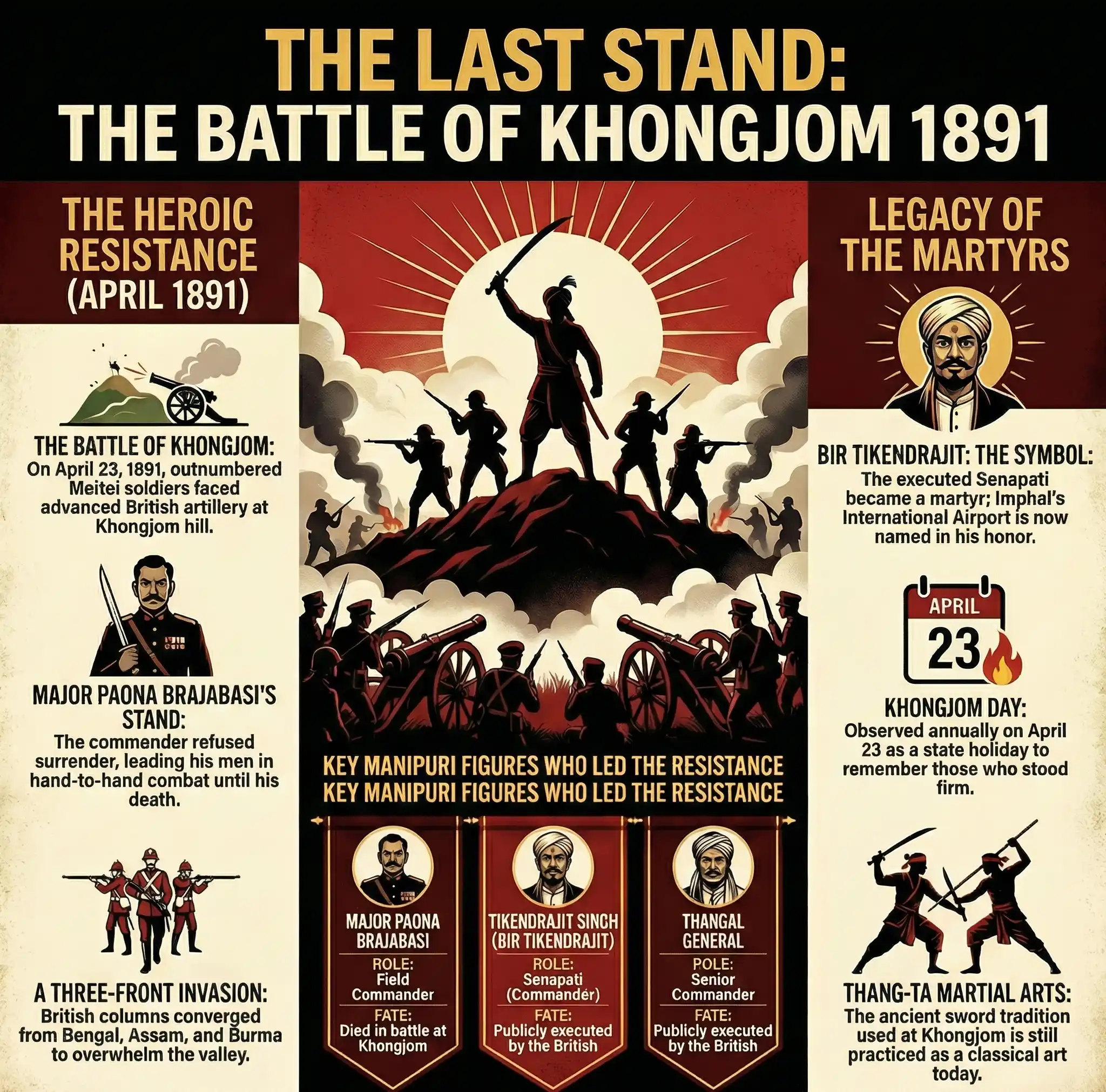
For the British Empire, that settled it. Three columns were sent into Manipur, from Kohima in the north, from Silchar in the west, and from Tamu, across the Burmese border, in the east.
Manipur was going to lose. Everyone knew it. The question was only how.
Manipur was going to lose. Everyone knew it. The question was only how.
Khongjom
The Tamu column was the one that had to be met in the south. The Maharaja sent a force to Thoubal, and then, when it was clear that would not be enough, another four hundred or so men under Paona Brajabashi and Chongtha Mia Singh. They took up position at Khongjom, on the road to Imphal.
The British attacked on 23 April with artillery first, and then with infantry up the hill. The Manipuris had swords, spears and a few muskets, and they used what they had. By Manipuri accounts they held and struck back hard for a long time. But by the end of the day, the hill was lost and most of its defenders were dead.
Pa Togan Nengminza: The Garo Resistance Against British Annexation
The answer
That is when the offer was made, according to the story. And that is where the story ends the way Manipur remembers it.
Paona, it is said, answered that death was more welcome than treason. Then he unwound the cloth wrapped around his headgear, bared his neck, and told the officer to cut off his head.
No British record describes it that way, and it has come down through memory, ballad and retelling. What is certain is that Paona Brajabashi did not surrender, and that he died at Khongjom that day.
He answered that death was more welcome than treason. Then he unwound the cloth from his headgear and bared his neck.
After
Four days later, on 27 April, the British entered Imphal. Tikendrajit was hunted down and captured. Queen Victoria herself worried that hanging him would cause bad feeling across India. The Viceroy insisted. On 13 August 1891, Tikendrajit and his general Thangal were hanged in public in Imphal. Kulachandra was deported to the Andaman Islands. A young boy, Churachand, was put on the throne, and Manipur became a princely state under British control.
Manipur remembers both days. The thirteenth of August is Patriots’ Day. The twenty-third of April is Khongjom Day, and on the hill where Paona fell, now called Kheba Ching, there is a memorial with his statue. Every year, people gather there, and singers perform the Khongjom Parva, the ballad of the battle.
The kingdom lost its war in a single spring. What it kept was the memory of how it lost: of an old soldier on a hill, offered his life by a man from his own land wearing the other side’s uniform, and taking the cloth from his head instead.
The Integration of Princely States: The Making of a United India
10 Lessons from the Battle of Walong 1962 Mystery
If you think you have remembered everything about this topic take this QUIZ
Results


#1. What event in 1890 CE triggered the British decision to intervene directly in Manipur’s internal affairs?
#2. Who was the British Chief Commissioner of Assam whose attempt to arrest Tikendrajit Singh led to the outbreak of war?
#3. From which three directions did the British military columns converge on Manipur in 1891?
#4. On what date was the Battle of Khongjom fought?
#5. Which specific military advantage did the British Bengal column use to overwhelm the Manipuri defenders at Khongjom?
#6. What happened to Tikendrajit Singh and Thangal General on 13 August 1891?
#7. What is the traditional Meitei martial art of sword and spear combat practiced by the soldiers of Manipur?
#8. Which major infrastructure in Manipur is currently named after Bir Tikendrajit Singh?
What was the Anglo-Manipuri War of 1891 CE?
The Anglo-Manipuri War was a conflict between the kingdom of Manipur and the British Imperial forces triggered by a succession dispute within the Manipuri royal family and the British decision to intervene and assert direct control over the kingdom. It ended with a complete British military victory, the public execution of two Manipuri leaders, and the transformation of Manipur into a British-controlled princely state.
Who was Major Paona Brajabasi?
Major Paona Brajabasi was a senior commander in the Manipuri royal army who led the defence at the Battle of Khongjom on 23 April 1891 CE. He and his outnumbered force held their position against a British column with artillery support, fighting until they were overwhelmed. Paona Brajabasi died in the battle and is celebrated as one of Manipur’s greatest heroes.
What was the Battle of Khongjom?
The Battle of Khongjom was fought on 23 April 1891 CE near the village of Khongjom in Manipur. It was the most celebrated engagement of the Anglo-Manipuri War, where Paona Brajabasi and his Manipuri soldiers made their last stand against the advancing British Bengal column. Despite fighting bravely against overwhelming firepower, the Manipuri force was defeated.
Who was Tikendrajit Singh and why is he remembered?
Tikendrajit Singh, known as Bir Tikendrajit, was the Senapati or military commander of Manipur whose refusal to be arrested by the British triggered the Anglo-Manipuri War. He was publicly hanged by the British on 13 August 1891 CE along with Thangal General. His composed death and the injustice of his trial transformed him into a beloved martyr. The international airport at Imphal is named after him.
How is the Battle of Khongjom remembered today?
Every year on 23 April, the people of Manipur observe Khongjom Day as a state holiday. A war memorial stands at the battle site. Traditional Pena songs in the Meitei language carry the story of the battle across generations. The day is one of the most important annual commemorations in Manipur’s cultural calendar.
Sources & References
The Better India, “Paona Brajabashi, The Manipuri Major Who Chose Death Over Serving The British” (9 August 2018) — the forces sent to Thoubal and Khongjom, and the commemoration of Khongjom Day.
Northeast Advisor, “Unsung Freedom Fighters from Northeast India” (15 August 2021) — the traditional account of the offer and Paona’s reply, as given by Kakchingtabam Hemchandra Sharma.
Penguin Random House India, “A forgotten war of British Raj that became an international scandal” (13 August 2020) — the three British columns, Queen Victoria’s objection and the deportation of Kulachandra.
Directorate of Information and Public Relations, Government of Manipur, official Khongjom Day documentation — the Anglo-Manipur War and Paona Brajabasi’s last stand at Khongjom on 23 April 1891; scholarly histories by Lokendra Arambam and Jyotirmoy Roy provide the wider political context.