Garo Hills, December 1976: a people who had mostly become Christian gathered at Asanang to beat the drums of a harvest festival their grandparents had danced for the sun god, so that it would not be forgotten
In a Garo village that still keeps the old faith, Wangala begins quietly.
The day before the dancing, the nokma, the village headman, performs a ritual called Rugala. He offers the first of the special rice beer brewed from the new harvest, with cooked rice and vegetables, to Misi Saljong, the sun god, whom the Garos call the Great Giver. On the doors of the houses, people press handprints of rice flour, three fingers at a time, marks said to stand for the water level and to ask for a good harvest again next year. The next day comes the burning of incense, and then the drums.
The drum is the dama, long and slim, slung from the shoulder. The dancers move in two lines, men and women, to its beat, and to the bamboo flutes. It goes on for days.
On the doors, people press handprints of rice flour, three fingers at a time.
The Great Giver
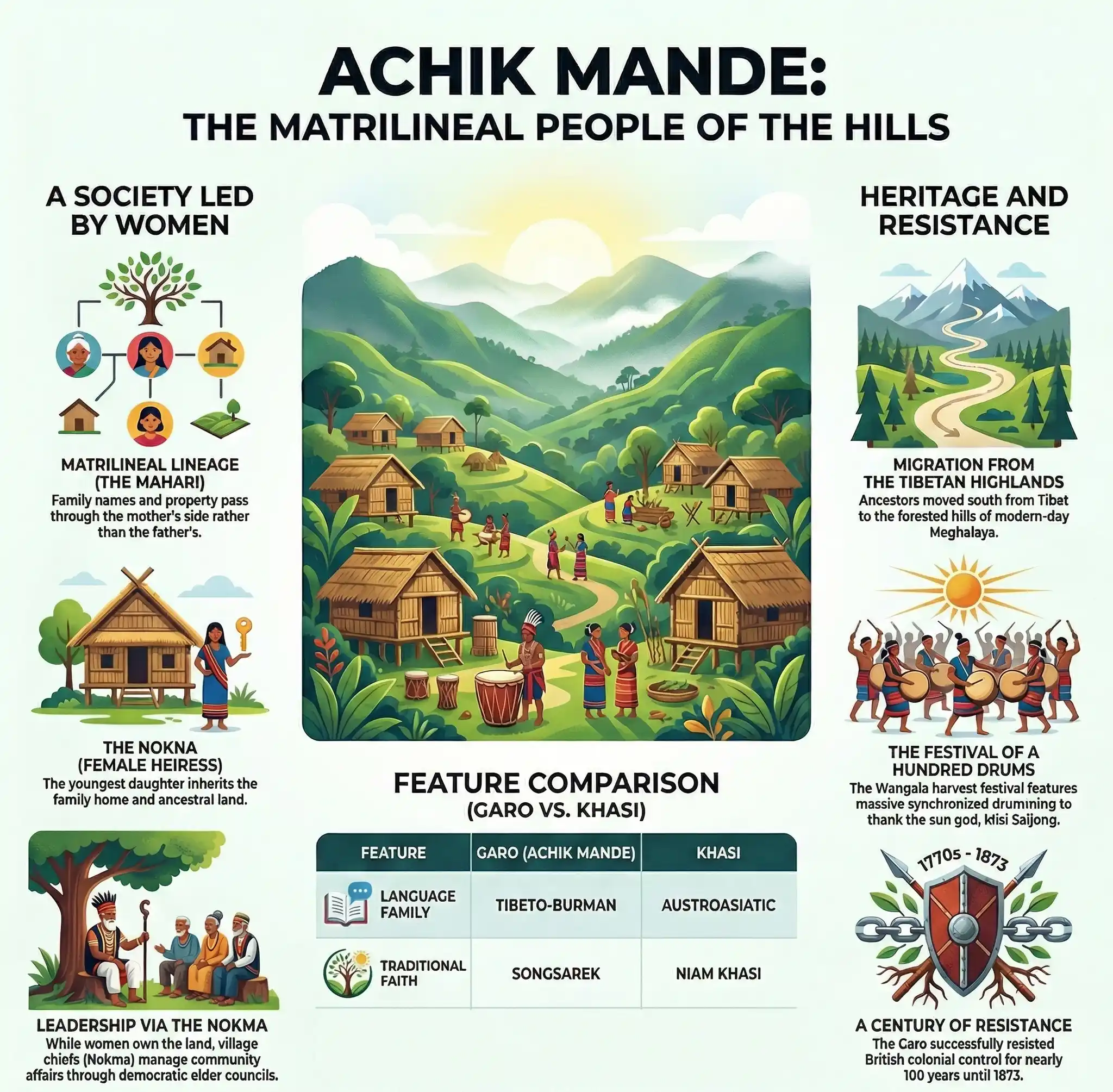
This was the heart of Songsarek, the old religion of the Garo, or A’chik, people of the western hills of Meghalaya. In it, the world was made at the command of Tatara Rabuga, a god so high he cannot be reached. Closer to human life was Saljong, represented by the sun, keeper of all the crops. Without his favour no harvest could be reaped. Before the fields were sown, he was given a sacrifice in the fields. After the harvest, he was given Wangala.
For a people who cut and burned patches of hill forest to grow rice, millet and vegetables, and moved on when the soil tired, the harvest was not a figure of speech. Wangala was how a village said thank you.
Mature Harappan Phase: When India Built the World’s First Planned Cities
Razia Sultan: The Woman Who Ruled Delhi as a “Sultan”
The drums go quiet
In the second half of the nineteenth century, American Baptist missionaries came to the Garo Hills. Over the next hundred years, most Garos became Christians. Churches went up in the villages. Many old festivals, bound up with the old gods, faded.
Wangala was one of them. By the middle of the twentieth century it was still danced properly in the Songsarek villages, but elsewhere the Garos’ most important festival was, in the words of one Garo writer, fast disappearing. There were Garo children who never got to hear the dama played for Wangala at all.
One of them was Timothy Shira. As a boy, he later remembered, people in the hill villages still held Wangala, but there were no roads and there were wild animals in the forest, and he could not get there to see it.
Children were growing up who had never heard the drums played together.
1976
In 1972 the Garo, Khasi and Jaintia hills became a state of their own, Meghalaya. Its first Chief Minister, Captain Williamson A. Sangma, was a Garo. He and a group of Garo leaders and thinkers began to talk about what could be done to keep the culture alive.
They settled on a plan. They would take Wangala, the festival of a religion most of them no longer practised, and stage it on a grand scale, as a celebration of who the Garos were. Each contingent would have about thirty dancers and ten drums. Ten contingents would come together. That made three hundred dancers, and a hundred drums.
On 6 and 7 December 1976, at Asanang, the headquarters of the Rongram development block about eighteen kilometres from Tura, the first Hundred Drums Wangala Festival was held.
The Integration of Princely States: The Making of a United India
Two Wangalas
It has been held every year since, now in November, and it has grown enormously. Troupes come from all over the Garo Hills and beyond, from Garo communities in Karbi Anglong, Tripura and Nagaland, and from Bangladesh. The dancers are not necessarily Songsarek. There are prizes, crowds, and tourists.
Some Garos worry about that. The district administration of East Garo Hills writes frankly that since the coming of Christianity, Wangala has been celebrated largely as a token attempt to conserve an ancient heritage, and that the truly traditional Wangala survives only in a few remote Songsarek villages. Timothy Shira, speaking as chief guest at the festival in 2025, said he had once told a troupe to bring someone who really knew the dance to teach them, because it had to be performed correctly.
So there are two Wangalas now. One is on a stage near Tura, with a hundred drums and an audience. The other is in a village that still keeps the old faith, where the nokma pours the first rice beer for the sun, and three fingers of rice flour go onto the doors.
The first would not exist without the second. And the second, perhaps, is a little less alone because of the first. For three days every November, a people who mostly worship in churches beat the drums of their grandparents’ thanksgiving, loud enough that the children, this time, can hear it.
Vedic Period: From Nomadic Hymns to Iron Age Kingdoms
10 Lessons from the Battle of Walong 1962 Mystery
If you think you have remembered everything about this topic take this QUIZ
Results


#1. What is the traditional self-name of the Garo people, and what does it mean?
#2. According to the article, which language family does the Garo language belong to?
#3. In the Garo matrilineal society, what is the specific title given to the youngest daughter who inherits the family property?
#4. Who is the most important deity in the traditional Songsarek faith of the Garo people?
#5. Which festival is known as the “festival of a hundred drums” and is held to thank the sun god for the harvest?
#6. What was the primary weapon used by Garo warriors during their resistance against the British?
#7. In what year did the British establish full administrative control over the Garo Hills?
#8. Under which schedule of the Indian Constitution was the Garo Hills Autonomous District Council set up to protect tribal rights?
Who are the Garo tribe and where do they live?
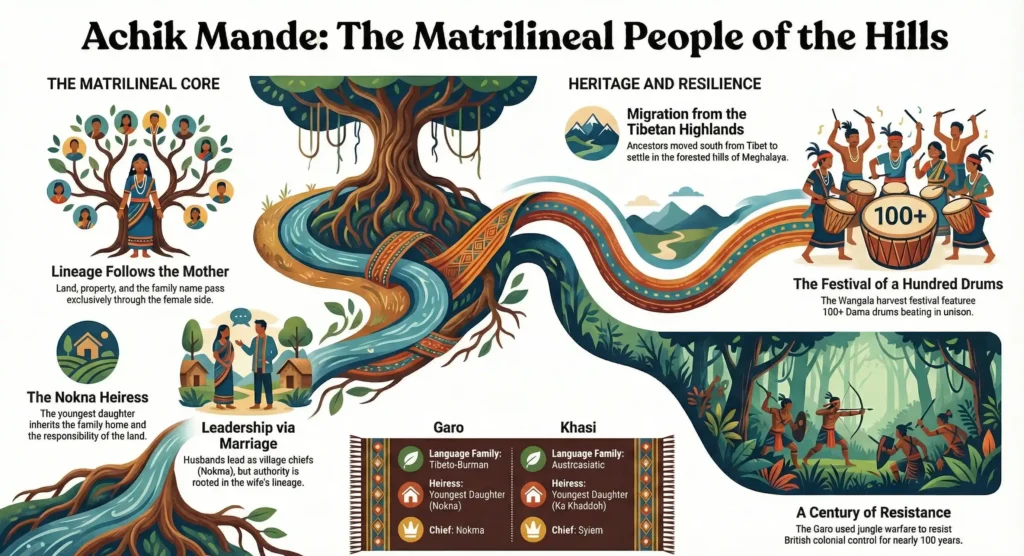
The Garo, who call themselves Achik Mande, are an indigenous people of the Garo Hills in Meghalaya, Northeast India. Many also live in Assam, Tripura, and Bangladesh.
What makes the Garo tribe special?
The Garo are one of the few matrilineal societies left in the world. In their community, property and family identity pass through the mother’s side. The youngest daughter of every family is the heiress.
What is the Wangala festival?
Wangala is the Garo harvest festival held to thank Misi Saljong, the sun god of their Songsarek faith. It is famous for the sound of a hundred Dama drums played together and is celebrated every year across the Garo Hills.
What religion do the Garo follow today?
Most Garo people today are Baptist Christians, following the influence of American missionaries from the 1860s. Some Garo, especially in remote areas, still follow Songsarek, their ancient animist faith.
How did the Garo people resist British rule?
The Garo fought British military expeditions using the jungle as their shield, attacking supply lines and retreating into the forest. This resistance went on for nearly a hundred years before the British established full control in 1873.
Sources & References
Matters India, Tilotama R. Marak, “Meghalaya’s Garo tribe revives traditional post-harvest festival” (9 November 2021) — the Rugala and incense rituals, the decline of Wangala and the plan for the Hundred Drums festival.
The Shillong Times, “Hundred-drums Wangala Festival concludes with cultural splendour, reflection on Garo heritage” (8 November 2025) — Timothy D. Shira’s recollections and the role of Captain Williamson A. Sangma.
East Garo Hills District Administration, “Festivals” — the modern festival, its performers and the survival of traditional Wangala in Songsarek villages.
South Garo Hills District Administration, “Culture & Heritage” — Tatara Rabuga, Saljong and the place of Wangala in Garo belief.