Bombay, 1895 and after: Shivkar Bapuji Talpade tried to build a flying machine. What happened at Chowpatty is uncertain. What happened to the machine afterwards is a quieter story
For years, in a warehouse in Malad, on the northern edge of Bombay, there stood the bare frame of a damaged flying machine. Nobody flew it any more. Dust settled on it. But the children of the Talpade family would climb inside and sit there, pretending to fly.
Talpade’s niece, Roshan, told this to a local historian many decades later. Of everything said about the machine, it is one of the few details that comes from inside the family.
The children of the family would climb into the old frame and sit there, pretending to fly.
The instructor
The man who built it was Shivkar Bapuji Talpade, born in 1864 in the Pathare Prabhu community of south Bombay. He was a member of the Arya Samaj, devoted to Sanskrit and the Vedas, and he worked as a technical instructor in the art and craft department of the Sir J.J. School of Art. He had tools there, and materials, and it is said that he built his machine with them.
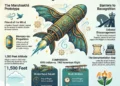
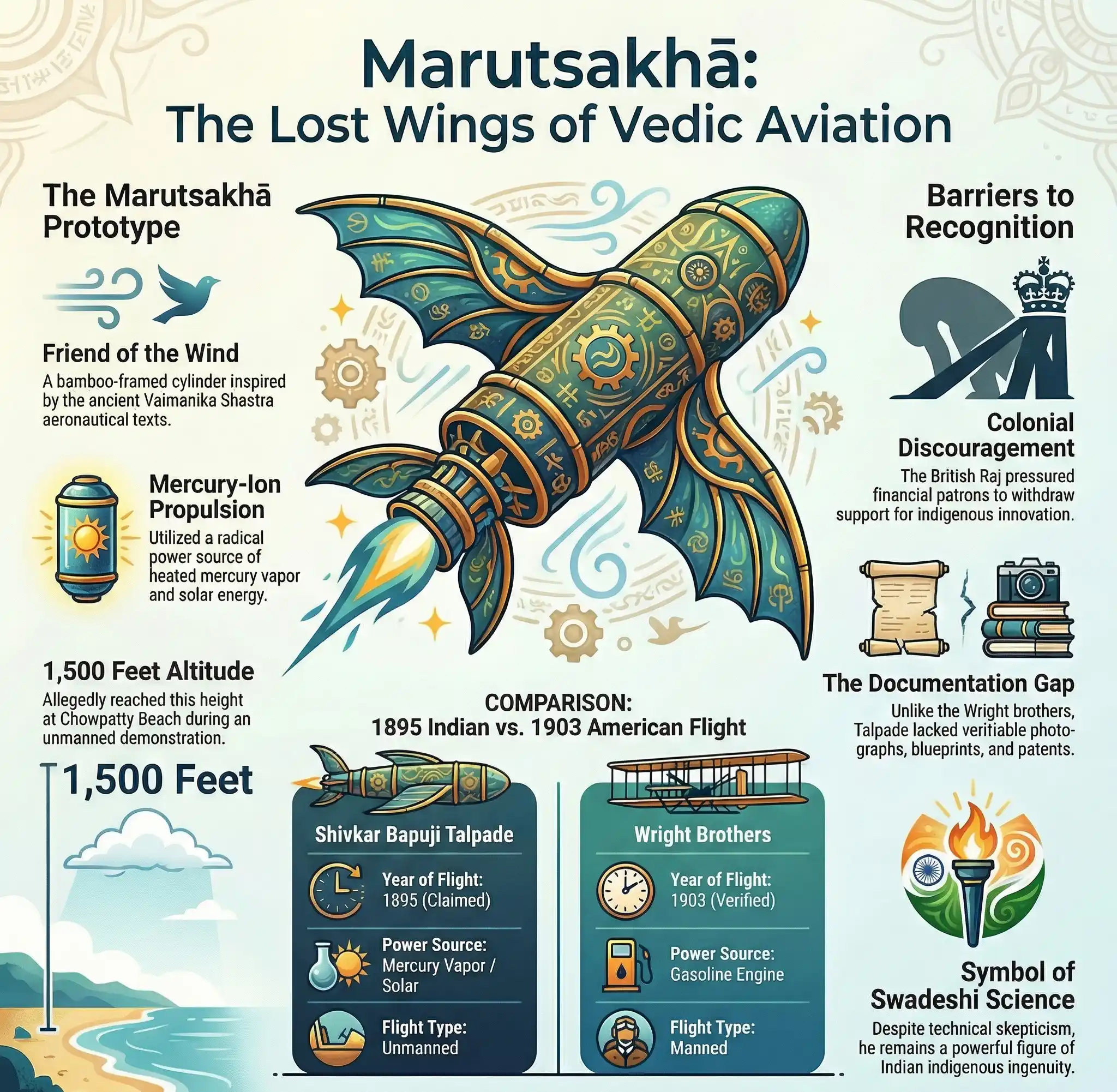
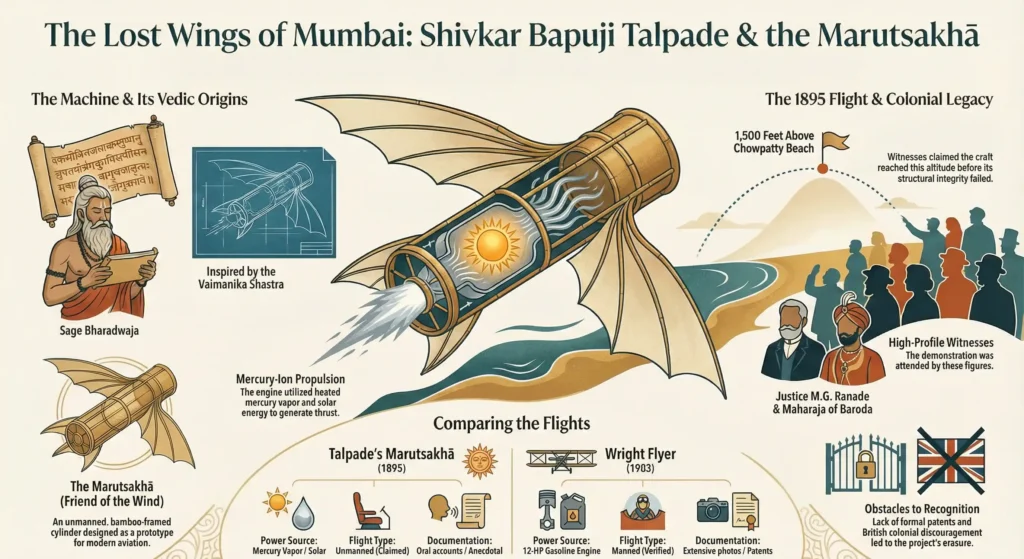
He called it Marutsakha, friend of the wind. By most accounts it was not an aeroplane in the modern sense, with wings and a pilot, but an unmanned cylindrical frame of bamboo. One of his students, P. Satawlekar, later wrote that most people around Talpade thought he was a fool to try.
Manjul Bhargava: (1974- Present)
Venkatraman Ramakrishnan: (1952- Present)
Chowpatty
Sometime around 1895, Talpade took his machine to Chowpatty beach.
What happened there depends on who is telling it. In the grand version, which has been repeated in books, websites, a paper at the Indian Science Congress and a 2015 Hindi film, a large crowd gathered, including the Maharaja of Baroda and the judge Mahadev Govind Ranade, and the Marutsakha rose to 1,500 feet and flew for several minutes, eight years before the Wright brothers.
The architect Pratap Velkar, who grew up two buildings away from Talpade’s house in Girgaum and spent years researching him, told a smaller story. His father, he said, had been at Chowpatty. There were only a few curious onlookers and some friends. The machine rose a small height, and crashed within minutes.
In one version it flew to 1,500 feet before a Maharaja. In the other it rose a little, in front of some friends, and crashed.
The missing report
The grand version leans on a newspaper report in the Marathi daily Kesari. The Sanskrit scholar D.K. Kanjilal cited it in a 1985 book. But one documentary film-maker who searched the Kesari archives from 1895 to 1905 found nothing. The snippet, it emerged, had been written in 1952. A year later, the paper’s former editor, G.V. Ketkar, said it was not entirely reliable. Talpade himself, he pointed out, did not mention any such demonstration in the articles he wrote for Arya Dharma between 1904 and 1908, or in his own book on ancient flying machines.
There is a problem with the ancient text as well. The Vaimanika Shastra, the Sanskrit treatise often said to have guided Talpade, was examined by scientists at the Indian Institute of Science in 1974. They concluded that it could not be dated earlier than 1904, and that the craft it described could not fly. If the text did not exist before 1904, it is hard to see how it could have guided a flight in 1895.
After
Whatever happened at Chowpatty, Talpade did not give up. According to Velkar, he tried to raise money to build another machine. He asked the Maharaja of Baroda. He appealed to a group of businessmen in Ahmedabad. Nobody paid. The damaged machine went into the warehouse at Malad.
Talpade died in 1916. Years later, parts of the machine and his research papers were taken from the family by a retired Air Vice Marshal, and passed on to a retired Defence Ministry scientific officer in Pune. When Velkar asked to see them, the officer refused. He had studied the papers closely, he told Velkar, and they showed that Talpade had been unsuccessful.
The frame
The legend of Talpade needs him to have won, to have beaten the Wright brothers and been robbed of the credit. The record, such as it is, does not support that.
What it does support is smaller, and in its way more moving. A craft instructor in Bombay, with no patron and no money, read what he could, built what he could with his own hands, took it to a beach, and tried. When it failed, he tried to raise money to try again. And for years after, in a dusty warehouse, children climbed into what was left of his machine and flew it the only way they could.
Velkar himself, after all his research, admitted there was very little evidence either way. What interested him, he said, was that “someone way back then had tried.”
Har Gobind Khorana: (1922- 2011)
Daulat Singh Kothari : (1906–1993)
If you think you have remembered everything about this topic take this QUIZ
Results


#1. Who is famously claimed to have constructed and flown an unmanned airplane named Marutsakhā in 1895?
#2. Which ancient Hindu scripture profoundly inspired Talpade’s aeronautical concepts?
#3. According to the article, what was the conceptual power source for Talpade’s aircraft?
#4. What altitude did the Marutsakhā allegedly reach during its demonstration at Chowpatty Beach?
#5. Which high-profile individual was reportedly a witness to Talpade’s flight demonstration?
#6. What does the name of the aircraft, “Marutsakhā,” translate to?
#7. Where did Talpade receive his formal education and later work as a technical instructor?
#8. What reportedly happened to the remains of the Marutsakhā after Talpade’s death in 1916?
Did Shivkar Bapuji Talpade fly before the Wright Brothers?
According to Indian anecdotal history, he flew an unmanned aircraft in 1895, eight years before the Wright brothers’ 1903 manned flight. However, there is no contemporary, verifiable documentation to prove this globally.
What was the name of Talpade’s flying machine?
It was named Marutsakhā, which translates from Sanskrit as “Friend of the Wind.”
Where did Talpade get his aircraft design?
He was deeply inspired by the ancient Vedic text Vaimanika Shastra, which describes the construction and operation of legendary Vimanas (flying chariots).
How was the Marutsakhā powered?
Accounts suggest it was powered by a unique engine that utilized heated mercury vapor and solar energy to create thrust.
Why did Talpade stop his experiments?
He faced severe financial ruin after his primary patron, the Maharaja of Baroda, allegedly withdrew funding under pressure from the British colonial administration.
Read More: https://curiousindian.in/venkatraman-ramakrishnan-1952-present/
Sources & References
Open Magazine, Lhendup G. Bhutia, “The Myth of the Indian Aviator” (29 January 2015) — Pratap Velkar’s research, the family’s recollections, the warehouse at Malad, the fate of the papers and the 1974 IISc study.
Business Standard, “The aviator?” (13 January 2015) — the Kesari report, its 1952 origin and G.V. Ketkar’s assessment.
H.S. Mukunda et al., “A critical study of the work ‘Vyamanika Shastra’”, Scientific Opinion (1974) — the dating and feasibility of the text.
Down To Earth, “Did our ancestors fly airplanes?” (19 April 2024) — how the Talpade claim entered modern retellings.
Author


Exploring the Soul of Bharat through History, Science, Culture, and its Diversity
Our Mission
Curious Indian is a definitive knowledge portal dedicated to chronicling the events, personalities, and cultural shifts that defined the Indian subcontinent. From the ancient Vedic Period to the complexities of 21st-century politics, our goal is to provide deep-dive analysis that inspires.
Editorial Standards & E-E-A-T
Every article published under our brand undergoes a rigorous fact-checking process. We prioritize primary historical records, academic citations, and credible archives to ensure our readers receive accurate, high-authority information.
Historical Integrity Directly sourcing from ASI archives and academic journals.Topical Authority Comprehensive clustering of Indian Science, Biographies, and Wars.Managed by Paripurna Datta and TEAM | Dedicated to the Knowledge of India.