London, 11 January 1935: a twenty-four-year-old Indian physicist read his paper at the Royal Astronomical Society, and the most famous astronomer in Britain stood up after him
On Friday, 11 January 1935, Subrahmanyan Chandrasekhar went to Burlington House in Piccadilly to read a paper at the monthly meeting of the Royal Astronomical Society. He was twenty-four. He had been in England for four and a half years, and he had spent most of them working on one question: what happens to a star when it runs out of fuel and collapses.
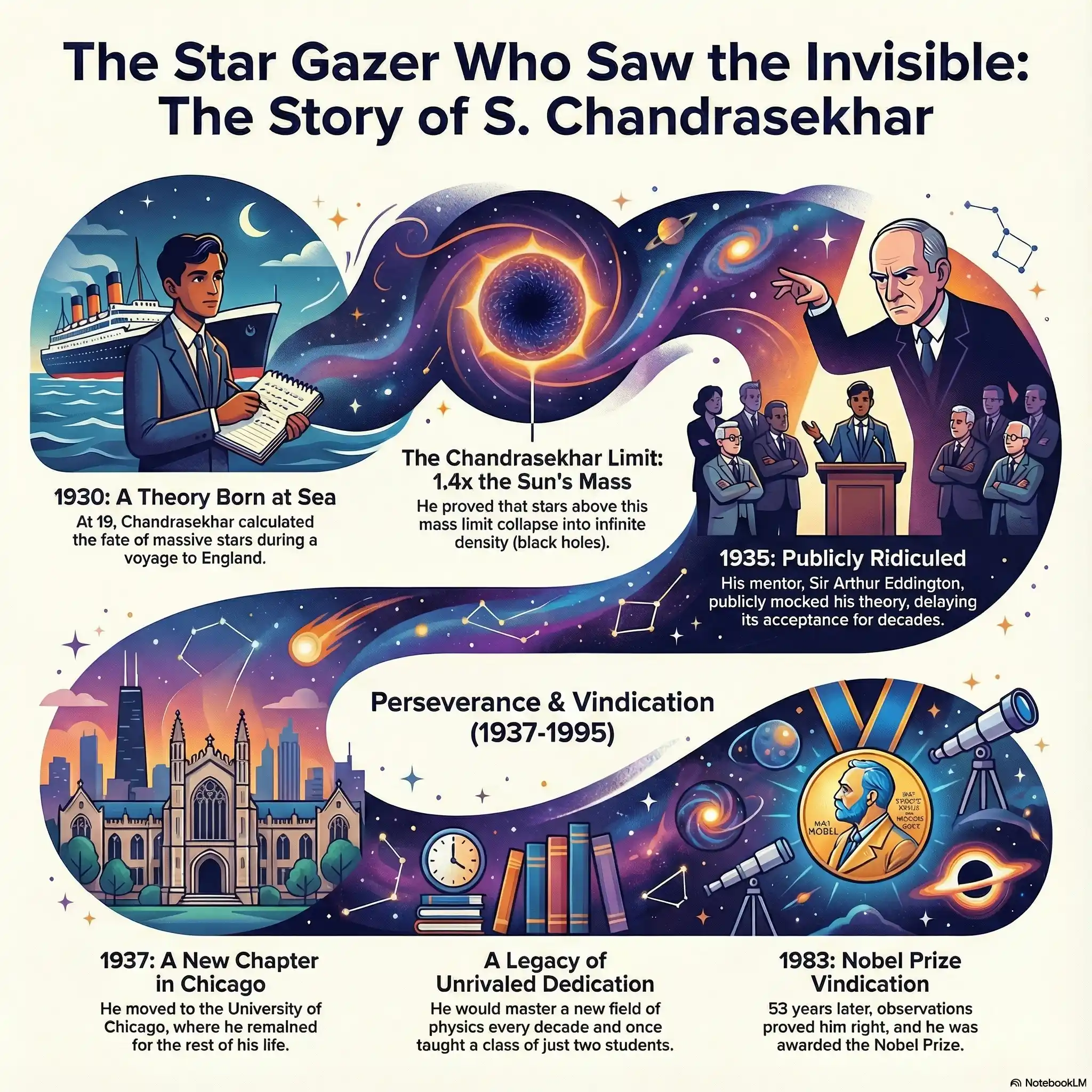
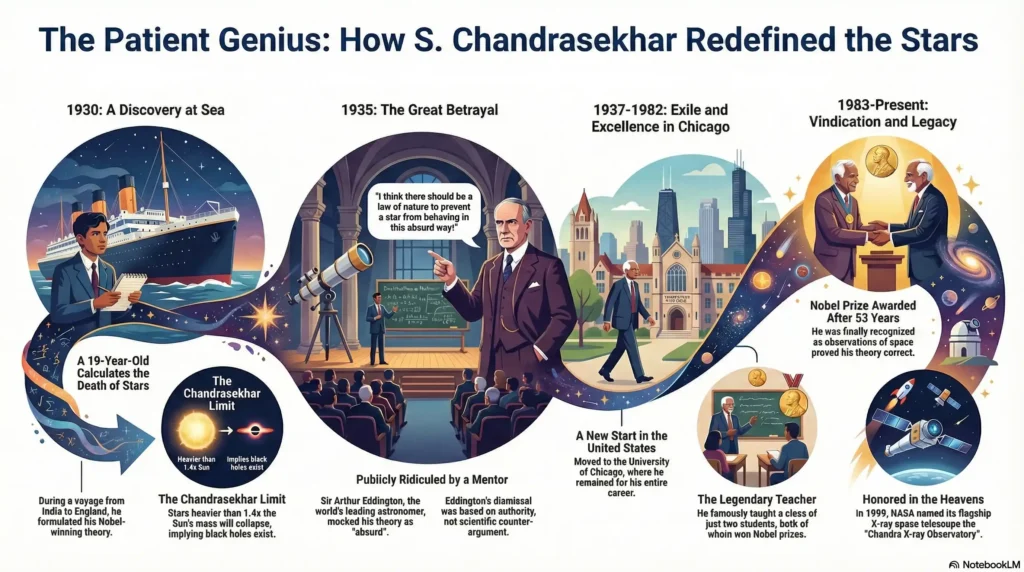
He had first worked out the answer at nineteen, on the ship from Madras to England in 1930, with nothing to do for weeks but calculate. A dying star shrinks into a white dwarf, held up by the pressure of its packed electrons. But when he brought Einstein’s relativity into the sums, the pressure had a limit. Above a certain mass, about one and a half times the Sun, nothing could hold the star up. It would go on collapsing, towards something nobody in 1930 had a name for.
Since then he had done the full calculation, carefully and at length. That was what he had come to present.
The Fall of Sadiya: How the Chutiya Kingdom Met Its End in 1524
The programme
Before the meeting he had seen the printed programme. Right after his own paper was one by Sir Arthur Eddington.
Eddington was the most famous astronomer in Britain, the man who had led the eclipse expedition that confirmed Einstein, and the author of the standard book on how stars work. He was a Fellow at Trinity, Chandrasekhar’s own college, and they saw each other often. He knew what Chandrasekhar had been working on. In all their conversations, he had never mentioned that he was writing a paper of his own on the same subject.
Eddington had booked the slot after his, and had said nothing about why.
U Tirot Sing: The Khasi Chief Who Fought an Empire for Four Years
Burlington House
Chandrasekhar read his paper. He set out the calculation and the limit, and what it seemed to mean: that a heavy enough star could not settle down as a white dwarf at all.
Then Eddington stood up.
His paper was called “Relativistic Degeneracy”, and it was an attack on everything Chandrasekhar had just said. He did not say the mathematics was wrong. He said the result was absurd. A star that kept on collapsing was a reductio ad absurdum, and so the physics that produced it must be at fault. He thought, he told the room, that there should be a law of Nature to prevent a star from behaving in this absurd way.
Underneath the jokes was a technical objection. Eddington argued that Chandrasekhar had mixed Einstein’s relativity with the quantum theory of the electrons in a way that was not allowed, and that done properly, the limit would disappear. The star, in his version, would always find a way to stop.
He was funny, and the room laughed. Edward Milne, another of the great names in the room, spoke up in support of him.
He did not say the mathematics was wrong. He said the star was not allowed to do it.
Anglo-Manipuri War 1891: When Manipur Chose to Fight to the Last Man
Afterwards
He left the meeting badly shaken. A young man from Madras, four years out of college, had been told in public by the greatest authority in his field that his life’s first real work was a kind of joke, and the room had laughed.
The physicists, it turned out, were on his side. Within weeks he had letters from Copenhagen, where Niels Bohr’s group had looked at Eddington’s argument. Bohr could find nothing wrong with Chandrasekhar’s reasoning. Léon Rosenfeld read Eddington’s paper twice and called it the wildest nonsense. Wolfgang Pauli said Eddington did not understand physics.
But the physicists were not the ones who mattered. As Chandrasekhar wrote to Rosenfeld, the astronomers went on believing Eddington. For years the limit stayed where Eddington had put it, a curiosity, and Chandrasekhar left the subject and worked on other things.
The laughingstock
The Jaintia Rebellion: The Farmer Who Defied the British Empire
He never quarrelled with Eddington in public, and they stayed on cordial terms until Eddington’s death. But he did not forget that evening. Almost fifty years later, in the year he was awarded the Nobel Prize in Physics, he still remembered it plainly. Eddington had told a lot of jokes, he said, and made him a laughingstock.
The stars that Eddington thought nature would never allow are now called neutron stars and black holes. The limit Chandrasekhar read out in Burlington House that Friday carries his name.
Pa Togan Nengminza: The Garo Resistance Against British Annexation
If you think you have remembered everything about this topic take this QUIZ
Results


#1. What fundamental concept did Subrahmanyan Chandrasekhar apply to the study of stellar structures during his 1930 sea voyage?
#2. According to the biography, what is the fate of a star whose mass is greater than the Chandrasekhar Limit?
#3. Who was the eminent and highly respected astronomer who publicly ridiculed Chandrasekhar’s theory in 1935?
#4. What was the basis of Sir Arthur Eddington’s public criticism of Chandrasekhar’s work at the Royal Astronomical Society?
#5. Following the hostile reception in England, where did Chandrasekhar spend the majority of his professional career?
#6. What was Chandrasekhar’s distinctive approach to his research work during his ‘Chicago Years’?
#7. How long was the delay between Chandrasekhar making his discovery and receiving the Nobel Prize for it?
#8. What is the remarkable fact presented about the two students Chandrasekhar taught in the 1940s?
What is the Chandrasekhar Limit?
It is the maximum mass of a stable white dwarf star. The limit is approximately 1.4 times the mass of the Sun. Any star heavier than this cannot remain a white dwarf and will collapse into a neutron star or black hole.
Why did Arthur Eddington oppose Chandrasekhar?
Eddington found the concept of a star collapsing into a point (infinite density) philosophically “absurd.” He refused to accept the mathematical conclusion because it contradicted his intuitive understanding of nature
Is Subrahmanyan Chandrasekhar related to C.V. Raman?
Yes, Sir C.V. Raman, the first Asian to win a Nobel Prize in science, was Chandrasekhar’s paternal uncle.
Did Chandrasekhar ever return to India?
He visited often, but he lived the majority of his life in the United States, working at the University of Chicago until his death in 1995.
Sources & References
Luisa Bonolis, “Stellar structure and compact objects before 1940: Towards relativistic astrophysics”, European Physical Journal H (2017) — the Copenhagen correspondence of January 1935, Rosenfeld’s and Pauli’s verdicts, and Chandrasekhar’s letter on the astronomers.
The Christian Science Monitor, “Neither ridicule nor praise dims the vision of ’83 Nobel physicist” (2 December 1983) — Eddington’s “law of nature” remark and Chandrasekhar’s recollection of being made a laughingstock.
Encyclopedia.com, “Subrahmanyan Chandrasekhar” (Complete Dictionary of Scientific Biography) — the January 1935 meeting and the long delay in accepting the limit.
Kameshwar C. Wali, Chandra: A Biography of S. Chandrasekhar (University of Chicago Press, 1990) — the programme, Eddington’s silence beforehand and the meeting itself; recommended for checking before publishing.
Author


Exploring the Soul of Bharat through History, Science, Culture, and its Diversity
Our Mission
Curious Indian is a definitive knowledge portal dedicated to chronicling the events, personalities, and cultural shifts that defined the Indian subcontinent. From the ancient Vedic Period to the complexities of 21st-century politics, our goal is to provide deep-dive analysis that inspires.
Editorial Standards & E-E-A-T
Every article published under our brand undergoes a rigorous fact-checking process. We prioritize primary historical records, academic citations, and credible archives to ensure our readers receive accurate, high-authority information.
Historical Integrity Directly sourcing from ASI archives and academic journals.Topical Authority Comprehensive clustering of Indian Science, Biographies, and Wars.Managed by Paripurna Datta and TEAM | Dedicated to the Knowledge of India.