Since 2009 Salman Khan’s films have not asked the audience to believe in a character, and that is the whole business model
Wanted came out in 2009, and something in the arrangement between the star and the audience changed.
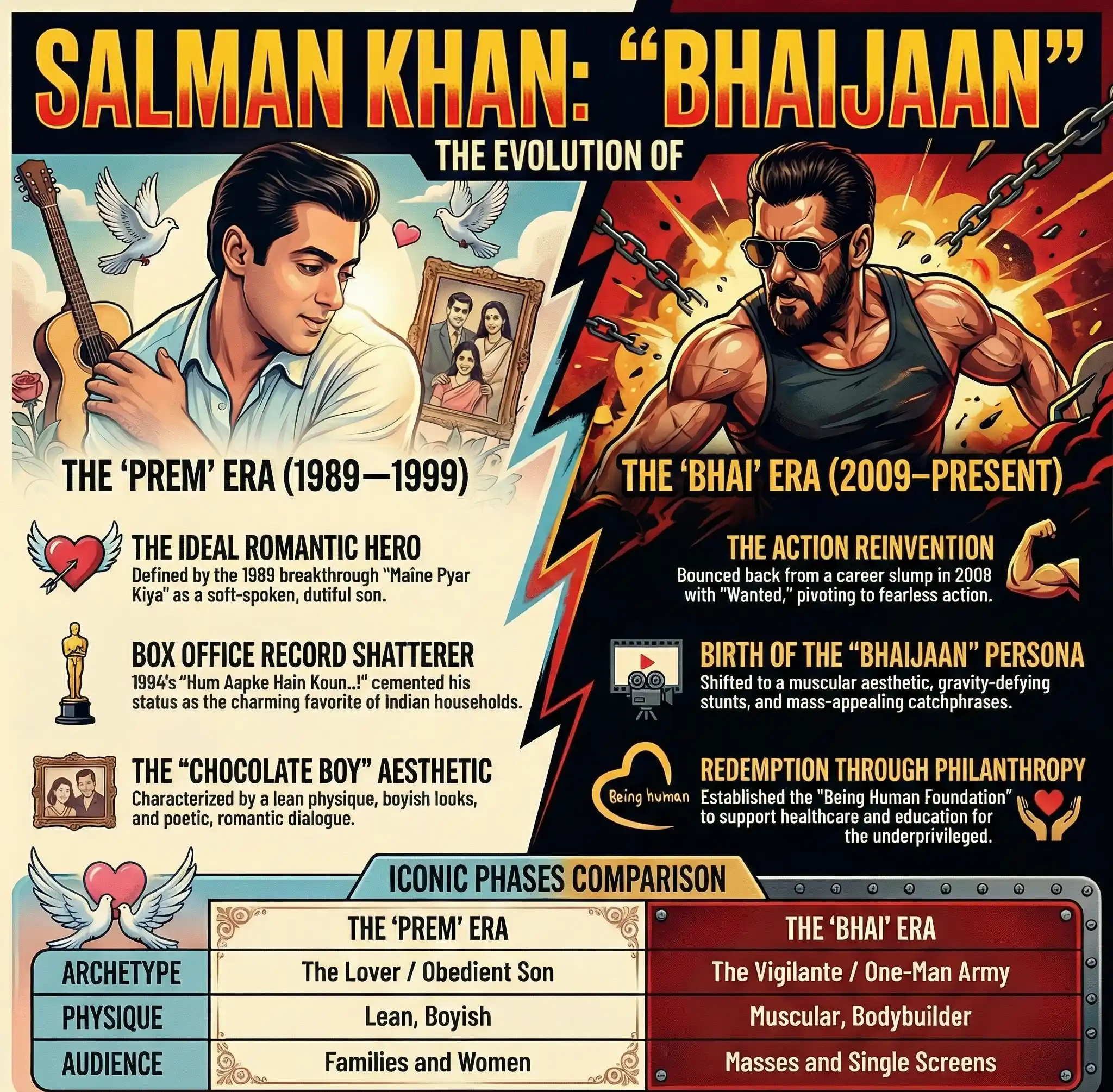
What followed was Dabangg, Ready, Bodyguard, Ek Tha Tiger, Kick, Bajrangi Bhaijaan, Sultan and Tiger Zinda Hai, and the figure at the centre of them is the same man every time. Unbeatable in a fight, loyal past the point of sense, impatient with procedure, protective of whoever is weakest in the frame.
These are not roles in the usual sense. The audience is not being asked to believe in a character for three hours. It is being told that he will be there, and it turns up on that basis.
Maine Pyar Kiya in 1989 made him a star at twenty-three, and Hum Aapke Hain Koun in 1994 was for a while the highest earning Hindi film ever made. He was a romantic lead with a particular kind of softness, and he was good at it.
His father is Salim Khan, one half of the writing team that invented the angry young man for Amitabh Bachchan in the 1970s, so the machinery of Hindi film stardom was a household subject before he was in it. Then most of the 2000s went flat. The films did not work, the reviews were bad, and the industry had begun to talk about him in the past tense. Wanted was not a comeback so much as a change of product.
The Eid arrangement
He took a date on the calendar and made it his own.
A Salman Khan release at Eid became a fixture for the better part of a decade, and the opening weekend stopped having much to do with whether the film was any good. Bigg Boss, which he has hosted since 2010, put him in Indian living rooms every week of the year in between.
The economics follow. Distributors buy the date rather than the picture, and the picture has to be quite bad to lose money. The effect is that he is not really in the film business in the way his contemporaries are. He is a recurring presence that films are built around.
Any account of him that leaves this out is not an account of him, so here it is, with the outcomes as the courts recorded them and nothing added.
In September 2002 his vehicle went into five men sleeping on a pavement in Bandra. One of them died and four were injured. A sessions court convicted him in May 2015 and sentenced him to five years. In December 2015 the Bombay High Court acquitted him of all charges, holding that the prosecution had not proved he was driving or that he had been drinking. The Maharashtra government’s appeal against that acquittal is pending in the Supreme Court.
Separately, a court in Jodhpur convicted him in April 2018 of poaching two blackbuck in 1998 and sentenced him to five years. He was granted bail after two nights and that appeal is also pending. He was acquitted in the related chinkara and firearms cases.
Ravindra Patil
The name almost nobody remembers is the police constable assigned to him as a bodyguard.
Patil was the prosecution’s main witness in the 2002 case and said Khan had been driving. He was later dismissed from the police service, went missing for long stretches, was found destitute in Mumbai and died of tuberculosis in 2007, aged about thirty-two. The High Court, when it acquitted Khan, held that Patil was not a reliable witness.
Whatever the courts concluded about the evidence, two lives in that case visibly ended inside it, and neither belonged to the famous man.
What the persona is for
He set up the Being Human Foundation in 2007 and it does real work, funding healthcare and education out of a clothing business.
Around forty thousand people are said to have been treated through its hospital tie-ups. It also fits the figure on screen exactly: the man who looks after people, outside the official channels, on his own terms. That consistency is the point rather than a coincidence.
Indian stardom has always run on the audience agreeing to mix up the man and the parts. He is the furthest that has ever been taken, because the parts stopped bothering to be anybody else.
The nickname ‘Bhaijaan’ (meaning Elder Brother) became popular after his role in films where he played a protector figure, and also because of his generous, big-brotherly nature within the film industry.
What is the Being Human Foundation?
It is a charitable trust founded by Salman Khan in 2007. The foundation works primarily in the areas of healthcare and education for the underprivileged in India.
Has Salman Khan ever won a National Award?
As an actor, he hasn’t won a National Award for acting, but he has received two National Film Awards as a producer for Chillar Party and Bajrangi Bhaijaan.
Which is Salman Khan’s first movie?
His acting debut was in the film Biwi Ho To Aisi in 1988, where he played a supporting role. His first leading role was in Maine Pyar Kiya (1989).
Sources & References
Encyclopaedia Britannica (“Salman Khan”) — his career and his principal films.
Bombay High Court, judgment of December 2015 — the acquittal in the 2002 case and the court’s findings on the evidence.
Press Trust of India — the Jodhpur conviction of April 2018, the grant of bail and the status of the appeals.
Being Human Foundation — its healthcare and education programmes and how they are funded.
Exploring the Soul of Bharat through History, Science, Culture, and its Diversity
Our Mission
Curious Indian is a definitive knowledge portal dedicated to chronicling the events, personalities, and cultural shifts that defined the Indian subcontinent. From the ancient Vedic Period to the complexities of 21st-century politics, our goal is to provide deep-dive analysis that inspires.
Editorial Standards & E-E-A-T
Every article published under our brand undergoes a rigorous fact-checking process. We prioritize primary historical records, academic citations, and credible archives to ensure our readers receive accurate, high-authority information.
Historical IntegrityDirectly sourcing from ASI archives and academic journals.
Topical AuthorityComprehensive clustering of Indian Science, Biographies, and Wars.
Managed by Paripurna Datta and TEAM | Dedicated to the Knowledge of India.