Loktak Lake, Manipur: people build homes, fish and graze deer on islands that drift. For centuries those islands rose and sank with the seasons. Then the water stopped going down
On Loktak Lake in Manipur, you can walk on ground that is not attached to anything.
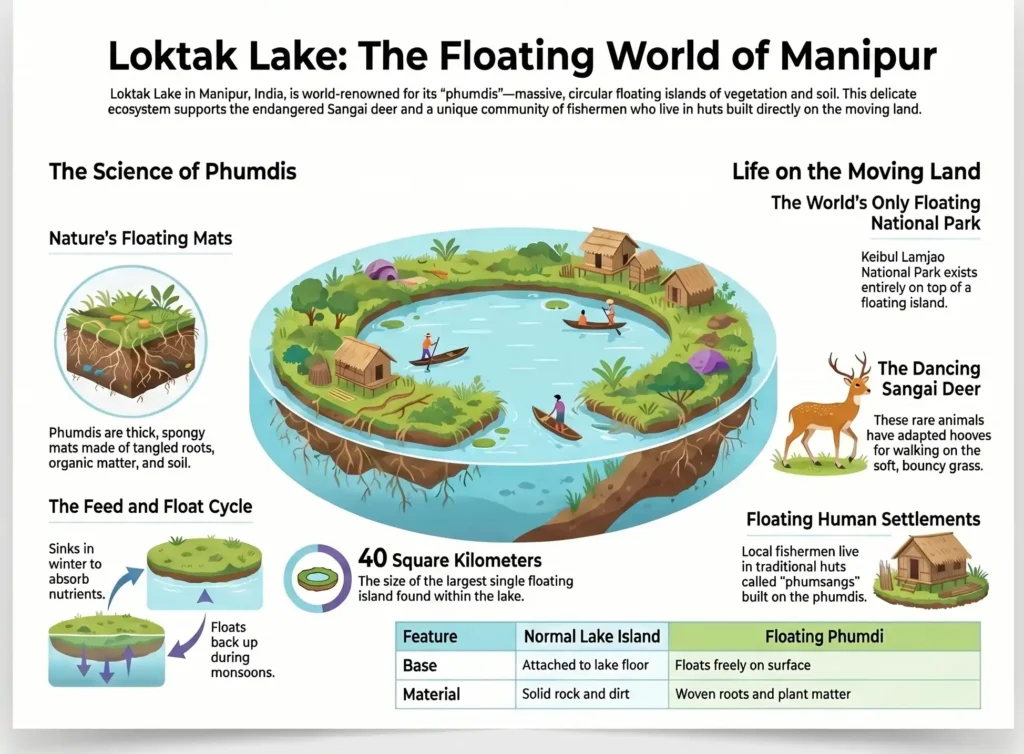
The lake is covered in patches of what looks like solid land: green, grassy, big enough in places to hold a house. But push a long bamboo pole down through the edge and you will find water underneath. These are phumdis, floating islands made of a thick mat of vegetation, soil and slowly rotting plant matter. The Loktak Development Authority’s atlas groups them into thickness classes from about 0.2 metres to more than 1 metre, depending on location and stage of development.
People live on them. A deer lives on them. And for centuries, they had a rhythm of their own.
Push a long bamboo pole down through the edge and you will find water underneath.
The breathing islands
Loktak is the largest freshwater lake in the north-east. Its size swells and shrinks with the seasons.
In the old cycle, the phumdis moved with it. In the dry months, early in the year, the water level dropped, and the floating islands sank slowly until they rested on the lake bed. There they drew in nutrients from the mud below. Then the monsoon came, the lake rose, and the islands floated up again, thick and healthy, ready for another year.
In a way, the islands breathed. Down in the dry season, up in the rains.
Lata Mangeshkar (1929–2022): The Voice of the Millennium
Nargis Dutt (1929–1981): The Graceful Soul of Indian Cinema
The dancing deer
In the south of the lake lies the biggest phumdi of all, about forty square kilometres of floating grassland. In 1977 it was made the Keibul Lamjao National Park. It is the only floating national park in the world.
It exists for one animal: the sangai, Manipur’s brow-antlered deer, a rare subspecies of Eld’s deer found here and nowhere else. The sangai’s hooves are divided, and the joints above them are unusually long, so that it can step lightly across ground that gives and sways beneath it. Watching it pick its way across the floating grass, people say it looks as if it is dancing. In Manipur it is called the dancing deer.
It is the only floating national park in the world, and it exists for one animal: the dancing deer.
The fishers
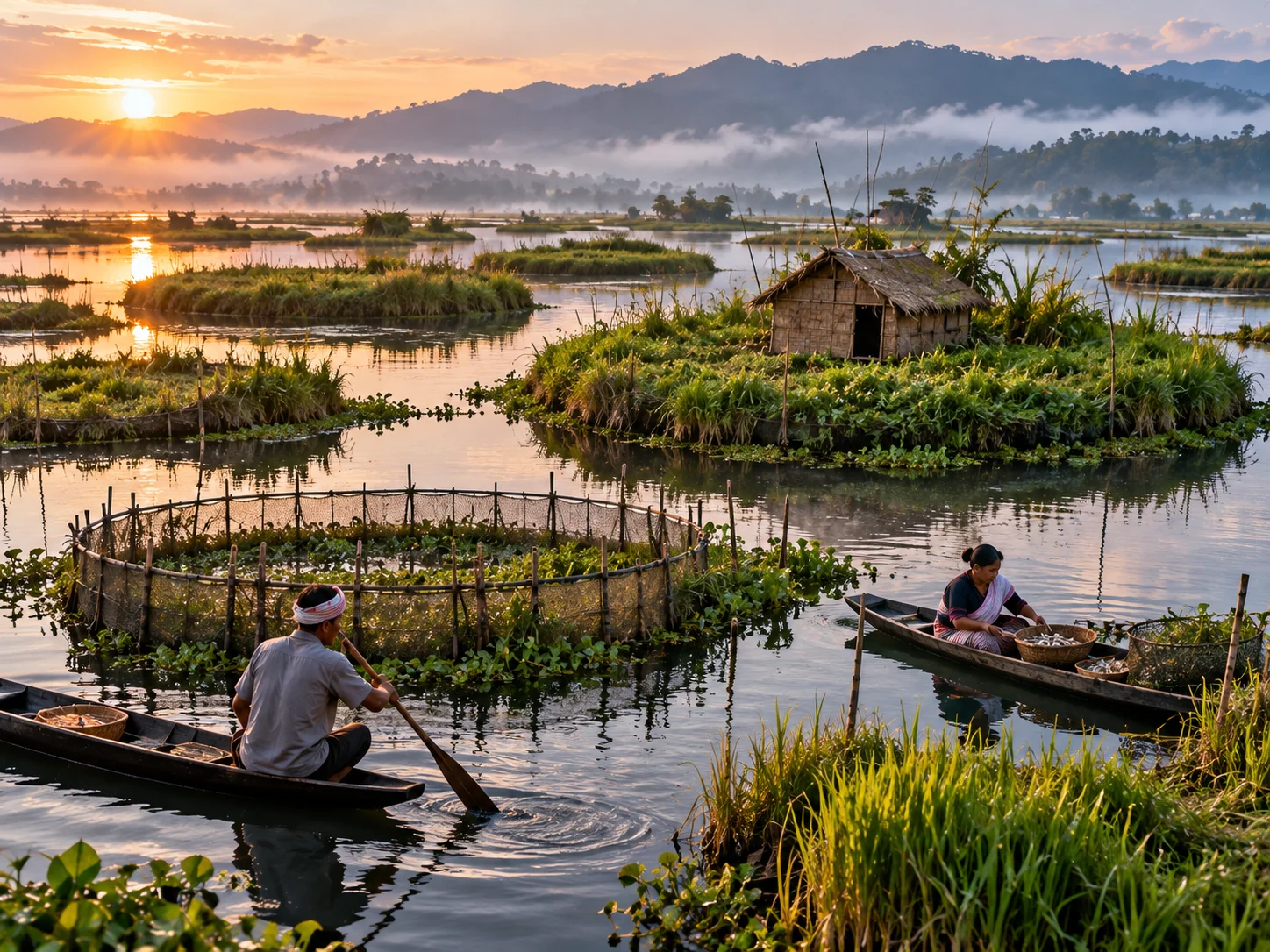
People have long lived around Loktak, and from it. The fishers built small huts called phumshangs on the phumdis, as resting places while they worked the water. From the 1960s, some of those huts became permanent homes. By one estimate, around four thousand people now live in huts on the floating islands.
They fish in a traditional way called athaphum. Sections of phumdi are cut and arranged into rings on the water, and fish gather inside them. From the air, Loktak is dotted with these green circles.
Meena Kumari (1933–1972): Sorrow and Stardom of the Tragedy Queen
The barrage
In 1983, a hydroelectric project on the lake began operating, built around the Ithai barrage on the Manipur river downstream. To keep the power station running, the water in Loktak had to stay high all year round.
So the water stopped going down.
The phumdis could no longer sink to the lake bed in the dry season. They floated all year, cut off from the nutrients below, and slowly grew thinner. By the early 2000s, scientists were warning that the floating grassland of Keibul Lamjao, the sangai’s only home, was thinning and breaking apart.
The fishers lost something too. The higher water swallowed tens of thousands of hectares of fields and grazing land around the lake. “We used to have fertile agricultural fields,” one resident told Al Jazeera. With the fields gone, many families turned to fishing all year round, and the athaphum rings multiplied across the lake.
Mohammed Rafi (1924–1980): The Voice That Touched a Million Hearts
Two stories of one lake
The government set up the Loktak Development Authority to restore the lake. In 2006, a new law banned huts on the phumdis and athaphum fishing across most of the lake. The authority sees the huts and fish rings as part of what is choking Loktak. In November 2011, with armed police, it burned 777 huts in the floating village of Champu Khangpok, calling the residents illegal encroachers.
The fishers see it differently. They say they are not encroachers but people whose fields were taken by the barrage, and that the lake’s real troubles began with the dam, and with the pollution rivers carry down from Imphal.
Both are describing something real. Loktak is under strain, and so are the people who depend on it.
The rhythm
What the lake lost, above all, was a rhythm. For centuries, the islands, the deer and the fishers all lived by the rise and fall of the water. Now the water is held at one level, and everything that once moved with it is trying to adjust.
The sangai still steps carefully across the floating grass of Keibul Lamjao. The fishers still set their nets. And under them both, the ground that floats is waiting for a dry season deep enough to let it touch bottom again.
Srikakulam District: The Spiritual & Historical Pearl of North Andhra
If you think you have remembered everything about this topic take this QUIZ
Results


#1. What is the local name for the circular floating islands found on Loktak Lake?
#2. What are the floating islands primarily made of?
#3. Which rare animal is known as the “dancing deer” of Manipur?
#4. What is the name of the world’s only floating national park located on the lake?
#5. What are the traditional wooden huts built by fishermen on the floating islands called?
#6. How does the Ithai Barrage dam negatively affect the floating islands?
#7. Which international convention declared Loktak Lake a wetland of international importance?
#8. According to the “Fast Facts,” what do local women use to run a busy early morning market?
What exactly is a floating island made of?
It is completely made of a thick spongy mix of plant roots dead organic leaves and rich soil that weaves together over many years to form a floating mat.
Can human beings safely walk on these islands?
Yes, the larger ones are incredibly strong and thick. They can easily support the weight of humans, small houses and large wild animals.
Why is the local deer called the dancing deer?
The rare sangai deer has to constantly shift its weight to keep its balance on the soft bouncy grass which makes it look exactly like it is performing a delicate dance.
Do people really live on the lake permanently?
Yes, hundreds of local fishing families build small wooden huts directly on the thickest grass patches and live their entire lives on the moving water.
How do the islands get their food to stay green?
Traditionally they sink to the bottom of the lake during the dry winter to absorb rich minerals from the mud before floating back up during the heavy rainy season.
Sources & References
Himalayan Geographic, “The Sangai Story: Keibul Lamjao National Park” (1 September 2018) — the natural cycle of the phumdis and its disruption by the Ithai barrage.
Voices for Biodiversity, “Loktak Lake: The World’s Only Floating Lake” (27 January 2016) — Keibul Lamjao, the sangai’s adaptations, and athaphum fishing.
Frontline, “Guardians of the Lairembee” (7 October 2022) — the Loktak Development Authority, the 2006 Act, and the burning of huts at Champu Khangpok in November 2011.
Al Jazeera, “Future adrift: India’s Indigenous Meitei lose floating homestays” (7 December 2022) — the fields lost to the barrage and the shift to year-round athaphum fishing.
Loktak Development Authority, The Atlas of Loktak — the distribution and measured thickness classes of phumdis and the lake’s changing floating-island ecology.