Sunday, August 23, 2026
24 °c
Columbus
Curious Indian
  • Indian History
  • Modern India
  • Art & Culture
  • Science & Discovery
  • Festivals of India
  • Mysteries
  • The Great Indian Timeline
No Result
View All Result
  • Indian History
  • Modern India
  • Art & Culture
  • Science & Discovery
  • Festivals of India
  • Mysteries
  • The Great Indian Timeline
No Result
View All Result
Curious Indian
No Result
View All Result
Home Arts & Culture

Satyajit Ray (1921–1992): The Auteur Who Redefined Indian Cinema

From Calcutta’s Artistic Heritage to Global Cinematic Legend: The Life, Vision, and Enduring Legacy of Satyajit Ray

Curious Indian by Curious Indian
in Arts & Culture, Biography, Entertainment Personalities
Reading Time: 7 mins read
0 0
A A
Satyajit Ray

Satyajit Ray

Share on FacebookShare on Twitter

Table of Contents

Toggle
  • Early Life: A Legacy of Arts
  • The Turning Point: Advertising to Auteur
  • The Apu Trilogy and Global Fame
  • Literary and Musical Genius
  • Later Years and Recognition
  • Quick Comparison: Eras of a Master
  • Curious Indian Fast Facts
  • Conclusion
  • If you think you have remembered everything about this topic take this QUIZ
  • Results
    • #1. Which film, released in 1955, marked Satyajit Ray’s debut as a director?
    • #2. Which Italian film inspired Satyajit Ray to become a filmmaker during his stay in London in 1950?
    • #3. What is the name of the famous fictional private investigator created by Satyajit Ray?
    • #4. Satyajit Ray began his career as a junior visualiser at which British advertising agency?
    • #5. Many believe that Steven Spielberg’s movie E.T. was inspired by which unproduced script written by Satyajit Ray?
    • #6. What was Satyajit Ray’s first film shot entirely in color?
    • #7. Satyajit Ray designed the original book cover for which famous book by Jawaharlal Nehru?
    • #8. In 1992, Satyajit Ray became the first Indian to receive which prestigious award for lifetime achievement?
    • What was Satyajit Ray’s first film?
    • Did Satyajit Ray win an Oscar?
    • Who is Feluda?
    • Was Satyajit Ray a music composer?
    • What is the Apu Trilogy?
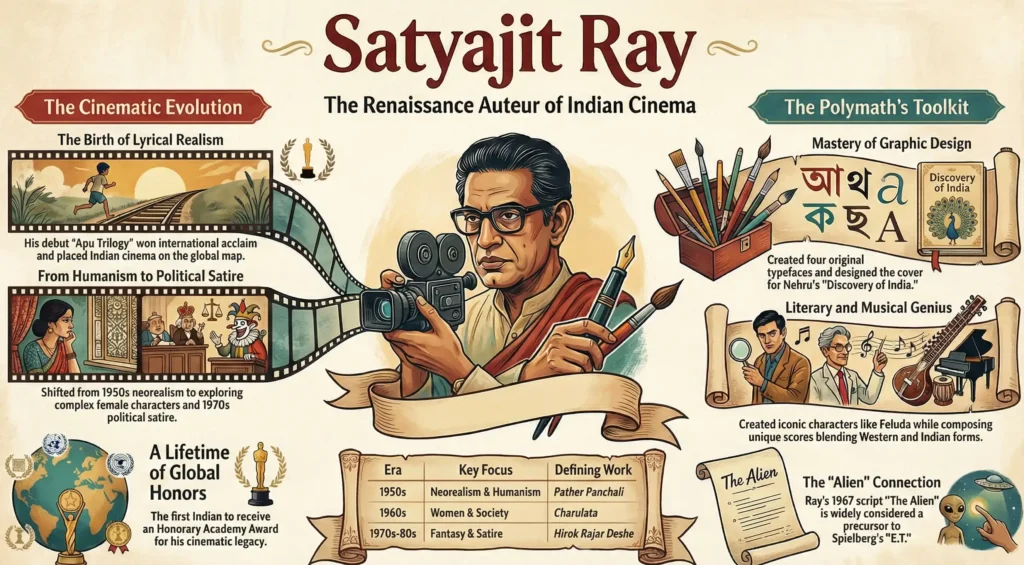
Satyajit Ray, born in Calcutta in 1921, was a polymath who revolutionized Indian cinema. Starting his career as a graphic designer, he found his calling in filmmaking after watching Bicycle Thieves. His debut, Pather Panchali (1955), the first part of the celebrated Apu Trilogy, won major international awards and established him as a master of realism. Beyond direction, Ray was a celebrated author, creating beloved characters like Feluda and Professor Shonku, and a music composer who scored his own films. In 1992, just weeks before his death, he became the first Indian to receive an Honorary Academy Award.
AttributeDetails
Full NameSatyajit Ray
Date of BirthMay 2, 1921
BirthplaceCalcutta (now Kolkata), British India
Date of DeathApril 23, 1992
ProfessionFilmmaker, Author, Music Composer, Illustrator
Debut FilmPather Panchali (1955)
Key AwardsHonorary Academy Award (1992), Bharat Ratna (1992), Legion of Honour (1987)
SpouseBijoya Ray (Married 1949)
ChildrenSandip Ray
Notable WorksThe Apu Trilogy, Charulata, Jalsaghar, Goopy Gyne Bagha Byne

Early Life: A Legacy of Arts

Satyajit Ray

Satyajit Ray was born into a distinguished Bengali family known for their contributions to art and literature. His grandfather, Upendrakishore Ray Chowdhury, was a writer and illustrator, and his father, Sukumar Ray, was a pioneer of Bengali nonsense rhyme. However, tragedy struck early when his father died when Ray was just three. Raised by his mother, Suprabha Ray, he studied at Ballygunge Government High School and later Presidency College. At his mother’s insistence, he attended Visva-Bharati University in Santiniketan, founded by Rabindranath Tagore, where he gained a deep appreciation for Indian art and rural life.

READ MORE:  Milestones of Balraj Sahni’s Acting Career

The Turning Point: Advertising to Auteur

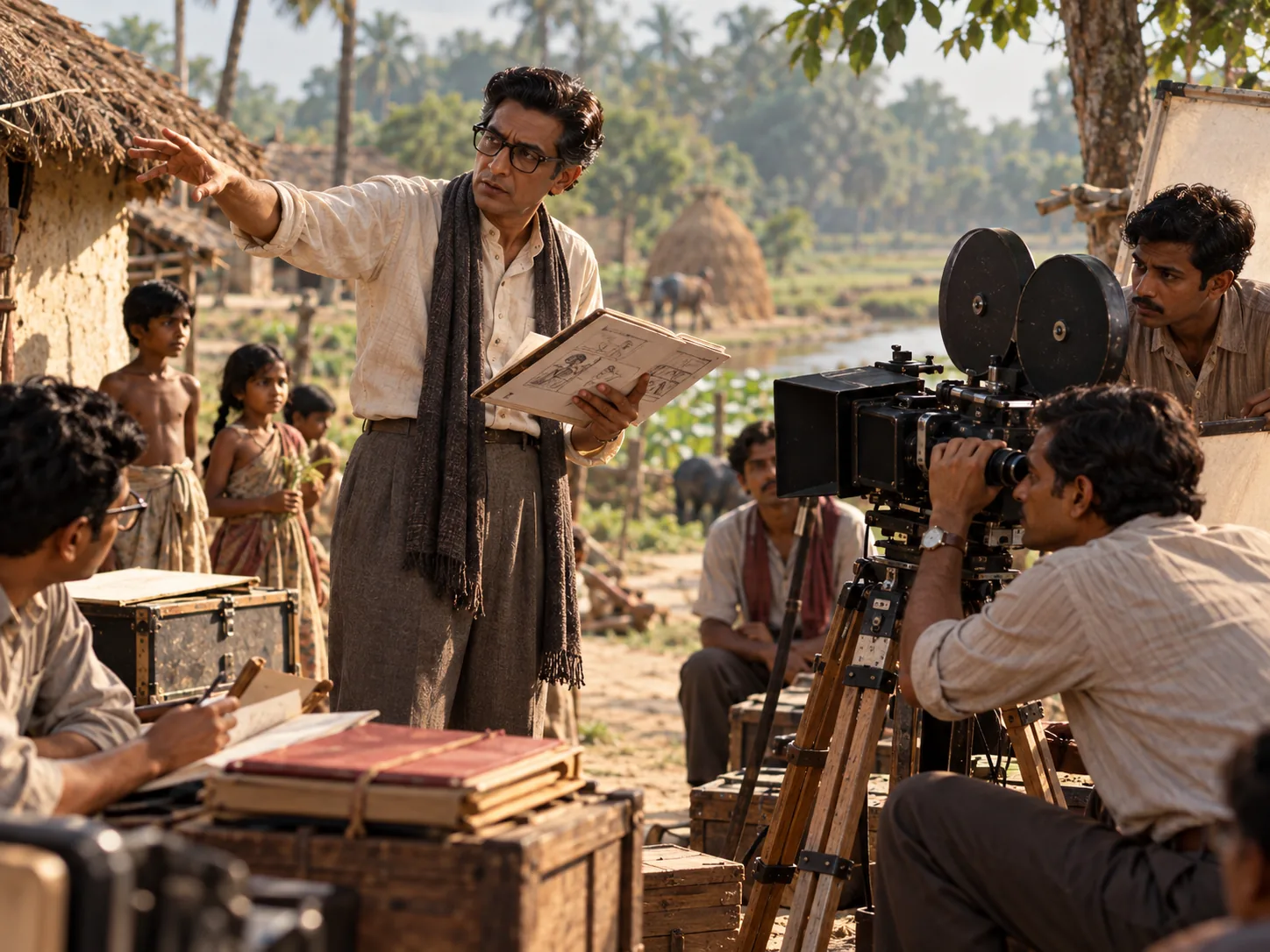
Ray began his career as a junior visualiser at the British advertising agency D.J. Keymer. While he excelled at graphic design—creating covers for books like Man-Eaters of Kumaon—his heart lay in cinema. A stint in London in 1950, where he watched 99 films in six months (including Vittorio De Sica’s Bicycle Thieves), convinced him to become a filmmaker. He returned to India with a determination to adapt Bibhutibhushan Bandyopadhyay’s novel Pather Panchali.

Waheeda Rehman : Elegance, Excellence, and Breaking Barriers

The Apu Trilogy and Global Fame

Struggling for funds, Ray shot Pather Panchali over three years. Released in 1955, the film was a revelation, winning the “Best Human Document” award at the Cannes Film Festival. It was followed by Aparajito (1956), which won the Golden Lion at Venice, and Apur Sansar (1959). Together, The Apu Trilogy is considered one of the greatest cinematic achievements in history, known for its lyrical realism and humanism.

Literary and Musical Genius

Ray was a true Renaissance man.

  • The Author: To revive the children’s magazine Sandesh, he started writing stories. He created Feluda, the sharp-witted private investigator, and Professor Shonku, the eccentric scientist, both of whom remain cultural icons in Bengal.
  • The Composer: Unsatisfied with standard film music, Ray began composing his own scores starting with Teen Kanya (1961). His music blended Western classical elements with Indian folk and classical forms, creating a unique soundscape for his films.

Later Years and Recognition

In his later years, Ray continued to experiment with films like the musical Goopy Gyne Bagha Byne and the political satire Hirak Rajar Deshe. Despite failing health in the 80s, he directed masterpieces like Ghare Baire. In 1992, the Academy of Motion Picture Arts and Sciences awarded him an Honorary Oscar for his lifetime achievement, which he accepted from his hospital bed in Calcutta, calling it the “best achievement of my movie-making career.”

READ MORE:  Yash Chopra (1932–2012): Visionary Who Redefined Indian Romance

Rekha: From Reluctant Child Star to Eternal Diva


Quick Comparison: Eras of a Master

EraKey FocusDefining WorksImpact
1950sNeorealism & HumanismPather Panchali, AparajitoPut Indian cinema on the world map; introduced realism.
1960sWomen & SocietyCharulata, MahanagarExplored complex female characters and urbanization.
1970s-80sFantasy & DetectiveSonar Kella, Hirok Rajar DesheEntertained children while offering sharp political satire.

Aamir Khan: Excellence and The Art of Perfection

Curious Indian Fast Facts

  • The Calligrapher: Ray designed four typefaces for the Roman script—Ray Roman, Ray Bizarre, Daphnis, and Holiday Script.
  • The E.T. Connection: Ray wrote a script called The Alien in 1967, which Hollywood studios showed interest in. Many believe Steven Spielberg’s E.T. was inspired by this unproduced script.
  • First Color Film: His first film in color was Kanchenjungha (1962), which was also the first time he wrote an original screenplay instead of adapting a book.
  • Poster Designer: He designed the posters for his own films, combining his background in graphic art with his cinematic vision.
  • Nehru’s Discovery: He designed the cover for the original edition of Jawaharlal Nehru’s The Discovery of India.

Conclusion

Satyajit Ray was more than a filmmaker; he was a cultural phenomenon who viewed the world through a lens of profound empathy. From the rural paths of Apu to the mystery-filled streets of Feluda’s Calcutta, his work bridged the gap between high art and popular entertainment. As the only Indian filmmaker to receive an Oscar, a Bharat Ratna, and the Legion of Honour, Ray’s legacy remains a towering beacon of artistic integrity and humanism.

READ MORE:  Reign of Shah Jahan: The Emperor Who Built the Taj Mahal

Yash Chopra (1932–2012): Visionary Who Redefined Indian Romance

If you think you have remembered everything about this topic take this QUIZ


Results

Share your score!
Tweet your score!
Tweet your score!
Share to other
QUIZ START

#1. Which film, released in 1955, marked Satyajit Ray’s debut as a director?

Previous
Next

#2. Which Italian film inspired Satyajit Ray to become a filmmaker during his stay in London in 1950?

Previous
Next

#3. What is the name of the famous fictional private investigator created by Satyajit Ray?

Previous
Next

#4. Satyajit Ray began his career as a junior visualiser at which British advertising agency?

Previous
Next

#5. Many believe that Steven Spielberg’s movie E.T. was inspired by which unproduced script written by Satyajit Ray?

Previous
Next

#6. What was Satyajit Ray’s first film shot entirely in color?

Previous
Next

#7. Satyajit Ray designed the original book cover for which famous book by Jawaharlal Nehru?

Previous
Next

#8. In 1992, Satyajit Ray became the first Indian to receive which prestigious award for lifetime achievement?

Previous
Finish

What was Satyajit Ray’s first film?

His debut film was Pather Panchali (Song of the Little Road), released in 1955.

Did Satyajit Ray win an Oscar?

Yes, he received an Honorary Academy Award in 1992 for his lifetime contribution to cinema.

Who is Feluda?

Feluda is a fictional private investigator created by Satyajit Ray, appearing in a series of popular Bengali novels and short stories.

Was Satyajit Ray a music composer?

Yes, starting from 1961, Ray composed the music for all his own films, blending Western and Indian styles.

What is the Apu Trilogy?

It is a series of three films—Pather Panchali, Aparajito, and Apur Sansar—that depict the coming-of-age story of a boy named Apu.

Read More: https://curiousindian.in/madhubala-february-1933-february-1969/

Tags: film director
ShareTweetPin
Curious Indian

Curious Indian

Curious Indian Exploring the Soul of Bharat through History, Science, Culture, and its Diversity
Our Mission Curious Indian is a definitive knowledge portal dedicated to chronicling the events, personalities, and cultural shifts that defined the Indian subcontinent. From the ancient Vedic Period to the complexities of 21st-century politics, our goal is to provide deep-dive analysis that inspires.
Editorial Standards & E-E-A-T Every article published under our brand undergoes a rigorous fact-checking process. We prioritize primary historical records, academic citations, and credible archives to ensure our readers receive accurate, high-authority information.
Historical Integrity Directly sourcing from ASI archives and academic journals.
Topical Authority Comprehensive clustering of Indian Science, Biographies, and Wars.
Managed by Paripurna Datta and TEAM  |  Dedicated to the Knowledge of India.

Related Posts

History of Tea in India
Arts & Culture

The Cup that was Sold to Us before We Loved it

August 13, 2026
Vande Mataram: An Idea
Arts & Culture

The Song We Love and Fight Over

August 13, 2026
First Feminist of India: Tarabai Shinde
Arts & Culture

The First Feminist nobody Read

August 13, 2026
No Result
View All Result

Stay Updated

  • Trending
  • Latest
Gupta Empire

Gupta Empire: When India Led the World in Science and Culture

June 19, 2026
Indian rock-cut architecture Infographics

Ancient Secrets of Indian Rock-Cut Architecture: Journey Through Stone

June 18, 2026
Shivkar Bapuji Talpade

Shivkar Bapuji Talpade: India’s First Aviation Pioneer

August 2, 2026
Padmanabhaswamy Temple Treasure

7 Secrets of Padmanabhaswamy Temple Treasure

June 6, 2026
Age of Consent Act 1891

The Death that Forced a Law

August 15, 2026
Dandi March

The Pinch of Salt That Broke an Empire

August 13, 2026
Swadeshi Movement through Matchbox

A small flame of swadeshi

August 13, 2026
Famine in Bengal (1943)

Three Million Empty Plates

August 13, 2026

Widget Title

Facebook Instagram
Curious Indian Logo

Explore the soul of India, that is Bharat with Curious Indian. A definitive guide to Indian history, arts, culture, biographies, and the events that defined our present.

Follow us on social media:

Recent Articles

  • The Death that Forced a Law
  • The Pinch of Salt That Broke an Empire
  • A small flame of swadeshi

Legal Policies

  • Contact Us
  • Disclaimer
  • About Us
  • Privacy Policy
  • Editorial Policy & Standards: Curious Indian

© 2026 Curious Indian- Everything about India

Welcome Back!

Login to your account below

Forgotten Password?

Retrieve your password

Please enter your username or email address to reset your password.

Log In

Add New Playlist

No Result
View All Result
  • Indian History
  • Modern India
  • Art & Culture
  • Science & Discovery
  • Festivals of India
  • Mysteries
  • The Great Indian Timeline

© 2026 Curious Indian- Everything about India

This website uses cookies. By continuing to use this website you are giving consent to cookies being used. Visit our Privacy and Cookie Policy.
Not enough quota to unlock this post
Unlock left : 0
Are you sure want to cancel subscription?
×