How a leaderless revolt proved India could no longer be ruled
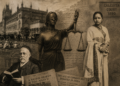
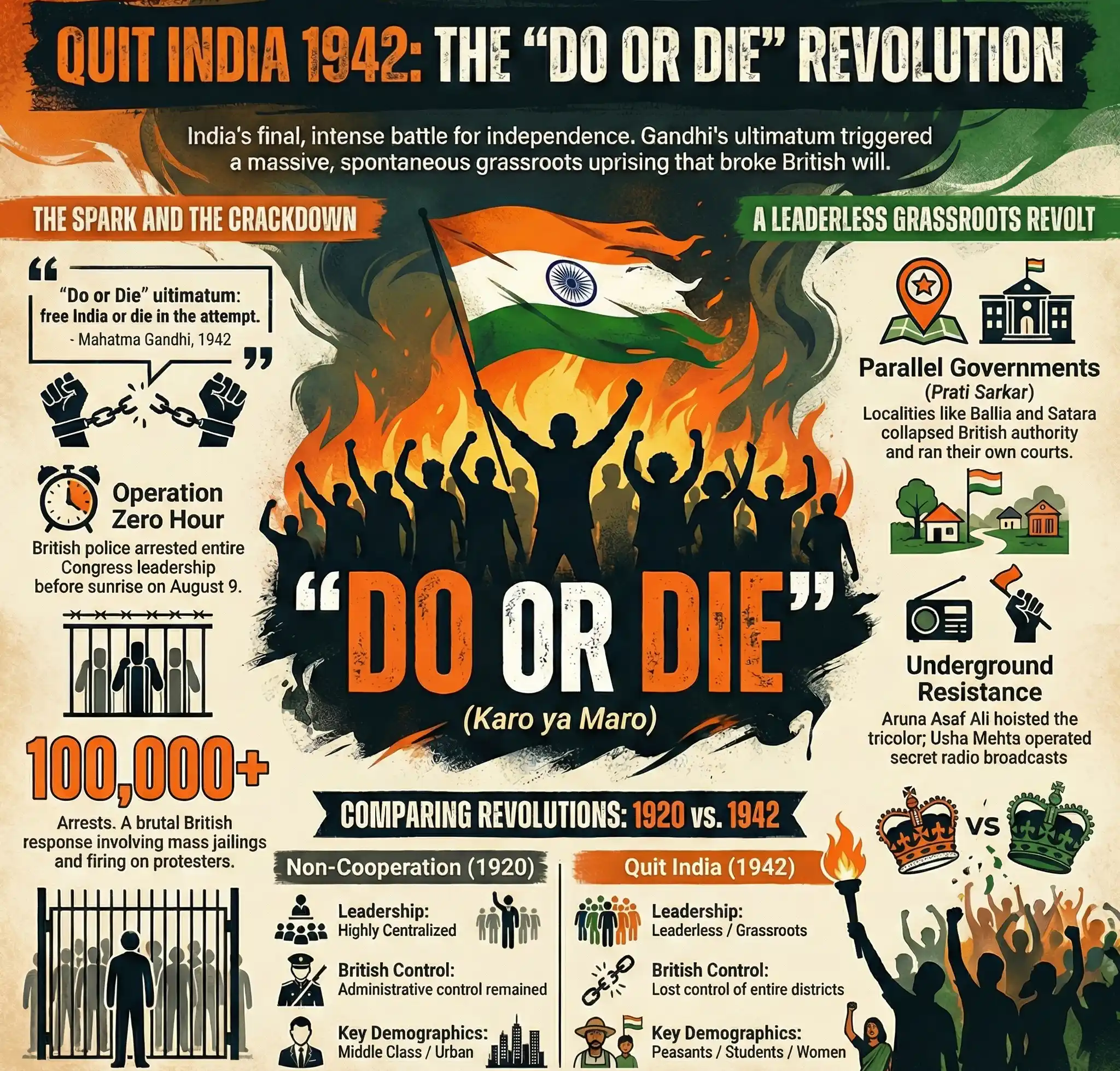
Before dawn on 9 August 1942, British police fanned out across India, and in the space of a few hours they arrested almost every leader the freedom movement had.
Gandhi was taken. Nehru was taken. Patel, Azad, one after another, the whole top rank of the Indian National Congress was seized in their homes and carried off to prisons and forts. It was a swift, ruthless, carefully planned strike, and its purpose was simple. The British meant to cut the head off the movement before it could even begin.
By any ordinary logic, it should have worked. A movement without its leaders is usually a movement that dies.
Instead, the uprising the arrests were meant to prevent exploded the moment the leaders were gone. It burned across the country for months, run by no one famous and by everyone at once. This is the story of the Quit India Movement, and of the strange and powerful truth it laid bare: that a demand for freedom, once it truly belongs to a whole people, no longer has a single head that anyone can cut off.
A post-dated cheque
By 1942, the Second World War had arrived at India’s border. The Japanese army had swept through Burma and stood at the gates of the east, and a frightened Britain badly needed India calm and cooperative.
So the British sent a senior politician, Sir Stafford Cripps, to make an offer. It amounted to a vague promise of self-government at some point after the war was won. To Indians who had heard such promises before, and watched them dissolve, it was worthless. Gandhi famously dismissed it as a post-dated cheque, and the mission collapsed.
Something in the national mood now hardened. The British were plainly not going to leave of their own accord, and their war was dragging India toward a Japanese attack. The time for asking politely was over. The demand was no longer for reform, or for a share of power, or for a promise. It was a single word: quit.
Do or Die
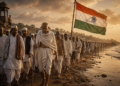
On 8 August 1942, the Congress gathered in Bombay and passed the Quit India resolution. That evening Gandhi rose to speak, and the man famous for his caution set caution aside.
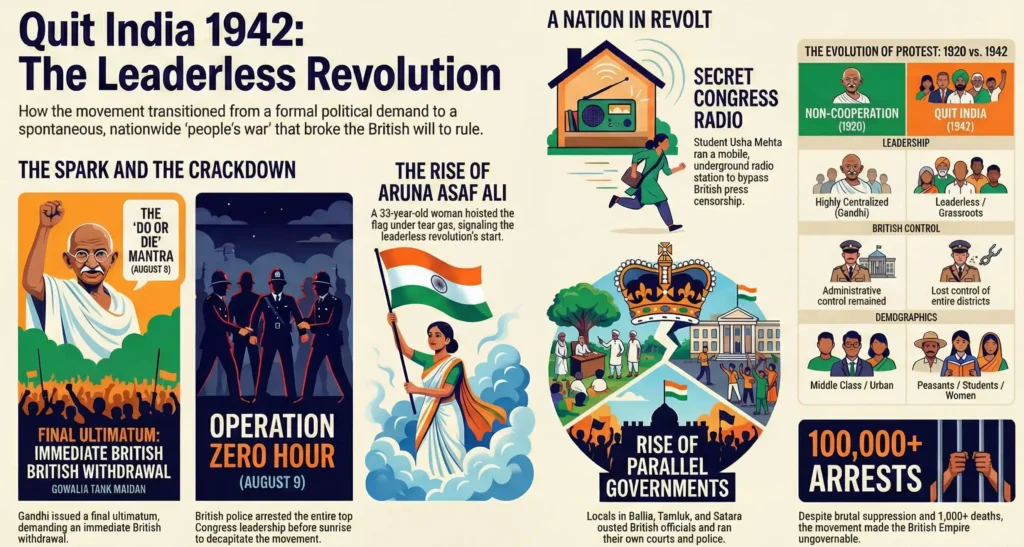
He gave the country a mantra of just four words. Do or Die. We shall free India, he said, or die in the attempt.
It was not a request. It was an ultimatum flung at an empire.
The Indo-Pakistani War of 1971: A Victory of Humanity and Strategy
Operation Zero Hour
The British answer came before the sun was up.
In a pre-planned operation, the police moved in the darkness of that same night and arrested the entire leadership. Gandhi was locked away in the Aga Khan Palace in Pune; the others were scattered to distant forts. By sunrise on 9 August, before the movement had held a single march, its every famous leader was behind bars.
The British went to bed believing they had strangled the rebellion in its cradle. They could not have been more wrong.
The revolt with no leaders
What happened next had never happened before. With the great names all in prison, India did not fall silent. It erupted.
With no one left to give orders, ordinary people gave their own. Across the country, crowds went on strike, tore up railway tracks, cut telegraph wires, and stormed police stations and government offices. And into the empty space where the leaders had been, complete unknowns simply stepped up. A young woman named Aruna Asaf Ali pushed through the tear gas at the Bombay meeting ground and hoisted the national flag in defiance, then vanished underground to help run the resistance. A twenty-two-year-old student named Usha Mehta set up a secret radio station in a suitcase, moving it from house to house each day to stay ahead of the British detector vans, telling the nation that the revolt was alive and calling from somewhere in India.
With the household names in jail, the movement was carried by the unknown: a young woman with a flag, a student with a hidden radio, a village with a grievance and no more fear.
India’s First Nuclear Test: The Story of Smiling Buddha
When the villages ruled themselves
The deepest proof of what had changed came in the countryside, where in district after district British rule simply stopped working.
In several places the crowds did not merely protest. They took over. Locals threw out the colonial officials and set up governments of their own, which they called Prati Sarkar, parallel governments. In Ballia, in Tamluk, in Satara, ordinary Indians ran their own police, held their own courts, and collected their own taxes. Some of these little republics lasted only weeks. One in Bengal ran for around two years.
For a while, in corners of India, the British were not so much driven out as made irrelevant. The people were already governing themselves.
The wounded animal
The empire hit back with everything it had, and it was savage.
Soldiers fired into crowds. Whole villages were fined and punished together. In some places, aircraft strafed gatherings from the sky. Around a hundred thousand people were thrown into prison, and many hundreds, by some counts more than a thousand, were killed. There were heroes in that storm whose names deserve to outlive it, like Matangini Hazra, a woman of seventy-three in Bengal who was shot again and again and kept walking forward, holding the flag, until she fell.
Two hard truths belong here as well. Unlike in 1922, when Gandhi had called off a whole movement over one outbreak of violence, this time he did not disown the people even as much of the revolt turned violent. The fury, now, ran too deep to be recalled. And not everyone joined. The Muslim League held itself apart, and the Communists opposed the movement because their Soviet ally was fighting on Britain’s side in the war. The broad unity of an earlier age was not there, and its absence would echo into the years ahead.
Within a few months, by brute force, the movement was crushed.
The head they could not cut off
And yet, in the only way that finally mattered, the British had lost.
They had set out, on that August night, to cut the head off the freedom movement. What they discovered was that it no longer had one. The demand for freedom had passed out of the hands of a few great men and into the hands of the whole people, the student and the peasant, the woman with the flag and the student at the hidden radio. And that was something no prison could hold. You can jail a leader. You cannot jail a nation’s will.
After 1942, the British knew, even if they would not say it aloud, that they were governing a country that had already, in its heart, stopped consenting to be governed. When the war ended and the leaders walked out of prison in 1945, they came out to find the essential work already done. India was not yet free on paper. But it had, quietly and completely, ceased to belong to Britain.
An empire can hold a people down by force for a time. It cannot hold down a whole people who have all, together, decided to be free. That was the real lesson of the night they jailed everyone. They emptied the country of its leaders and found, to their alarm, that the thing they truly feared was now in everyone, and there were not enough prisons in the world for that.
The 1969 Bank Nationalization: How Indira Gandhi Seized the Vaults
The Emergency: When India’s Democracy Was Put in Chains
If you think you have remembered everything about this topic take this QUIZ
The Indo-Pakistani War of 1965: When Courage Defeated Technology
Why was the Quit India Movement launched?
It was launched due to the failure of the Cripps Mission, the hardships caused by World War II (inflation/famine), and the immediate desire for full independence to defend India against Japanese aggression.
What was the slogan of the Quit India Movement?
The slogan was “Do or Die” (Karo ya Maro), given by Mahatma Gandhi.
Who ran the Secret Congress Radio?
Usha Mehta, a 22-year-old student, along with associates like Vithalbhai Jhaveri, ran the underground radio station.
Why is it called a “Leaderless Revolt”?
Because the British arrested all top Congress leaders (Gandhi, Nehru, Patel) on the very first morning (August 9), leaving the masses to organize and lead themselves.
What was the British response code-named?
The swift arrest of leaders was code-named Operation Zero Hour.
Sources & References
- Encyclopaedia Britannica (“Quit India Movement” and “Mahatma Gandhi”) — the launch on 8 August 1942, the resolution, and the mass arrests.
- Encyclopaedia Britannica (“Stafford Cripps”) — the failed 1942 mission that preceded the movement.
- Amrit Mahotsav, Government of India (Usha Mehta and the Congress Radio) — the underground radio and the leaderless resistance.
- Know India, National Portal of India (Aruna Asaf Ali) — the figures who led the revolt after the arrests.
Author


Exploring the Soul of Bharat through History, Science, Culture, and its Diversity
Our Mission
Curious Indian is a definitive knowledge portal dedicated to chronicling the events, personalities, and cultural shifts that defined the Indian subcontinent. From the ancient Vedic Period to the complexities of 21st-century politics, our goal is to provide deep-dive analysis that inspires.
Editorial Standards & E-E-A-T
Every article published under our brand undergoes a rigorous fact-checking process. We prioritize primary historical records, academic citations, and credible archives to ensure our readers receive accurate, high-authority information.
Historical Integrity Directly sourcing from ASI archives and academic journals.Topical Authority Comprehensive clustering of Indian Science, Biographies, and Wars.Managed by Paripurna Datta and TEAM | Dedicated to the Knowledge of India.