How the East India Company turned trade into an empire
Try, for a moment, to picture this.
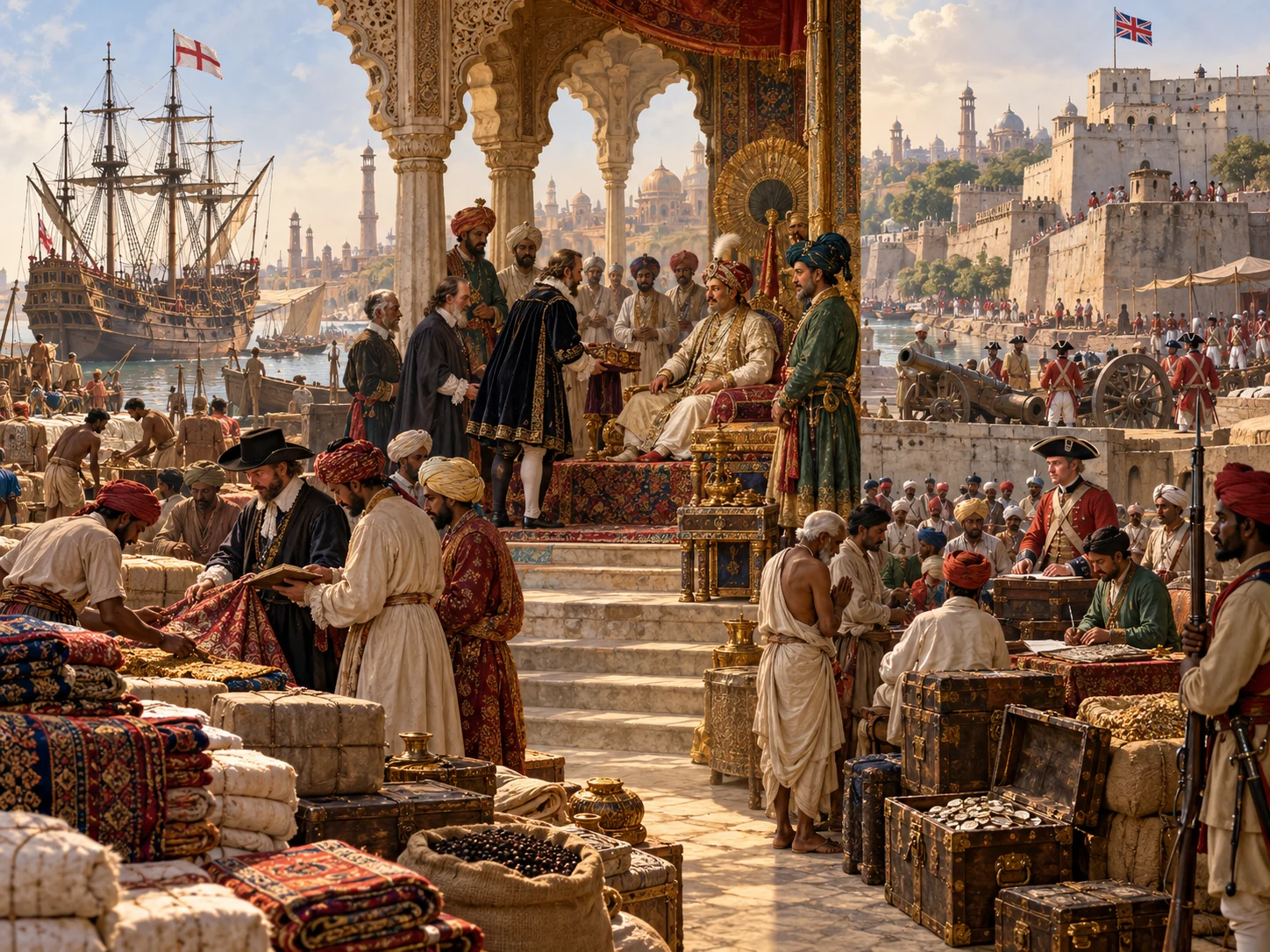
Imagine a private business, a company with shareholders, a board of directors and a head office in a distant city, slowly taking over an entire country. Not just its shops and its factories, but its taxes, its courts and its armies. Imagine a corporation with a private military larger than the armed forces of most nations, governing tens of millions of people, and answering to no voter and no king.
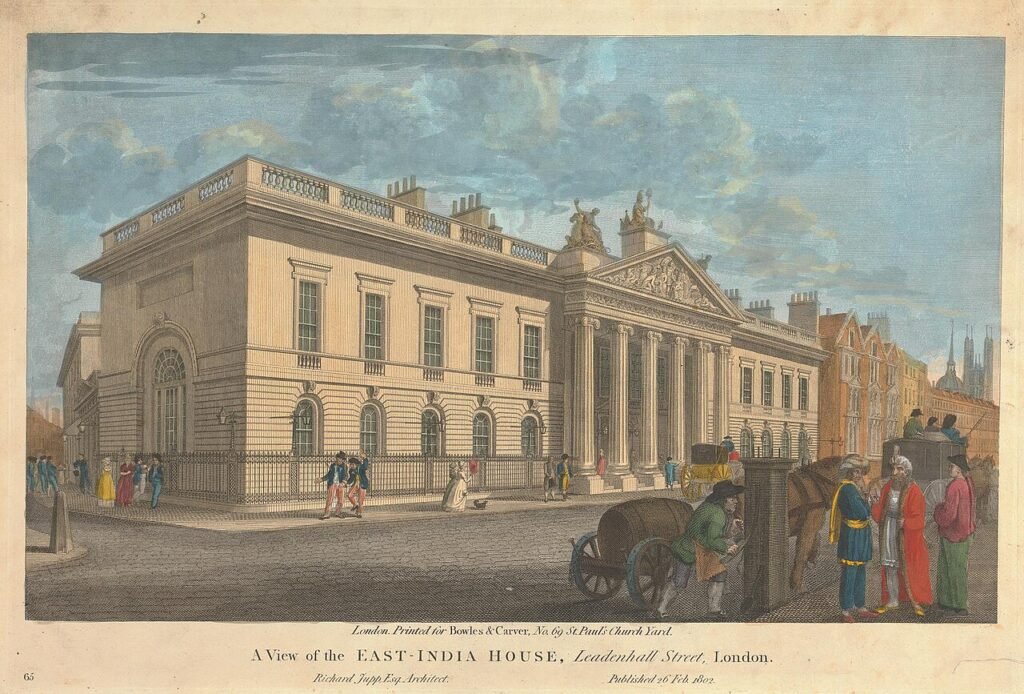
Source: Wikimedia Commons · anonymous · CC0
It sounds like science fiction. It actually happened, and the country was India.
The company was called the East India Company, and its story is one of the strangest in all of history. It is the tale of how a handful of London merchants who set out to buy pepper ended up ruling a subcontinent.
It started with pepper
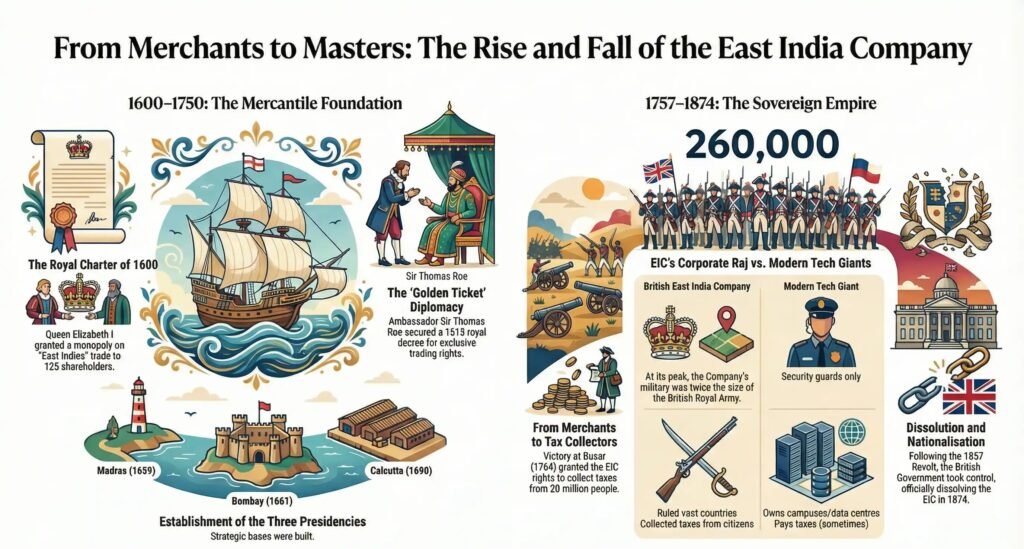
The Company was born on the last day of the year 1600, when Queen Elizabeth I signed a charter giving a group of English merchants the sole right to trade with the “East Indies.” People took to calling it, half fondly, “John Company.”
Source: Wikimedia Commons · Montanus, Arnoldus, 1625-1683 Dutch East India Company Meurs, Jacob van, 1619-1680 · Public domain
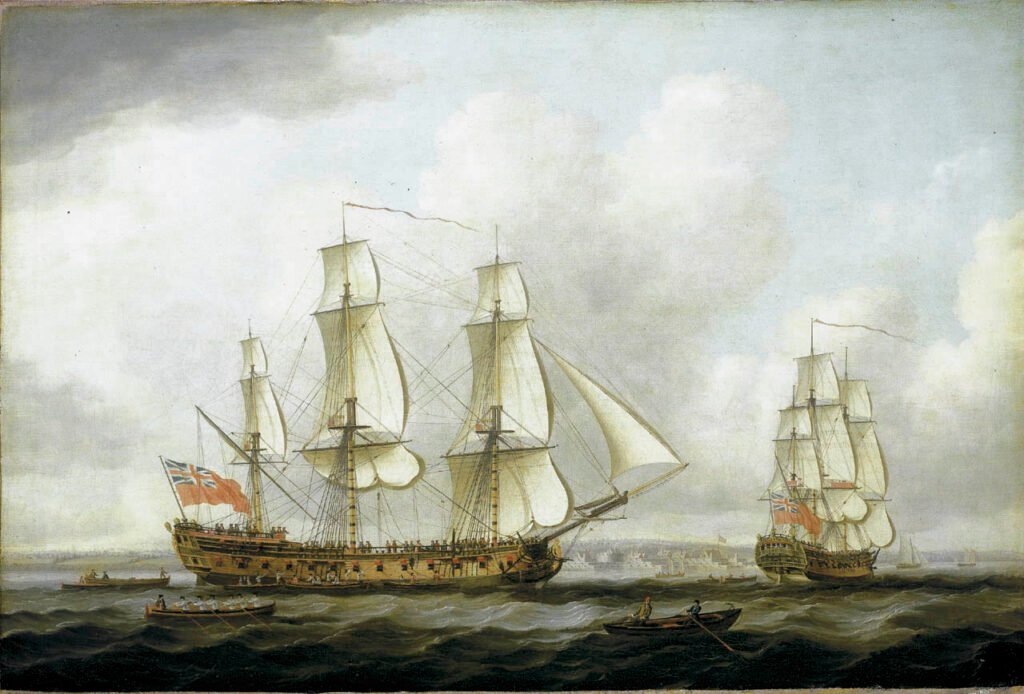
Its very first voyage, in 1601, did not even go to India. It sailed to Sumatra, in what is now Indonesia, chasing pepper.
But the seas east of India were already crowded. The Dutch had a firm grip on the Spice Islands and had no wish to share them. So the English merchants looked west instead, to the vast and wealthy lands of India, and to something India made better than anyone: fine cotton and silk cloth.
That switch, from spice to textiles, is what first brought them to Indian shores. In the beginning they wanted nothing more than to buy cheap and sell dear.
Source: Wikimedia Commons · John Cleveley the Elder · Public domain
Reign of Aurangzeb 1658-1707: The Zenith and Decline of the Mughals
The golden ticket
To trade in India, though, you needed the permission of India’s rulers, and in 1600 that meant the mighty Mughal Empire.
An early envoy named William Hawkins reached the court of Emperor Jahangir in 1608 but came away with nothing, blocked by the Portuguese who were already there. The English saw that they needed someone with real royal weight behind him. So in 1615, King James I sent a proper ambassador, Sir Thomas Roe.
Source: Wikimedia Commons · Walker, John Vigne, G. T. Snderson, J. Wade, C. Durand, H. M. · Public domain
Roe was a patient and clever man. He spent four years at Jahangir’s dazzling court, sharing the emperor’s love of wine and talking with him about art and faraway places. The patience paid off.
Roe won a farman, a royal decree from the emperor himself, granting the English the right to trade and to build “factories,” which were really fortified warehouses. It was the golden ticket the Company had come for.
From that single sheet of paper, everything else would grow.

Source: Wikimedia Commons · Unknown · CC0
Three little forts
Over the next hundred years, the Company put down roots in three coastal spots that would each become one of India’s greatest cities.
In the south, at Madras (today’s Chennai), it bought a strip of land and raised Fort St. George. Far to the east, among a cluster of riverside villages, a Company man named Job Charnock founded the settlement that would grow into Calcutta (today’s Kolkata), watched over by Fort William.
The oddest prize of all was Bombay (today’s Mumbai). The islands came to the English king, Charles II, as part of a dowry when he married a Portuguese princess. He had little use for the swampy place, so he simply rented it out.
The king leased the future city of Mumbai to the East India Company for the grand sum of ten pounds a year.
For a long time, that was all the Company was: a chain of trading forts, buying cloth and shipping it home. For roughly a century and a half, it stayed in its lane and behaved like a merchant.
Establishment of the British Raj 1858: The Dawn of Imperial India
The vacuum
Then the ground shifted under everyone’s feet.
The great Mughal Empire, which had once towered over the whole of India, began to crack and weaken. As its power drained away, the country filled with smaller rulers scrambling for the pieces, and there was no longer any single authority strong enough to keep foreigners in check.
Into that gap stepped ambition. The French ran their own East India Company, and under a bold governor named Joseph Dupleix they began meddling in Indian politics, backing one local prince against another to win an edge. The British felt they had no choice but to play the same game, or be shoved out of it.
Almost without meaning to, a trading company was learning how to make and unmake kings.
The day it stopped being a business
The great turning point came in 1757, in Bengal.
A Company officer named Robert Clive beat the Nawab of Bengal at the Battle of Plassey, a victory owed as much to bribery and betrayal as to any fighting, and set a puppet ruler of his own on the throne. A few years later, in 1764, the Company won again at the Battle of Buxar. This time the prize was made official.
In 1765 the weakened Mughal emperor signed over to the Company the Diwani of Bengal, Bihar and Orissa: the legal right to collect all the taxes of one of the richest regions on earth.
Overnight, a company that had sailed to India to buy cotton was collecting taxes from around twenty million people. It was no longer a business with a trading licence. It was a government.
This was the moment the Company crossed a line no company had crossed before. It now had land, subjects and revenue, and it had learned a dangerous lesson: ruling was far more profitable than trading.
Battle of Buxar 1764: The Victory That Made British Rule Inevitable
The corporate raj
What followed was one of the strangest arrangements in history. A subcontinent was now governed, for profit, by a corporation.
The Company had its own coinage, its own laws and its own courts. Above all, it had its own army.
At its height the East India Company kept a private army of roughly a quarter of a million soldiers, by some counts about twice the size of Britain’s own national army.
With power like that, and almost no one to answer to, the results were as predictable as they were terrible. In 1770 a famine swept through Bengal while Company officials kept demanding their taxes, and in some cases made things worse by hoarding grain to sell at a profit. Perhaps a third of the region’s people died.
The scale of the horror, and the scandal of officials growing fabulously rich while millions starved, finally jolted the British government into acting. Through laws such as the Regulating Act of 1773 and Pitt’s India Act of 1784, Parliament began pulling the Company under state control. It was no longer willing to let a business run a country entirely as it pleased.
The ghost of the Company
The end came slowly, and then all at once.
In 1857 a huge rebellion broke out across northern India against Company rule. It was put down, but it convinced the British government that a private company could not be trusted to hold India any longer. In 1858 the Crown took over directly, beginning the era of the British Raj, and the Company itself was quietly wound up a few years after that.
Its reach had always been startling. This same Company’s grip on the tea trade helped spark the Boston Tea Party in 1773, and with it the American Revolution, half a world away.
But its deepest mark was left on India. For a hundred years, a business had treated a whole civilisation as an asset to be squeezed. The East India Company remains the oldest and sharpest warning we have of what can happen when the hunger for profit is handed the powers of a state, and no one is left with the will to say no.
Battle of Plassey 1757: The Betrayal That Changed India’s Destiny
If you think you have remembered everything about this topic take this QUIZ
Results


#1. What was the primary destination and commodity of the East India Company’s first voyage in 1601?
#2. By what specific means did the British Crown acquire the island of Bombay before leasing it to the EIC?
#3. Which three villages were merged by Job Charnock to establish the foundation of Calcutta in 1690?
#4. What was the significance of the ‘Diwani Rights’ granted to the EIC in 1765?
#5. At its height, how did the size of the East India Company’s private army compare to the British Royal Army?
#6. Which parliamentary act was introduced in response to the EIC’s mismanagement during the Bengal Famine of 1770?
#7. According to the source material, what was the financial reward for EIC shareholders during its most lucrative periods?
#8. How did the EIC influence the early history of the United States of America?
When was the East India Company founded?
It was founded on December 31, 1600.
Who was the first ambassador to the Mughal Court?
Sir Thomas Roe was the first successful ambassador sent by King James I to the court of Jahangir in 1615.
Which battle turned the EIC into a political power?
The Battle of Plassey (1757) and subsequently the Battle of Buxar (1764) transformed the EIC into a ruling power.
What was the first EIC factory in India?
The first factory was established in Surat around 1608-1613.
Why was the Company dissolved?
The Company was dissolved following the Indian Rebellion of 1857. The British Government blamed the Company’s mismanagement for the revolt and took direct control of India (The Raj).
Sources & References
- Encyclopaedia Britannica (“East India Company”) — the 1600 charter, the shift from spices to Indian textiles, the growth of the presidencies, and the change from trader to ruler.
- The British Library (Sir Thomas Roe at the Mughal court) — Roe’s embassy to Jahangir in 1615 and the trading rights he secured.
- UK Parliament (living heritage: the East India Company) — the royal charter, the Company’s regulation through the Regulating Act and Pitt’s India Act, and the transfer of power to the Crown.
- Know India, National Portal of India (Battle of Plassey) — Clive’s victory in 1757 and the Company’s turn from trade to territorial rule in Bengal.