How the emperor at the peak of India’s golden age became the legendary ideal king of folklore
For two thousand years, the children of India have grown up on stories about a great king named Vikramaditya. In the tales, he is the wisest, the fairest, and the most generous ruler who ever lived, a king so good and so clever that his very name became a kind of shorthand for the perfect ruler.
His court sparkled with nine brilliant scholars. His justice was famous the length of the land. And his adventures fill whole books of folk tales that are still happily told today. But here is the truly wonderful thing about it all. Behind that shimmering legend there stands a real man. His name was Chandragupta the Second, and he ruled India at the very peak of its golden age. This is the story of the emperor who ruled so gloriously that he slowly turned into a legend.
Reign of Alauddin Khalji 1296-1316: The Iron Fist of Delhi
The high noon of the golden age
Chandragupta the Second was the third of three remarkable kings who, one after the other, built up India’s golden age between them.
His grandfather had founded the Gupta empire, largely through one very clever marriage. His father, the great Samudragupta, had then drawn its borders wide with a warrior’s sword. And now it fell to Chandragupta to do the third thing, and in a way the finest thing of all: to take the great empire that his family had built, and to fill it up with beauty, learning, wealth, and peace.
His grandfather founded the empire with a marriage. His father drew its map with a sword. Chandragupta II filled that map in with poetry, prosperity, and peace.
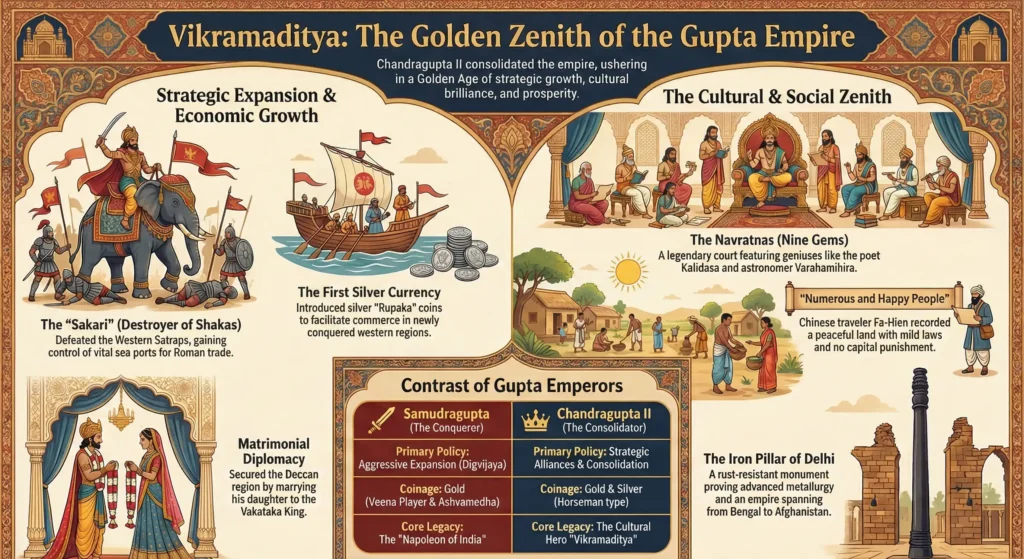
Under his rule, the Gupta golden age reached its dazzling high noon. And it was he who took the proud title that would, in time, grow into a legend all its own: Vikramaditya, which means “the Sun of Valour.”
The court of nine gems
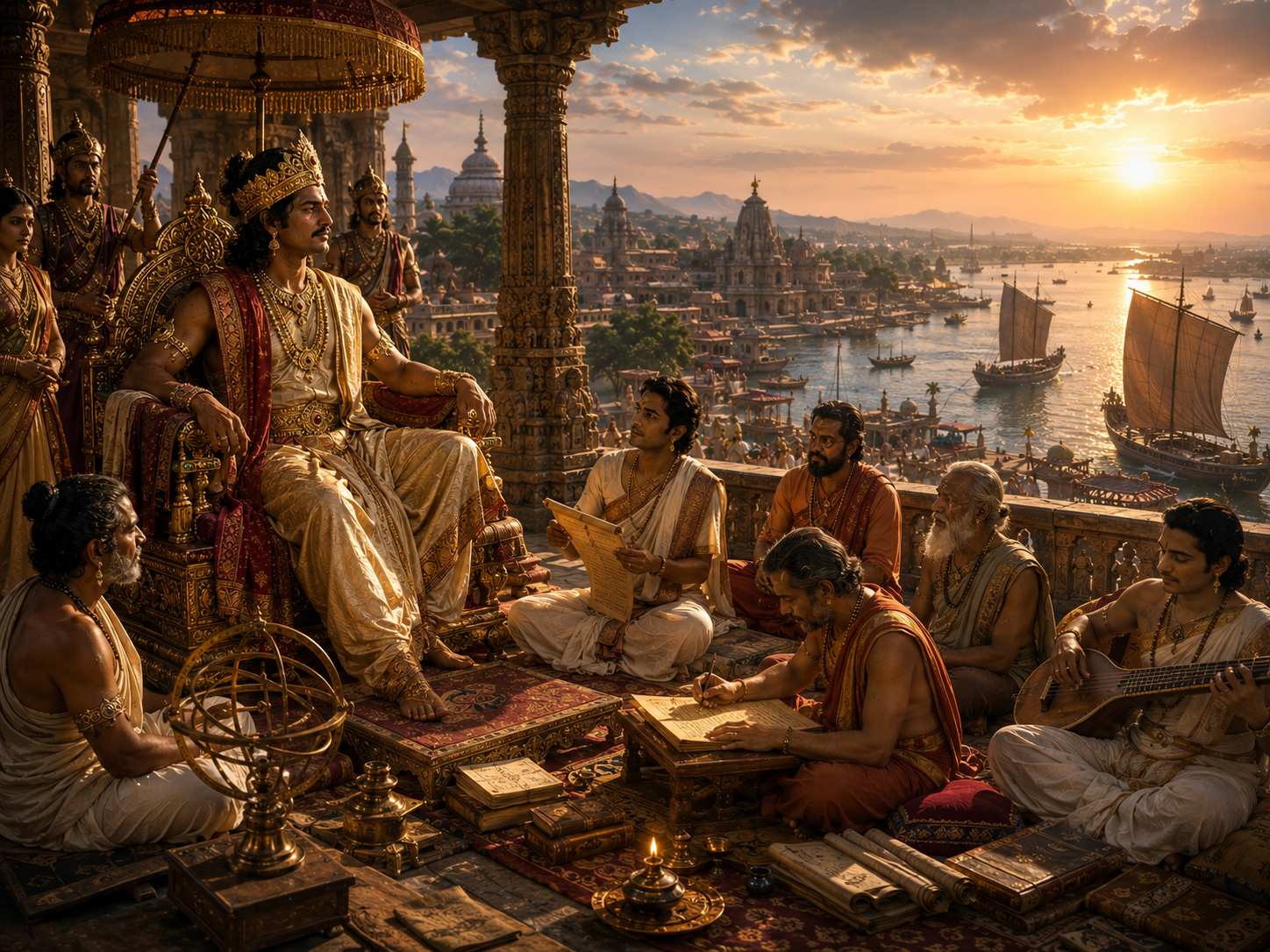
In the old tales, the great King Vikramaditya’s court was graced by nine dazzling scholars, known together as the Nine Gems: the very finest poets, astronomers, doctors, and thinkers of the whole age. And here the legend and the real history shine together beautifully, because Chandragupta’s court truly was one of the most brilliant gatherings of talent the world has ever seen.
The brightest of all his “gems” was a poet named Kalidasa, the greatest writer the Sanskrit language would ever produce, so gifted that he is often simply called the Shakespeare of India. His plays and his poems, brimming with longing and beauty and wit, are still read and loved a full fifteen hundred years later. Around him gathered great astronomers and scholars and physicians.
In an age when artists were hardly ever paid, Chandragupta II honoured and rewarded his poets and scholars. And so the greatest minds of the day, above all the poet Kalidasa, came flocking to his court.
That one generous habit, rare in the ancient world, meant that the finest talent of the age gathered around him, and the golden age of Indian art and science blazed at its very brightest.
Reign of Akbar 1556-1605: The Golden Age of the Mughal Empire
The one war that opened the sea
Chandragupta was not only a patron of beauty, though. When he needed to be, he was a formidable soldier too. But above all the rest, he fought one single war that mattered far more than any other.
For four hundred years, a foreign people called the Shakas had ruled the rich lands of western India, and in doing so they blocked the empire off from the sea. Chandragupta marched his armies against them, defeated their last king, and took those western lands for his own. And this was no ordinary conquest, because of exactly what it opened up.
By defeating the Shakas, Chandragupta II won India’s western sea ports, and through them came pouring a great flood of trade with Rome and Arabia, the very wealth that helped to pay for the golden age.
Suddenly the Gupta empire had its own busy harbours on the Arabian Sea, and through them flowed rich trade with the wider world. That trade brought in gold, and the gold, in turn, helped to pay for the poets and the palaces and the long years of peace. In the south, meanwhile, he was cleverer still: instead of fighting, he married his own daughter into a powerful neighbouring royal house, and so won their firm friendship without a single battle being fought. He understood, just as his grandfather had before him, that a well-chosen wedding could sometimes be every bit as powerful as a war.
The traveller who saw it
Reign of Raja Raja Chola I 985-1014: The Golden Age of the Cholas
We do not have to simply take India’s own word for how golden this age truly was, because a complete stranger came, and saw it with his own eyes, and wrote it all down.
During Chandragupta’s reign, a Chinese Buddhist monk named Faxian journeyed the whole way across India on foot, searching for sacred books, and he kept a careful record of everything he saw along the way. What he described was a land wonderfully at peace and at ease. The people, he wrote, were prosperous and content, and seemed to compete with one another only in the doing of good deeds. Travellers could journey about safely, without papers and without fear. Along the roads stood rest-houses for the weary, and in the cities there were free hospitals for the sick and the poor.
A Chinese monk who walked across Chandragupta’s India described a happy, prosperous, peaceful land, with free hospitals for the poor and rest-houses along every road.
It is one of the most glowing descriptions of any land anywhere in the ancient world. And, tellingly, it comes not from some proud court poet paid to flatter, but from a foreign visitor who had no reason at all to praise. The golden age, it turns out, was entirely real.
The man who became the ideal
And so, at the last, we come back to the legend. Over the long centuries that followed his death, the real emperor Chandragupta the Second slowly grew larger and larger than life.
His title, Vikramaditya, floated gently free of the actual man who had borne it, and became something grander and more dreamlike: the name of the perfect king in the imagination of an entire civilisation. Generations of storytellers heaped upon “King Vikramaditya” every single virtue that a ruler could possibly possess, wisdom and justice, courage and boundless generosity, until he stood, in the Indian mind, as the very idea of what a good king ought to be.
It is a rare and rather beautiful fate for any person. Chandragupta the Second was so fine a king, and he ruled over so bright an age, that in the end he stopped being merely a man in a history book, and became instead a legend, a fairy tale, a dream. Fifteen hundred years later, his real empire is dust, and his real face is quite forgotten. But the ideal that he came to stand for, the wise and just and generous king, surrounded by his poets, ruling over a happy and peaceful land, has never once faded. It is perhaps the finest compliment that a civilisation ever paid to any of its rulers. It did not merely remember him. It quietly turned him into the very shape of its own best dreams.
Reign of Harshavardhana 606-647 CE: The Empire of Benevolence
If you think you have remembered everything about this topic take this QUIZ
Results


#1. Which powerful group did Chandragupta II decisively defeat to earn the title “Sakari” (Destroyer of Sakas)?
#2. Who was the Chinese Buddhist monk that traveled across India for 14 years during Chandragupta II’s reign?
#3. Among the legendary Navratnas (Nine Gems) in his court, who is famously known as the “Shakespeare of India”?
#4. While Pataliputra remained the official capital, which city emerged as the cultural and commercial second capital of the empire?
#5. According to the play Devichandraguptam, whose throne did Chandragupta II claim after defeating a Shaka king in disguise?
#6. Chandragupta II was the first Gupta ruler to issue which specific type of currency, known as “Rupaka”?
#7. Which famous rust-resistant monument bears an inscription of a king named “Chandra,” detailing his conquests from Bengal to Afghanistan?
#8. According to the comparison table, how did Chandragupta II primarily expand Gupta influence in the Deccan region?
What title did Chandragupta II adopt?
He adopted the title Vikramaditya (Sun of Valour).
Which Chinese traveler visited India during his reign?
Fa-Hien visited India during his reign (399–414 CE).
Who were the Navratnas?
They were the nine gems (scholars/artists) in his court, including the famous poet Kalidasa and astronomer Varahamihira.
Which dynasty did Chandragupta II defeat to earn the title ‘Sakari’?
He defeated the Western Kshatrapas (Shakas).
What is the significance of the Mehrauli Iron Pillar?
It contains an inscription of King ‘Chandra’ (Chandragupta II) and is famous for not rusting despite being over 1600 years old, showcasing Gupta metallurgical skill.
Sources and references
- Anantam IAS (“Gupta Empire”) and New World Encyclopedia — Chandragupta II (r. c. 375/380–415 CE) as the high noon of the Gupta golden age, his title Vikramaditya (“Sun of Valour”), and his identification with the legendary composite Vikramaditya, patron of the Navaratnas at Ujjain.
- Prepp and Brainly (“Chandragupta II”) — the defeat of the Western Kshatrapas (Shakas) and annexation of Gujarat, Malwa and Kathiawar, the title Shakari, the securing of western sea trade, and the Vakataka marriage alliance through his daughter Prabhavatigupta.
- Curious Indian’s own overview (“Reign of Chandragupta II Vikramaditya”) — the framing that Samudragupta drew the map with a sword while Chandragupta II filled it with culture and prosperity, the Navaratnas including Kalidasa and Varahamihira, and the Iron Pillar of Mehrauli bearing the inscription of King Chandra.
- Geneanet (Faxian’s account) and The Indosphere — Faxian’s description of a prosperous, virtuous, peaceful land with rest-houses and free hospitals, and Ujjain established as the western cultural capital on lucrative trade routes.
- General histories of the Gupta period — artists being paid and honoured at court as a rare practice, Chandragupta II as a devout Vaishnava tolerant of Buddhism and Jainism, and the reign as the cultural and economic peak of the golden age.
Author


Exploring the Soul of Bharat through History, Science, Culture, and its Diversity
Our Mission
Curious Indian is a definitive knowledge portal dedicated to chronicling the events, personalities, and cultural shifts that defined the Indian subcontinent. From the ancient Vedic Period to the complexities of 21st-century politics, our goal is to provide deep-dive analysis that inspires.
Editorial Standards & E-E-A-T
Every article published under our brand undergoes a rigorous fact-checking process. We prioritize primary historical records, academic citations, and credible archives to ensure our readers receive accurate, high-authority information.
Historical Integrity Directly sourcing from ASI archives and academic journals.Topical Authority Comprehensive clustering of Indian Science, Biographies, and Wars.Managed by Paripurna Datta and TEAM | Dedicated to the Knowledge of India.