The Reign of Aurangzeb (1658–1707) marks the final chapter of the "Great Mughal" era. Born Muhi-ud-Din Muhammad, he ascended the throne after a bloody War of Succession, defeating his brother Dara Shikoh and imprisoning his father, Shah Jahan, in the Agra Fort. Taking the title Alamgir ("Conqueror of the World"), he ruled for 49 years. His reign is characterized by massive territorial expansion—annexing the Deccan sultanates of Bijapur and Golconda—but also by rigid religious orthodoxy. He reintroduced the Jizya tax on non-Muslims, destroyed temples, and executed the ninth Sikh Guru, Tegh Bahadur. These policies triggered relentless rebellions by the Marathas, Jats, Sikhs, and Rajputs. By the time of his death in 1707, the empire was financially bankrupt and politically fractured, paving the way for the Mughal decline.| Feature | Details |
| Reign Dates | July 31, 1658 – March 3, 1707 |
| Regnal Title | Alamgir |
| Predecessor | Shah Jahan |
| Successor | Bahadur Shah I |
| Key Rivals | Chhatrapati Shivaji, Dara Shikoh |
| Major Conquests | Bijapur (1686), Golconda (1687) |
| Religious Policy | Re-imposition of Jizya (1679) |
| Burial Place | Khuldabad, Aurangabad |
The War of Succession: A Throne Bathed in Blood
In 1657, Emperor Shah Jahan fell ill. This triggered a vicious civil war among his four sons: Dara Shikoh (the liberal intellectual), Shuja (Governor of Bengal), Murad (Governor of Gujarat), and Aurangzeb (Governor of Deccan).
Aurangzeb proved to be the master tactician. He allied with Murad to defeat the imperial armies at the Battle of Samugarh (1658), the decisive turning point. He then executed Murad, drove Shuja into exile, and captured Dara Shikoh, parading him through Delhi in rags before beheading him. His father, the builder of the Taj Mahal, was imprisoned in the Agra Fort for the remaining eight years of his life, gazing at his creation through a window.
Martyrdom of Guru Tegh Bahadur: The Sacrifice for Human Rights
Administrative and Religious Shifts
Unlike his great-grandfather Akbar, who championed secularism (Sulh-i-kul), Aurangzeb was an orthodox Muslim. He aimed to turn India into an Islamic state.
- Moral Policing: He appointed Muhtasibs (censors of public morals) to enforce Sharia law, ban music, gambling, and alcohol.
- Religious Tax: In 1679, he reintroduced the hated Jizya tax on non-Muslims, which had been abolished by Akbar a century earlier.
- Temple Destruction: He ordered the destruction of several famous temples, including the Kashi Vishwanath in Varanasi and the Keshavdeva Temple in Mathura, building mosques in their place (Gyanvapi and Idgah).
These policies alienated the Rajput chieftains, who had been the pillars of the Mughal state, leading to the Rajput Rebellion of 1679.
Foundation of the Khalsa 1699: The Birth of the Saint-Soldiers
The Maratha Challenge: The “Mountain Rat”
The defining conflict of Aurangzeb’s life was against the Marathas. Chhatrapati Shivaji Maharaj rose from the Western Ghats to challenge Mughal authority. Aurangzeb dismissed him as a “Mountain Rat,” a mistake that cost him dearly.
- Treaty of Purandar (1665): Aurangzeb’s general, Jai Singh, forced Shivaji to sign this treaty and visit the Mughal court in Agra.
- The Escape: When Shivaji visited Agra in 1666, he was placed under house arrest. In a legendary feat, he escaped by hiding in a basket of sweets.
- The War of 27 Years: After Shivaji’s death in 1680, Aurangzeb moved to the Deccan himself to crush the Marathas. He captured and brutally executed Shivaji’s son, Sambhaji, in 1689. However, this only galvanized the Maratha resistance, turning the war into a “people’s war” that drained the Mughal treasury for decades.
The Deccan Ulcer
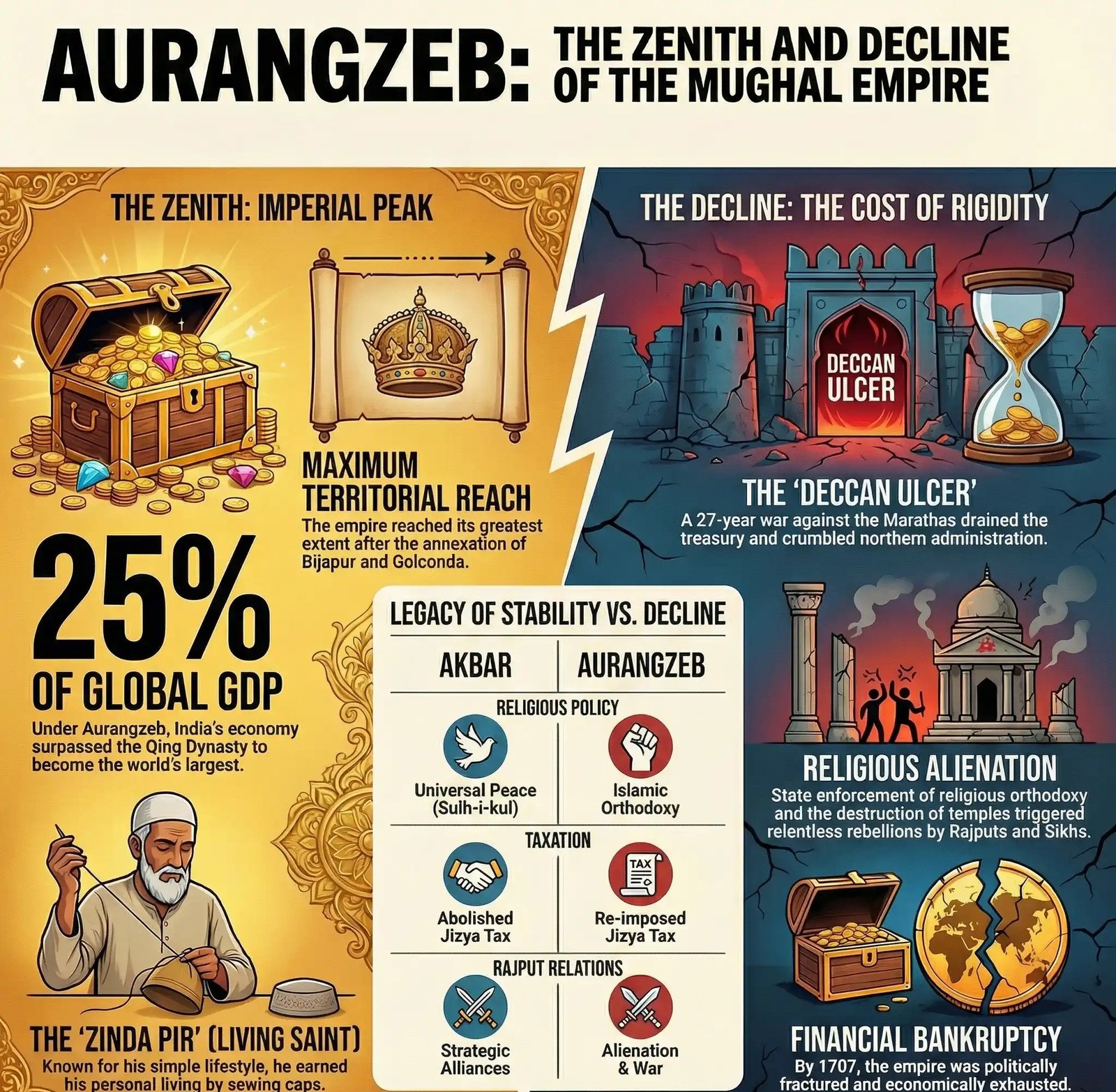
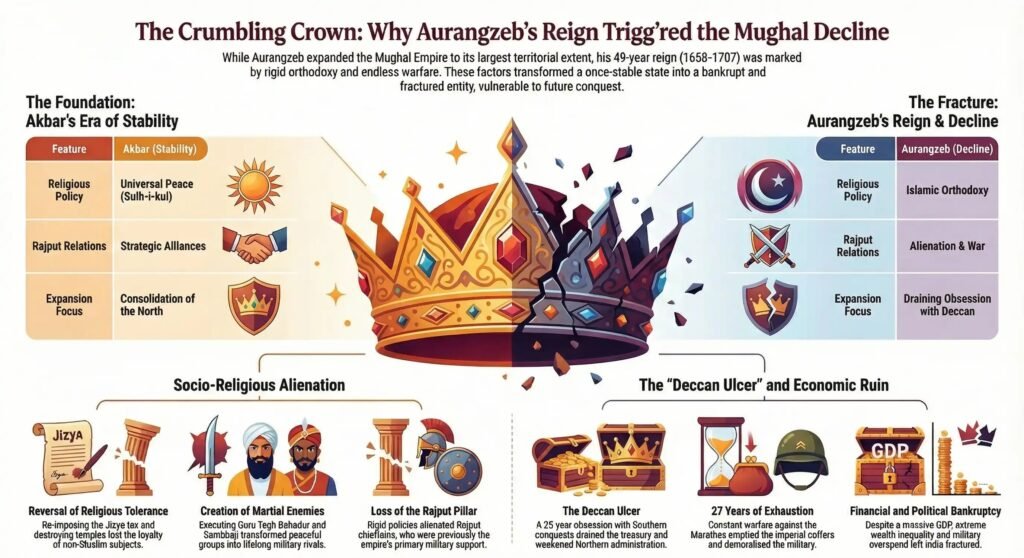
Aurangzeb spent the last 25 years of his life in the Deccan. His obsession was to conquer the Shia sultanates of Bijapur (annexed 1686) and Golconda (annexed 1687). While he succeeded in expanding the empire to its maximum limit, this “Deccan Ulcer” bled the empire dry. The northern administration crumbled in his absence, leading to the rise of agrarian revolts by the Jats (under Gokula and Raja Ram) and the Satnamis.
Nadir Shah’s Invasion of Delhi 1739: The Massacre That Emptied India
Conflict with the Sikhs
Relations with the Sikhs reached a breaking point during Aurangzeb’s reign. The ninth Guru, Guru Tegh Bahadur, championed the rights of Kashmiri Brahmins against forced conversion. Aurangzeb had him executed in Delhi in 1675. This act transformed the Sikhs from a peaceful sect into a martial order (Khalsa) under the tenth Guru, Guru Gobind Singh, who waged a lifelong war against Mughal tyranny.
Quick Comparison Table: Akbar vs. Aurangzeb
| Feature | Akbar (1556–1605) | Aurangzeb (1658–1707) |
| Religious Policy | Sulh-i-kul (Universal Peace) | Islamic Orthodoxy |
| Taxation | Abolished Jizya | Re-imposed Jizya |
| Rajput Relations | Strategic Alliances (Matrimonial) | Alienation & War |
| Music & Arts | Patronized (Tansen, Miniature Art) | Banned Music / Austere |
| Expansion Focus | Consolidation of North | Obsession with Deccan |
| Legacy | Stability & Cultural Synthesis | Fragmentation & Communal Rift |
Curious Indian: Fast Facts
- The Zinda Pir: Aurangzeb was known as Zinda Pir (Living Saint) by his Muslim subjects because of his simple lifestyle. He refused to use the state treasury for his personal expenses.
- Sewing Caps: To earn his living, he sewed caps and copied the Quran by hand. He requested that his funeral expenses be paid only from these earnings (amounting to 4 rupees and 2 annas).
- Largest Economy: Under his reign, India’s GDP was valued at 25% of the world’s economy, surpassing the entire Qing Dynasty of China, though wealth inequality was extreme.
- The Unmarked Grave: Unlike the grand mausoleums of his ancestors (Taj Mahal, Humayun’s Tomb), Aurangzeb is buried in a simple, open-air kachcha grave in Khuldabad, as per his will.


Conclusion
The Reign of Aurangzeb is a cautionary tale of how rigidity can destroy greatness. He was the hardest-working Mughal emperor, yet he failed. He conquered more land than any of his predecessors, but he lost the hearts of his people. By abandoning the policy of tolerance that had sustained the empire for a century, he left behind a fractured India that was ripe for the taking—first by the Marathas, and then by the British.
Death of Tipu Sultan: The Fall of the Tiger of Mysore
If you think you have remembered everything about this topic take this QUIZ
Results


#1. Which regnal title, meaning “Conqueror of the World”, did Muhi-ud-Din Muhammad adopt upon ascending the throne?
#2. During the War of Succession, which decisive 1658 battle saw Aurangzeb defeat the imperial armies to secure his path to the throne?
#3. Aurangzeb appointed specific officials to enforce Sharia law and monitor public morality. What were these officials called?
#4. In 1679, Aurangzeb re-imposed a tax on non-Muslims that had been abolished a century earlier. What was this tax called?
#5. Which Sikh Guru was executed in Delhi in 1675 after championing the rights of Kashmiri Brahmins against forced conversion?
#6. The term “Deccan Ulcer” refers to Aurangzeb’s obsession with conquering which two Shia sultanates?
#7. Why did Aurangzeb earn the moniker “Zinda Pir” (Living Saint) among his Muslim subjects?
#8. Which legendary Maratha leader escaped Mughal house arrest in Agra in 1666 by hiding in a basket of sweets?
How long did Aurangzeb rule?
Aurangzeb ruled for 49 years, from 1658 to 1707.
Why is Aurangzeb controversial?
He is controversial due to his reimposition of the discriminatory Jizya tax, the destruction of Hindu temples, and the execution of Guru Tegh Bahadur and Sambhaji.
Who did Aurangzeb defeat to become Emperor?
He defeated his eldest brother Dara Shikoh in the War of Succession.
What was the “Deccan Ulcer”?
It refers to Aurangzeb’s long, expensive, and ultimately futile campaign in the Deccan (South India) against the Marathas and Sultanates, which drained the empire’s resources.
Where is Aurangzeb buried?
He is buried in a simple grave in Khuldabad, near Aurangabad, Maharashtra.