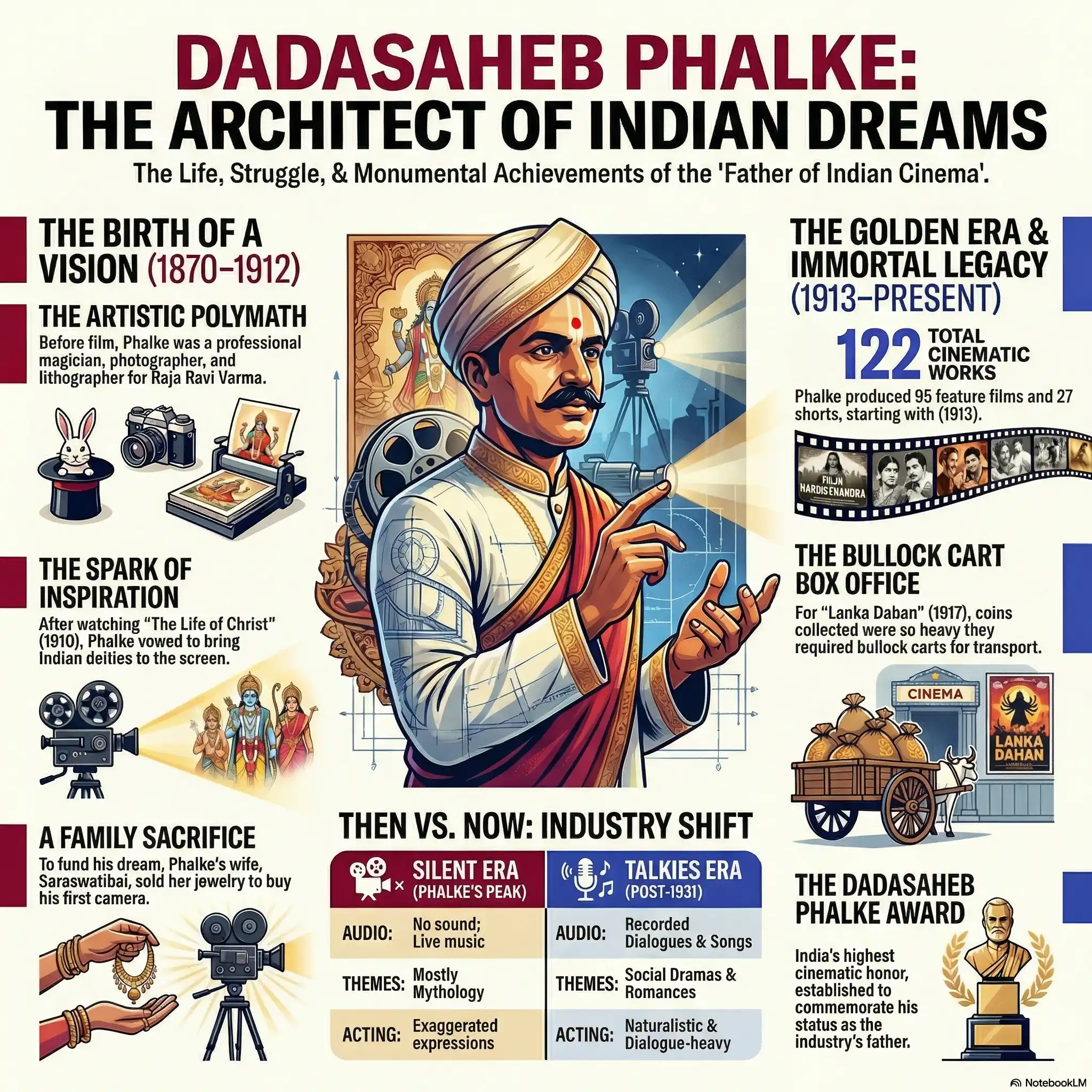
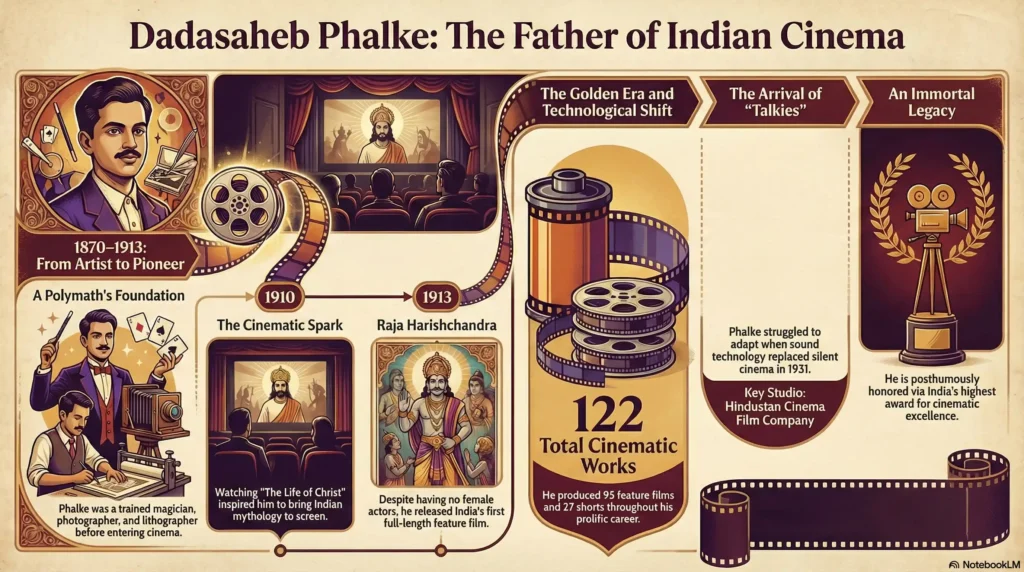
Dhundiraj Govind Phalke, popularly known as Dadasaheb Phalke (1870–1944), was an Indian producer-director-screenwriter, revered as the Father of Indian Cinema. A man of many talents—magician, photographer, and lithographer—he was inspired to make films after watching The Life of Christ in 1910. Against immense odds and financial ruin, he released India's first full-length feature film, Raja Harishchandra, in 1913. He went on to make 95 feature films and 27 short films, establishing the Hindustan Cinema Film Company. However, the arrival of sound in cinema (Talkies) in 1931 marked his decline, and he died in relative obscurity, only to be posthumously honored with the Dadasaheb Phalke Award, India's highest award in cinema.| Feature | Details |
| Birth Name | Dhundiraj Govind Phalke |
| Born | April 30, 1870 (Trimbak, Nashik) |
| Died | February 16, 1944 (Nashik) |
| First Film | Raja Harishchandra (1913) |
| Studio | Phalke Films / Hindustan Cinema Film Company |
| Total Works | 95 Feature Films, 27 Short Films |
| Key Films | Raja Harishchandra, Lanka Dahan, Kaliya Mardan |
| Spouse | Saraswatibai Phalke (India’s first film editor/technician) |
| Legacy | Father of Indian Cinema |
Early Life: The Magician and Artist
Born in Trimbak, Maharashtra, Phalke was not just a filmmaker; he was a polymath. He studied at the Sir J.J. School of Art in Bombay and later at Kala Bhavan, Baroda. He worked as a photographer, a draftsman for the Archaeological Survey of India, and even a printer.
- Raja Ravi Varma Connection: Phalke worked at the famous painter Raja Ravi Varma’s lithography press. This experience in visual storytelling and mythology would later define his cinematic style.
- The Magician: He also trained as a magician, a skill that helped him master the “trick photography” and special effects essential for his mythological films.
Reign of Chandragupta II Vikramaditya: The Golden Age of India
The Spark: “The Life of Christ”
In 1910, Phalke watched the silent French film The Life of Christ at a theater in Bombay. It was a life-changing moment. While others saw a religious story, Phalke saw a medium. He visualized Lord Krishna and Lord Rama on the screen instead of Jesus. He famously remarked, “Could we, the sons of India, ever be able to see Indian images on the screen?”
The Struggle: Selling the Mangalsutra
Phalke’s dream was expensive. To learn the craft, he traveled to London in 1912 to buy a Williamson camera and raw film stock.
- Financial Crisis: Upon returning, he had no money to produce the film. In a supreme act of faith, his wife, Saraswatibai Phalke, sold her jewelry (including her Mangalsutra) to fund his project. She also supported the crew, cooking for them and holding white sheets for lighting, effectively becoming Indian cinema’s first technician.
Sangam Period: The Golden Age of Tamil Literature
Raja Harishchandra (1913): The First Blockbuster
Phalke chose the story of the truthful King Harishchandra for his debut.
- No Women Actors: Acting was considered a taboo profession for women. Even prostitutes refused to act in his film. Phalke was forced to cast a male actor, Anna Salunke, to play the role of Queen Taramati.
- The Release: The film premiered at the Coronation Cinema in Bombay on May 3, 1913. It was a silent film with English and Hindi intertitles. The audience was mesmerized. For the first time, they saw their own stories moving on a screen.
- Special Effects: Phalke used his magic skills to create “miracles” on screen, which thrilled the audience.
Reign of Raja Raja Chola I: The Golden Age of the Cholas
The Golden Era: Hindustan Cinema Film Company
Following the success of Raja Harishchandra, Phalke moved to Nashik and founded the Hindustan Cinema Film Company.
- Mohini Bhasmasur (1913): This film is notable because Phalke finally found a female actor, Durgabai Kamat, to play the lead, breaking the gender barrier.
- Lanka Dahan (1917): A massive hit. It is said that the money collected at the box office (in coins) was so heavy that it had to be transported in bullock carts. Anna Salunke played both Rama and Sita, the first dual role in Indian cinema.
- Kaliya Mardan (1919): Features his daughter, Mandakini Phalke, as the child Krishna, arguably India’s first child star.
The Decline: The Silence Ends
Phalke was a master of the silent image. When Ardeshir Irani released Alam Ara (the first Indian talkie) in 1931, the industry changed overnight. Phalke could not adapt to the new technology and the complex dialogue-writing it required. His last film, Gangavataran (1937), was his only sound film, but it failed to recreate the magic of his silent era. He retired to Nashik and died in 1944, largely forgotten by the industry he created.
Sunayani Devi: A Woman’s Voice in the Bengal School
Comparison: Silent Era (Phalke) vs. Talkies Era
| Feature | Silent Era (Phalke’s Time) | Talkies Era (Post-1931) |
| Audio | No sound; Live music accompaniment | Dialogues and Songs recorded |
| Language | Universal (Intertitles used) | Regional (Hindi/Urdu/Tamil etc.) |
| Acting Style | Exaggerated expressions (Mime) | Naturalistic / Dialogue-heavy |
| Key Figure | Dadasaheb Phalke | Ardeshir Irani (Alam Ara) |
| Themes | Mostly Mythology | Social Dramas / Romances |
Fast Facts
- First “Technician”: Phalke’s wife, Saraswatibai, is often uncredited, but she perforated the film reels, developed the footage, and managed the production unit.
- Godavari: In Raja Harishchandra, the role of the female lead was played by a man named Anna Salunke, who worked as a cook in a restaurant before Phalke found him.
- Stamps: The Government of India released a postage stamp in his honor in 1971.
- Only Sound Film: Gangavataran (1937) was the only movie Phalke made with sound; it took two years to complete due to his failing health.
Conclusion
Dadasaheb Phalke was not just a director; he was an institution. He taught India how to dream with open eyes. While he died without the riches that modern Bollywood stars enjoy, his legacy is immortal. Every time a film is released in India, it owes its existence to the stubborn man from Nashik who refused to believe that moving pictures were just a “foreign invention.”
Gupta Empire: The Golden Age of Ancient India
If you think you have remembered everything about this topic take this QUIZ
Results


#1. What was the birth name of Dadasaheb Phalke?
#2. Which 1910 silent film inspired Dadasaheb Phalke to make his own films?
#3. What was the title of India’s first full-length feature film released by Phalke in 1913?
#4. Who supported Phalke’s dream by selling her jewelry and is often considered Indian cinema’s first technician?
#5. Why did Phalke cast a male actor (Anna Salunke) to play the role of a queen in his debut film?
#6. Which 1913 film is notable for breaking the gender barrier by casting a female actor, Durgabai Kamat?
#7. What was the title of Dadasaheb Phalke’s only sound film (talkie), released in 1937?
#8. Phalke’s cinematic style was heavily influenced by his earlier work at the lithography press of which famous painter?
Which was the first film directed by Dadasaheb Phalke?
Raja Harishchandra, released in 1913.
Why is he called the Father of Indian Cinema?
He produced India’s first full-length indigenous feature film and established the filmmaking infrastructure (studio, distribution) in India.
Did Dadasaheb Phalke make any sound films?
Yes, he made one sound film titled Gangavataran (1937), but it was not successful.
Who played the female role in his first film?
A male actor named Anna Salunke played the role of Queen Taramati because no women were willing to act.
What is the highest award in Indian cinema?
The Dadasaheb Phalke Award, instituted by the Government of India in 1969.