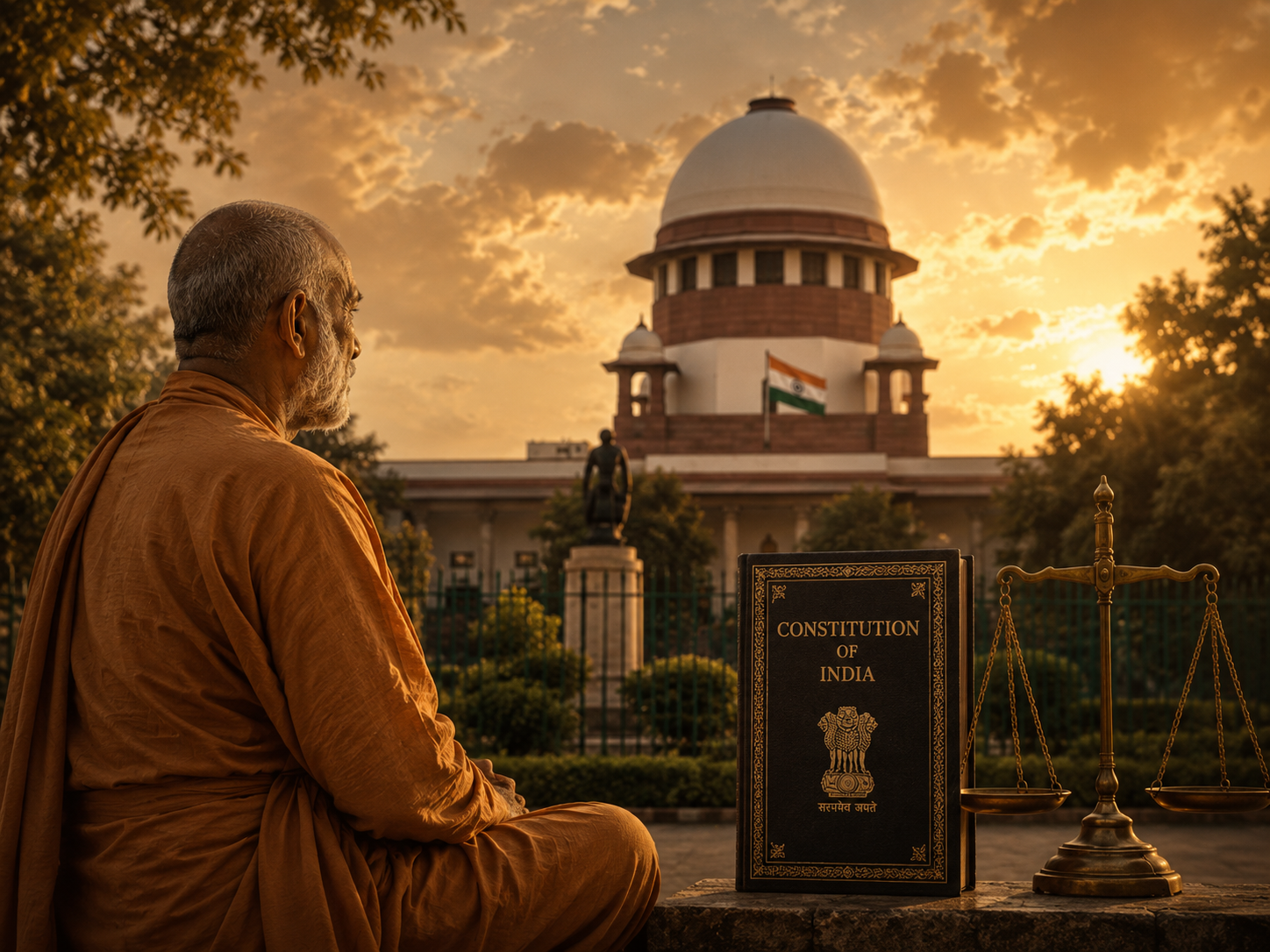
How the 1973 Basic Structure Doctrine stopped Parliament from Rewriting the Constitution’s Soul
In a small monastery in Kerala lived a quiet monk. All he wanted was to stop the government from taking away his monastery’s land. He was not a politician. He was not trying to change history.
But the court case this monk began ended up doing something enormous. A few years later, when a powerful government tried to tear up India’s Constitution and rule almost without limits, it was this case that stood in the way. This one case built the wall that held.
His name was Kesavananda Bharati. This is the story of how a monk accidentally saved the country’s rulebook.
The Fearless Verses of Kabir That Challenged Orthodox Society
A monk, some land, and a new law
Kesavananda Bharati was the head of the Edneer Mutt, a Hindu monastery in the Kasaragod district of Kerala. The mutt owned land, as such places often did.
In those years, the Kerala government passed land reform laws that allowed the state to take over large landholdings, including some of the mutt’s property. The aim of such laws was to give land to the poor, which was a fair goal. But it meant the monastery would lose land it had held for a long time.
So in 1970, the monk went to the Supreme Court to stop it. He argued that he had a right to manage his religious property. At its heart, it was a simple fight about land.
The lawyer who saw something bigger
Then a brilliant lawyer named Nani Palkhivala took up the case, and he saw a much larger question hiding inside it.
The small fight was: can the state take this monastery’s land? But Palkhivala wanted to ask something far bigger. Is there any limit at all on the power of Parliament to change the Constitution? Or can the people in power change absolutely anything they want?
That question would decide the future of Indian democracy.
The Rationalist Awakening Sparked by Gopal Hari Deshmukh in Maharashtra
The rulebook and the people who can change it
To see why, picture the Constitution as the master rulebook of the whole country. It says how power works, and it lists the freedoms that protect every citizen.
Parliament, the elected group of lawmakers, is allowed to change this rulebook. That is called amending it. But how far does that power reach? Can they edit small rules only, or can they rewrite even the deepest ones, including the rules that stop those in power from becoming all-powerful?
A few years earlier, the court had said Parliament could not touch citizens’ basic rights. The government of the time, led by Prime Minister Indira Gandhi, did not accept this. It passed a set of amendments to grab back the power to change any part of the Constitution it liked. Kesavananda Bharati’s case became the ground where this collision would finally be settled.
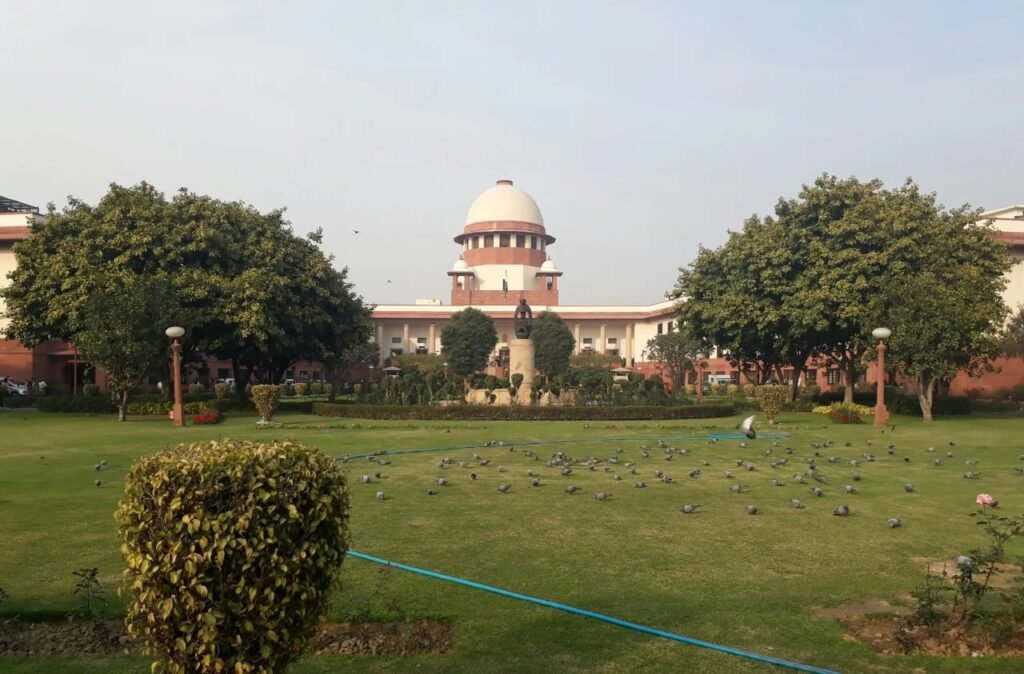
in 1972 and 1973. Source: Wikimedia Commons
The biggest bench in history
The Supreme Court understood how huge the question was. So it did something it had never done before.
Thirteen judges sat together to hear the case, the largest bench in the history of India’s Supreme Court. They listened to arguments for 68 days, spread over about five months. The final judgment ran to more than 700 pages.
The whole country waited for the answer.
Savitribai Phule: School That Changed India’s History
A verdict by a single vote
The answer came on 24 April 1973, and it was as close as a decision can be. Seven judges on one side, six on the other. A single vote decided it.
The court chose a careful middle path. Yes, it said, Parliament can change any part of the Constitution, even the rules about basic rights. But it cannot destroy the Constitution’s “basic structure,” its very soul. The rulebook can be edited. Its heart cannot be ripped out.
The judge whose vote tipped the balance was Justice H.R. Khanna. His idea can be put in plain words: the power to change something is not the same as the power to destroy it.
And what counts as the soul that can never be amended away? Things like democracy itself, free and fair elections, the rule of law, an independent court, and the freedoms of ordinary citizens. No government, however strong, is allowed to erase these.
The punishment
The government was angry with this result, and it hit back fast.
The very next day, it named a judge who had voted against the “basic structure” idea, Justice A.N. Ray, as the new Chief Justice of India. To do this, it jumped him over three judges who were senior to him and who had voted for the idea. All three of those judges resigned in protest.
Many people saw this as a clear warning to the courts. Rule against those in power, and power will strike back at you.
Why it mattered so soon
Then came the test, and it arrived faster than anyone imagined.
In 1975, Indira Gandhi declared the Emergency, a period when many rights were suspended and much of the opposition was jailed. Her government tried to change the Constitution to place itself beyond the reach of the courts.
One amendment, the 39th, tried to put the Prime Minister’s own election above any court’s power to question it. The Supreme Court struck it down, using the basic structure idea from Kesavananda’s case. Another, the 42nd, tried to make Parliament’s power to amend the Constitution total and beyond all challenge. In 1980, in a case called Minerva Mills, the court struck that down too, on the very same principle.
Without the wall built in the monk’s case, those changes might have stood. India could have become a country where the government could rewrite the rules to keep itself in power forever. The quiet case from Kerala was the thing that held the line.
The 1969 Bank Nationalization: How Indira Gandhi Seized the Vaults
The honest argument about it
Many people call this the judgment that saved Indian democracy, and during the Emergency it plainly did. But there is a real and fair argument on the other side, and it should be heard too.
The words “basic structure” appear nowhere in the Constitution. The judges invented the idea themselves. So critics ask a sharp question: who gave a small group of unelected judges the power to overrule the elected representatives of the people, and to decide which rules are too important to ever change?
Supporters have a strong answer. Without some limit like this, a temporary majority could simply vote away democracy itself, and after that, no election would ever be truly free again. A locked core, they say, is what keeps the people safe from a government that wants too much.
This tug-of-war between Parliament and the courts has never fully ended. It flares up again even today. But notice that both sides are really arguing about the same worry: how to stop too much power from gathering in too few hands.
The monk who lost and won
Here is the strange, quiet ending. Kesavananda Bharati never got his land back. He lost his own case. He went home to his small monastery and lived out his life far from the spotlight, and he died in September 2020.
Yet the question he accidentally set in motion gave India a rule that even its most powerful government could not break. A monk who only wanted to protect a monastery’s fields ended up guarding the soul of an entire country’s rulebook.
Most of us have never heard his name. After a story like this, perhaps we should.
If you think you have remembered everything about this topic take this QUIZ
Results


#1. What was Kesavananda Bharati’s role before the court case?
#2. Why did Kesavananda Bharati originally go to the Supreme Court in 1970?
#3. Who was the brilliant lawyer who saw a larger constitutional question in the case?
#4. How many judges sat on the bench for the Kesavananda Bharati case?
#5. What was the final verdict ratio on 24 April 1973?
#6. What major legal concept did this case establish?
#7. How did the government react to the verdict the very next day?
#8. What was the ultimate outcome for Kesavananda Bharati regarding his land?
What is the Kesavananda Bharati case?
It was a landmark 1973 Supreme Court case that decided whether the Indian Parliament had
unlimited power to amend the Constitution. It resulted in the creation of the basic structure
doctrine, which placed limits on the government’s power to alter the nation’s core democratic rules
What was the basic structure doctrine?
It is a legal principle establishing that while Parliament can amend any part of the Constitution, it
cannot destroy its fundamental features or “soul.” These unchangeable features include
democracy, free and fair elections, the rule of law, and an independent court system
Who was Kesavananda Bharati?
He was the head of the Edneer Mutt, a Hindu monastery in the Kasaragod district of Kerala. In
1970, he originally filed a legal challenge to stop the state government from taking over his
monastery’s land under new land reform laws.
How many judges decided the Kesavananda Bharati case?
A massive 13-judge bench heard the case for 68 days—the largest bench in the history of India’s
Supreme Court. They delivered a highly contested 7:6 majority verdict on 24 April 1973.
Did Kesavananda Bharati win his land back?
No, he actually lost his own land dispute case and never recovered the property for his monastery.
However, the constitutional question his case raised ended up establishing a limit on governmental
power that is widely credited with saving Indian democracy.
Sources and references
- Supreme Court of India (official Kesavananda Bharati Judgment portal) and LegalFly case summary — Kesavananda Bharati as head of the Edneer Mutt in Kasaragod, the 1970 challenge to Kerala’s land reform laws, the 13-judge bench under Chief Justice S.M. Sikri, the 7:6 verdict of 24 April 1973, and the holding that Parliament may amend any part of the Constitution but not destroy its basic structure.
- Vajiram & Ravi and Testbook (UPSC notes) — the 68-day hearing from 31 October 1972 to 23 March 1973, Nani Palkhivala leading the petitioner’s side, the 24th, 25th and 29th Amendments at issue, and the point that Bharati lost his land case but won the larger constitutional principle.
- The Legal Quorum and National Herald — Justice H.R. Khanna’s decisive vote and his view that the power to amend does not include the power to destroy, the 703-page judgment, and the Golaknath (1967) background that led the government to pass the amendments.
- LiveLaw (“The Soul They Could Not Amend”) and Anantam IAS — the supersession of Justices Shelat, Hegde and Grover the day after the verdict, the elevation of Justice A.N. Ray as Chief Justice, the three resignations in protest, and the doctrine later striking down the 39th Amendment in Indira Nehru Gandhi v. Raj Narain (1975).
- Minerva Mills v. Union of India (1980) coverage and IJCRT paper — the 42nd Amendment’s attempt to make Parliament’s amending power absolute, and the Supreme Court reaffirming the basic structure doctrine to strike down those clauses.
- ThePrint (obituary, 6 September 2020) — details of Kesavananda Bharati’s life as the Edneer seer and his death, and the enduring role of the basic structure doctrine in Indian constitutional law.