How an Entire Community Chose Exile Over Dishonor
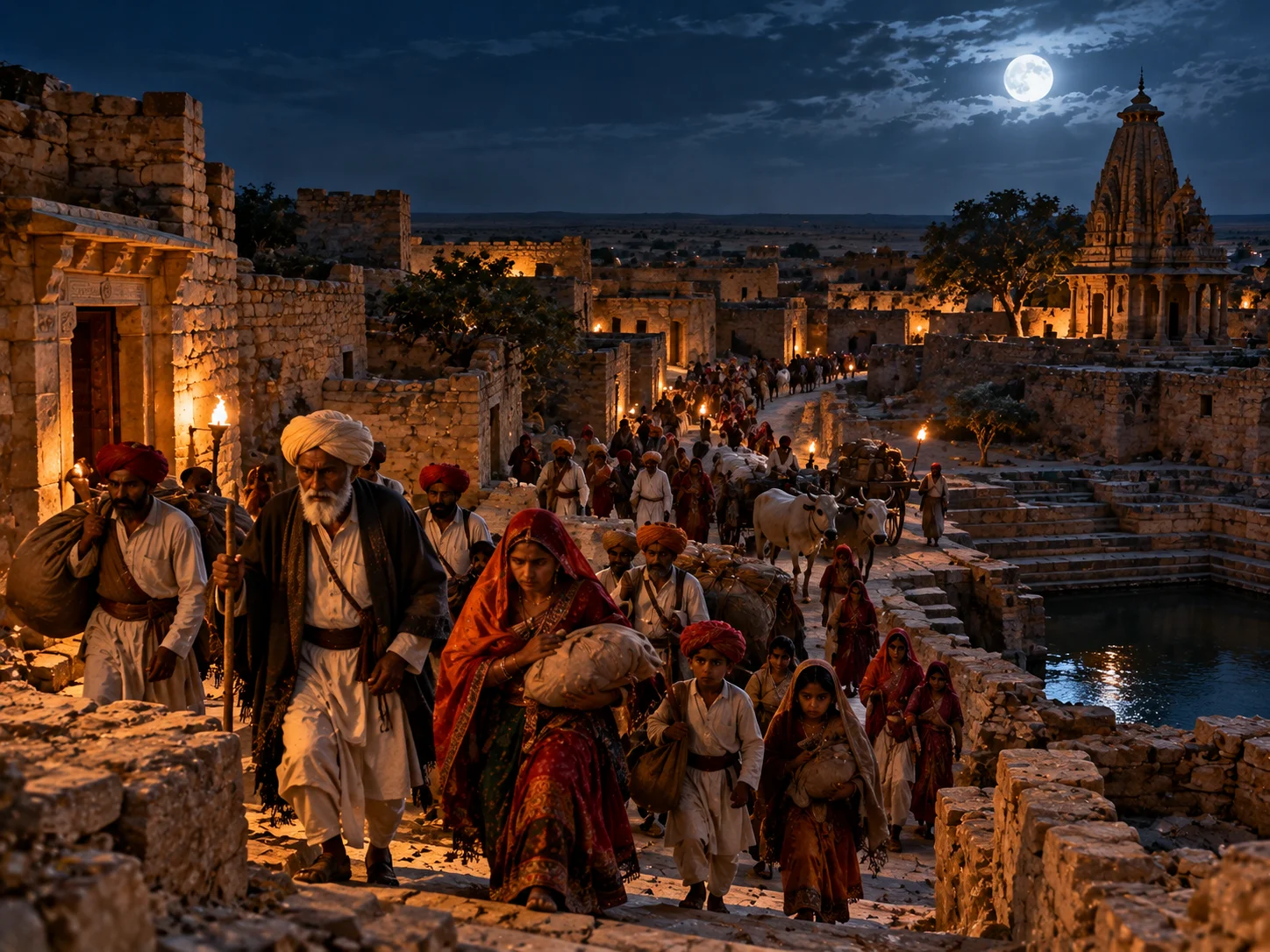
On a single night in 1825, the Paliwal Brahmin community of Kuldhara and eighty-three surrounding villages in the Thar Desert of Rajasthan packed whatever they could carry, left behind the stone houses they had built and maintained across five centuries of habitation, cursed the land they were leaving against any future settlement, and disappeared so completely that no historical record has established with certainty where they went. The village of Kuldhara, which they abandoned, stands today as a collection of roofless stone ruins that the Archaeological Survey of India has protected and that generations of visitors have walked through with the particular alertness of people in a place that carries the weight of something unresolved. The silent exodus of Kuldhara is not simply a ghost story. It is a historical event whose causes are documented in tradition with considerable specificity and whose human dimensions, the sacrifice of a community’s entire accumulated life to preserve something it valued more than that life, deserve more careful attention than the haunted village narrative usually provides.
Why Peer Ali Khan Chose the Gallows Over Betraying His City
The Night That Ended Five Centuries
Communities do not abandon their homes easily. When an entire community makes that decision simultaneously, in a single night, leaving behind everything that cannot be carried, the force of whatever drove that decision must be understood as something very close to unbearable.
The Paliwal Brahmins of Kuldhara had been in the Jaisalmer district for approximately five centuries before the night of 1825. They had built a village of stone houses organized around the social and religious conventions of a prosperous Brahmin community in the Thar Desert. They had developed sophisticated solutions to the fundamental challenge of desert habitation, the reliable management of water in one of the most arid environments in the world.
In 1825, they left all of it. The stone houses. The water systems. The agricultural fields. The temples. The accumulated physical infrastructure of five centuries of intelligent desert habitation. They left it in a single night and they cursed the land as they went.
Who the Paliwals Were
Mythological Origins of the Kumbh Mela and Descent of the Ganga
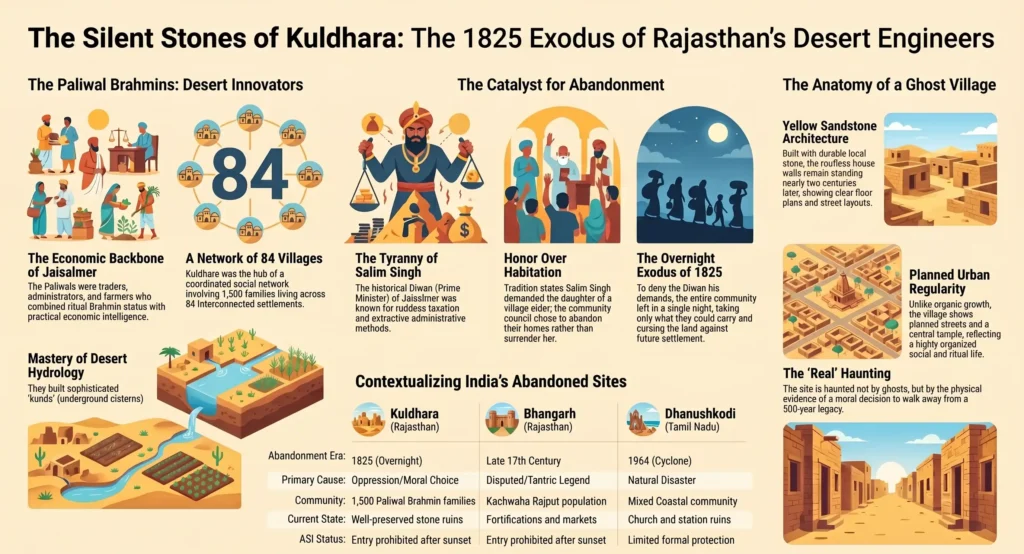
The Paliwal Brahmin community was one of the most prosperous and socially organized communities in the Jaisalmer region of the eighteenth and early nineteenth centuries. They were traders, administrators, and farmers who had combined their Brahmin social position with a practical economic intelligence that made them the economic backbone of the Jaisalmer district’s rural economy.
Their agricultural innovations in the Thar Desert are what most distinguish the Paliwal community in the historical record. In a landscape that receives among the lowest annual rainfall of any inhabited region in India, the Paliwals developed techniques of water harvesting, storage, and distribution that allowed sustained agriculture across settlements that would otherwise have been incapable of supporting significant populations. The kunds, underground water cisterns that the Paliwals constructed to capture and store the limited rainfall, are considered engineering achievements of a high order, and some of them remain intact in the ruins of Kuldhara today.
The community occupied not just Kuldhara but a network of eighty-four villages across the Jaisalmer district, all connected by the common identity and the shared agricultural and water management practices of the Paliwal tradition. The simultaneous abandonment of all eighty-four villages, coordinated in a single night, required a level of community organization and communication that demonstrates the coherence of the Paliwal identity.
Salim Singh and the Cause of Exodus
The traditional account of why the Paliwals left Kuldhara points to a specific person and a specific set of events. Salim Singh, who served as the Diwan, the prime minister, of the Jaisalmer state in the early nineteenth century, is described in Paliwal oral tradition as a man of considerable power whose administration was marked by a pattern of extraction from the communities under his authority that went beyond the conventional demands of taxation.
The Paliwal community, as one of the most prosperous groups in the Jaisalmer district, was a natural target for this extraction. Salim Singh is described in the traditional account as having imposed increasingly heavy taxes on the Paliwals, demands that went beyond what any legitimate administration could justify.
The specific incident that precipitated the overnight exodus involves not a tax demand but a personal one. Salim Singh is said to have expressed his intention to take the daughter of a village elder of Kuldhara. For the Paliwal community, whose social identity was organized around the honor of the Brahmin community and the protection of its women from precisely this kind of predatory attention from the powerful, this demand represented a violation of a fundamental principle that no economic calculation could override.
A council of the community’s elders from across the eighty-four villages reached the unanimous conclusion that compliance was impossible. The honor of the community’s women was not negotiable, and the power of Salim Singh was sufficient that resistance by conventional means was not realistic. The only available response was departure, simultaneous and complete.
Historical Evidence and Salim Singh’s Record
Goddess Kamakhya and Mythology Behind the Ambubachi Mela
Salim Singh, the figure at the center of the traditional account, is not simply a character in a folk narrative. He is a historical person about whom a considerable amount is known from sources other than Paliwal oral tradition. Salim Singh Mehta served as the Diwan of Jaisalmer in the late eighteenth and early nineteenth centuries and was by most historical accounts a man of considerable administrative ability and equally considerable ruthlessness.
He is documented in multiple sources as having imposed heavy financial demands on the communities under his administration, using the power of his position to extract wealth in ways that the rulers of Jaisalmer state sometimes found excessive. The historical Salim Singh is also the subject of an extraordinary architectural legacy. Salim Singh ki Haveli, one of the most distinctive buildings in Jaisalmer, is a structure of remarkable elaboration that speaks to both the wealth Salim Singh accumulated during his tenure and the character of a man who chose to express that wealth through exceptional architectural extravagance.
Historical accounts of Salim Singh’s conduct as Diwan include references to his harsh treatment of communities under his authority, providing a general historical context that supports rather than contradicts the specific tradition about his treatment of the Paliwals.
What Was Left Behind
Walking through the ruins of Kuldhara today, what strikes the careful visitor is not the romantically dilapidated quality that popular accounts tend to emphasize but the evidence of a life of considerable sophistication and organization.
The houses of Kuldhara were built in stone, the yellow sandstone of the Jaisalmer region that weathers slowly and retains its structure across centuries. The houses are roofless, but the walls stand to significant heights in many cases, and the floor plans of individual houses and their relationships to each other are clearly readable.
The organization of the village reflects the social and domestic conventions of a prosperous Brahmin community. The temple at the village center occupies the position of social and ritual focal point. The streets between the houses are laid out with a regularity that suggests planned development. The water management structures, including the kunds that the Paliwals constructed, are present in the ruins and some retain enough structural integrity to demonstrate the engineering sophistication of the original construction.
What is absent is almost as eloquent as what remains. There are no personal objects, no items of household use, none of the domestic material that accumulates in a lived house across generations of occupation. The community took what could be carried and left what could not, and the line between those two categories is visible in what the ruins contain.
The Curse and Its Legacy
The curse that the departing Paliwals left on the land of Kuldhara is the element of the story that has contributed most directly to its reputation as a haunted place. The land was cursed against habitation, against prosperity for anyone who attempted to settle there, and against the reversal of the abandonment.
Several attempts have reportedly been made to resettle Kuldhara since 1825, and all have reportedly failed, with the settlers leaving after experiencing difficulties that the local tradition attributes to the effects of the curse. The Archaeological Survey of India’s decision to prohibit entry after sunset has given the curse of Kuldhara an institutional framing that reinforces the sense that something about Kuldhara at night is actively dangerous.
But the more interesting question about the curse is what it was intended to accomplish at the moment it was made. A community leaving a place they had occupied for five centuries, under circumstances that combined humiliation, loss, and the necessity of sacrificing an accumulated life to preserve something more fundamental, would naturally want their departure to mean something. The curse was the formal declaration that the departure was not simply a defeat but an act of will, that the land being left was being left deliberately and permanently.
The Lost Community
Vishwakarma Puja and the Ancient Theology Behind Worship of Tools
One of the most frustrating gaps in the historical record of the Kuldhara abandonment is the absence of clear documentation of where the Paliwal community went after leaving their eighty-four villages. A community of approximately fifteen hundred families cannot simply have disappeared into the desert without leaving any trace.
What the available evidence suggests is that the community dispersed across multiple destinations, with different family groups and village clusters moving to different areas of Rajasthan and possibly beyond. The dispersal would have been deliberate and coordinated, consistent with the organization that the overnight abandonment itself required, but the specific destinations and the subsequent history of the dispersed community have not been documented.
The descendants of the Paliwal community, if they can be identified, have not come forward in a way that has allowed their subsequent history to be documented. The community that built the sophisticated water management systems of the Thar Desert and maintained five centuries of prosperous desert habitation effectively vanished from the historical record on the night they cursed Kuldhara and walked into the desert.
Kuldhara in Contemporary Memory
The contemporary Kuldhara is a site of significant and growing tourism, part of the broader Jaisalmer heritage circuit that draws visitors to the golden fort city and its surrounding desert landscape. The village receives hundreds of thousands of visitors annually, many of them attracted primarily by the supernatural reputation rather than by the historical and architectural significance of what the ruins actually represent.
The tourism development at Kuldhara has been a mixed outcome for the site. The supernatural framing has overshadowed the historical and architectural dimensions that deserve more careful attention. The Paliwal water management systems that survive in the ruins are extraordinary examples of desert engineering. The domestic architecture of the village provides an unusually complete record of a Rajput-era desert settlement. The historical event of the overnight abandonment, understood as a community’s deliberate sacrifice of its accumulated material life to preserve its fundamental values, is one of the most dramatic and humanly interesting stories in Rajasthan’s rich social history.
The Real Haunting
Kuldhara is genuinely haunted, but not necessarily in the sense that the ghost story tradition suggests. It is haunted by the specific, documented, humanly comprehensible decision of a community that valued its honor more than its home, that chose dispossession over compliance, and that expressed that choice in the most complete and irreversible way available to it.
The ruins are not simply the remnants of an abandoned village. They are the physical evidence of a moral decision, made by approximately fifteen hundred families in a single night, that the conditions under which continued habitation was possible were conditions incompatible with the fundamental values of the community. The stone walls that still stand, the water cisterns that still hold their structure, the temple that still occupies the center of the settlement, are all material remains of a community that chose to leave them rather than accept the alternative.
That is a story worth taking seriously in its own terms. The most haunting thing about Kuldhara is not that ghosts walk its streets after sunset. It is that a community of human beings walked its streets for five centuries and then chose, in a single night, to walk away and never come back. That choice, and the necessity that produced it, is the real ghost of Kuldhara.
How Mirabai Left the Palace and Found Her God
If you think you have remembered everything about this topic take this QUIZ
Results


#1. In which year was the prosperous Paliwal Brahmin village of Kuldhara abandoned overnight?
#2. How many surrounding settlements were abandoned simultaneously along with Kuldhara by the departing community?
#3. What traditional term refers to the underground water cisterns constructed by the Paliwals to harvest and store rainfall in the Thar Desert?
#4. Which historically documented Diwan (prime minister) of Jaisalmer is blamed in oral tradition for driving out the Paliwal community through heavy taxation and oppressive conduct?
#5. Approximately how many centuries of accumulated habitation did the Paliwal Brahmin community leave behind when they vacated Kuldhara?
#6. What specific building material was used to construct the houses of Kuldhara, allowing the wall structures to stand nearly two centuries after abandonment?
#7. Which official regulatory body currently protects Kuldhara and enforces a strict entry prohibition after sunset?
#8. Approximately how many families across Kuldhara and its surrounding villages are estimated to have taken part in the overnight exodus?
Why did the Paliwal Brahmins abandon Kuldhara in 1825?
The traditional account holds that the Paliwal community abandoned Kuldhara and eighty-three surrounding villages in a single night in 1825 because of the oppressive conduct of Salim Singh, the Diwan of Jaisalmer, whose demands on the community included a reported intention to take the daughter of a village elder. For a Brahmin community whose social identity was organized around the protection of its women’s honor, this demand was incompatible with continued habitation under Salim Singh’s authority, and the community elected to depart completely rather than comply.
Who were the Paliwal Brahmins and what made them distinctive?
The Paliwal Brahmins were a prosperous trading and agricultural community that had inhabited the Jaisalmer district for approximately five centuries before the 1825 abandonment. They were distinguished by their sophisticated water management technology, specifically the underground kunds they built to harvest and store the limited rainfall of the Thar Desert, which allowed sustained agriculture in one of India’s most arid environments. Their simultaneous organisation of an overnight exodus across eighty-four villages also demonstrates a level of community cohesion and communicative capacity unusual in the social landscape of early nineteenth-century Rajasthan.
What happened to the Paliwal community after they left Kuldhara?
No historical record has established with certainty where the Paliwal community went after leaving Kuldhara and the surrounding villages. The community of approximately fifteen hundred families dispersed across multiple destinations, and their subsequent history has not been documented in a way that allows the story to be followed beyond the night of departure. Some researchers suggest elements of the community settled in other parts of Rajasthan, while others propose that the dispersal was so complete that the community’s distinct identity dissolved through assimilation into local populations wherever individual families settled.
What is the archaeological significance of the Kuldhara ruins?
The ruins of Kuldhara are archaeologically significant as one of the most complete physical records of a Rajput-era desert settlement in India. The stone houses, built in Jaisalmer’s yellow sandstone, retain their walls to significant heights, and the floor plans of individual houses and their social organisation are clearly readable. The Paliwal water harvesting systems, including intact kunds, demonstrate sophisticated desert engineering. The domestic organisation of the village, including the temple’s position, the regularity of the street layout, and evidence of household arrangements in surviving walls, provides detailed information about prosperous Rajput-era desert domestic life.
Is the curse of Kuldhara historically documented or primarily a folk tradition?
The curse is primarily preserved in Paliwal oral tradition rather than in written historical documentation. The broader traditional account, including the oppression by Salim Singh and the overnight exodus, has historical support in the documented character of Salim Singh’s administration and in the physical evidence of the village’s abrupt abandonment. The curse itself, as a formal supernatural imprecation on the land, is a traditional element that functions in the narrative both as a moral statement about the injustice of what drove the community away and as the explanation for the reported failure of subsequent resettlement attempts. Its historical reality in the sense of a deliberate communal declaration of departure is plausible. Its supernatural force is a matter of belief and tradition rather than historical documentation.
Sources & References
Paliwal community identity and settlements — The Paliwal Brahmins occupied a network of eighty-four villages across the Jaisalmer district for approximately five centuries, organized as a prosperous trading and agricultural community whose simultaneous overnight exodus in 1825 required an extraordinary level of community coordination and demonstrates the coherence of Paliwal collective identity.
Salim Singh’s documented administration — Salim Singh Mehta served as Diwan of Jaisalmer in the late eighteenth and early nineteenth centuries and is historically documented in multiple sources as a man of considerable ruthlessness who extracted wealth from communities under his authority using the power of his position, with his harshness providing external historical context supporting the Paliwal oral tradition about his conduct.
Water management technology and engineering — The Paliwal-constructed kunds, underground water cisterns designed to harvest and store limited Thar Desert rainfall, allowed sustained agriculture in one of India’s most arid environments and are recognized by modern engineers as sophisticated engineering achievements, with many kunds remaining intact in the Kuldhara ruins demonstrating the Paliwal understanding of desert hydrology.
The curse and resettlement tradition — The departing Paliwals cursed the land against habitation and future prosperity, with reported resettlement attempts after 1825 allegedly failing due to difficulties attributed to the curse, and the Archaeological Survey of India’s sunset prohibition at Kuldhara reinforcing the site’s supernatural reputation while officially citing safety concerns regarding hazardous ruins.
Absence of post-abandonment record — No historical documentation establishes with certainty where the approximately fifteen hundred Paliwal families dispersed after leaving Kuldhara in 1825, making the community’s subsequent history one of Rajasthan’s unresolved questions and suggesting the dispersal was deliberate and coordinated across multiple destinations but effectively removed the community from the historical record.