How Syed Ahmad Khan Built the Aligarh Movement to Transform Muslim Education
Syed Ahmad Khan watched the world that had shaped him collapse in 1857 and drew from the wreckage a conclusion that most of his contemporaries found either incomprehensible or unacceptable: that the future of Indian Muslims depended not on the recovery of what had been lost but on the acquisition of something that had never been possessed, a rigorous modern education that could hold the best of the Islamic intellectual tradition alongside the scientific and empirical knowledge that was reshaping the world in the second half of the nineteenth century. The grassroots educational movement he built in Aligarh, beginning with a school and ending with a college that became a university, was not the project of a man who had accepted colonial subordination as permanent. It was the project of a man who had decided that intellectual preparation was the only genuine foundation for any future worth building, and who was prepared to spend the rest of his life building it.
The Rationalist Awakening Sparked by Gopal Hari Deshmukh in Maharashtra
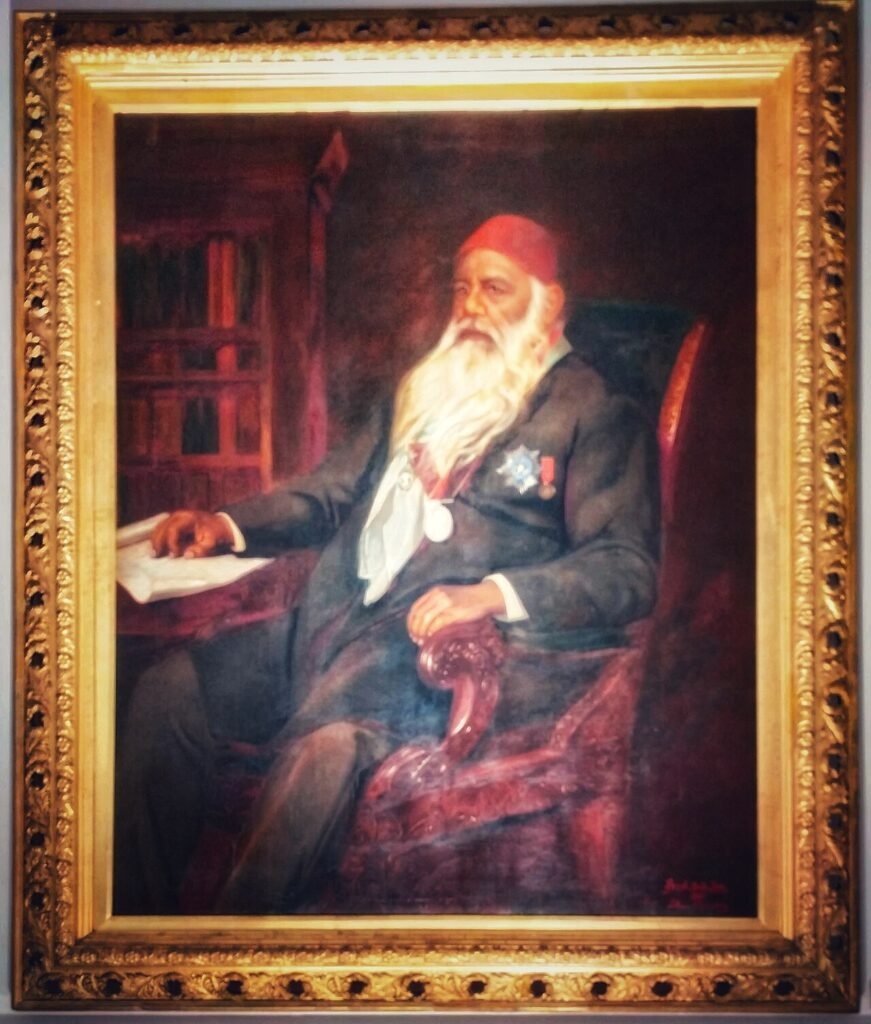
Related to article: The Man Who Read the Ruins · Source: Wikimedia Commons · Sufe · CC BY-SA 4.0
The Scholar Who Understood What Had Happened
Thakkar Bapa’s Tribal Upliftment Work in Remote India
Syed Ahmad Khan was thirty-nine years old when the uprising of 1857 began, a judicial officer of the colonial administration in Bijnor in the United Provinces, a man who had grown up in Delhi in a family with deep connections to the Mughal court. Delhi was the center of the Indo-Islamic cultural world that had shaped every aspect of his intellectual formation, and when the uprising was suppressed, the city was subjected to violence and humiliation that left its Muslim population physically devastated and psychologically shattered.
The Mughal court was abolished. The Emperor was exiled to Rangoon. The Muslim aristocracy and the learned class found themselves in a suddenly different world, one in which the cultural and political structures that had organized their lives were gone and in which the colonial administration viewed the Muslim community with deep suspicion.
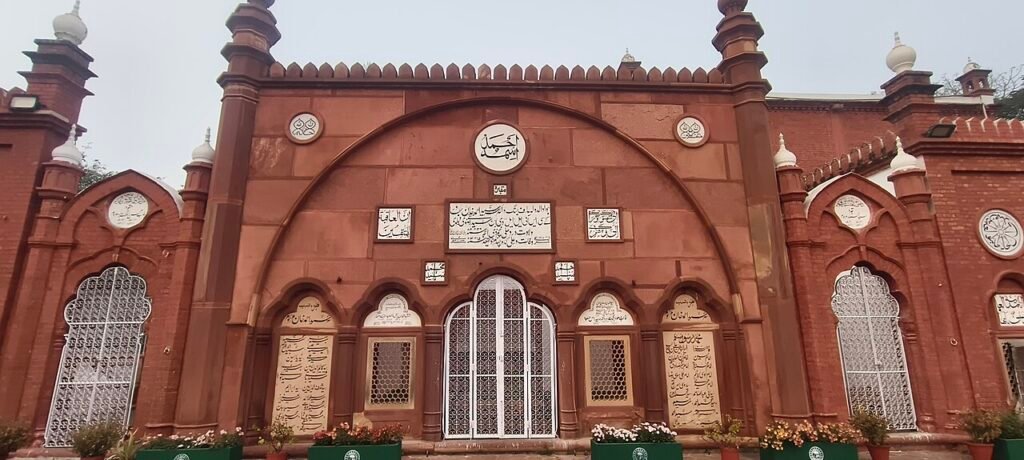
Related to article: The Man Who Read the Ruins · Source: Wikimedia Commons · Khaatir · CC BY 4.0
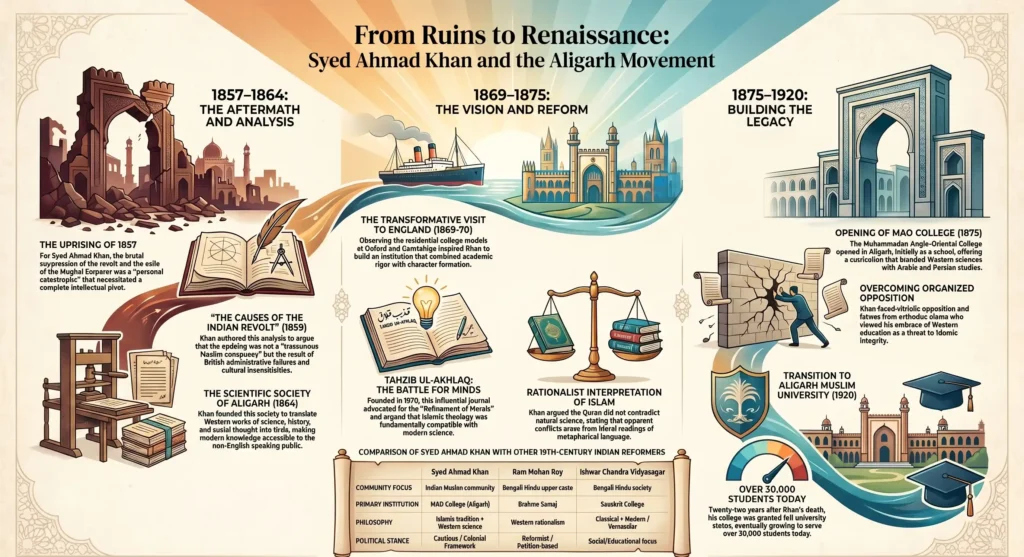
Syed Ahmad Khan’s response to this catastrophe was to think about it as carefully as he could. He wrote an analysis of the causes of the uprising, the Asbab-e-Baghawat-e-Hind, which was translated into English and published as The Causes of the Indian Revolt in 1859. It was a document of unusual intellectual courage, arguing against the dominant British interpretation that the uprising had been a treasonous Muslim conspiracy and presenting instead a careful account of the administrative failures, the cultural insensitivities, and the structural grievances that had made the uprising possible.
The analysis revealed the quality of mind that would build the Aligarh Movement. He was not interested in mourning or in grievance as a permanent condition. He was interested in understanding, and from understanding, in action.
The Delhi That Formed Him
To understand what Syed Ahmad Khan was trying to do in Aligarh, it is necessary to understand something about the intellectual world of pre-1857 Delhi that had formed him. Delhi in the early nineteenth century was one of the most intellectually vibrant cities in Asia, a center of the Indo-Islamic literary and scholarly tradition that had been developing for centuries under Mughal patronage.
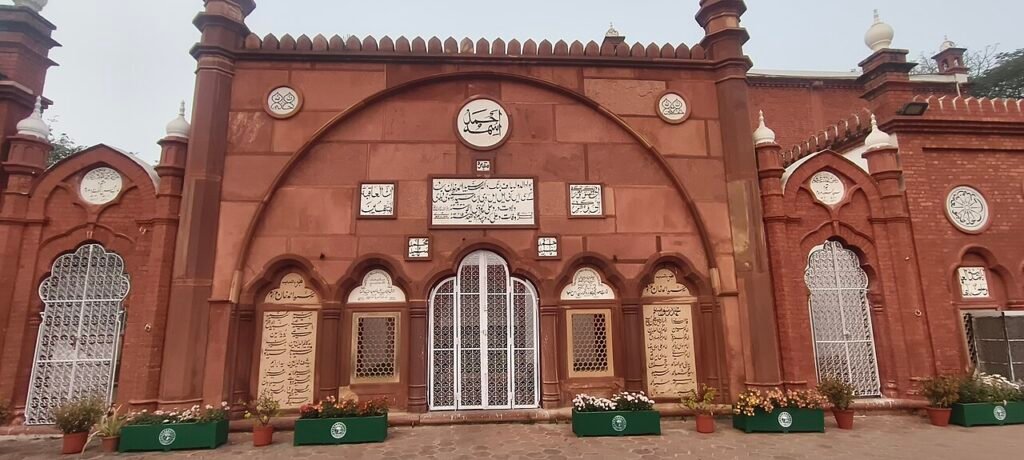
Related to article: The Man Who Read the Ruins · Source: Wikimedia Commons · Khaatir · CC BY 4.0
The poet Mirza Ghalib was his contemporary and acquaintance. The scholar and reformer Shah Waliullah’s tradition of Islamic intellectual renewal was part of the intellectual atmosphere he had grown up in. The Delhi College, which combined Western scientific and literary education with the classical Islamic tradition, had been one of the most innovative educational experiments in early nineteenth-century India, and its graduates and teachers were part of the intellectual circle that shaped his early formation.
He had received a traditional education in Arabic, Persian, and the classical texts of the Islamic tradition, supplemented by the broader intellectual culture of a city that took ideas seriously. He had also read widely in the emerging literature of Western science and empiricism that was becoming available in translation, and he had been deeply impressed by what he read, not as an alien tradition but as a set of methods and findings that he believed were compatible with the core commitments of Islamic thought properly understood.
This conviction, that modern scientific and empirical knowledge was not the enemy of Islam but was in fact consistent with Islam’s own intellectual tradition of careful observation and rational inquiry, was the philosophical foundation of everything he would build in Aligarh.
Related to article: The Man Who Read the Ruins · Source: Wikimedia Commons · Public domain
The Scientific Society and the First Institutional Experiment
How Kamaladevi Chattopadhyay Saved India’s Artisan Heritage
Before the college, there was the Scientific Society. Syed Ahmad Khan founded the Scientific Society of Aligarh in 1864, an organization dedicated to translating works of Western science, history, and social thought into Urdu, making them accessible to Indian Muslims who read Urdu but did not have access to English-language scientific literature.
The Society’s work was both practically important and symbolically significant. Practically, it began the process of making modern knowledge available in the language of the educated Muslim public of northern India, building the intellectual infrastructure that a modern educational institution would eventually require. Symbolically, it argued through action that the engagement with modern knowledge was not a betrayal of Islamic identity but an extension of the intellectual tradition of the educated Muslim community, which had always valued the translation and adaptation of knowledge from different traditions.
The translations the Society produced included works on history, natural science, and social thought, and they were distributed widely through the Society’s journal and through the networks of the educated Muslim community across the United Provinces and beyond. The Society also published a bilingual journal, appearing in both Urdu and English, which was intended to create a channel of communication between the Muslim educated community and the colonial administration that Syed Ahmad Khan believed was essential to the political and social recovery of the community after 1857.
The Scientific Society was a beginning, but Syed Ahmad Khan understood that translation alone was not sufficient. What was needed was an institution that could actually produce men who had mastered both the Islamic intellectual tradition and the modern scientific and liberal education that the world of the second half of the nineteenth century was making necessary.
Tahzib ul-Akhlaq and the Argument for Modernity
In 1870, Syed Ahmad Khan founded a journal whose name translates approximately as the Refinement of Morals, the Tahzib ul-Akhlaq, which became one of the most influential and controversial Urdu-language publications of the nineteenth century. Modeled in some respects on the Tatler and Spectator of eighteenth-century English journalism, the journal was designed to engage the educated Muslim reading public in a sustained conversation about the reform of social customs, the relationship between Islam and modern knowledge, and the practical steps that the Muslim community needed to take.
The journal argued against practices it considered socially regressive, including certain customs related to women’s seclusion and education, against the blind following of traditional religious authority without rational examination, and against the fatalism that Syed Ahmad Khan believed was preventing the Muslim community from engaging with the opportunities and challenges of its actual historical situation.
It also made the positive argument for modern education with a directness and a force that the orthodox establishment found threatening. Syed Ahmad Khan wrote in the journal about the compatibility of Islamic theology with modern science, developing a rationalist interpretation of Islamic thought that has since been recognized as one of the important contributions to the tradition of Islamic modernism. He argued that the Quran, properly understood, did not contradict the findings of natural science but was in fact consistent with them, and that the apparent contradictions were the result of literal readings of metaphorical language rather than of genuine incompatibility between religious and scientific truth.
These arguments provoked fierce opposition from the ulama, who accused him of heresy, of distorting Islamic teaching, and of serving the interests of the colonial power. The opposition was organized, sustained, and at times vitriolic. Syed Ahmad Khan continued publishing the journal for years, refusing to moderate his positions in response to pressure that he considered the expression of exactly the intellectual conservatism he was arguing against.
The Vision Born in England
In 1869 and 1870, Syed Ahmad Khan traveled to England with his son, spending approximately a year and a half observing English educational and social institutions. The visit was transformative. He attended lectures, visited Oxford and Cambridge, observed the social and intellectual culture of Victorian England, and came back convinced that the residential college model, the combination of academic instruction with the formation of character and social identity that the ancient English universities embodied, was exactly what Indian Muslims needed.
He was not impressed by everything he saw in England. He was clear-eyed about the arrogance and the cultural limitations of the colonial mentality he encountered. But he was genuinely impressed by the educational institutions and by what they produced, men who combined intellectual breadth with the confidence and social capability to engage effectively with the world’s most complex problems.
He wrote about his English observations in a series of letters that were published in India and that gave his readers the most detailed account available in Urdu of what English educational and social life actually looked like from the inside. The letters were both practical and argumentative, presenting the case for modern education through the evidence of what it had produced in the society that had developed it most fully.
When he returned to India, he began working on the institution that would embody the vision the English visit had crystallized. He had seen what he wanted to build. Now he had to build it.
Building the College Against the Odds
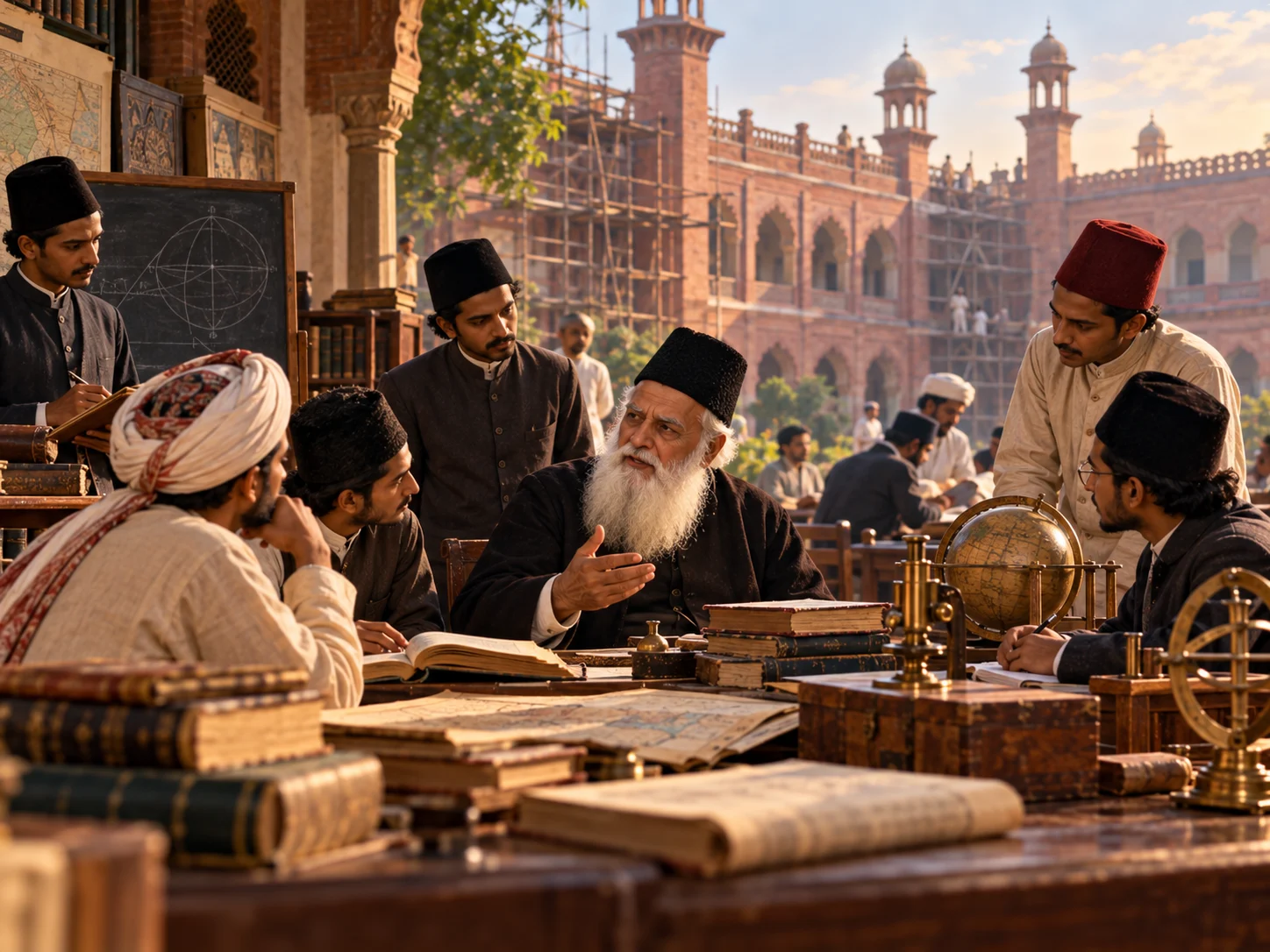
The Muhammadan Anglo-Oriental College at Aligarh opened in 1875, initially as a school and then developing into a full college affiliated with Calcutta University. The process of building it was a sustained exercise in fundraising, persuasion, political navigation, and personal determination that tested every dimension of Syed Ahmad Khan’s organizational capacity.
He raised funds from Muslim nobility across northern India, from the Nizam of Hyderabad, from wealthy merchants, and from the network of educated Muslims who understood what he was trying to do. He negotiated with the colonial administration for land, for official recognition, and for the institutional status that would allow the college’s degrees to carry weight in the employment market. He recruited English professors alongside Indian scholars, insisting on the combination of Western scientific education with Islamic studies that his vision required.
The curriculum he designed was comprehensive in ways that reflected his fundamental conviction about what modern education needed to be. Students studied English, mathematics, natural science, history, and the social sciences alongside Arabic, Persian, and the Islamic intellectual tradition. The residential structure of the college, modeled on the Oxford and Cambridge pattern he had observed in England, was designed to create the kind of total educational environment in which character and social identity were formed alongside intellectual capability.
The opposition from the ulama continued throughout the establishment of the college and into its early years of operation. Fatwas were issued declaring that attendance at the college was religiously impermissible. Parents who might otherwise have sent their sons were warned that the college was a vehicle for the corruption of Islamic values. The social pressure on families with connections to the traditional religious establishment was real and sustained.
Syed Ahmad Khan addressed this opposition partly through argument, through his journals and his public speeches, and partly through the demonstrated quality of the institution he was building. As graduates of the college began to enter public life, the practical case for modern education made itself in ways that abstract argument could not have achieved as quickly.
The graduates of the Muhammadan Anglo-Oriental College went on to careers in law, the civil service, journalism, and eventually politics. They carried with them the combination of intellectual formation that the college had provided, the capacity to engage with modern knowledge while maintaining a grounded identity in the Islamic tradition, and they applied that combination to the problems of their era with an effectiveness that justified everything Syed Ahmad Khan had argued.
The Aligarh Movement and Its Intellectual Legacy
The Aligarh Movement, the broader cultural and intellectual current that Syed Ahmad Khan’s institutions generated and sustained, extended well beyond the campus of the college itself. It produced a generation of Muslim intellectuals who engaged with the questions of modernity, identity, and political organization that the late nineteenth and early twentieth centuries posed to every community in India, and who brought to those questions the particular intellectual formation that the combination of modern education with Islamic tradition had given them.
The movement’s influence on subsequent Indian Muslim political thought has been profound and in some respects contested. Some of the most significant figures of the following generation, including Muhammad Iqbal and Muhammad Ali Jinnah, drew their intellectual formation from the institutions Syed Ahmad Khan had built. The movement produced people capable of thinking seriously about complex questions, and serious thinking about complex questions does not reliably produce uniform conclusions. The graduates of his college disagreed with each other, sometimes profoundly, about the most important political questions of their era. That disagreement was itself evidence that the education had worked.
The college became Aligarh Muslim University in 1920, granted full university status by an act of the Indian legislature, twenty-two years after Syed Ahmad Khan’s death. The university continues to be one of the most significant educational institutions in India, with a student population of approximately thirty thousand and a global alumni network whose contribution to Indian and international public life across a century of operation represents the fullest possible realization of what its founder had envisioned.
The Architecture of Knowledge
Syed Ahmad Khan built his movement in Aligarh on a single conviction that he held with a consistency that decades of opposition, controversy, and personal difficulty could not shake. He believed that knowledge was the prerequisite for dignity, that the acquisition of modern education was not a betrayal of the Islamic tradition but the most faithful response available to its core intellectual commitments, and that the construction of institutions capable of transmitting that knowledge was the most important thing he could do with the years available to him.
He was right about the knowledge. He was right about the institutions. The graduates of what he built went on to engage with the most consequential questions of the following century with an intellectual formation that they could not have received anywhere else, and the quality of their engagement, whatever one thinks of the conclusions different graduates reached, was itself evidence that the education had worked.
The controversies of the Aligarh Movement, the charges of collaboration with colonialism, the debates about whether his political caution served or harmed the long-term interests of the community he was serving, and the deeply contested question of the movement’s relationship to the eventual partition of India, are real controversies that serious historians continue to engage with. They are not resolved by the fact that what he built continues to function and to educate. But they are perhaps given a different kind of context by that fact.
He was a man who read the ruins of 1857 and decided that the most honest response was to build. He built in Aligarh, in the specific conditions of the late nineteenth century, with the resources and the relationships available to him, against opposition that was real and sustained, and what he built has outlasted every aspect of the political world in which it was built.
How Jyotiba Phule’s Satyashodhak Samaj Challenged Caste in Maharashtra
If you think you have remembered everything about this topic take this QUIZ
Results


#1. In which year was the Muhammadan Anglo-Oriental College at Aligarh founded by Syed Ahmad Khan?
#2. What was the title of the English translation of Syed Ahmad Khan’s 1859 analysis on the causes of the 1857 uprising?
#3. Which organization did Syed Ahmad Khan establish in 1864 to translate works of Western science, history, and social thought into Urdu?
#4. Which English journals served as models for the publication of Syed Ahmad Khan’s Urdu journal “Tahzib ul-Akhlaq”?
#5. The residential college model implemented by Syed Ahmad Khan at Aligarh was directly inspired by his visits to which universities?
#6. What name did Syed Ahmad Khan use for the rationalist interpretation of Islamic theology that argued the Quran was consistent with natural science?
#7. In which year was the Muhammadan Anglo-Oriental College officially granted full university status as Aligarh Muslim University?
#8. Which award or title was conferred upon Syed Ahmad Khan by the British colonial government in the year 1888?
Who was Syed Ahmad Khan and what was the Aligarh Movement?
Syed Ahmad Khan was a nineteenth-century Indian Muslim scholar, reformer, and institution builder born in Delhi in 1817. The Aligarh Movement was the broad cultural and educational current generated by the institutions he built and the intellectual tradition he developed, centered on the Muhammadan Anglo-Oriental College at Aligarh. Its core argument was that Indian Muslims needed modern scientific and liberal education combined with the Islamic intellectual tradition to participate effectively in the life of the subcontinent after the catastrophe of 1857, and it produced a generation of Muslim intellectuals whose engagement with questions of modernity, identity, and politics shaped Indian history for the century that followed.
What was the Muhammadan Anglo-Oriental College and why was it significant?
The Muhammadan Anglo-Oriental College, opened in 1875 at Aligarh, was a residential institution modeled on the Oxford and Cambridge pattern that Syed Ahmad Khan had observed during his visit to England. It combined modern scientific and liberal education with Islamic studies, was staffed by both English and Indian scholars, and was designed to produce graduates capable of engaging with the intellectual and professional demands of the modern world while maintaining their identity in the Islamic tradition. It became Aligarh Muslim University in 1920 and remains one of India’s most significant educational institutions, making it one of the most enduring institutional legacies of any nineteenth-century Indian reformer.
How did Syed Ahmad Khan respond to the 1857 uprising and its aftermath?
His response was analytical rather than simply emotional. He wrote The Causes of the Indian Revolt in 1859, arguing against the dominant British interpretation that the uprising had been a treasonous Muslim conspiracy and presenting instead a careful account of the administrative failures and structural grievances that had produced it. He then drew from his analysis the practical conclusion that the future of Indian Muslims depended not on recovering what had been lost in 1857 but on building new institutional foundations, particularly in education, that could prepare the community for effective participation in the changed world that the uprising’s suppression had produced.
What opposition did Syed Ahmad Khan face in building his educational institutions?
The most sustained opposition came from the orthodox ulama, who issued fatwas declaring attendance at his college religiously impermissible and argued that his rationalist interpretation of Islamic theology was heretical. They maintained that his embrace of Western education was a betrayal of the Islamic tradition and a form of collaboration with the colonial power. The social pressure on families with connections to the traditional religious establishment was real and sustained, requiring Syed Ahmad Khan to build the institution against active organized opposition while simultaneously running a journal and conducting a public argument for modern education that addressed the theological objections head-on.
What is the lasting legacy of the Aligarh Movement in Indian history?
The lasting legacy operates at multiple levels simultaneously. Institutionally, the college Syed Ahmad Khan built became Aligarh Muslim University, which has educated approximately thirty thousand students annually for over a century and produced graduates who have contributed to Indian and international public life across every domain. Intellectually, the movement created a tradition of Islamic modernism in the Indian context that engaged seriously with the relationship between the Islamic tradition and modern knowledge, influencing subsequent generations of Muslim thinkers from Iqbal onward. Politically, the movement produced the intellectual formation of figures who went on to shape some of the most consequential debates in modern Indian history, a legacy that is genuinely complex and continues to be debated by historians.
How Pandita Ramabai Pioneered a Fearless Crusade for Women’s Education
Sources & References
Syed Ahmad Khan’s life and intellectual formation — Born October 17, 1817 in Delhi; died March 27, 1898 in Aligarh. Judicial officer in Bijnor during 1857; drew from catastrophe a vision of modern Islamic education. Received traditional Islamic education alongside engagement with Western science and empiricism, developing conviction that modern knowledge was compatible with Islamic thought.
The Asbab-e-Baghawat-e-Hind and analytical response to 1857 — Published The Causes of the Indian Revolt in 1859, offering intellectual courage in arguing against British interpretation of the uprising as Muslim conspiracy, instead documenting administrative failures and structural grievances. Demonstrated that understanding catastrophe could lead to constructive action rather than mere grievance.
Scientific Society and Tahzib ul-Akhlaq — Founded Scientific Society of Aligarh in 1864 to translate Western science, history, and social thought into Urdu, making modern knowledge accessible to educated Muslim public. Established journal Tahzib ul-Akhlaq (1870) modeled on English Tatler and Spectator, arguing for reform, modern education, and rationalist interpretation of Islamic theology compatible with science.
The English visit and Muhammadan Anglo-Oriental College — Traveled to England 1869-1870, observing Oxford and Cambridge residential college model. Opened Muhammadan Anglo-Oriental College at Aligarh in 1875 with combined curriculum of Western science and Islamic studies, fundraised from Muslim nobility including Nizam of Hyderabad, faced opposition from orthodox ulama through fatwas but graduated students who entered law, civil service, and politics.
Aligarh Muslim University and lasting legacy — College became Aligarh Muslim University in 1920 with approximately thirty thousand students today. Influenced subsequent generation including Muhammad Iqbal and Muhammad Ali Jinnah. Established tradition of Islamic modernism engaging with compatibility of religious thought and modern knowledge. Received KCSI honor in 1888.