Before Dhirubhai Ambani built Reliance Industries into one of the largest companies in India, he spent ten years in Aden, the British colonial port in what is now Yemen, working first as a petrol pump attendant and then as a clerk and trader at A. Besse and Company. The decade he spent observing, learning and eventually participating in the commodity and currency trading of a busy international port gave him the instincts, the risk appetite and the understanding of market mechanics that he would later apply at an entirely different scale in India. This piece traces those Aden years and the specific gambles that defined them.| Detail | Information |
| Subject | Dhirubhai Ambani’s early years at Aden |
| Full Name | Dhirajlal Hirachand Ambani |
| Born | 28 December 1932, Chorwad, Gujarat, India |
| Died | 6 July 2002, Mumbai, Maharashtra, India |
| Aden Period | 1948 to 1958 |
| Employer at Aden | A. Besse and Company |
| Starting Role | Petrol pump attendant, later clerk |
| Key Insight | Currency arbitrage and commodity trading opportunities |
A Petrol Pump Attendant’s Education in Markets
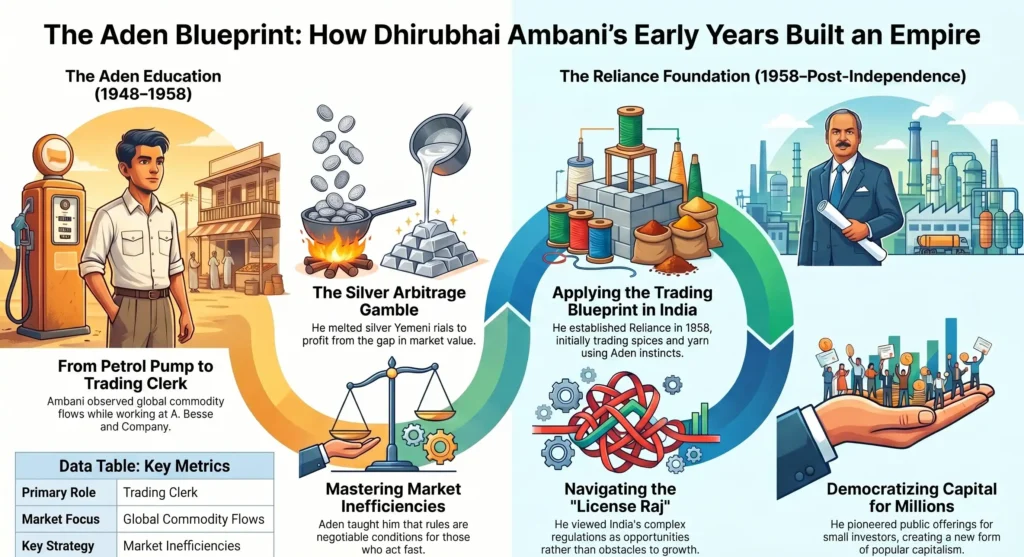
Dhirubhai Ambani arrived in Aden in 1948 at the age of sixteen with almost no money, almost no formal education beyond high school and no connections in the trading world he was entering. He found work as a petrol pump attendant at a Shell filling station and then as a clerk at A. Besse and Company, the trading firm that would give him his first education in how international commodity markets worked, how currencies moved and how a man who understood these things could make money in the gaps between what markets offered and what traders were willing to see. The education he received at Aden cost him nothing in tuition and everything in attention. He paid attention. He was born on 28 December 1932 in Chorwad, Gujarat, and died on 6 July 2002 in Mumbai.
The Boy from Chorwad
Dhirubhai was born in Chorwad, a small coastal town in the Junagadh district of Gujarat. His father Hirachand Govardhandas Ambani was a schoolteacher, a profession that provided respectability but limited income. The family was not poor by the standards of rural Gujarat but was far from the commercial class whose children typically entered trading and business through family networks and inherited capital.
Dhirubhai left school after completing his matriculation and worked briefly in Junagadh before the opportunity arose to travel to Aden. His older brother Ramniklal had already gone to Aden and had found work there, and it was through this family connection that Dhirubhai was able to make the journey. The connection gave him a starting point but not a platform. Whatever he built in Aden, he would build through his own observation, his own relationships and his own willingness to act on the opportunities he identified. The journey from Chorwad to Aden was the first significant gamble of his life. He was sixteen years old, traveling to a foreign country where he had minimal connections and no guaranteed employment beyond his brother’s presence. The alternative, staying in Junagadh and finding local work, was safer and smaller. Dhirubhai chose the larger and less certain option, as he would continue to choose throughout his life.
How Azim Premji Turned Cooking Oil Into a Technology Empire
Aden in the 1950s
Aden in the late 1940s and 1950s was one of the busiest ports in the world. Situated at the mouth of the Red Sea on the southern tip of the Arabian Peninsula, it was a British colonial possession and a critical hub for trade between Europe, Asia and East Africa. Ships from dozens of countries passed through its harbor carrying oil, commodities, textiles and manufactured goods. The port had a merchant community of extraordinary diversity, with Indian, Yemeni, British, Jewish and Somali traders operating alongside each other in the compressed geography of a colonial entrepot where money moved fast and information was the most valuable commodity of all.
It was into this world that Dhirubhai arrived in 1948, carrying almost nothing except the ambition that everyone who knew him in those years has described as the most immediately noticeable thing about him. He was not the most educated person at Aden. He was not the most connected. He was not, at the beginning, the most experienced. But he paid attention to everything, he remembered everything he observed and he was willing to take risks that more cautious men would not consider. Those qualities, attention, memory and appetite for risk, were the education that Aden gave him.
A. Besse and Company
The firm where Dhirubhai found employment after his initial period at the Shell filling station was A. Besse and Company, one of the most significant trading houses operating in Aden at the time. The company traded in a wide range of commodities across the Indian Ocean region, buying and selling goods across multiple markets and managing the complex logistics of moving products between ports where prices, regulations and trading conditions varied significantly.
Working as a clerk at A. Besse and Company was, for a young man with Dhirubhai’s appetite for commercial understanding, an extraordinary education. He could observe directly how commodity prices moved between markets, how the timing of buying and selling decisions affected profitability and how experienced traders used their knowledge of market conditions to position themselves advantageously before others recognized what was happening.
He absorbed these lessons with the focused attention that multiple accounts of his Aden years consistently describe. He was not simply doing his job. He was studying the trading world around him the way a student studies a subject he intends to master, and he was doing so in an environment where the subject matter was presented in its most concentrated and consequential form.
Vasco da Gama Reaches India: The Discovery of the Sea Route to East
The Currency Arbitrage Gamble
The specific gamble that became the most discussed episode of Dhirubhai’s Aden years involved the Yemeni rial and its relationship to the silver content of British coins. This episode has been told in various versions in the biographical accounts of Dhirubhai’s life, and the precise details vary between sources. But the essential logic is consistent across all versions.
The Yemeni rial was at the time a silver currency whose value was tied to its silver content. British silver coins, including the Maria Theresa thaler that was widely used in trade across the Red Sea and Arabian Sea region, also had specific silver content. The market price of silver fluctuated, and there were moments when the relationship between the official exchange rate of these currencies and the market value of their silver content created an arbitrage opportunity: a chance to convert one form of currency into another and then convert the resulting silver value into profit through the difference between official and market rates.
Dhirubhai identified this opportunity and acted on it. He bought Yemeni rials, melted them for their silver content and sold the silver at a profit that the official currency markets had not yet closed. The scheme required capital, which he had limited access to, and nerve, which he had in abundance. It also required speed, because arbitrage opportunities of this kind close as other market participants recognize and act on the same opportunity.
The episode was not simply profitable in the immediate financial sense. It was formative in the psychological sense. It demonstrated to Dhirubhai that markets contained inefficiencies that could be identified and exploited by someone who was paying close enough attention, that speed of action and willingness to commit capital before the opportunity disappeared were the critical variables, and that the rules of any given market were not absolute constraints but negotiable conditions that smart traders could work within and sometimes against. These were the instincts he brought back to India.
The Trading Networks
Beyond the currency arbitrage episode, Dhirubhai’s years at Aden involved participation in commodity trading across the Indian Ocean region. The port’s position as a hub for trade between India, East Africa and the Arabian Peninsula meant that commodities including spices, textiles and agricultural products moved through it continuously, and the trading community that handled these flows developed sophisticated networks of information, credit and relationship that allowed them to operate across multiple markets simultaneously.
Dhirubhai’s participation in these networks, first as an observer and employee and gradually as an independent actor, gave him an understanding of how trading networks function, how trust and relationship create commercial advantage and how information asymmetry, knowing something that others do not know yet, is the foundation of trading profit.
He developed relationships with traders from multiple communities during his Aden years, relationships that the diverse merchant community of the port made available to anyone willing to invest the time and attention required to build them. The cross-community commercial relationships he developed in Aden prefigured the broad and diverse stakeholder network that would characterize Reliance’s development in India decades later.
How the Murugappa Group Built a Silent Empire in Southern India
The Return to India
Dhirubhai left Aden in 1958, ten years after his arrival. He was twenty-six years old. He had saved money, developed commercial instincts and built a set of relationships and a way of thinking about markets that he was ready to apply in a different context.
The India he returned to was operating under the License Raj, the system of industrial licensing and government control that made building a manufacturing business extraordinarily complicated. The complexity of this system was, for someone with Dhirubhai’s particular set of skills, not simply an obstacle. It was also an opportunity. A system this complex, with this many rules and approvals and relationships involved in every commercial decision, was a system where someone who understood it better than others and was willing to navigate it more boldly than others could gain significant advantage.
He returned to Bombay and established Reliance Commercial Corporation in 1958, initially trading in spices and yarn. The trading experience of Aden was directly applicable to this work. The networks he had built were partially transferable. The instincts he had developed about market timing, risk and the identification of opportunity in the gaps between what markets offered officially and what they would bear in practice were entirely transferable. The gambles he had taken at Aden were practice. India was the arena he had been preparing for.
From Trading to Manufacturing
The transition from the Aden trading years to the building of Reliance was not immediate or linear. Dhirubhai spent years in Bombay trading textiles and building the commercial relationships and the understanding of Indian market conditions that would eventually enable his move into manufacturing. The yarn trading business gave him deep knowledge of the textile industry and identified the manufacturing opportunity that became Reliance’s first major industrial venture, a textile mill at Naroda in Gujarat that began production in 1966.
The Naroda mill was financed partly through an approach to capital raising that itself reflected the lessons of Aden. Dhirubhai raised capital from small investors across Gujarat through a public offering that was accessible to ordinary people rather than only to institutional investors, building a shareholder base that would eventually number in the millions and that gave Reliance both the capital it needed and a constituency of small investors whose loyalty became a commercial and political asset.
This democratization of equity investment in India, which Dhirubhai pioneered through Reliance’s multiple public offerings over the decades, changed the relationship between Indian retail investors and the stock market permanently. The approach of bringing ordinary Indians into the stock market as investors in a single large company created a form of popular capitalism that had no precedent in India at the time.
Martyrdom of Guru Arjan Dev: The Event That Transformed Sikhis
Quick Comparison Table
| Feature | Dhirubhai Ambani | Jamsetji Tata | Verghese Kurien | Shiv Nadar |
| Starting Point | Petrol pump attendant, Aden | Family trading business | Government bond obligation | Calculator assembly |
| Primary Industry | Petrochemicals, textiles | Steel, textiles | Dairy cooperatives | Information technology |
| Capital Source | Trading profits, personal savings | Family business capital | Government and UN funding | Pooled engineer savings |
| Method | Bold risk, market disruption | Methodical planning | Cooperative institution building | Incremental technology building |
| Colonial Context | Post colonial, License Raj | Full colonial period | Post independence | Post independence |
Curious Indian: Fast Facts
- Dhirubhai Ambani arrived in Aden in 1948 at the age of sixteen and initially worked as a petrol pump attendant at a Shell filling station.
- He worked for A. Besse and Company, one of the most significant trading houses operating in Aden, where he received his informal education in commodity and currency trading.
- The currency arbitrage scheme involving Yemeni rials and their silver content was one of the most discussed episodes of his Aden years, demonstrating his willingness to identify and act on market inefficiencies.
- He returned to India in 1958 after ten years in Aden and established Reliance Commercial Corporation initially trading in spices and yarn.
- The textile mill at Naroda in Gujarat, which began production in 1966, was Reliance’s first major manufacturing venture.
- Dhirubhai pioneered the democratization of equity investment in India through public offerings accessible to small investors across Gujarat and eventually across the country.
- He was born on 28 December 1932 in Chorwad, a small coastal town in the Junagadh district of Gujarat, the son of a schoolteacher.
- Reliance Industries, which he built from this beginning, became one of the largest companies in India and one of the significant ones in Asia.
The Capacity for Gaps
The ten years Dhirubhai Ambani spent in Aden were not years of preparation in the ordinary sense of that word. He was not studying for an examination or accumulating credentials for a career. He was living inside the most concentrated form of the commercial world he intended to operate in, observing it with complete attention, participating in it with increasing confidence and developing the specific instincts about risk, timing and market mechanics that would define everything he did afterward.
The currency arbitrage gamble was not simply a profitable transaction. It was a demonstration to himself that he could identify an opportunity that others had missed, act on it faster than the market could close it and profit from the difference between what the rules said and what the reality was. That capacity, for seeing gaps and moving through them before they closed, was the essential Dhirubhai Ambani skill, and it was developed, tested and refined in the trading environment of a British colonial port in the years before anyone outside Chorwad and Aden had heard his name. He brought that capacity back to India in 1958 and spent the next four decades applying it at a scale that transformed not only his own fortune but the structure of Indian industry, the composition of the Indian stock market and the commercial geography of a country that had barely begun to understand what he was building before he had already built the next thing. The petrol pump attendant from Chorwad became the man who changed India’s relationship with its own economy. Aden was where that transformation began.
Jamsetji Tata: The Steel City That Outlived Its Founder by a Century
If you think you have remembered everything about this topic take this QUIZ
Results


#1. At what age did Dhirubhai Ambani arrive in the bustling British colonial port of Aden in the year 1948?
#2. What was Dhirubhai Ambani’s very first job when he arrived at the international trading hub of Aden?
#3. Which prominent trading firm gave Dhirubhai Ambani his core informal education in international commodity markets and currency movements?
#4. What brilliant financial gamble did Dhirubhai execute in Aden by taking advantage of a market gap in silver value?
#5. In which small coastal town within the Junagadh district of Gujarat was Dhirubhai Ambani born in 1932?
#6. After spending ten years learning the mechanics of trade in Aden, in what year did Dhirubhai return to India to start his own corporation?
#7. What system of complex industrial licensing and rigid government controls did Dhirubhai successfully navigate when he returned to India?
#8. How did Dhirubhai Ambani fundamentally change the Indian retail investment landscape while expanding Reliance?
Why did Dhirubhai Ambani go to Aden and what did he do there?
Dhirubhai went to Aden in 1948 at the age of sixteen, following his older brother who had already found work there. He initially worked as a petrol pump attendant at a Shell filling station before securing employment as a clerk at A. Besse and Company, one of the most significant trading houses in Aden. Over ten years he observed and participated in the commodity and currency trading that moved through one of the world’s busiest ports, developing the commercial instincts that would define his subsequent career in India.
What was the currency arbitrage scheme that Dhirubhai conducted at Aden?
The scheme involved the relationship between the Yemeni rial, a silver currency, and the market value of the silver it contained. When the market price of silver created a gap between the official exchange rate of the Yemeni rial and the value of its silver content, Dhirubhai converted rials into silver and sold the silver at a profit. The scheme required capital and speed because arbitrage opportunities close as other market participants recognize them. It demonstrated his ability to identify and act on market inefficiencies faster than others.
How did the Aden years influence Dhirubhai’s approach to business in India?
The Aden years gave Dhirubhai three things that defined his subsequent career. First, a deep understanding of how commodity and currency markets work and where their inefficiencies lie. Second, a risk appetite and a willingness to commit capital decisively before opportunities disappeared. Third, an understanding of how trading networks function and how relationships and information create commercial advantage. All three of these capacities were directly applicable to the License Raj environment he encountered when he returned to India.
What was Reliance Commercial Corporation and when did Dhirubhai establish it?
Reliance Commercial Corporation was established by Dhirubhai in Bombay in 1958, the year he returned from Aden. It initially traded in spices and yarn, applying the trading experience and market knowledge he had developed in Aden to the Indian commercial environment. The corporation was the foundation from which Reliance Industries eventually grew through Dhirubhai’s pivot into textile manufacturing and subsequently into petrochemicals, refining and a range of other industries.
How did Dhirubhai Ambani change Indian retail investment?
Dhirubhai pioneered the democratization of equity investment in India through public offerings of Reliance shares that were accessible to small investors rather than only to institutional buyers. He raised capital from ordinary people across Gujarat and eventually across India, building a shareholder base that eventually numbered in the millions. This approach changed the relationship between Indian retail investors and the stock market permanently, creating a form of popular capitalism that had no precedent in India at the time.