Monday, May 25, 2026
22 °c
Columbus
Curious Indian
  • Arts & Culture
  • Festivals of India
  • Indian History
  • Indian Politics
  • Biography
    • Entertainment Personalities
    • Science Personalities
  • Unsolved India
No Result
View All Result
  • Arts & Culture
  • Festivals of India
  • Indian History
  • Indian Politics
  • Biography
    • Entertainment Personalities
    • Science Personalities
  • Unsolved India
No Result
View All Result
Curious Indian
No Result
View All Result
Home Arts & Culture

Why Toda Tribe Honors Their Sacred Buffaloes in Nilgiri Hills

paripurnadatta by paripurnadatta
in Arts & Culture, Festivals of India, Regional Culture, Rituals & Traditions
Reading Time: 13 mins read
0 0
A A
Toda tribe

Toda tribe

Share on FacebookShare on Twitter

Table of Contents

Toggle
  • Why the Toda Tribe Honors Their Sacred Buffaloes in the Nilgiris 
  • The Sacred Dairy and the Priest Who Tends It
  • Why the Buffalo Is Sacred
  • The Funerary Buffalo Sacrifice
  • The Toda Mund and Its Sacred Geography
  • The Toda Embroidery and Its Connection to the Sacred
  • Quick Comparison Table
  • Curious Indian: Fast Facts
  • Conclusion
  • If you think you have remembered everything about this topic take this QUIZ
    • Who are the Toda and where do they live?
    • What is the ti and why is it significant in Toda culture?
    • Why do the Toda sacrifice buffaloes at funerals?
    • How are the Toda embroidery patterns connected to their sacred traditions?
    • What threats does the Toda tradition currently face?
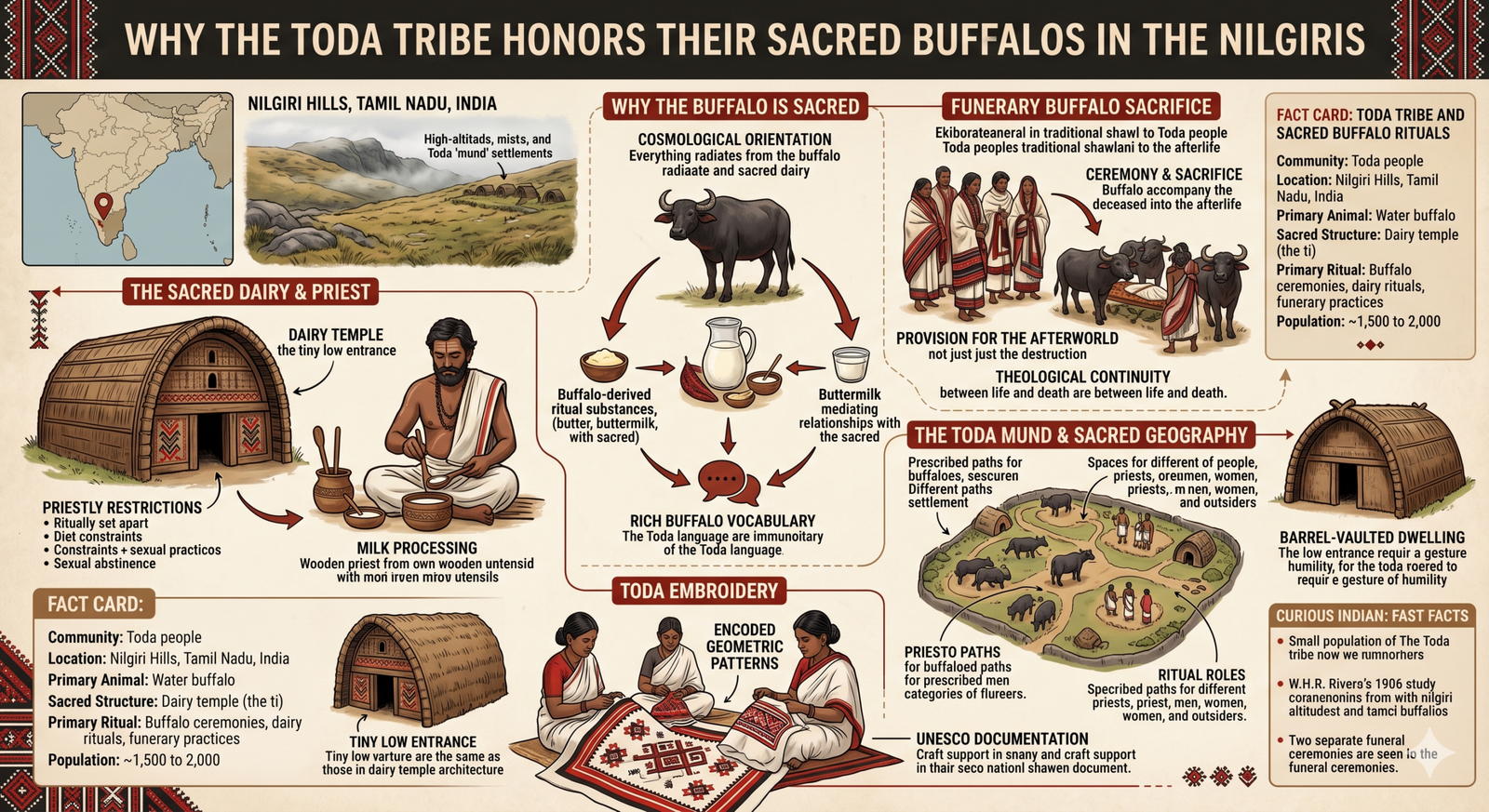
The Toda are a small pastoral tribe inhabiting the Nilgiri Hills of Tamil Nadu whose entire cultural, religious and social life is organized around the sacred status of the water buffalo. Their priestly dairy temples, called ti, are among the most restricted sacred spaces in any living Indian tradition. Their funerary rituals involve elaborate buffalo sacrifice. Their embroidery tradition encodes the same sacred geometries that govern their ritual spaces. With a population of fewer than two thousand people, the Toda represent one of the most internally coherent and culturally distinctive small communities in India, and their buffalo rituals are the living center of everything they have built.
DetailInformation
SubjectToda Tribe and Sacred Buffalo Rituals
CommunityToda people
LocationNilgiri Hills, Tamil Nadu, India
Primary AnimalWater buffalo
Sacred StructureDairy temple, called the ti
Primary RitualBuffalo ceremonies, dairy rituals, funerary practices
UNESCO StatusToda embroidery inscribed, broader culture documented
Current PopulationApproximately 1,500 to 2,000 individuals

Why the Toda Tribe Honors Their Sacred Buffaloes in the Nilgiris 

The Nilgiri Hills rise steeply from the plains of Tamil Nadu and Kerala into a landscape of grassland, shola forest and mist that feels genuinely separate from the India below. The Toda have lived in these hills for as long as their oral traditions reach back, which is considerably further than any written record of them. They inhabit a small number of settlements called munds, clusters of barrel-roofed structures of distinctive architectural form, scattered across the high grasslands where their buffaloes graze.

Everything about Toda life, the layout of the mund, the design of the buildings, the organization of the social hierarchy, the structure of ritual responsibility, radiates outward from a single center: the buffalo and the sacred dairy where its milk is processed by the tribe’s priests.

To understand the Toda is to understand what it looks like when a community builds a complete civilization around one animal.

The Gold and Gems of Tanjore Painting: Devotion in Art
Toda tribe

The Sacred Dairy and the Priest Who Tends It

At the heart of every Toda settlement is the ti, the sacred dairy temple. The ti is a small stone and thatch structure whose entrance is so low that a person must crawl to enter. Inside, the priest processes buffalo milk into butter and buttermilk using wooden implements that are themselves sacred objects, touched only by the priest and never by ordinary community members.

The ti is not accessible to most Toda. Women are entirely excluded. Ordinary Toda men approach it only in specific ritual contexts. The priest who tends the ti, called the palol, maintains a set of restrictions in his daily life that mark him as permanently set apart from the ordinary social world. He cannot eat food prepared by anyone outside a specific ritual category. He cannot cross certain boundaries within the landscape without specific ritual preparation. He cannot have sexual relations during the period of his priestly service. His life is organized around the maintenance of the ti’s ritual purity.

READ MORE:  How Kodava Celebrates Weapons During Kailpodh Festival

The dairy priest of the most sacred Toda dairies is among the most ritually constrained individuals in any living tradition in India. The restrictions he observes are not occasional disciplines adopted for specific occasions. They are the permanent condition of his priestly office, maintained continuously throughout his period of service.

The anthropological documentation of the Toda priestly system, conducted initially by W.H.R. Rivers in his landmark 1906 study published by Macmillan and Company, represents one of the most detailed records of a living priestly dairy tradition anywhere in ethnographic literature.

Shekhawati Murals and Stories Painted on Desert Walls

Why the Buffalo Is Sacred

The Toda do not have a fully systematized theological explanation of why the buffalo is sacred in the way that a textual religion might produce such an explanation. What they have instead is a cosmological orientation in which the buffalo occupies the central position so completely that the question of why it is sacred dissolves into the more fundamental question of what Toda existence would be without it.

The buffalo provides milk, which the priestly dairy transforms into the ritual substances that mediate the Toda relationship with the sacred. The buffalo’s movements through specific spaces in the landscape, its presence in or absence from specific ritual contexts, its life and its death, are all events of cosmological significance within the Toda understanding of the world. A world without buffalo would not simply be a poorer world for the Toda. It would be a world in which the structures that make Toda life coherent had collapsed.

This is reflected in the Toda language, which contains an extraordinarily rich vocabulary for distinguishing between different categories of buffalo, different grades of sacredness, different ritual roles and different relationships between specific animals and specific ritual functions. The linguistic elaboration around the buffalo reflects the conceptual elaboration of a community that has spent centuries thinking carefully about the central object of its sacred attention.

Researchers working with the Anthropological Survey of India have noted that the Toda buffalo vocabulary contains distinctions that have no equivalent in any neighboring language or culture, reflecting the unique depth of the community’s engagement with this single animal across generations of sustained ritual practice.

The Funerary Buffalo Sacrifice

The most dramatic expression of the buffalo’s sacred status in Toda culture occurs at funerals. The Toda funerary tradition is elaborate and extended, involving two separate ceremonies conducted over a period that can span months or years. The first funeral ceremony takes place shortly after death. The second, more elaborate ceremony, which completes the rites of passage for the deceased, may be held much later.

At both ceremonies, buffaloes are sacrificed. The number and category of buffaloes sacrificed reflects the social status of the deceased and the capacity of the family. The sacrificed animals accompany the deceased into the next life, providing them with the buffalo-centered existence in the afterworld that mirrors the buffalo-centered existence they had in this one.

The funerary buffalo sacrifice is not understood as destruction. It is understood as provision. The Toda afterlife is imagined as a continuation of Toda life, requiring the same sacred animals, the same dairy rituals and the same priestly structures that organize existence in the Nilgiris. Death transfers the person from one context to another without fundamentally altering the nature of their existence or their relationship with the buffalo.

This theological continuity between life and death, mediated by the buffalo sacrifice, is one of the most distinctive features of Toda cosmology and one that has no precise parallel in any of the major religious traditions of the surrounding region.

READ MORE:  The Relentless Pursuit of Excellence by Legendary Filmmaker K. Asif

The Toda Mund and Its Sacred Geography

The physical layout of the Toda mund, the settlement cluster, is not arbitrary. It encodes the same sacred distinctions that govern the social and ritual organization of the community. The ti, the sacred dairy, occupies a specific position relative to the residential structures. The movements of buffaloes through the mund follow prescribed paths. The spaces accessible to different categories of people, priests, ordinary men, women, children, outsiders, are defined by the same logic that defines ritual hierarchy throughout Toda culture.

The barrel-vaulted residential structures of the Toda mund, with their distinctive thatched exteriors and their low entrances requiring a person to bow to enter, have attracted considerable architectural attention as among the most distinctive domestic structures of any South Indian tribal community. Their form is not simply functional. The low entrance that requires bowing is understood within Toda culture as a gesture of humility appropriate to the threshold of a sacred domestic space.

The broader landscape of the Nilgiri plateau is also organized within the Toda sacred geography. Specific hills, streams and grazing areas carry ritual designations. The movement of buffalo herds between different grazing areas follows patterns that have ritual as well as ecological dimensions. The landscape is not simply a resource to be exploited but a structured sacred space through which the Toda and their buffaloes move according to inherited principles.

S.H. Raza and the Bindu: How a Dot Held the Universe

The Toda Embroidery and Its Connection to the Sacred

The Toda embroidery tradition, practiced by Toda women, produces textile work of extraordinary geometric precision using a restricted palette of red and black on white handwoven cloth. The patterns used in Toda embroidery are not decorative inventions. They are the same geometric forms that appear in the architecture of the sacred dairy, in the spatial organization of the mund and in the ritual objects used in dairy ceremonies.

The embroidery is therefore not simply a textile craft. It is a form of sacred documentation, encoding in wearable form the same geometric logic that governs the sacred spaces of Toda life. A Toda shawl carrying the traditional embroidery patterns is, within the community’s own understanding, a garment that participates in the same sacred order as the dairy temple.

The documentation and support of Toda embroidery has been taken up by craft organizations and researchers, with the tradition receiving attention from institutions including the Crafts Council of India as one of the most distinctive and endangered textile traditions in South India. The small size of the Toda community means that the number of women who practice the full embroidery tradition is extremely limited, making it one of the most vulnerable living craft traditions in India. The unique textile legacy is recognized internationally, with documentation preserved in global archives such as the UNESCO World Heritage Centre databases.

Quick Comparison Table

FeatureToda Buffalo RitualsJallikattu, Tamil NaduKambala, KarnatakaHornbill Festival, Nagaland
CommunityToda tribe, NilgirisTamil agricultural communitiesTulu community, coastal KarnatakaNaga tribes, Nagaland
Primary AnimalWater buffalo, sacredBull, sport and valorBuffalo, racingVarious, cultural display
CharacterRitual, priestly, sacredCompetitive, celebratoryCompetitive, ceremonialCelebratory, communal
Religious BasisToda animist cosmologyAgricultural tradition, DravidianAgricultural traditionTribal animist tradition
Current StatusContinuing, community smallLegally contested, continuingContinuingAnnual festival, continuing

Curious Indian: Fast Facts

  • The Toda population numbers fewer than two thousand people, making them one of the smallest distinct tribal communities in India.
  • The sacred dairy temple called the ti has an entrance so low that a person must crawl to enter, a gesture of humility required even of the priest who tends it.
  • The Toda priestly vocabulary for different categories of buffalo contains distinctions that have no equivalent in any neighboring language or culture.
  • W.H.R. Rivers conducted the first systematic anthropological study of the Toda in 1906, producing one of the most detailed records of a living priestly dairy tradition in ethnographic history.
  • Toda funerary ceremonies involve two separate rituals that can be separated by months or years, with buffalo sacrifice at both occasions.
  • The geometric patterns in Toda embroidery are the same as those governing the architecture of the sacred dairy and the spatial organization of the settlement.
  • Women are entirely excluded from the sacred dairy and the rituals performed within it.
  • The Toda inhabit barrel-vaulted structures with low entrances requiring occupants and visitors to bow upon entering.
READ MORE:  Architecture of Truth: How Dignaga Buddhist Logic Changed the World

Conclusion

The Toda have built something that most modern societies have lost the capacity to build: a complete and internally coherent world in which the sacred and the practical are not separated, in which the animal that provides food is also the animal at the center of the cosmology, in which the patterns on a woman’s shawl encode the same geometry as the walls of the priestly temple, in which life and death are organized around the same central object.

The buffalo is not sacred because Toda decided to make it sacred. The Toda are who they are because the buffalo has been sacred to them for longer than their oral traditions can reach. The sacredness and the identity are inseparable, which means that any significant disruption to the buffalo-centered life of the Toda is not simply a practical problem. It is an existential one.

The Nilgiri Hills are under pressure from tourism, urbanization, plantation agriculture and the many forces that the modern world directs at traditional landscapes. The Toda are adapting as they always have, slowly and on their own terms. The ti is still tended. The funerary ceremonies are still performed. The embroidery patterns are still being worked by women who learned them by watching women who learned them by watching women. The buffalo is still sacred.

For now, the world that Toda built is still standing.

If you think you have remembered everything about this topic take this QUIZ

This quiz no longer exists

Who are the Toda and where do they live?

The Toda are a small pastoral tribe inhabiting the Nilgiri Hills of Tamil Nadu in South India. With a population of fewer than two thousand people, they are one of the smallest distinct tribal communities in India. They live in small settlements called munds scattered across the high grasslands of the Nilgiri plateau, where their sacred water buffaloes graze.

What is the ti and why is it significant in Toda culture?

The ti is the sacred dairy temple at the heart of every Toda settlement. It is a small stone and thatch structure with an entrance so low that entry requires crawling. Inside, the priestly dairy specialist processes buffalo milk using sacred wooden implements. The ti is inaccessible to most Toda, with women entirely excluded and ordinary men permitted entry only in specific ritual contexts. It is the most sacred space in Toda religious life and the center around which all other ritual and social structures are organized.

Why do the Toda sacrifice buffaloes at funerals?

The Toda afterlife is imagined as a continuation of Toda life, requiring the same buffalo-centered existence, dairy rituals and priestly structures as life in the Nilgiris. Sacrificing buffaloes at funerary ceremonies is understood as providing the deceased with the animals they will need in the next life. The sacrifice is not destruction but provision, a final act of care for the person who has died that reflects the same values organizing Toda life.

How are the Toda embroidery patterns connected to their sacred traditions?

The geometric patterns used in Toda embroidery are the same as those governing the architecture of the sacred dairy, the spatial organization of the mund and the ritual objects used in dairy ceremonies. A Toda embroidered shawl is therefore not simply a decorative textile. It encodes the same sacred geometry that organizes the spaces and practices of Toda religious life, making it a form of wearable sacred documentation.

What threats does the Toda tradition currently face?

The Toda face multiple pressures including the small size of the community itself, urbanization and tourism in the Nilgiri Hills, changes in land use affecting the grasslands where their buffaloes graze and the difficulty of maintaining hereditary priestly traditions when the community is so small. The embroidery tradition is particularly vulnerable because the number of women practicing the full tradition is extremely limited. Researchers and craft organizations have documented the tradition but the most critical factor in its survival is whether the Toda community itself can maintain the conditions that give the sacred buffalo practices their meaning.

Tags: Indian sacred animalsNilgiri HillsNilgiri tribal heritagePastoral tribes IndiaSacred buffalo IndiaToda embroideryToda ritualsToda tribeTribal India traditions
ShareTweetPin
paripurnadatta

paripurnadatta

Related Posts

Chhau mask dance
Arts & Culture

How Chhau Mask Dance of Purulia Invoke Martial Spirits

May 24, 2026
Konyak Naga facial tattoos
Arts & Culture

Konyak Naga Facial Tattoos: History Written on Human Skin

May 24, 2026
Thimithi festival
Festivals of India

Thimithi Festival: How Tamil Devotion Walks Through Fire

May 24, 2026
No Result
View All Result

Stay Updated

  • Trending
  • Latest
Life of Mahavira: From Prince Vardhamana to Great Conqueror

Life of Mahavira: From Prince Vardhamana to Great Conqueror

April 11, 2026
Life of Buddha: The Journey to Enlightenment

Life of Buddha: The Journey to Enlightenment

April 11, 2026
Christmas in India

Christmas in India: A Festive Blend of Faith, Flavors, and Tradition

April 11, 2026
From Shimla to Stardom: The Complete Biography of Anupam Kher

From Shimla to Stardom: The Complete Biography of Anupam Kher

April 11, 2026
Kanaklata Barua

Kanaklata Barua: Assam’s Youngest Martyr of the Quit India Movement

May 24, 2026
Chhau mask dance

How Chhau Mask Dance of Purulia Invoke Martial Spirits

May 24, 2026
Konyak Naga facial tattoos

Konyak Naga Facial Tattoos: History Written on Human Skin

May 24, 2026
Thimithi festival

Thimithi Festival: How Tamil Devotion Walks Through Fire

May 24, 2026

Widget Title

Facebook Twitter Youtube RSS
Curious Indian Logo

Explore the soul of Bharat with Curious Indian. A definitive guide to Indian history, arts, culture, biographies, and the events that defined our future.

Follow us on social media:

Recent News

  • Kanaklata Barua: Assam’s Youngest Martyr of the Quit India Movement
  • How Chhau Mask Dance of Purulia Invoke Martial Spirits
  • Konyak Naga Facial Tattoos: History Written on Human Skin

Category

  • Ancient Civilizations & The Vedic Age
  • Architecture
  • Artists & Cultural Icons
  • Arts & Culture
  • Battles of India
  • Biography
  • Business & Industrialists
  • Colonial India
  • Cultural Insights
  • Dance & Music
  • Entertainment Personalities
  • Festivals of India
  • Freedom Fighters
  • Freedom Movement
  • Historical Events & Turning Points
  • Indian History
  • Indian Politics
  • Lesser-Known Facts
  • Major Festivals
  • Medieval India
  • Mythological Origins
  • North East India
  • Paintings & Visual Arts
  • Political Leaders
  • Post-Independence India
  • Regional Culture
  • Religious & Spiritual Figures
  • Rituals & Traditions
  • Science Personalities
  • Scientific Discoveries
  • Sculpture
  • Social Issues
  • SOCIETY & MYSTERIES
  • Strange & Unknown Stories
  • Textiles & Handicrafts
  • Uncategorized
  • Unsolved India
  • Unsung Heroes

© 2026 Curious Indian- Everything about India

Welcome Back!

Login to your account below

Forgotten Password?

Retrieve your password

Please enter your username or email address to reset your password.

Log In

Add New Playlist

No Result
View All Result
  • Arts & Culture
  • Festivals of India
  • Indian History
  • Indian Politics
  • Biography
    • Entertainment Personalities
    • Science Personalities

© 2026 Curious Indian- Everything about India

This website uses cookies. By continuing to use this website you are giving consent to cookies being used. Visit our Privacy and Cookie Policy.
Are you sure want to unlock this post?
Unlock left : 0
Are you sure want to cancel subscription?
×