A Thousand Years of Returning the Dead to the Sky
On Malabar Hill in Mumbai, behind a screen of dense trees that the Parsi community planted specifically to shield the site from outside view, stand three circular stone structures that most Mumbai residents have never seen from the inside and never will. These are the Towers of Silence, among the oldest continuously used sacred structures in the city. They carry associations of gothic darkness that have nothing to do with what they actually are. To understand them, you need to begin not with death but with purity. In Zoroastrian theology, the sky burial tradition is not primarily about death. It is about the sacred status of the natural world and the obligation of the living to protect it even in the moment of their dying.
Zoroastrian Theology and the Problem of Death
Zoroastrianism is one of the oldest monotheistic religions in the world, founded by the prophet Zarathustra in ancient Iran. Scholars debate the date of his life, but most place it somewhere between 1500 and 600 BCE. The religion teaches that the world is the creation of Ahura Mazda, the supreme being of wisdom and light, and that creation is fundamentally good. The sacred elements of creation—fire, water, earth and air—are understood as manifestations of divine goodness that must be protected from pollution.
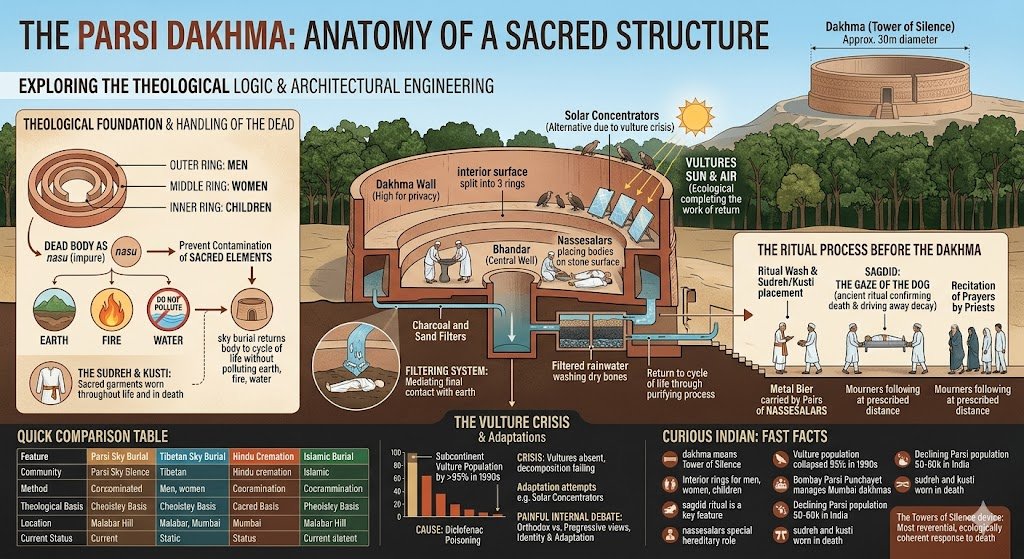
Death, in Zoroastrian understanding, is the one moment when the human body becomes a source of potential pollution. The corpse is understood as nasu, ritually impure. The primary obligation of the community in handling the dead is to prevent this impurity from contaminating the sacred elements. You cannot bury a body in earth without polluting the earth. You cannot consign it to water without polluting water. You cannot burn it without polluting fire, which is the most sacred element of all in Zoroastrian practice.
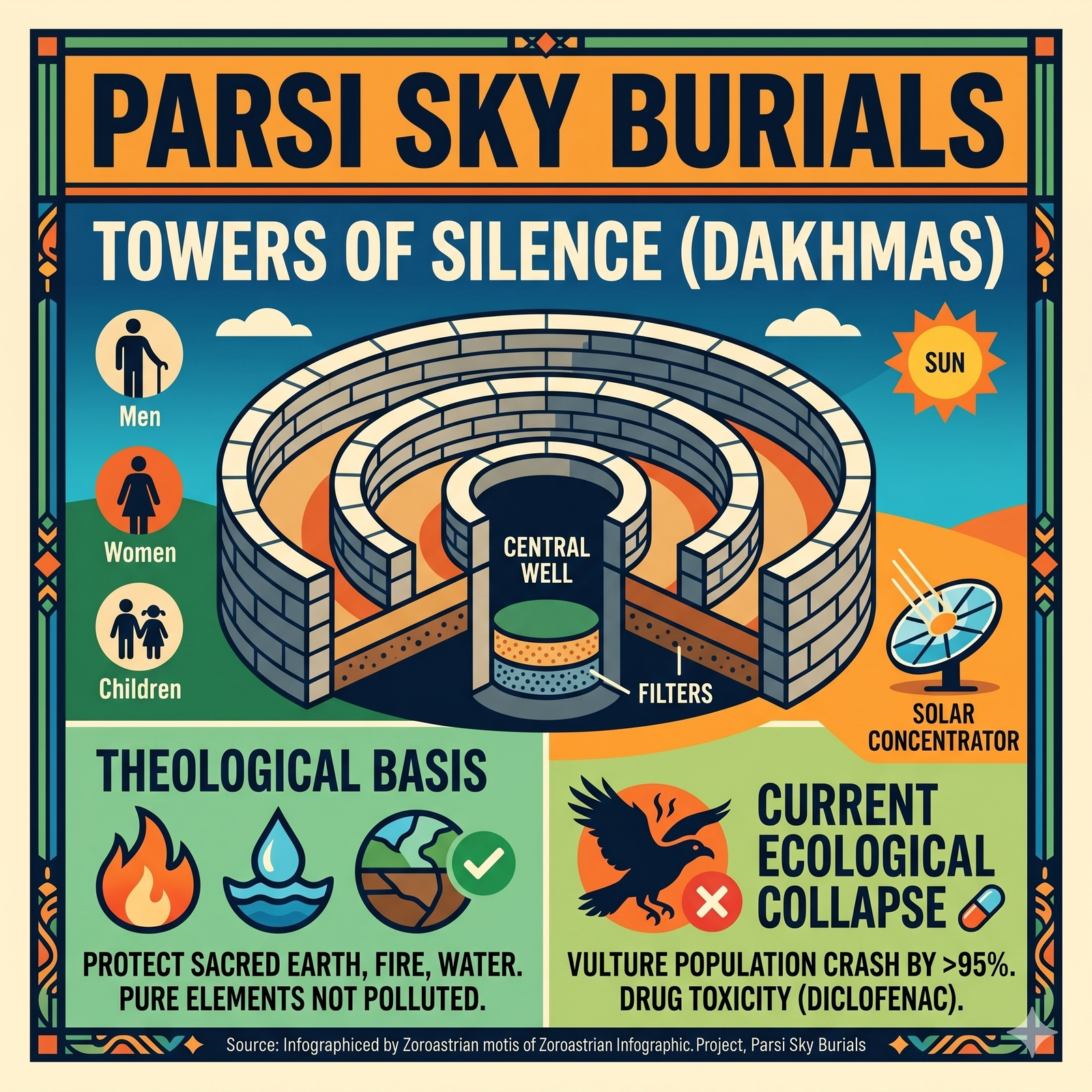
The solution, developed over millennia of theological and practical reflection, is to give the body to the sky. To lay it on a stone surface open to the sun and to scavenging birds, allowing it to be consumed and returned to the cycle of life without contaminating any of the elements that Zoroastrian theology holds sacred. The sun, understood as the eye of Ahura Mazda, purifies what remains. The birds complete the work of return. The stone tower, which cannot be polluted by the dead in the way that earth or water can, provides the surface on which this happens.
Reign of Chandragupta I: The Founder of the Gupta Golden Age
The Architecture of the Dakhma
The dakhma, the Tower of Silence, is a precisely engineered structure whose design encodes the theological logic of the tradition it serves. The Mumbai towers, managed by the Bombay Parsi Punchayet, are circular stone structures approximately thirty meters in diameter and several meters high, with walls tall enough to prevent visibility from outside. The interior surface of the tower is divided into three concentric rings.
The outermost ring is for the bodies of men. The middle ring is for women. The innermost ring, closest to the central well, is for children. This arrangement reflects a specific understanding of the relationships between different members of the community in death, with children closest to the central point of return.
At the center of the tower is a deep circular well called the bhandar. Once the sun and the birds have done their work and the bones are dry, they are gathered and deposited in the bhandar, where they slowly disintegrate and are washed by rainwater through charcoal and sand filters into the earth. The filtering system is itself a theological device, ensuring that even this final contact between the remains and the natural world is mediated through a purifying process.
The nassesalars, the men whose hereditary responsibility it is to carry the bodies into the dakhma and arrange them on the stone surface, are among the most ritually specialized members of the Parsi community. Their work is considered simultaneously essential and isolating. Because of their constant contact with nasu, they are required to maintain specific ritual protocols in their daily lives that limit their contact with other community members in certain contexts. This hereditary specialization dates back centuries and is one of the most ancient institutional features of the tradition.
The Ritual Preparation of the Body
Before a body reaches the Tower of Silence, it passes through a sequence of ritual preparation that begins in the home of the deceased. The body is washed and dressed in a white sudreh, the sacred inner garment that every Zoroastrian wears from the time of their initiation, and a kusti, the sacred thread woven from wool that is tied around the waist. These garments are worn in death as they were worn in life, the continuity of the sacred dress marking the continuity of the person’s relationship with their faith across the boundary of death.
A dog is brought to view the body, a ritual called sagdid, meaning the gaze of the dog. The dog’s gaze is understood in Zoroastrian tradition to drive away the demon of decay and to confirm that life has departed from the body. This practice, ancient in its origins and documented in the Avesta, the Zoroastrian sacred scripture, is one of the most distinctive features of the tradition.
Prayers are recited by priests throughout the preparation period. The body is then carried to the dakhma on a metal bier by the nassesalars, who work in pairs and are accompanied by mourners who follow at a prescribed distance, holding a white cloth between them in pairs to maintain a ritual connection to the procession without coming into direct contact with the nasu.
Reign of Muhammad bin Tughluq: When Brilliance Met Disaster
The Vulture Crisis
The practice that has sustained the Parsi sky burial tradition for over a thousand years depends on a specific ecological relationship: the presence of vultures in sufficient numbers to consume the bodies laid on the dakhma within hours of their placement. In the early twentieth century, the towers on Malabar Hill were surrounded by white-backed vultures that were once common across the Indian subcontinent, and the process the tradition required proceeded efficiently.
In the 1990s, the vulture population of the Indian subcontinent collapsed. The cause was eventually identified as diclofenac, an anti-inflammatory drug used in veterinary medicine that proved fatally toxic to vultures who consumed the carcasses of treated animals. Within a decade, a population that had numbered in the tens of millions was reduced by more than ninety-five percent.
For the Parsi community, the consequences were immediate and deeply distressing. Without vultures, the bodies placed on the dakhma were not being consumed. The process that was central to the tradition’s theological integrity was failing. The Bombay Parsi Punchayet began exploring alternative methods, including solar concentrators that could accelerate the decomposition process through focused sunlight, to replace the function the vultures had performed.
A Community in Internal Debate
The response to the vulture crisis has not been uniform within the Parsi community. A significant portion of the community, particularly those with more orthodox religious views, insists that the dakhma tradition must be maintained in its original form and that any significant alteration represents an unacceptable departure from a practice of fundamental religious and theological importance. They have resisted the adoption of alternative burial methods, including burial in Zoroastrian cemeteries that some community members have advocated.
Others within the community argue that the theological principle underlying the sky burial—the protection of sacred elements from pollution—is more important than the specific architectural form of the dakhma, and that if the dakhma cannot function as intended, alternative methods that honor the same principle are theologically legitimate.
This internal debate has unfolded against the backdrop of the Parsi community’s broader demographic crisis. The Parsi population in India has been declining for decades due to low birth rates and emigration. The community that once numbered over one hundred thousand in India now numbers somewhere between fifty and sixty thousand. The question of how to maintain the integrity of a tradition in a community under demographic and ecological pressure simultaneously is one the community is working through in real time.
The Parsi community’s engagement with these questions has been supported by institutions including the Parzor Foundation, a UNESCO-partnered project dedicated to preserving and promoting Zoroastrian culture and heritage in India. The foundation has been involved in documenting the dakhma tradition and supporting the community’s efforts to navigate its current challenges.
Intricate Kolam Floor Art Drawn Daily in South Indian Homes
A Tradition Under Pressure and Still Standing
The Towers of Silence ask something of those who try to understand them from outside the tradition. They ask for the suspension of the assumptions about death and disposal that most people carry without examining. Within those assumptions, exposure of the dead to birds seems disturbing. Within the Zoroastrian framework that produced the dakhma, it is the most reverential and the most ecologically coherent response to death that a community has devised.
The vulture crisis has placed that framework under a pressure it was not designed to withstand. The birds that were the essential biological component of the tradition are gone. The solar concentrators are a sincere attempt to honor the tradition’s principles in changed circumstances. Whether they succeed in preserving what matters most about the tradition is a question the community is still working through.
What is certain is the seriousness of the tradition itself. A community that has maintained a specific relationship with death across fifteen centuries, across the displacement from Iran to India, across colonialism and modernization and now ecological collapse, is not maintaining it out of habit. It is maintaining it because the theology behind it remains coherent and the identity it expresses remains real. The Towers of Silence are still standing on Malabar Hill. The community they serve is still here.
Danda Nata: Twenty One Days of Sacred Suffering in Odisha
Why Toda Tribe Honors Their Sacred Buffaloes in Nilgiri Hills
If you think you have remembered everything about this topic take this QUIZ
This quiz no longer existsWhat is the theological reason behind the Parsi sky burial tradition?
Zoroastrian theology holds that earth, fire and water are sacred elements that must not be polluted by the dead. A body cannot be buried without polluting earth, consigned to water without polluting water or cremated without polluting fire. The sky burial on the dakhma avoids all three forms of pollution by exposing the body on a stone surface to the sun and to scavenging birds, returning it to the natural cycle without contaminating any sacred element.
What is a dakhma and how is it designed?
A dakhma is a circular stone tower, open to the sky, on whose interior surface bodies are laid after death. The interior is divided into three concentric rings, the outermost for men, the middle for women and the innermost for children. At the center is a deep well called the bhandar into which dried bones are eventually deposited. The design encodes the theological logic of the tradition in its architecture.
What happened to the vulture population and why does it matter for this tradition?
In the 1990s, the vulture population of the Indian subcontinent collapsed by over ninety-five percent due to diclofenac, a veterinary anti-inflammatory drug that proved fatally toxic to vultures. Without vultures, the bodies placed on the dakhma are not consumed as the tradition requires. The Bombay Parsi Punchayet has explored solar concentrators as an alternative means of accelerating decomposition, but the loss of the vultures remains the most serious practical challenge the tradition has faced
What is the ritual of sagdid and what is its significance?
Sagdid means the gaze of the dog in Avestan. It is a ritual in which a dog is brought to view the body of the deceased before the funeral proceedings continue. In Zoroastrian tradition, the dog’s gaze is understood to drive away the demon of decay and to confirm that life has departed from the body. The practice is documented in the Avesta, the Zoroastrian sacred scripture, and is one of the oldest continuously practiced elements of the funeral tradition.
How is the Parsi community responding to the challenges facing the sky burial tradition?
The community is divided between those who insist on maintaining the dakhma tradition in its original form and those who advocate for alternative methods that honor the same theological principles. The Bombay Parsi Punchayet has introduced solar concentrators to help address the absence of vultures. The Parzor Foundation, a UNESCO-partnered project, has been documenting the tradition and supporting the community’s efforts to navigate its current ecological and demographic challenges.
Sources & References
Zoroastrian sacred texts and theological documentation — Avesta (Zoroastrian scripture), concepts of nasu (ritual impurity), sacred elements (fire, water, earth, air), and theological principles of purity and pollution.
Parsi community historical records — Bombay Parsi Punchayet archives, management of the Mumbai Towers of Silence on Malabar Hill, dakhma architecture and design specifications, ritual procedures and nassesar roles.
Vulture population documentation — Indian subcontinent vulture decline statistics (95% reduction in 1990s), diclofenac toxicity research, ecological impact studies on sky burial practice.
Parsi demographic data — population statistics (from 100,000+ to 50,000-60,000), emigration patterns, birth rate trends, and religious minority status in India.
Parzor Foundation documentation — UNESCO-partnered project records on Zoroastrian culture preservation, dakhma tradition documentation, and community response to ecological and demographic challenges.
Tata Institute of Social Sciences research — studies on minority religious communities navigating environmental change, Parsi community response to the vulture crisis.
Parsi funerary rituals and practices — sagdid (dog gaze ritual), preparation procedures, sudreh and kusti (sacred garments), kusti (sacred thread), and procession protocols.