Thursday, May 21, 2026
14 °c
Columbus
Curious Indian
  • Arts & Culture
  • Festivals of India
  • Indian History
  • Indian Politics
  • Biography
    • Entertainment Personalities
    • Science Personalities
  • Unsolved India
No Result
View All Result
  • Arts & Culture
  • Festivals of India
  • Indian History
  • Indian Politics
  • Biography
    • Entertainment Personalities
    • Science Personalities
  • Unsolved India
No Result
View All Result
Curious Indian
No Result
View All Result
Home Biography Artists & Cultural Icons

The Dark Ink Masks of Rabindranath Tagore

paripurnadatta by paripurnadatta
in Artists & Cultural Icons, Arts & Culture, Biography, Paintings & Visual Arts
Reading Time: 9 mins read
0 0
A A
Rabindranath Tagore
Share on FacebookShare on Twitter

Table of Contents

Toggle
  • The Silent Shift in Expression
  • Mistakes Turned into Magic
  • The Haunting Human Faces
  • A Break from Traditional Beauty
  • Uncovering the Psychological Depths
  • Tools of the Unplanned Trade
  • Taking the Shadows to the World
  • Quick Comparison Table
  • Curious Indian: Fast Facts
  • Conclusion
  • If you think you have remembered everything about this topic take this QUIZ
  • Results
    • #1. At what stage of his life did Rabindranath Tagore unexpectedly shift his creative focus from writing to painting?
    • #2. How did the visual patterns that birthed Tagore’s new artistic career initially begin?
    • #3. What specific commercial medium readily found on his writing desk did Tagore primarily use for his dark portraits?
    • #4. What name is frequently used to describe the haunting, hollow-eyed human faces that became a primary subject of Tagore’s art?
    • #5. In which major city did Rabindranath Tagore hold his first successful public art exhibition in the year 1930?
    • #6. How did Tagore’s artistic style differ from the contemporary Bengal School of Art led by his nephew Abanindranath Tagore?
    • #7. According to the fast facts, what physical condition is believed to have influenced Tagore’s unique, earthy color choices?
    • #8. Why did Rabindranath Tagore intentionally choose to never give official titles to his paintings?
    • When did Rabindranath Tagore start painting?
    • What materials did he use for his art?
    • Why do his faces look so dark and sad?
    • Did he ever exhibit his paintings in public?
    • Where can people view these original paintings today?

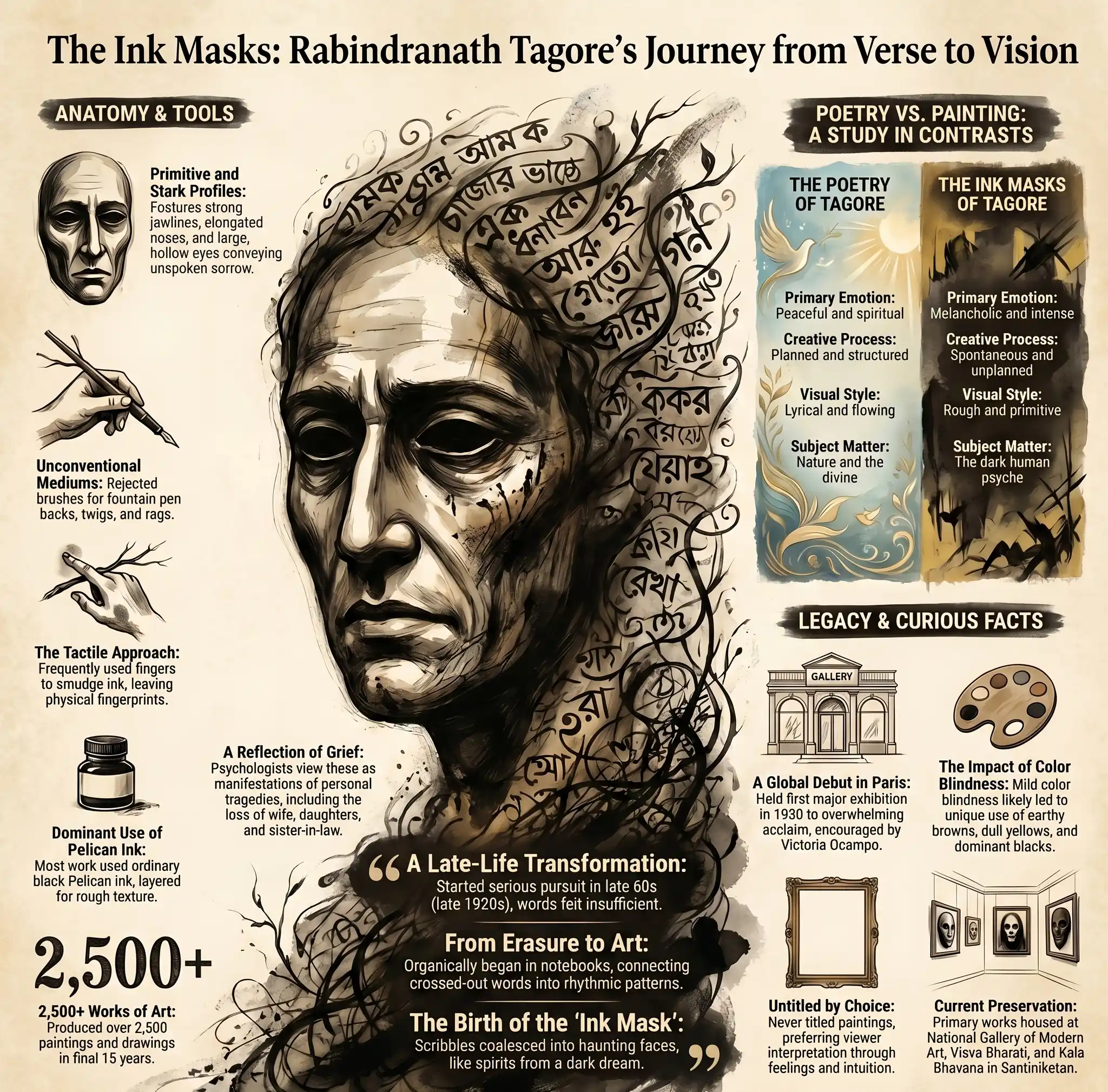
This narrative explores the unexpected journey of a literary giant who turned to painting in the twilight of his life. We dive into how crossed out words on his writing manuscripts slowly evolved into striking and emotional portraits. By examining these mysterious ink masks, we witness the raw human emotions of fear and sorrow that Rabindranath Tagore channeled into his profound visual art.

FeatureDetail
ArtistRabindranath Tagore
Medium UsedPelican ink on paper
Art PeriodLate nineteen twenties to nineteen forties
Primary SubjectHaunting human faces and ink masks
Current LocationNational Gallery of Modern Art and Visva Bharati
Rabindranath Tagore

The Silent Shift in Expression

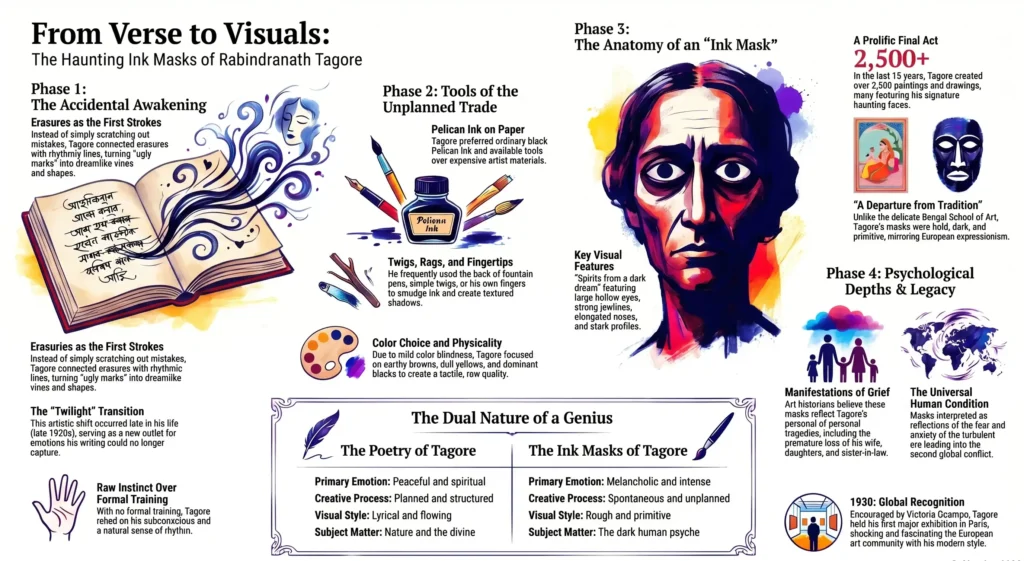
The story of this artistic awakening begins late in a life that was already filled with incredible achievement. When Rabindranath Tagore was approaching his late sixties, the world knew him primarily as a master of words. He was a Nobel laureate whose poems and songs celebrated the divine beauty of nature and the human soul. Yet something profound shifted within him during this twilight period. The words that had always flowed so easily began to feel insufficient for the deep emotions he was experiencing. A heavy silence began to replace his usual melodies.

During his quiet hours of writing, Tagore found himself lingering over his mistakes. Instead of simply scratching out a wrong word, he began to connect the lines of his erasures. He let his pen wander across the page in a dreamlike state. These random scribbles slowly took on a life of their own. They formed rhythmic patterns that looked like strange vines or unknown creatures. This was the quiet and completely unplanned birth of a new artistic genius. The transition from a celebrated writer to an experimental painter happened not in a grand studio but in the lonely margins of his own notebooks.

READ MORE:  Reign of Akbar: How a 13-Year-Old Boy Became "Akbar the Great"

Mistakes Turned into Magic

To truly understand these paintings, we must look at how they were born. The process was entirely organic and deeply personal. When Tagore crossed out a word, he felt a strange sense of pity for the ugly mark left on the clean paper. He felt an urge to rescue these mistakes and turn them into something beautiful. He started weaving the crossed out words together with thick black ink. This rhythmic connection of errors soon transformed his manuscripts into incredible visual tapestries.

He did not have formal training in fine arts. He did not know the strict rules of perspective or anatomy that other artists studied for years. Instead he relied entirely on his raw instinct and a deep sense of rhythm. He let the ink guide his hand without any preconceived plan. This freedom allowed his subconscious mind to pour out onto the paper. The shapes he created were completely unique to his own inner world. They were not meant to please anyone else. They were a private conversation between the artist and his own wandering thoughts.

The Haunting Human Faces

As his confidence grew, the abstract shapes on his manuscripts began to evolve into distinct figures. The most striking and memorable of these were the human faces. These faces are often referred to as his ink masks. They are incredibly powerful and deeply unsettling. The portraits do not look like ordinary people you might pass on the street. Instead they look like spirits emerging from a dark dream. They stare out from the paper with large and hollow eyes that seem to hold an ocean of unspoken sorrow.

The faces are often drawn in stark profile or head on. They feature strong jawlines and elongated noses. The heavy use of dark pelican ink gives them a rough and primitive texture. There is no joy in these faces. They speak of melancholy, isolation, and a deep understanding of human suffering. When you look at them, you can feel the immense weight of the years Tagore had lived. These ink masks capture the raw and unfiltered emotions that polite society often tries to hide away.

A Break from Traditional Beauty

The artistic style of these masks was a massive departure from the popular art of the time. The Bengal School of Art which was led by his own nephew Abanindranath Tagore focused heavily on delicate lines and soft colors. They painted romantic scenes from mythology and history. Rabindranath completely ignored this gentle tradition. His art was bold and dark and sometimes entirely chaotic. He did not care about painting beautiful or perfect figures.

He wanted to capture the fierce energy of life itself. His work shared more in common with primitive art and the expressionist movements happening in Europe than with anything going on in India at the time. The colors he used later in his paintings were often earthy and muted. He used browns and dull yellows mixed with dominant blacks. This bold rejection of traditional beauty shocked many of his admirers. They could not understand why the poet of peace was creating such dark and disturbing images.

READ MORE:  Gommateshwara Statue and the Philosophy of Inner Peace

Uncovering the Psychological Depths

Art historians and psychologists have spent decades trying to decode the meaning behind these haunting masks. Many believe they are a direct reflection of his immense personal tragedies. Throughout his life, Tagore lost many of the people he loved most deeply. His wife, his daughters, and his beloved sister in law all passed away prematurely. He carried a massive burden of grief within his heart. The ink masks are seen as a visual manifestation of this deep and lingering sadness.

Others believe the faces represent the universal human condition. They see the masks as a reflection of the fear and anxiety that gripped the world during the turbulent years leading up to the second global conflict. The raw and unpolished nature of the artwork strips away all social masks, revealing the vulnerable soul underneath. Whatever the true inspiration was, the emotional impact of the paintings is undeniable. They force the viewer to confront the darker realities of existence that Tagore himself was bravely facing in his final years.

Tools of the Unplanned Trade

The way Tagore painted was as unconventional as the art itself. He rarely used proper artist brushes or expensive canvases. He preferred to use whatever was immediately available on his writing desk. His primary medium was ordinary black pelican ink. He would apply it using the back of his fountain pen or a simple twig. He often used his own fingers to smudge the ink and create deep shadows.

Sometimes he would dip a piece of rag into the ink to create broad and sweeping textures across the paper. This tactile and physical approach to painting gave his work a uniquely raw quality. The fingerprints and smudges left on the paper serve as a permanent physical connection to the artist himself. It is as if he was trying to physically mold his emotions into shape with his bare hands. This urgent and immediate technique perfectly matched the intense feelings he was trying to express.

Taking the Shadows to the World

Despite his initial hesitation, Tagore eventually shared his visual art with the public. In nineteen thirty, he held his first major art exhibition in Paris. The response from the European art community was overwhelmingly positive. They were fascinated by the raw power and modern feel of his work. They recognized a kindred spirit in his bold expressionism. The exhibition traveled to several other major cities, bringing his dark and emotional masks to a global audience.

Today these paintings are considered a vital part of his immense legacy. They are carefully preserved in institutions to ensure future generations can experience their power. While his poetry continues to soothe the soul, his ink masks serve as a powerful reminder of the complex and brilliant mind behind the words. They prove that true artistic genius cannot be contained within a single medium. The haunting faces remain a profound gift, inviting us to look closely at the beautiful and terrifying depths of the human heart.

READ MORE:  Razia Sultan: The Woman Who Ruled Delhi as a "Sultan"

Quick Comparison Table

AspectThe Poetry of TagoreThe Ink Masks of Tagore
Primary EmotionPeaceful and spiritualMelancholic and intense
Creative ProcessPlanned and structuredSpontaneous and unplanned
Visual StyleLyrical and flowingRough and primitive
Subject MatterNature and the divineThe dark human psyche

Curious Indian: Fast Facts

  • He created over two thousand five hundred paintings and drawings in the last fifteen years of his life.
  • He suffered from a mild form of color blindness which experts believe influenced his unique and earthy color choices.
  • His first art exhibition was highly encouraged and organized by an Argentine writer named Victoria Ocampo.
  • He never gave titles to his paintings because he wanted the viewer to interpret the meaning purely through their own feelings.
  • Many of his original ink masks are safely housed and displayed at the Kala Bhavana in Santiniketan.

Conclusion

The final chapter of Rabindranath Tagore is a beautiful testament to the endless possibilities of the human spirit. When his poetic voice grew quiet, his hands found a new way to speak. The haunting ink masks he left behind are not just strange drawings on old paper. They are the deeply personal diary entries of a brilliant mind grappling with mortality and grief. Through dark ink and rough smudges, he revealed a vulnerable side that his polished writings often kept hidden.

These striking faces challenge us to look beyond the calm surface of the legendary poet and understand the complex human being underneath. They remind us that it is never too late to reinvent ourselves or to find a new way to express our deepest truths. The mystery of the ink masks continues to captivate art lovers everywhere, standing as a permanent monument to a creative genius that literally flowed right to the very end of his life.

If you think you have remembered everything about this topic take this QUIZ


Results

Share your score!
Tweet your score!
Tweet your score!
Share to other
QUIZ START

#1. At what stage of his life did Rabindranath Tagore unexpectedly shift his creative focus from writing to painting?

Previous
Next

#2. How did the visual patterns that birthed Tagore’s new artistic career initially begin?

Previous
Next

#3. What specific commercial medium readily found on his writing desk did Tagore primarily use for his dark portraits?

Previous
Next

#4. What name is frequently used to describe the haunting, hollow-eyed human faces that became a primary subject of Tagore’s art?

Previous
Next

#5. In which major city did Rabindranath Tagore hold his first successful public art exhibition in the year 1930?

Previous
Next

#6. How did Tagore’s artistic style differ from the contemporary Bengal School of Art led by his nephew Abanindranath Tagore?

Previous
Next

#7. According to the fast facts, what physical condition is believed to have influenced Tagore’s unique, earthy color choices?

Previous
Next

#8. Why did Rabindranath Tagore intentionally choose to never give official titles to his paintings?

Previous
Finish

When did Rabindranath Tagore start painting?

He seriously began drawing and painting when he was around sixty seven years old in the late nineteen twenties.

What materials did he use for his art?

He mostly used ordinary writing ink on paper, applying it with fountain pens, twigs, small rags, and even his own fingers.

Why do his faces look so dark and sad?

Experts believe the dark emotion reflects his deep personal grief over losing many family members and his thoughts on human suffering.

Did he ever exhibit his paintings in public?

Yes, he held his first major and highly successful art exhibition in Paris in the year nineteen thirty.

Where can people view these original paintings today?

Many of his original artworks are kept at the National Gallery of Modern Art in New Delhi and the museum in Santiniketan.

Tags: Cultural IconsIndian ArtInk PaintingsRabindranath TagoreVisva Bharati
ShareTweetPin
paripurnadatta

paripurnadatta

Related Posts

Kangra miniature paintings
Arts & Culture

The Romantic Soul of Kangra Miniature Paintings 

May 21, 2026
Nandalal Bose
Arts & Culture

How Nandalal Bose Painted Artwork of Indian Constitution

May 21, 2026
Khudiram Bose
Biography

The Final Letters of Khudiram Bose and Soul of Young Bengal

May 20, 2026
No Result
View All Result

Stay Updated

  • Trending
  • Latest
Life of Mahavira: From Prince Vardhamana to Great Conqueror

Life of Mahavira: From Prince Vardhamana to Great Conqueror

April 11, 2026
Life of Buddha: The Journey to Enlightenment

Life of Buddha: The Journey to Enlightenment

April 11, 2026
Christmas in India

Christmas in India: A Festive Blend of Faith, Flavors, and Tradition

April 11, 2026
From Shimla to Stardom: The Complete Biography of Anupam Kher

From Shimla to Stardom: The Complete Biography of Anupam Kher

April 11, 2026
Rabindranath Tagore

The Dark Ink Masks of Rabindranath Tagore

May 21, 2026
Kangra miniature paintings

The Romantic Soul of Kangra Miniature Paintings 

May 21, 2026
Nandalal Bose

How Nandalal Bose Painted Artwork of Indian Constitution

May 21, 2026
Khudiram Bose

The Final Letters of Khudiram Bose and Soul of Young Bengal

May 20, 2026

Widget Title

Facebook Twitter Youtube RSS
Curious Indian Logo

Explore the soul of Bharat with Curious Indian. A definitive guide to Indian history, arts, culture, biographies, and the events that defined our future.

Follow us on social media:

Recent News

  • The Dark Ink Masks of Rabindranath Tagore
  • The Romantic Soul of Kangra Miniature Paintings 
  • How Nandalal Bose Painted Artwork of Indian Constitution

Category

  • Ancient Civilizations & The Vedic Age
  • Architecture
  • Artists & Cultural Icons
  • Arts & Culture
  • Battles of India
  • Biography
  • Business & Industrialists
  • Colonial India
  • Cultural Insights
  • Dance & Music
  • Entertainment Personalities
  • Festivals of India
  • Freedom Fighters
  • Freedom Movement
  • Historical Events & Turning Points
  • Indian History
  • Indian Politics
  • Major Festivals
  • Medieval India
  • North East India
  • Paintings & Visual Arts
  • Political Leaders
  • Post-Independence India
  • Regional Culture
  • Religious & Spiritual Figures
  • Science Personalities
  • Scientific Discoveries
  • Sculpture
  • Social Issues
  • SOCIETY & MYSTERIES
  • Strange & Unknown Stories
  • Textiles & Handicrafts
  • Uncategorized
  • Unsolved India
  • Unsung Heroes

© 2026 Curious Indian- Everything about India

Welcome Back!

Login to your account below

Forgotten Password?

Retrieve your password

Please enter your username or email address to reset your password.

Log In

Add New Playlist

No Result
View All Result
  • Arts & Culture
  • Festivals of India
  • Indian History
  • Indian Politics
  • Biography
    • Entertainment Personalities
    • Science Personalities

© 2026 Curious Indian- Everything about India

This website uses cookies. By continuing to use this website you are giving consent to cookies being used. Visit our Privacy and Cookie Policy.
Are you sure want to unlock this post?
Unlock left : 0
Are you sure want to cancel subscription?
×