Thursday, May 21, 2026
14 °c
Columbus
Curious Indian
  • Arts & Culture
  • Festivals of India
  • Indian History
  • Indian Politics
  • Biography
    • Entertainment Personalities
    • Science Personalities
  • Unsolved India
No Result
View All Result
  • Arts & Culture
  • Festivals of India
  • Indian History
  • Indian Politics
  • Biography
    • Entertainment Personalities
    • Science Personalities
  • Unsolved India
No Result
View All Result
Curious Indian
No Result
View All Result
Home Arts & Culture

The Romantic Soul of Kangra Miniature Paintings 

paripurnadatta by paripurnadatta
in Arts & Culture, Indian History, Medieval India, Paintings & Visual Arts
Reading Time: 15 mins read
0 0
A A
Kangra miniature paintings
Share on FacebookShare on Twitter

Table of Contents

Toggle
  • The Soft Breath of the Mountains
  • A Refuge for the Artistic Spirit
  • The Language of Eternal Love
    •  
  • Colors Made from the Earth
  • Nature as a Sacred Stage
  • The Legacy of the Master Brush
  • The Mystery of the Unnamed Artists
  • Quick Comparison Table
  • Curious Indian: Fast Facts
  • Conclusion 
  • If you think you have remembered everything about this topic take this QUIZ
  • Results
    • #1. In which region did the Kangra miniature paintings bloom under the shadow of the Dhauladhar range?
    • #2. Which school of traditional Indian art does the Kangra style primarily belong to?
    • #3. Who was the ambitious ruler and primary patron under whose reign the Kangra school reached its peak?
    • #4. What central romantic theme and divine relationship lies at the heart of almost every Kangra miniature painting?
    • #5. From which source did the Kangra artists meticulously extract their deep blue pigments?
    • #6. What unique material was used to make the fine-tipped brushes that allowed artists to paint such intricate details?
    • #7. What durable and smooth specialized paper was utilized by the Kangra artists for their miniature masterpieces?
    • #8. Which famous classical poem heavily influenced the romantic and devotional themes depicted in Kangra art?
    • Where can I see the best collection of Kangra paintings?
    • What are the main colors used in these paintings?
    • Why are these paintings called miniatures?
    • Who was the most famous patron of Kangra art?
    • Are there any living artists who still practice this style?

This article explores the breathtaking beauty and emotional depth of the Pahari art tradition. We dive into how the artists of the Kangra Valley moved away from bold styles to create a softer, more lyrical form of expression. By looking at their use of natural colors and local landscapes, we uncover the mystery of how these small paintings managed to capture the massive scale of human emotion and divine romance.

FeatureDetail
OriginKangra Valley Himachal Pradesh
PeriodLate Eighteenth Century
StylePahari School of Art
Main ThemesLove Devotion and Nature
Primary PatronRaja Sansar Chand
Kangra miniature paintings

The Soft Breath of the Mountains

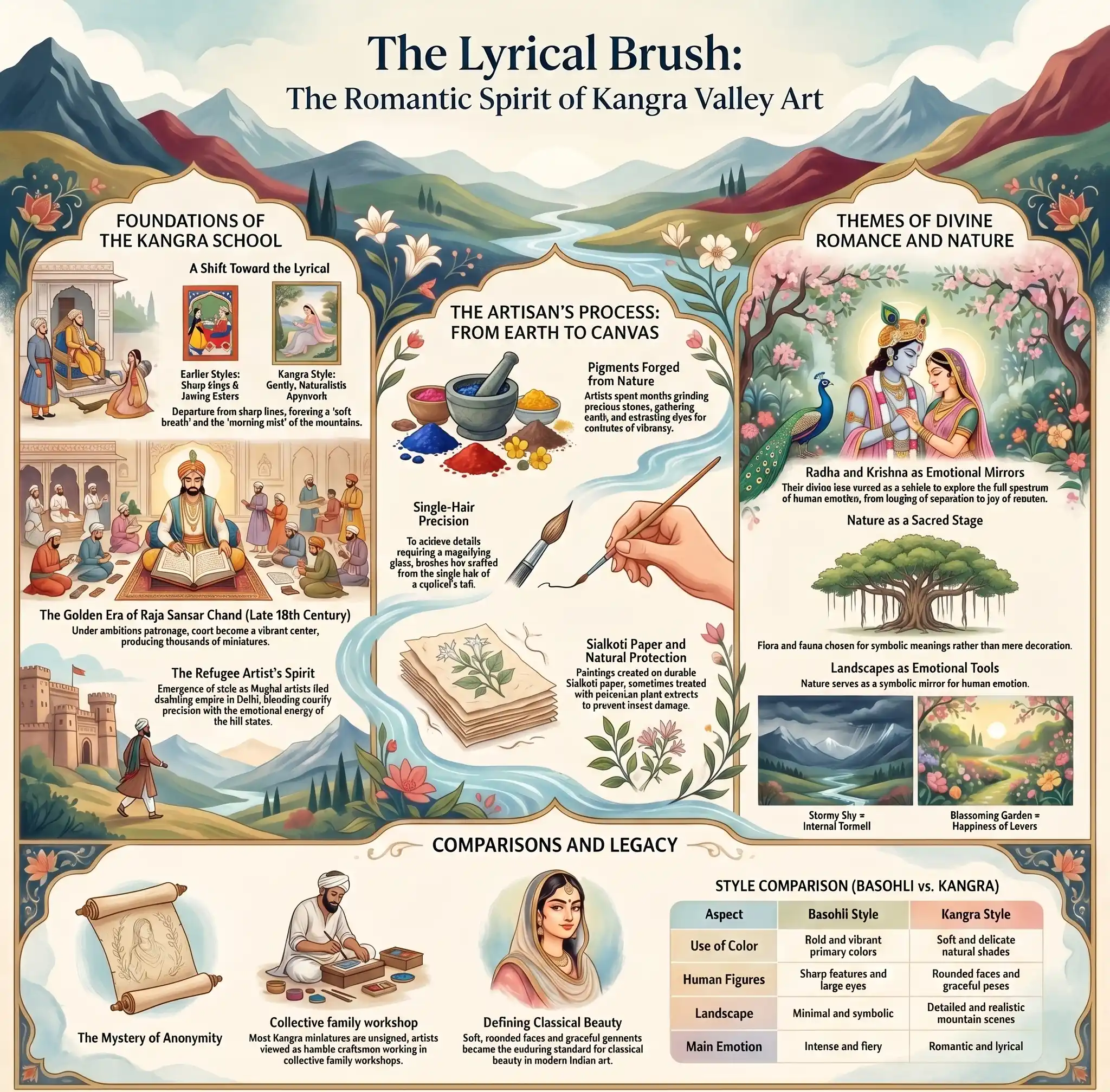
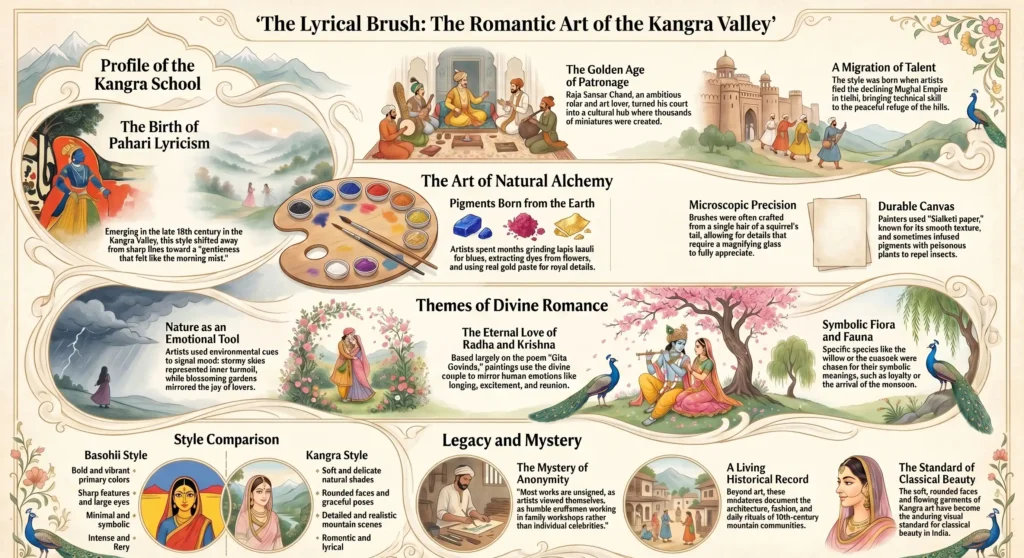
The story of these paintings begins where the earth meets the sky in the shadow of the Dhauladhar range. In the late eighteenth century, a new kind of beauty began to bloom in the Kangra Valley. Unlike the earlier styles of art that used sharp lines and bright, jarring colors, the artists here began to paint with a gentleness that felt like the morning mist. This was the birth of a style that would eventually define the romantic spirit of the hills. Walking through the galleries where these works are kept today feels like entering a silent, colorful dream.

The artists did not just paint figures. They painted the very atmosphere of the valley. You can almost feel the cool breeze moving through the trees and hear the distant sound of mountain streams in their work. This shift toward a more natural and lyrical style was not just a change in technique. It was a change in how people perceived the world around them. They began to see the divine in the everyday beauty of their surroundings. This deep connection to the land is a recurring theme in our history, much like the deep roots discussed in the Ahom Kingdom History where the environment shaped the destiny of a people.

READ MORE:  How the Kailasa Temple Was Carved From a Single Mountain

How Nandalal Bose Painted Artwork of Indian Constitution

A Refuge for the Artistic Spirit

The rise of this art form was a direct result of shifting power and searching spirits. When the Mughal Empire began to decline, many talented artists left the plains of Delhi in search of new patrons and peaceful lands. They found a welcoming home in the small hill states of the Punjab Himalayas. Here, away from the chaos of war and political intrigue, their creativity found a new life. They brought with them the technical skills of the Mughal courts but combined them with the raw, emotional energy of the mountains.

One of the most important figures in this story is Raja Sansar Chand. He was a young and ambitious ruler who had a deep passion for the arts. Under his generous patronage, the Kangra school reached its absolute peak. He turned his court into a vibrant center for poets, musicians, and painters. This era of cultural growth mirrors the intellectual flourishing found in The Kamarupa Ascendancy, where strong leadership allowed art and philosophy to thrive side by side. The artists at his court were encouraged to experiment and push the boundaries of their craft, leading to the creation of thousands of breathtaking miniatures. Many of these works are now carefully preserved by the National Museum of India for future generations to study and enjoy.

The Language of Eternal Love

At the heart of almost every painting from this period is the theme of romance. Specifically, the artists focused on the divine love between Radha and Krishna. They used this legendary relationship as a mirror for all human emotions. The paintings show the lovers in various moods: the excitement of a first meeting, the painful longing of separation, and the quiet joy of a secret reunion. These were not just religious icons. They were deeply human portraits of what it feels like to be in love.


1 of 3
– +
Kangra miniature paintings

The artists used the landscape of the Kangra Valley to heighten these emotions. A stormy sky might represent the turmoil in a lover’s heart, while a blossoming garden would mirror the happiness of a successful meeting. This use of nature as an emotional tool is a hallmark of the style. The figures are drawn with incredibly fine lines and graceful poses, giving them an almost ethereal quality. This attention to emotional detail is something we see across different eras of Indian storytelling, from the ancient caves to the modern cinematic visions of Satyajit Ray. The Victoria and Albert Museum holds a significant collection of these works, showcasing their global appeal as masterpieces of romantic expression.

Colors Made from the Earth

One of the most impressive technical feats of the Kangra artists was their mastery of color. They did not use synthetic dyes. Instead, they spent months preparing their own pigments from natural sources. They ground precious stones, gathered colorful earth, and even extracted dyes from exotic flowers and leaves. This gave their paintings a unique glow and a longevity that has allowed them to remain vibrant for over two hundred years.

READ MORE:  The Eternal Legacy of Charaka Samhita Medicine

The process was slow and required immense patience. Lapis lazuli provided the deep blues of the mountain night, while real gold was often ground into a fine paste to add a royal shimmer to jewelry and palace walls. The brushes were often made from the single hair of a squirrel’s tail, allowing the artists to paint details so fine they can only be truly appreciated with a magnifying glass. This level of craftsmanship shows a dedication to excellence that we also found in the traditional Textiles and Handicrafts of regional India. The Google Arts and Culture platform offers high resolution views of these details, revealing the hidden precision of the ancient masters.

Nature as a Sacred Stage

In Kangra art, the background is never just a background. The trees, birds, and flowers are all active participants in the story. The artists had a deep knowledge of the local flora and fauna. They painted specific species of trees like the willow, the mango, and the banyan, each chosen for its symbolic meaning. Even the birds, such as the peacock or the sarus crane, were used to symbolize loyalty or the arrival of the monsoon.

This love for the natural world was a reflection of the peaceful life in the valley. While other parts of India were facing the turmoil of colonial expansion and the Anglo Manipuri War, the hills offered a temporary sanctuary of beauty. The paintings capture a world that felt safe and eternal. They show us a time when humans lived in perfect harmony with the seasons and the land. This sense of peace and order is something the Archaeological Survey of India works to protect by maintaining the historical sites where these traditions once flourished.

How Madam Bhikaiji Cama Unfurled India’s Flag in Germany

The Legacy of the Master Brush

The influence of the Kangra style did not end when the royal courts faded away. Its impact can be seen in modern Indian art and even in the way we visualize our own history. The soft, rounded faces and the graceful, flowing garments depicted in the miniatures have become a standard for classical beauty in India. These artists created a visual language that feels both ancient and modern at the same time.

Their work also serves as a vital historical record. Through their paintings, we can see the architecture of the period, the fashion of the people, and the daily rituals of the mountain communities. It is a window into a world that has largely changed but still lives on through these small pieces of paper. Even during times of great conflict, such as the Battle of Shalateng or the Battle of Asal Uttar, the memory of this cultural beauty provided a sense of identity and pride to the people of the region. The enduring nature of this art is well documented by Britannica and other academic resources.

The Mystery of the Unnamed Artists

A fascinating mystery of this art form is that most of the paintings are unsigned. The artists saw themselves as humble craftsmen rather than individual celebrities. They worked in family workshops, passing down their secrets from father to son for generations. This anonymity adds a layer of collective soul to the work. It belongs to the valley and the people, rather than just one person.

READ MORE:  Understanding Donyi Polo Religion Today

When you look at a Kangra miniature today, you are looking at the combined skill and spirit of an entire community of creators. They were poets with brushes, capturing the fleeting moments of a Himalayan afternoon and turning them into eternal art. Their ability to find the divine in the human and the cosmic in the local is what makes their work a true treasure of Indian culture.

Quick Comparison Table

AspectBasohli StyleKangra Style
Use of ColorBold and vibrant primary colorsSoft and delicate natural shades
Human FiguresSharp features and large eyesRounded faces and graceful poses
LandscapeMinimal and symbolicDetailed and realistic mountain scenes
Main EmotionIntense and fieryRomantic and lyrical

Curious Indian: Fast Facts

  • The artists often used a special paper called Sialkoti paper which was known for its durability and smooth texture.
  • Poisonous plants were sometimes used in the pigments to prevent insects from eating the delicate paintings over time.
  • The themes were heavily influenced by the Gita Govinda, a famous poem describing the love of Radha and Krishna.
  • Some miniatures are so small that they were meant to be held in the hand and viewed privately like a personal treasure.
  • The Kangra school is considered the final great phase of traditional Indian painting before the arrival of modern styles.

Conclusion 

The Kangra miniature paintings remain one of the most beautiful gifts from the Himalayan foothills to the world. They are more than just historical artifacts. They are living expressions of the human heart. By blending the grandeur of the mountains with the intimacy of a shared glance between lovers, the artists created something truly unique. These paintings remind us that beauty can be found in the smallest details and that love is a language that needs no translation. As we move through our busy modern lives, these quiet masterpieces invite us to slow down and appreciate the soft colors of our own world. They stand as a permanent reminder of a time when art was a sacred duty and nature was the ultimate inspiration. The legacy of the Kangra masters continues to glow with a gentle light, proving that true romance and artistic vision are indeed timeless.

Gommateshwara Statue and the Philosophy of Inner Peace

If you think you have remembered everything about this topic take this QUIZ


Results

Share your score!
Tweet your score!
Tweet your score!
Share to other
QUIZ START

#1. In which region did the Kangra miniature paintings bloom under the shadow of the Dhauladhar range?

Previous
Next

#2. Which school of traditional Indian art does the Kangra style primarily belong to?

Previous
Next

#3. Who was the ambitious ruler and primary patron under whose reign the Kangra school reached its peak?

Previous
Next

#4. What central romantic theme and divine relationship lies at the heart of almost every Kangra miniature painting?

Previous
Next

#5. From which source did the Kangra artists meticulously extract their deep blue pigments?

#6. What unique material was used to make the fine-tipped brushes that allowed artists to paint such intricate details?

Previous
Next

#7. What durable and smooth specialized paper was utilized by the Kangra artists for their miniature masterpieces?

Previous
Next

#8. Which famous classical poem heavily influenced the romantic and devotional themes depicted in Kangra art?

Previous
Finish

Where can I see the best collection of Kangra paintings?

The National Museum in New Delhi and the Chandigarh Museum hold some of the most extensive and beautiful collections of these miniatures.

What are the main colors used in these paintings?

Artists used natural colors like lampblack for black, cinnabar for red, and lapis lazuli for blue, often mixing them with plant extracts.

Why are these paintings called miniatures?

They are called miniatures because of their small size and the incredible level of fine detail that requires very small brushes to execute.

Who was the most famous patron of Kangra art?

Raja Sansar Chand of Kangra is widely regarded as the most important patron who helped the style reach its highest level of perfection.

Are there any living artists who still practice this style?

Yes, there are still a few traditional artist families in the Himachal region who continue to practice and teach these ancient painting techniques.

Tags: Ancient ArtHimalayan CultureIndian HeritageKangra ArtPahari Paintings
ShareTweetPin
paripurnadatta

paripurnadatta

Related Posts

Rabindranath Tagore
Artists & Cultural Icons

The Dark Ink Masks of Rabindranath Tagore

May 21, 2026
Nandalal Bose
Arts & Culture

How Nandalal Bose Painted Artwork of Indian Constitution

May 21, 2026
Khudiram Bose
Biography

The Final Letters of Khudiram Bose and Soul of Young Bengal

May 20, 2026
No Result
View All Result

Stay Updated

  • Trending
  • Latest
Life of Mahavira: From Prince Vardhamana to Great Conqueror

Life of Mahavira: From Prince Vardhamana to Great Conqueror

April 11, 2026
Life of Buddha: The Journey to Enlightenment

Life of Buddha: The Journey to Enlightenment

April 11, 2026
Christmas in India

Christmas in India: A Festive Blend of Faith, Flavors, and Tradition

April 11, 2026
From Shimla to Stardom: The Complete Biography of Anupam Kher

From Shimla to Stardom: The Complete Biography of Anupam Kher

April 11, 2026
Rabindranath Tagore

The Dark Ink Masks of Rabindranath Tagore

May 21, 2026
Kangra miniature paintings

The Romantic Soul of Kangra Miniature Paintings 

May 21, 2026
Nandalal Bose

How Nandalal Bose Painted Artwork of Indian Constitution

May 21, 2026
Khudiram Bose

The Final Letters of Khudiram Bose and Soul of Young Bengal

May 20, 2026

Widget Title

Facebook Twitter Youtube RSS
Curious Indian Logo

Explore the soul of Bharat with Curious Indian. A definitive guide to Indian history, arts, culture, biographies, and the events that defined our future.

Follow us on social media:

Recent News

  • The Dark Ink Masks of Rabindranath Tagore
  • The Romantic Soul of Kangra Miniature Paintings 
  • How Nandalal Bose Painted Artwork of Indian Constitution

Category

  • Ancient Civilizations & The Vedic Age
  • Architecture
  • Artists & Cultural Icons
  • Arts & Culture
  • Battles of India
  • Biography
  • Business & Industrialists
  • Colonial India
  • Cultural Insights
  • Dance & Music
  • Entertainment Personalities
  • Festivals of India
  • Freedom Fighters
  • Freedom Movement
  • Historical Events & Turning Points
  • Indian History
  • Indian Politics
  • Major Festivals
  • Medieval India
  • North East India
  • Paintings & Visual Arts
  • Political Leaders
  • Post-Independence India
  • Regional Culture
  • Religious & Spiritual Figures
  • Science Personalities
  • Scientific Discoveries
  • Sculpture
  • Social Issues
  • SOCIETY & MYSTERIES
  • Strange & Unknown Stories
  • Textiles & Handicrafts
  • Uncategorized
  • Unsolved India
  • Unsung Heroes

© 2026 Curious Indian- Everything about India

Welcome Back!

Login to your account below

Forgotten Password?

Retrieve your password

Please enter your username or email address to reset your password.

Log In

Add New Playlist

No Result
View All Result
  • Arts & Culture
  • Festivals of India
  • Indian History
  • Indian Politics
  • Biography
    • Entertainment Personalities
    • Science Personalities

© 2026 Curious Indian- Everything about India

This website uses cookies. By continuing to use this website you are giving consent to cookies being used. Visit our Privacy and Cookie Policy.
Are you sure want to unlock this post?
Unlock left : 0
Are you sure want to cancel subscription?
×