For thirty years after 1857, old men kept walking up to British officials and announcing that they were Nana Saheb. Each time, the British checked. Each time, it was somebody else
The last of them came forward in 1888.
By then it had happened many times. An elderly man would present himself to a British officer or a magistrate somewhere in northern India and declare that he was Nana Saheb, the rebel Peshwa of Kanpur, the most wanted man in the empire.
Every time, the claim was investigated. Every time, it came to nothing. After 1888 the British quietly stopped looking.
Every time, the claim was investigated. Every time, it came to nothing.
Bithur
He was born Dhondu Pant in 1824, and he grew up at Bithur, near Kanpur, in the household of the last Peshwa, Baji Rao II, who had been defeated by the East India Company and pensioned off there in comfortable exile.
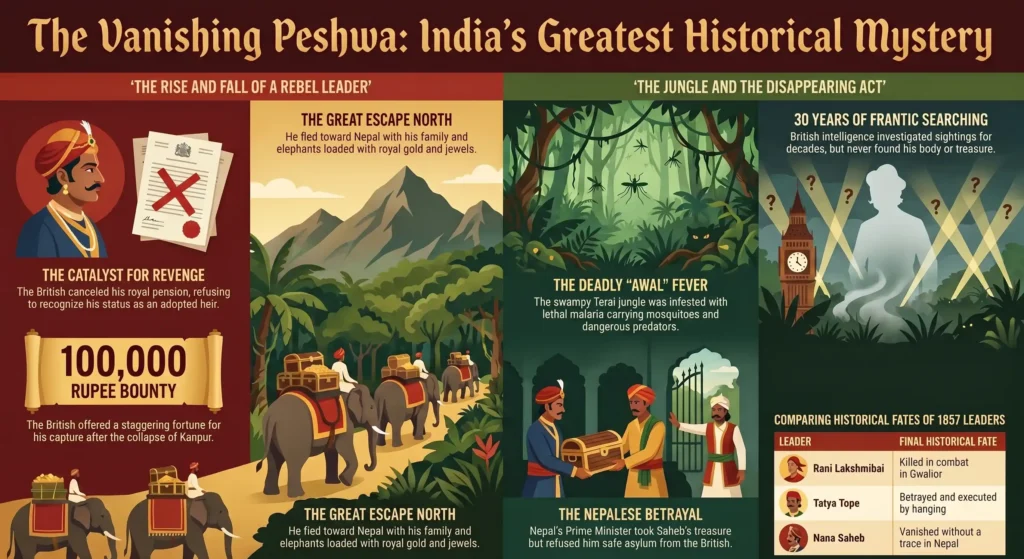
Baji Rao adopted him. When the old man died in 1851, Nana Saheb expected the pension and the honours to continue. The Company refused: an adopted son, it held, had no claim.
He sent agents to plead his case, including to London. He got nowhere. He remained rich, and he remained on good terms with the British families of Kanpur, but the grievance stayed.
Why The 2002 Muhnochwa Attacks Still Terrify Us
The Mysterious Son Bhandar Caves Lost Gold Vault
June 1857
When the sepoys rose in 1857, the rebels at Kanpur turned to him, and he took the leadership.
The British community took shelter in an entrenchment and held out for three weeks in the June heat. Nana Saheb offered terms: safe passage down the Ganga to Allahabad. On 27 June they went down to Satichaura Ghat to board the boats, and there the firing began. Most of the men were killed.
The surviving women and children were held in a house called the Bibighar. On 15 July, with a British column approaching, they were killed there too.
What followed was a reprisal of its own kind. The British retook Kanpur, and their punishment of those they suspected, and of many they did not, was savage. Bibighar became the single most inflammatory word in British India, and Nana Saheb became the name attached to it.
Whether he ordered the killings, allowed them, or lost control of men he could not command has been argued over ever since.
Bibighar became the most inflammatory word in British India, and his was the name attached to it.
North
After the British recaptured Kanpur, he went north, through Awadh, with family, followers and what treasure could be carried.
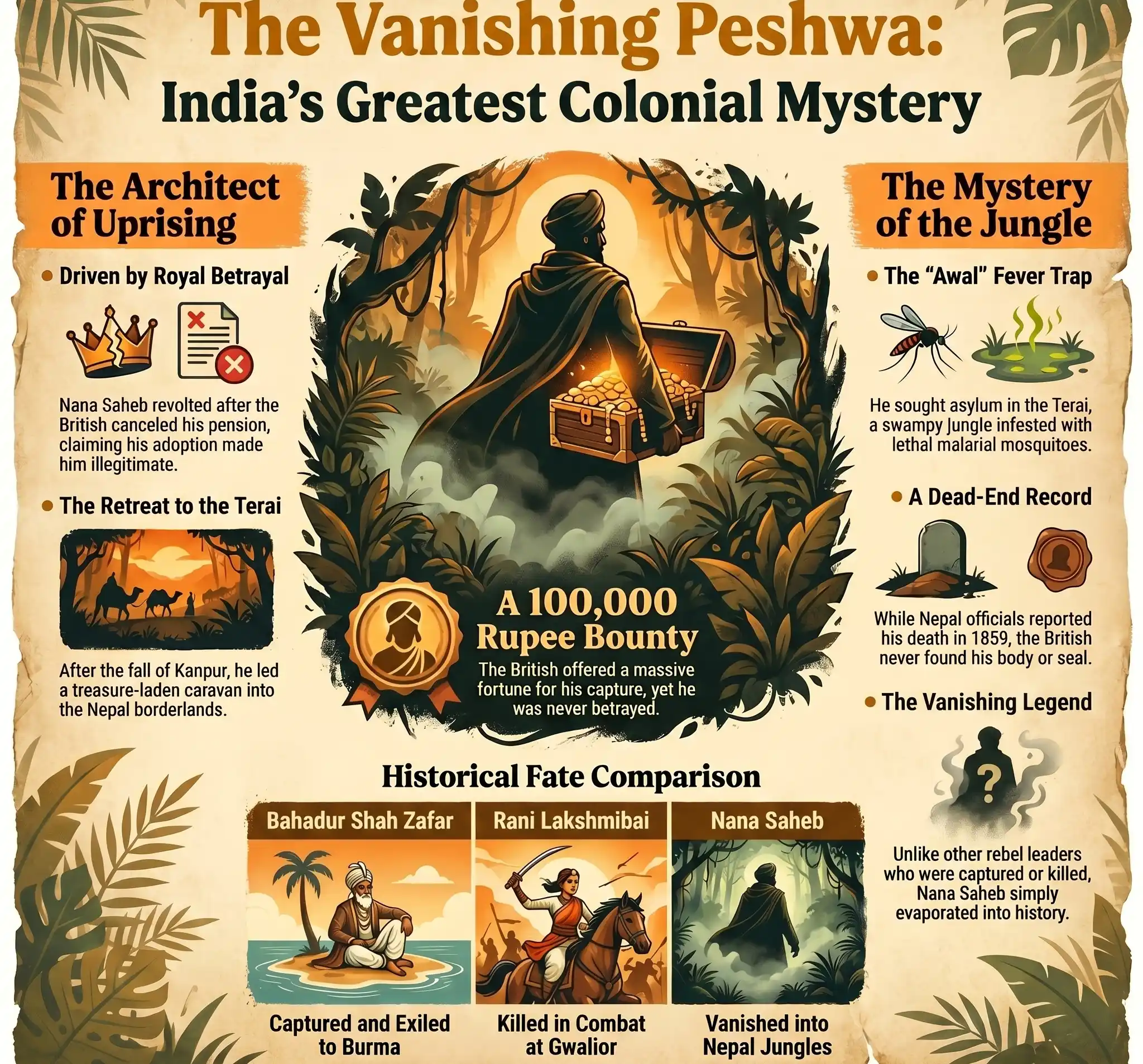
By 1859 he had crossed into the Nepal terai, the belt of dense, swampy jungle along the border, notorious for its fevers.
Nepal was not a natural refuge. Its Prime Minister, Jung Bahadur Rana, had sent troops to help the British put down the rebellion in Awadh. What he did about Nana Saheb is unclear and has been reported in contradictory ways. In February 1860 the British learned that Nana’s wives had taken refuge in Nepal, living in a house near Thapathali in Kathmandu. By some accounts the family’s protection was paid for in jewels.
Missing Key To The Indus Script Deadlock
The deaths
There is no shortage of endings to choose from.
Some early government records say he died on 24 September 1859, after being attacked by a tiger on a hunt. Others say fever, the malaria of the terai, took him. One account has him dead as early as September 1857. Others put his death decades later, as late as 1906.
No body was ever produced. No grave was ever identified. The British never confirmed any of it.
Meanwhile the sightings went on. He was reported in Nepal, in Gujarat, and in Constantinople. Leads came in and fell apart. And every so often, another old man came forward and said: I am he.
Why it mattered
For the British, the uncertainty was intolerable. They had hanged, shot and blown from guns a great many people for 1857. The one man whose name their newspapers used to justify all of it had walked into a jungle and never been accounted for.
For Indians, over the following decades, the same gap filled with something else. A man had defied the empire at its most brutal, and the empire, which could find almost anyone, had not been able to find him.
Both of those are stories about the men who kept coming forward. Somebody, somewhere, wanted to be him badly enough to risk a rope for it. And each time the British went to check, with all the force and reach of the Raj behind them, they had to write down the same thing.
Not him. Still missing.
When A Rumor Created The Monkey Man Of Delhi
If you think you have remembered everything about this topic take this QUIZ
Results


#1. Who was Nana Saheb’s father, the last Maratha Peshwa?
#2. What specific colonial policy led the British to cancel Nana Saheb’s royal pension?
#3. Which city served as the primary center for Nana Saheb’s uprising in 1857?
#4. Which natural barrier did Nana Saheb enter to escape the British army?
#5. What was the primary “invisible killer” disease found in the Terai swamps?
#6. How did Jung Bahadur Rana, the Prime Minister of Nepal, treat Nana Saheb?
#7. What was the value of the bounty placed on Nana Saheb’s head by the British?
#8. According to the text, how did Nana Saheb’s fate differ from Rani Lakshmibai?
Who exactly was Nana Saheb?
He was the adopted son of the exiled Maratha Peshwa Baji Rao II, and he became one of the primary leaders of the 1857 Indian rebellion against the British East India Company.
Why did he rebel against the British?
He rebelled because the British Governor General used the Doctrine of Lapse to cancel his royal title and stop his massive royal pension simply because he was an adopted son.
Where did he flee after losing the battle of Kanpur?
After his defeat, he fled north with his family and treasure, crossing the border into the incredibly dense and dangerous Terai jungles of Nepal.
Did the King of Nepal help him?
No, the powerful Prime Minister of Nepal, Jung Bahadur Rana, refused to give him military aid or proper asylum, instead forcing him to stay in the deadly, malaria-infested jungles.
Was his dead body ever found by the British?
No, his body was never found. While the Nepalese claimed he died of a fever in 1859, the British never found physical proof and continued hunting for him for decades.
Sources & References
Wikipedia, “Nana Saheb Peshwa II” — his birth and adoption at Bithur, the refusal of the pension, the siege of Kanpur, Satichaura and Bibighar, the flight to Nepal, the reports of his wives at Thapathali in February 1860, the claimants up to 1888 and the reported sightings; to be checked against Rudrangshu Mukherjee before publishing.
Perceval Landon, Nepal (1928) — the account that Nana Saheb lived out his days in western Nepal under the protection of Jung Bahadur Rana, and that his family was sheltered in exchange for jewels.
Reaction, “Lost history: what happened to Nana Saheb?” (2024) — the sightings in Nepal, Gujarat and Constantinople, the Nepalese record of the tiger hunt, and the later documents attributed to him.
Rudrangshu Mukherjee, Awadh in Revolt 1857–1858 and Spectre of Violence: The 1857 Kanpur Massacres — recommended for checking the events at Kanpur and the question of Nana Saheb’s responsibility before publishing.